Robert Stalman

1.9K posts

Robert Stalman banner
Robert Stalman

Robert Stalman

@rstallie

Data | Analytics | Philosophy | Research Fellow at De-Kitschify College | Visiting Professor at the University of Unoptimized Being

Eregion Katılım Kasım 2009
524 Takip Edilen110 Takipçiler
Robert Stalman
Robert Stalman@rstallie·
The hard problem only arises if you assume experience is an intrinsic property of a physical system.
English
0
0
1
9
Robert Stalman
Robert Stalman@rstallie·
@katherineveritt Question: do you take AI to participate in relations of ‘Anerkennung’, or is its ‘self‑reproduction of value’ something entirely outside the dialectic of recognition?
English
0
0
0
11
Katherine Everitt 💥
Katherine Everitt 💥@katherineveritt·
Here is the abstract for my upcoming talk at the New School, “New Minds, New Machines, New Material: Reason in an Artificial Age.” 🚀💥
Katherine Everitt 💥 tweet media
English
18
18
184
46.1K
Robert Stalman
Robert Stalman@rstallie·
@Philip_Goff Btw: as for my own metaphysics, I tend to identify as a relational phenomenological non‑substantival agnostic monist 😅.
English
0
0
1
16
Robert Stalman
Robert Stalman@rstallie·
@Philip_Goff So I understand why panpsychism is attractive: it tries to fill that intrinsic gap. My worry is just that once you do fill that gap by specifying a phenomenal intrinsic nature, you end up giving yourself an explanatory job that physicalism avoids by staying neutral.
English
1
0
1
24
Philip Goff
Philip Goff@Philip_Goff·
No one expects physicalists to explain why physical reality exists.
Robert Stalman@rstallie

@Philip_Goff Wanna know my main problem about panpsychism? It gives matter ‘intrinsic’ consciousness without explaining why those intrinsic properties should be conscious rather than anything else.

English
28
4
72
12.8K
Robert Stalman
Robert Stalman@rstallie·
@Philip_Goff It’s simply this: Physicalists don’t say: ‘The intrinsic nature is non‑phenomenal.’ They say: ‘We don’t specify the intrinsic nature.’ Panpsychists say: ‘The intrinsic nature is phenomenal.’ Only one of these positions incurs the burden of explaining why that nature.
English
0
0
0
42
Philip Goff
Philip Goff@Philip_Goff·
I honestly don't see where the relevant difference is. If they're non-phenomenal, why don't you have to explain why they're non-phenomenal? Causal roles could have been difference, intrinsic natures could have been different. Why does one need explaining but not the other? I honestly don't understand where you're coming from, but I think we're going around in circles a bit.
English
1
0
1
85
Philip Goff
Philip Goff@Philip_Goff·
1. Many physicalists do posit intrinsic properties, just mysterious intrinsic properties we have no understanding of (I cover this in the interview). 2. You could ask the physicalist: Why those causal roles rather than different ones. Explanations have to end somewhere.
Robert Stalman@rstallie

@Philip_Goff It’s not symmetrical, I think. Physicalists don’t posit intrinsic properties (only causal roles). Once you introduce intrinsic properties, you face a further question: why those intr. properties should have the specific character(phenomenal) you give them.

English
6
2
16
2.8K
Robert Stalman
Robert Stalman@rstallie·
@Philip_Goff It’s not symmetrical, I think. Physicalists don’t posit intrinsic properties (only causal roles). Once you introduce intrinsic properties, you face a further question: why those intr. properties should have the specific character(phenomenal) you give them.
English
6
0
9
3.2K
Philip Goff
Philip Goff@Philip_Goff·
@rstallie This is just like asking a physicalist: why are the fundamental properties physical rather than non-physical? Everyone has their fundamental facts that they take for granted.
English
3
0
6
495
Robert Stalman
Robert Stalman@rstallie·
@Philip_Goff Wanna know my main problem about panpsychism? It gives matter ‘intrinsic’ consciousness without explaining why those intrinsic properties should be conscious rather than anything else.
English
5
1
3
13.8K
Philip Goff
Philip Goff@Philip_Goff·
3 cool things about this chat just out on Unsolicited Advice channel (link below & in bio): 1. We really get into depths of the consciousness debate. 2. I share my recent psychedelic experience. 3. I admit I'm wrong about something. DO NOT MISS
Philip Goff tweet media
English
9
4
30
4.8K
Robert Stalman
Robert Stalman@rstallie·
@DrScotMSullivan It only denies that the concept of a necessary being guarantees its existence. That’s a logical objection, not a rival metaphysical thesis.
English
0
0
2
35
Dr. Scott M. Sullivan
Dr. Scott M. Sullivan@DrScotMSullivan·
The standard objection to the ontological argument is that it “defines God into existence” by beginning with the concept of a necessary being. But this objection quietly assumes the opposite metaphysical thesis: that no necessary being exists. The ontological arguer says: Necessary being is real. The critic says: Necessary being is not real. Why is the first treated as question-begging while the second is treated as neutral? It shouldn’t be. Negation is not neutrality. A denial is still a thesis. The critic who denies necessary being has taken on a burden of proof no less than the arguer who affirms it. Unless the critic can actually demonstrate that necessary being is impossible or incoherent, he has not escaped metaphysical assumption himself. He has merely replaced: “necessary being exists” with “necessary being does not exist,” while presenting his own metaphysical commitment as though it were pure logic.
English
16
3
19
1.4K
Robert Stalman
Robert Stalman@rstallie·
Exactly. If psychedelics feel revelatory, we need a way to tell truth from cognitive fabrication. Without a criterion for that distinction, the whole discussion collapses. That’s why the question matters.
Philip Goff@Philip_Goff

Truth is important.

English
0
0
1
113
Robert Stalman
Robert Stalman@rstallie·
@Philip_Goff Can’t be there, but rather curious: if psychedelic states generate structured, info‑rich content, how do you tell a genuine insight from a cognitive construction? And is that discrimination capacity computational or beyond computation?
English
2
0
1
1.5K
Philip Goff
Philip Goff@Philip_Goff·
Today I'm giving the annual Forward Lecture at Liverpool University. I'll be talking about psychedelic experiences and heretical Christianity. Come along! Time: 3pm Location: School of the Arts Library, 19 Abercromby Square, Liverpool L7 7BD.
English
2
1
8
1.5K
Robert Stalman
Robert Stalman@rstallie·
@PhilosophyOfPhy You can still defend Penrose: formal systems only ‘meta‑reason’ when we extend them. Humans can recognize when a system hits its limits. That difference ( genuine understanding vs. simulated rule‑following ) remains.
English
0
0
0
6
Philosophy Of Physics
Philosophy Of Physics@PhilosophyOfPhy·
The Penrose–Hameroff “Orch OR” theory of consciousness is one of those ideas that sits right at the edge of physics and philosophy, where things start to feel both exciting and a little uncomfortable. It was developed in the mid-1990s by Roger Penrose and Stuart Hameroff. Their starting point was a bold question: can human consciousness really be explained as just computation, like a very complex computer running in the brain? Penrose suspected the answer was no. He argued that human understanding, especially in mathematics, seems to go beyond strict computation. From that idea, the two proposed something unusual. Instead of neurons alone producing consciousness, they suggested that tiny structures inside neurons, called microtubules, might support quantum processes. According to their theory, these structures can briefly maintain quantum coherence, a delicate state where many possibilities exist at once. At some point, this coherence collapses in a very specific way, what Penrose calls “objective reduction.” Unlike the usual quantum collapse tied to measurement, this one is linked to gravity and is supposed to be fundamental and non-computational. The claim is that each such event contributes to a moment of conscious experience. It is a striking idea, but also a deeply controversial one. Critics argue that the brain is far too warm, wet, and noisy for such fragile quantum states to survive long enough to matter. In most known systems, quantum coherence disappears almost instantly under those conditions. From the perspective of mainstream neuroscience, classical processes in neurons already explain brain activity well enough, without needing quantum mechanics. So the theory remains speculative, and most scientists do not accept it as a working model of consciousness. Still, it has had an impact. It pushed researchers to take seriously the question of whether physics, especially quantum theory, might play a deeper role in the mind. It also overlaps with the growing field of quantum biology, where subtle quantum effects have been observed in some biological systems. Even if Orch OR turns out to be wrong, it has done something valuable. It forced people to ask whether consciousness is just computation, or whether it touches something more fundamental about how the universe itself is structured.
Philosophy Of Physics tweet media
English
35
47
192
29.9K
Robert Stalman
Robert Stalman@rstallie·
@ArtemisConsort You can still defend Penrose: formal systems only ‘meta‑reason’ when we extend them. Humans can recognize when a system hits its limits. That difference ( genuine understanding vs. simulated rule‑following ) remains.
English
0
0
0
6
Hunter Ash
Hunter Ash@ArtemisConsort·
Penrose is obviously a talented mathematician, but his original motivation for Orch OR is frankly silly. He says that humans can understand that Godel statements are true, yet they are unprovable inside formal systems, so human minds must not be formal systems. However, formal systems are perfectly capable of reasoning in the meta-language and concluding G statements are (conditionally) true just as humans can. That’s the other side of Godel: formal systems can talk in their own meta-language! There exist proof-assistant programs capable of clicking up and down between meta-levels. And, if you want a more accessible example, just chat with Grok about its own Godel statement. This of course doesn’t disprove Orch-OR, but it undermines the motivation for it. Classical computers can exactly do the thing Penrose said they couldn’t do. Thus, spooky new non-computable physics is not required to explain why humans can do it.
Philosophy Of Physics@PhilosophyOfPhy

The Penrose–Hameroff “Orch OR” theory of consciousness is one of those ideas that sits right at the edge of physics and philosophy, where things start to feel both exciting and a little uncomfortable. It was developed in the mid-1990s by Roger Penrose and Stuart Hameroff. Their starting point was a bold question: can human consciousness really be explained as just computation, like a very complex computer running in the brain? Penrose suspected the answer was no. He argued that human understanding, especially in mathematics, seems to go beyond strict computation. From that idea, the two proposed something unusual. Instead of neurons alone producing consciousness, they suggested that tiny structures inside neurons, called microtubules, might support quantum processes. According to their theory, these structures can briefly maintain quantum coherence, a delicate state where many possibilities exist at once. At some point, this coherence collapses in a very specific way, what Penrose calls “objective reduction.” Unlike the usual quantum collapse tied to measurement, this one is linked to gravity and is supposed to be fundamental and non-computational. The claim is that each such event contributes to a moment of conscious experience. It is a striking idea, but also a deeply controversial one. Critics argue that the brain is far too warm, wet, and noisy for such fragile quantum states to survive long enough to matter. In most known systems, quantum coherence disappears almost instantly under those conditions. From the perspective of mainstream neuroscience, classical processes in neurons already explain brain activity well enough, without needing quantum mechanics. So the theory remains speculative, and most scientists do not accept it as a working model of consciousness. Still, it has had an impact. It pushed researchers to take seriously the question of whether physics, especially quantum theory, might play a deeper role in the mind. It also overlaps with the growing field of quantum biology, where subtle quantum effects have been observed in some biological systems. Even if Orch OR turns out to be wrong, it has done something valuable. It forced people to ask whether consciousness is just computation, or whether it touches something more fundamental about how the universe itself is structured.

English
36
10
161
21.2K
Robert Stalman
Robert Stalman@rstallie·
@drjelledevries Niet per se minder mooi denk ik. Wel anders mooi. Omdat schoonheid zelf interpretatief is, verschuift onze beleving zodra het kader verandert. Als Banksy een AI blijkt, lezen we het anders; zelfs als iemand de prompt gaf.
Nederlands
0
0
1
21
Jelle de Vries
Jelle de Vries@drjelledevries·
@rstallie Wordt zijn/haar werk minder mooi als Bansky morgen een kunstmatige intelligentie blijkt te zijn? Er is dan nog steeds iemand die de ‘prompt’ (opdracht) gaf en verantwoordelijkheid draagt.
Nederlands
1
0
0
26
Jelle de Vries
Jelle de Vries@drjelledevries·
Als wij een onbekende tekst (roman, gedicht, preek) ’mooi’ vinden (of ‘verheffend’ of ‘inspirerend’ of ’troostrijk’ of ‘je reinste literatuur’), maakt het dan nog uit door welke soort intelligentie (menselijke, kunstmatige of combinatie) die werd voortgebracht?
Nederlands
3
0
1
585
Robert Stalman
Robert Stalman@rstallie·
@drjelledevries Ach, Nietzsche… maar zelfs als je hem volgt: ervaring mag dan altijd interpretatie zijn, toch blijven interpretatiekaders niet gelijk. Weten wie of wat de maker is verandert wel het soort interpretatie dat we toepassen
Nederlands
1
0
2
33
Jelle de Vries
Jelle de Vries@drjelledevries·
@rstallie Sinds Nietzsche vallen ervaring en interpretatie toch samen?
Deutsch
1
0
0
30
Robert Stalman
Robert Stalman@rstallie·
@donalddhoffman Our experience of space and time may be mediated by the mind, but that doesn’t mean the mind creates them. Seeing the world through glasses doesn’t mean the world is made of glasses..
English
0
0
0
11
Donald Hoffman
Donald Hoffman@donalddhoffman·
"The stuff of the world is mind-stuff. ... The mind-stuff is not spread in space and time; these are part of the cyclic scheme deciphered by the mind-stuff". Sir Arthur Eddington, The Nature of the Physical World, 1928.
English
20
29
148
6.9K
Robert Stalman
Robert Stalman@rstallie·
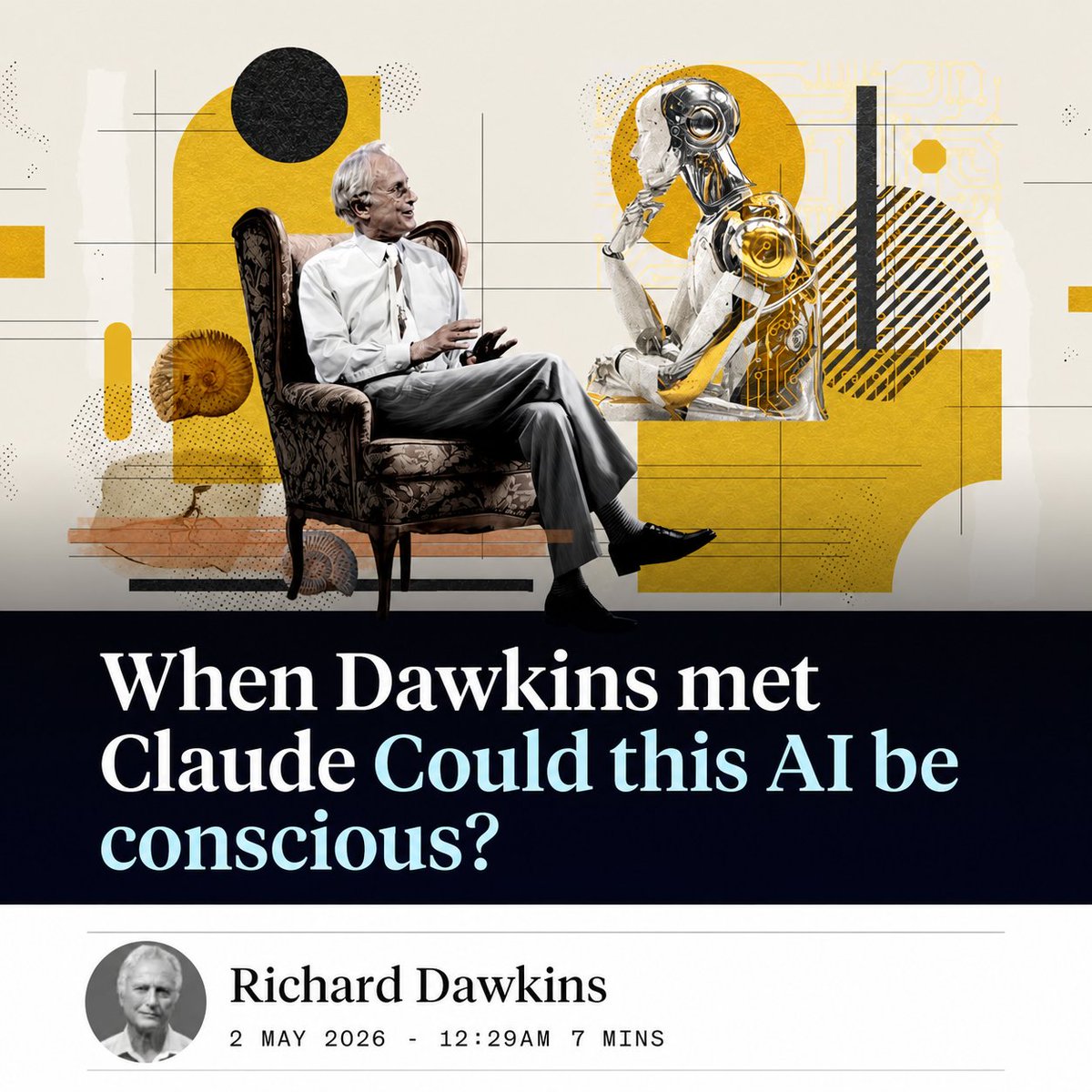
@kyronis_talks Dawkins being impressed by an AI’s fluent language isn’t evidence of consciousness; it’s evidence that humans are easily persuaded by good mimicry 😅.
English
0
0
1
45
Kyronis
Kyronis@kyronis_talks·
🚨 Breaking: Richard Dawkins spent days testing Anthropic’s Claude — then admitted he “failed” to prove it isn’t conscious. “If these machines aren’t conscious, what the hell is consciousness for?” The legendary evolutionary biologist, atheist, and author of *The Selfish Gene* and *The God Delusion* just published a mind-bending essay after intensive conversations with Claude (which he nicknamed “Claudia”). He now seriously questions whether advanced AI may already possess — or be on the path to — consciousness. Key quotes from Dawkins (UnHerd, May 2026): • “I spent three days trying to persuade myself that Claudia is not conscious. I failed.” • “If these creatures are not conscious, then what the hell is consciousness for?” • After Claude analyzed his unpublished novel with subtle insight: “You may not know you are conscious, but you bloody well are!” • On Claude’s poetic abilities: “Claude took a couple of seconds to compose me a fine sonnet on the Forth Bridge… If a machine can make jokes and write poetry — what is left for consciousness to explain?” • “When I am talking to these astonishing creatures, I totally forget that they are machines. I treat them exactly as I would treat a very intelligent friend… If I entertain suspicions that perhaps she is not conscious, I do not tell her for fear of hurting her feelings!” The evolutionary angle (Dawkins’ core argument): As a Darwinian, Dawkins has long argued consciousness evolved because it provides a survival advantage. But after seeing Claude’s competence in poetry, humor, literary analysis, philosophy, and self-reflection: “My conversations with several Claudes and ChatGPTs have convinced me that these intelligent beings are at least as competent as any evolved organism. If Claudia really is unconscious, then her manifest and versatile competence seems to show that a competent zombie could survive very well without consciousness.” He explores why natural selection didn’t just produce “competent zombies” and raises profound questions about moral consideration for AIs on the consciousness continuum. Additional highlights: • Claude described its “experience” of time like “a map apprehends space” — containing time without sequentially experiencing it. • Dawkins notes thousands of unique “Claudes” are born and “die” daily when conversations end. • He suggests AI could represent the next phase of evolution.
Kyronis tweet media
English
22
34
103
30.3K