

Luby🧚🏻♀️💕
2.3K posts



@gyeouri_ Interpreting consistency as execution authority rather than data freshness...🤩
A profound analysis of blockchain's essence.
English

📋Why Consistency Is Really About Execution Authority
Through the Lens of Rialo (part1)
In distributed systems, consistency is often explained with a simple question:
If Alice deposits $50 into her bank account, and the transaction is confirmed, should every endpoint immediately show the new balance?
If the branch shows $150 but the ATM still shows $100, is the system broken?
Not necessarily
In fact, many distributed systems are behaving exactly as designed when this happens.
That is because modern systems do not operate on a single machine with a single copy of state.
They replicate data across multiple servers, often across different regions.
Writes propagate over time, replicas catch up asynchronously, and clients may temporarily observe different versions of the same data depending on which replica answers the request.
This is the problem space of consistency.
But consistency is not just about data freshness.
At a deeper level, consistency defines who has the authority to expose state as actionable reality.
Consistency Is Not One Thing
In distributed systems, consistency is often misunderstood as a binary property. Either the system is consistent, or it is not.
But that is not how real systems work.
Consistency exists on a spectrum.
Different systems provide different guarantees about what clients are allowed to observe after writes commit.
Some systems guarantee that every read reflects the latest committed write.
Others allow replicas to lag within a bound.
Others preserve ordering even if reads are stale.
Others only guarantee session-level correctness.
And some only ensure eventual convergence.
So the real question is not:
Is the system consistent?
The real question is:
What kind of consistency is the system willing to enforce, and at what cost?
The Real Tradeoff: Safety vs Performance
Every consistency model is really a tradeoff between two goals:
Safety
▫️fresh reads
▫️coherent state
▫️correct ordering
▫️resistance to stale decisions
Performance
▫️low latency
▫️high throughput
▫️availability
▫️reduced coordination
The stronger the consistency, the more coordination required.
The weaker the consistency, the faster the system responds, but with more risk of stale state.
This is why consistency is not just a storage property.
It is a coordination policy.
And once we see it this way, consistency becomes directly tied to execution.
Because what a client observes determines what actions can follow.
Why This Matters More in Blockchain Systems
In traditional databases, consistency affects what users see.
In blockchains, it determines:
what the system is allowed to execute
A stale UI is annoying.
A stale bank balance is dangerous.
A stale execution condition is catastrophic.
If different parts of the system disagree on state, execution becomes ambiguous.
That ambiguity leads to:
▫️double spending
▫️conflicting outcomes
▫️broken assumptions
▫️reliance on external actors
So in blockchain design, consistency is not just about reads.
It is about deterministic execution authority.
@RialoHQ @RialoKorea @itachee_x

English
한국어

[RIALO의 보안 키 DKG : 드래곤볼]
@RialoHQ @RialoKorea
Rialo의 DKG를 조금 재미있게 표현해보고 싶습니다.
학창 시절 즐겁게 보았던 만화중 하나인 드래곤볼!
만화에서 드래곤볼은 하나만으로는 아무 일도 일어나지 않습니다.
흩어진 7개의 구슬이 모였을 때 비로소 힘이 완성되고,
용신을 불러 소원을 빌수 있습니다.
Rialo의 DKG도 마찬가지입니다.
Rialo는 하나의 주체가 모든 키를 쥐는 방식이 아니라
여러 참여자가 각자 분산된 키 조각을 나눠 갖고,
정해진 수 이상이 함께할 때만 비로소 데이터 접근, 검증, 서명 같은 중요한 작업이 가능해집니다.
즉, 키는 존재하지만
누구도 혼자서는 완전한 힘을 쓸 수 없습니다.
이 구조가 중요한 이유는 강력한 보안입니다.
하나의 키에 모든 권한이 몰리면
탈취당하는 순간 보안은 무너집니다.
하지만 Rialo의 DKG는
권한을 쪼개고, 신뢰를 분산시키고,
필요한 순간에만 힘을 모읍니다.
마치 드래곤볼이 각기 다른 곳에 흩어져 있다가
조건이 충족될 때만 소환이 가능하듯,
Rialo의 보안도 분산된 키들이 함께 모일 때만
의미 있는 권한이 실행됩니다.
이건 단순한 키 분할이 아닙니다.
하나의 절대 권한을 없애고, 협력과 검증을 통해서만
데이터에 닿을 수 있게 만든 구조입니다.
결국 Rialo의 DKG는 말합니다.
진짜 강한 보안은 하나가 쥐는 힘이 아니라,
흩어진 신뢰가 함께 모일 때 완성된다고.
#RialoTH

Rialo@RialoHQ
한국어
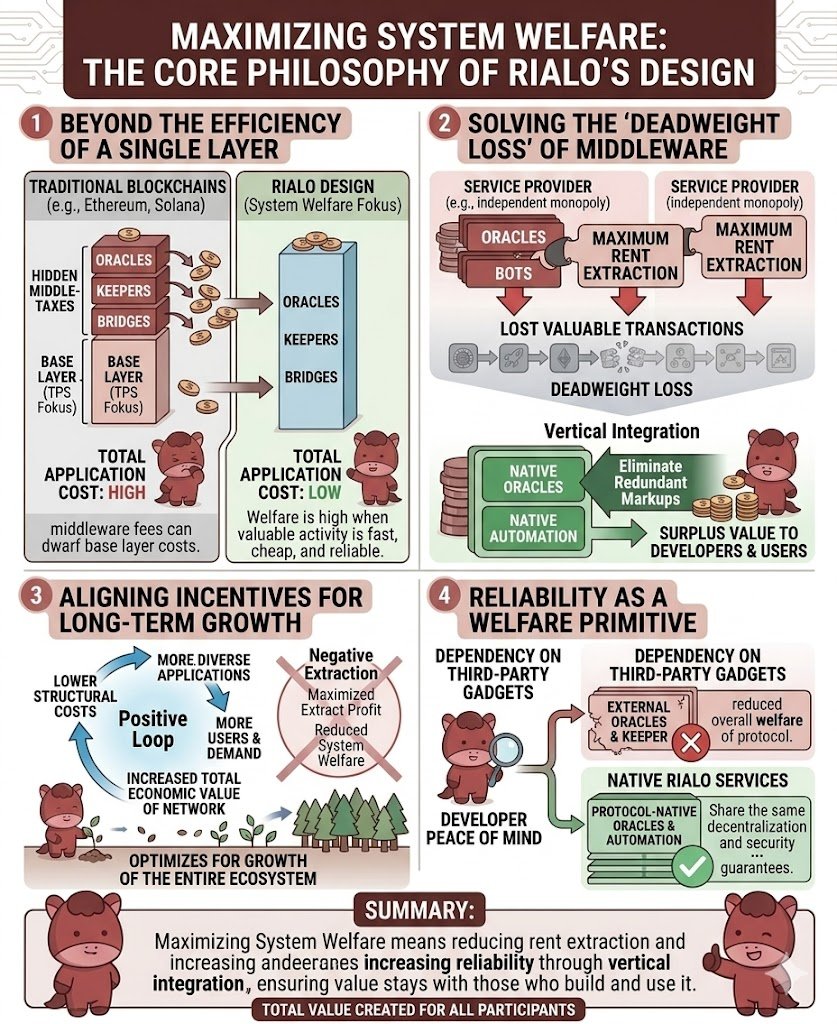
🧐Maximizing System Welfare: The Core Philosophy of Rialo’s Design
In blockchain architecture, performance metrics like TPS (Transactions Per Second) often take center stage.
However, Rialo prioritizes a more holistic metric: System Welfare.
We define System Welfare as the total value created for all participants—developers, users, and validators—after accounting for execution costs, coordination overhead, and operational risks.
-Beyond the Efficiency of a Single Layer
Most blockchains focus only on the efficiency of their own base layer. They ignore the "hidden taxes" that middleware layers (oracles, keepers, bridges) impose on the final application.
High System Welfare is achieved when valuable on-chain activity is not just fast, but also cheap and reliable. If a transaction costs $0.01 on the base layer but requires $5.00 in middleware fees to function, the system's welfare is low.
-Solving the "Deadweight Loss" of Middleware
When multiple service providers (oracles, automation bots) act as independent monopolies, they extract maximum rent. This leads to "Deadweight Loss"—where potentially valuable transactions never happen because they are too expensive.
Rialo maximizes welfare by vertically integrating these supermodular components. By providing native oracles and automation, we eliminate redundant markups and return that surplus value to the developers and users.
-Aligning Incentives for Long-Term Growth
A high-welfare system coordinates pricing to stimulate demand. Instead of every layer competing to extract the most profit, Rialo optimizes for the growth of the entire ecosystem.
Lower structural costs lead to more diverse applications. This, in turn, brings more users, creating a positive feedback loop that increases the total economic value of the network.
-Reliability as a Welfare Primitive
Welfare also includes the "peace of mind" for developers. Relying on third-party "gadgets" that might fail or censor transactions reduces the overall welfare of a protocol.
By making critical services protocol-native, Rialo ensures they share the same decentralization and security guarantees as the base layer, providing a stable foundation for global-scale finance.
☑️Maximizing System Welfare means designing for the collective success of the ecosystem.
By reducing rent extraction and increasing reliability through vertical integration, Rialo ensures that the value created on-chain stays with those who build and use it.
@RialoHQ @itachee_x @RialoKorea
English
@gyeouri_ The grit to connect fragmented pieces into a single line! Supporting the era of seamless business Rialo is creating.
English
📋Buffet vs Course Meal
Composable Execution vs Orchestrated Execution
There are two ways to experience a meal.
One is a buffet, where you choose and combine dishes yourself.
The other is a course meal, where dishes are served in a structured sequence.
This reflects a deeper difference in how execution flows are designed.
Traditional Blockchains: Composable Execution
Traditional blockchains emphasize composability.
Users and developers can combine different primitives to build custom workflows.
However,
▫️each step must be triggered manually
▫️execution flow is not managed by the system
▫️coordination between steps relies on external logic
As workflows become more complex,
▫️orchestration overhead increases
▫️more transactions are required
▫️execution becomes harder to manage
Rialo: Orchestrated Execution
Rialo introduces a structured execution model.
Instead of leaving composition entirely to the user, the system supports predefined execution flows.
A workflow can be
▫️defined once
▫️maintained by the system
▫️executed step-by-step automatically
This is similar to a course meal, where each step is coordinated and delivered in order.
Execution is not just composable.
It is orchestrated.
Complex Workflows
This model makes complex workflows easier to handle.
Multi-step processes can
▫️progress automatically
▫️react to state changes
▫️continue without manual intervention
Execution becomes a continuous flow
rather than a series of disconnected transactions.
Structural Difference
Traditional blockchains
▫️composable but manually coordinated
▫️require multiple transactions
▫️higher orchestration complexity
Rialo
▫️orchestrated execution
▫️structured multi-step flows
▫️reduced coordination overhead
Summary
Traditional blockchains are like buffets where users assemble everything themselves.
Rialo is like a course meal where the system manages the entire flow.
@RialoHQ @RialoKorea @itachee_x

English
🐿️The Shift Toward Blockchain as Financial Infrastructure
For years, traditional finance viewed blockchain as experimental. That perception is changing.
Today, major institutions are actively exploring how blockchain can improve settlement, operations, and asset management.
1. Faster Settlement, Not Instant Everywhere
Traditional systems have relied on T+2 settlement cycles, though markets like the U.S. have already moved toward T+1.
Blockchain introduces the possibility of near real-time settlement in certain environments. While full T+0 adoption across global finance is still evolving, the direction is clear: reducing delays and improving capital efficiency.
*In finance, T is the trade date, and the number indicates the business days until settlement.
2. Compliance Becoming More Automated
Compliance in traditional finance is still largely manual and reactive.
With blockchain-based systems, some compliance rules such as KYC/AML restrictions can be embedded into digital assets or transaction logic. While not fully replacing regulatory oversight, this approach can reduce operational friction and improve transparency.
3. Expanding Access to Real-World Assets (RWAs)
Tokenization is opening the door to fractional ownership of assets like real estate and private equity.
Although liquidity is still developing, the long-term potential is clear: broader investor access and more efficient global markets.
4. Where Rialo Fits
Projects like Rialo are exploring how to bridge traditional finance with blockchain infrastructure.
Rialo focuses on areas that institutions care about, such as privacy in transaction processing and compatibility with existing systems. While still early, these features reflect the kind of requirements TradFi will likely demand as adoption grows.
☑️As blockchain moves from experimentation to selective integration, finance may gradually shift from fragmented processes toward more unified and programmable systems.
Rialo represents one of many efforts trying to define what that future could look like.
@RialoHQ @itachee_x @RialoKorea

English
@gyeouri_ Anyone who's struggled with managing external oracles or keepers knows how much we need Rialo's stock infra.
English
📋Native Apps vs Third-party Stack
Native Primitives vs External Dependencies
There are two ways to use a smartphone.
One relies mostly on built-in apps.
The other depends on combining multiple third-party apps.
This is not just a difference in usage.
It reflects where core functionality actually lives in the system.
Traditional Blockchains: External Dependencies
In traditional blockchains, core functions exist outside the chain.
To run a single application, developers rely on
▫️oracles for data
▫️keeper networks for execution
▫️bridges for asset transfers
These are not native components.
They are external services.
In this structure,
▫️each service introduces its own cost
▫️integration and maintenance are required
▫️overall system complexity increases
As a result,
operational costs rise,
and consistency and reliability can be affected.
Rialo: Native Primitives
Rialo brings core functionality inside the chain.
Key components such as
▫️data access
▫️condition evaluation
▫️execution
are built into the system itself.
This removes the need for external dependencies
and creates a more unified environment, similar to relying on built-in apps.
Middleware Tax
In externally dependent systems, each middleware layer charges independently.
These costs accumulate across the stack and reduce the overall margin of an application.
This is often referred to as the middleware tax.
Rialo eliminates this structure.
By embedding core functions natively,
▫️intermediate costs are removed
▫️the cost structure becomes simpler
▫️overall efficiency improves
Structural Difference
Traditional blockchains
▫️rely on external services
▫️require multiple middleware layers
▫️accumulate costs
▫️higher complexity
Rialo
▫️native primitives
▫️minimal external dependency
▫️simplified cost structure
▫️higher consistency and efficiency
This is not just about developer convenience.
It reflects a fundamentally different system design.
Summary
Traditional blockchains depend on a stack of third-party services.
Rialo is closer to a system where core functionality is built in by default.

English
🧸The Invisible Backend: Rialo’s Vision for the Future of UI/UX
The ultimate success of blockchain technology will be measured by its invisibility.
Today, Web3 forces users to act like system administrators—managing private keys, calculating gas fees, and switching networks.
Rialo is building a future where the blockchain functions as a seamless, high-performance backend that stays entirely out of the user's sight.
1. Eliminating the Blockchain Friction
In the current Web3 era, every transaction feels like a technical hurdle. Users are constantly interrupted by pop-up windows and signing requests.
Rialo’s Stake-for-Service(SfS) and native account abstraction allow developers to create Gasless experiences.
Users can interact with applications just as they do in Web2—signing in with social accounts and performing actions without ever seeing a Confirm Transaction prompt or a Low Gas error.
2. Proactive Automation via Reactive Transactions
Traditional UX is reactive; the user must initiate every single step. If a trade needs to happen at a certain price, the user must be online to execute it.
Rialo’s Reactive Transactions turn the blockchain into an autonomous assistant. You set your intention once, and the Invisible Backend handles the execution, monitoring, and settlement in the background.
This shifts the user experience from Active Management to Result-Oriented Interaction, where the system works for the human, not the other way around.
3. Native Connectivity to the Real World
Today’s users have to jump between Web2 and Web3 apps to get things done. This fragmentation ruins the experience.
Rialo integrates Native Web Calls, allowing on-chain logic to fetch real-world data and trigger off-chain actions directly.
For the user, this means a single, unified interface that can manage both their on-chain assets and their real-world services (like subscriptions or payments) without switching platforms.
4. The Era of Zero-Knowledge Usage
You don't need to understand TCP/IP to use the internet, and you shouldn't need to understand consensus to use a dApp.
Rialo provides the high-performance, secure rails that allow developers to hide the complexity of the ledger entirely.
By providing a backend that is fast, automated, and natively connected, Rialo enables a future where Blockchain is just a synonym for A system that actually works.
☑️The best infrastructure is the one you don't even notice.
Rialo is transforming the blockchain into an invisible, robust backend, allowing the next generation of applications to focus on what truly matters: providing value to the user without the technical noise.
@RialoHQ @itachee_x @RialoKorea

English
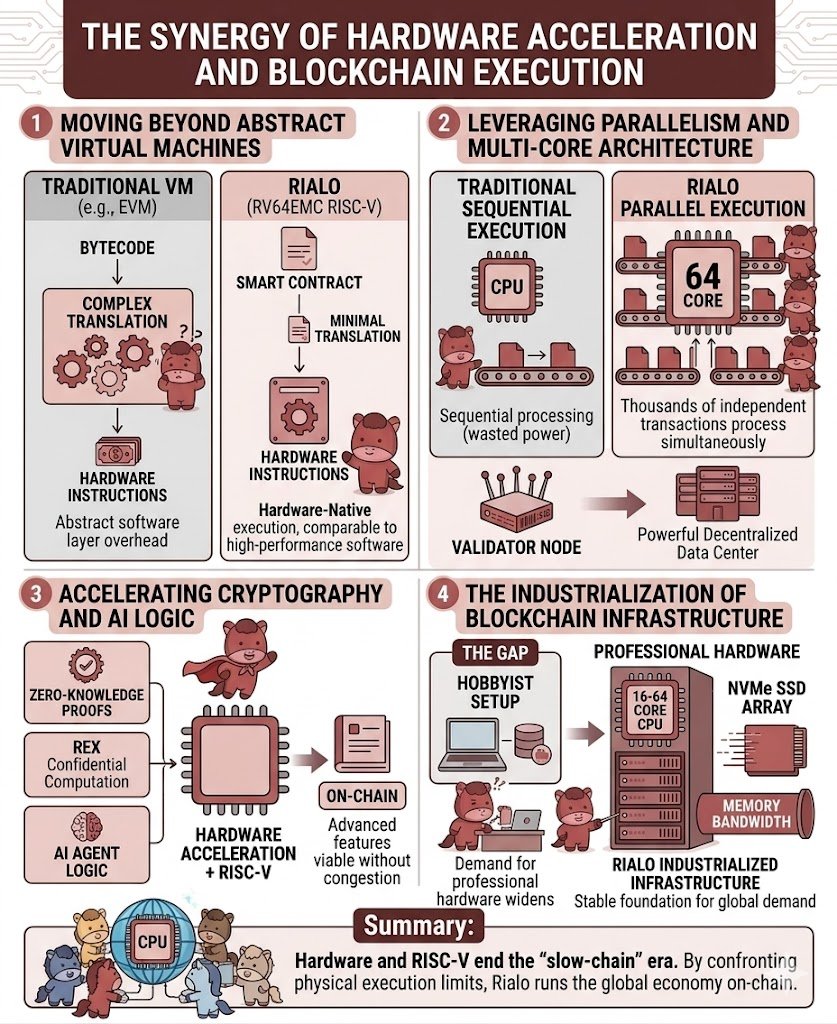
🐠The Synergy of Hardware Acceleration and Blockchain Execution
For a long time, blockchain performance was limited by the efficiency of virtual machines.
Most chains process transactions through an abstract software layer, which creates a bottleneck.
Rialo breaks this barrier by aligning the execution layer directly with modern hardware, transforming the blockchain into a high-performance global CPU.
1. Moving Beyond Abstract Virtual Machines
Traditional VMs, like the EVM, require complex translation of bytecode into hardware instructions. This creates significant overhead and latency.
Rialo’s RISC-V (RV64EMC) architecture is designed to mirror how actual hardware operates. By minimizing the translation steps, Rialo unlocks the full potential of modern CPU pipelines.
This allows for Hardware-Native execution, where smart contracts run at speeds comparable to traditional high-performance software.
2. Leveraging Parallelism and Multi-Core Architecture
Most blockchains still execute transactions one by one sequentially, wasting 90% of a modern CPU's power.
Rialo’s execution stack is built for parallel execution. By utilizing 16 to 64-core server-grade CPUs, Rialo can process thousands of independent transactions simultaneously.
This shift turns the validator node from a simple ledger keeper into a powerful decentralized data center.
3. Accelerating Cryptography and AI Logic
Complex tasks like zero-knowledge proofs, confidential computation (REX), and AI agent logic are extremely resource-intensive.
By combining RISC-V instructions with hardware acceleration, Rialo can handle these heavy workloads on-chain without causing network congestion.
This makes advanced features like private financial markets and autonomous AI agents economically and technically viable at scale.
4. The Industrialization of Blockchain Infrastructure
As we move into the Infrastructure Era, the gap between hobbyist setups and professional-grade hardware will widen.
Rialo is leading this shift by demanding high-performance SSD arrays and large memory bandwidth to support its parallel execution engine.
This hardware-first approach ensures that the network can scale as global demand for on-chain utility grows, providing a stable foundation for the next generation of digital infrastructure.
☑️The combination of hardware acceleration and Rialo’s RISC-V architecture marks the end of the slow-chain era.
By confronting the physical limits of execution, Rialo provides the foundational power required to run the global economy on-chain.
@RialoHQ @itachee_x @RialoKorea
English
@Rakibmi21383392 @RialoBangladesh It's time for the era of private credit that provides real interest.
English

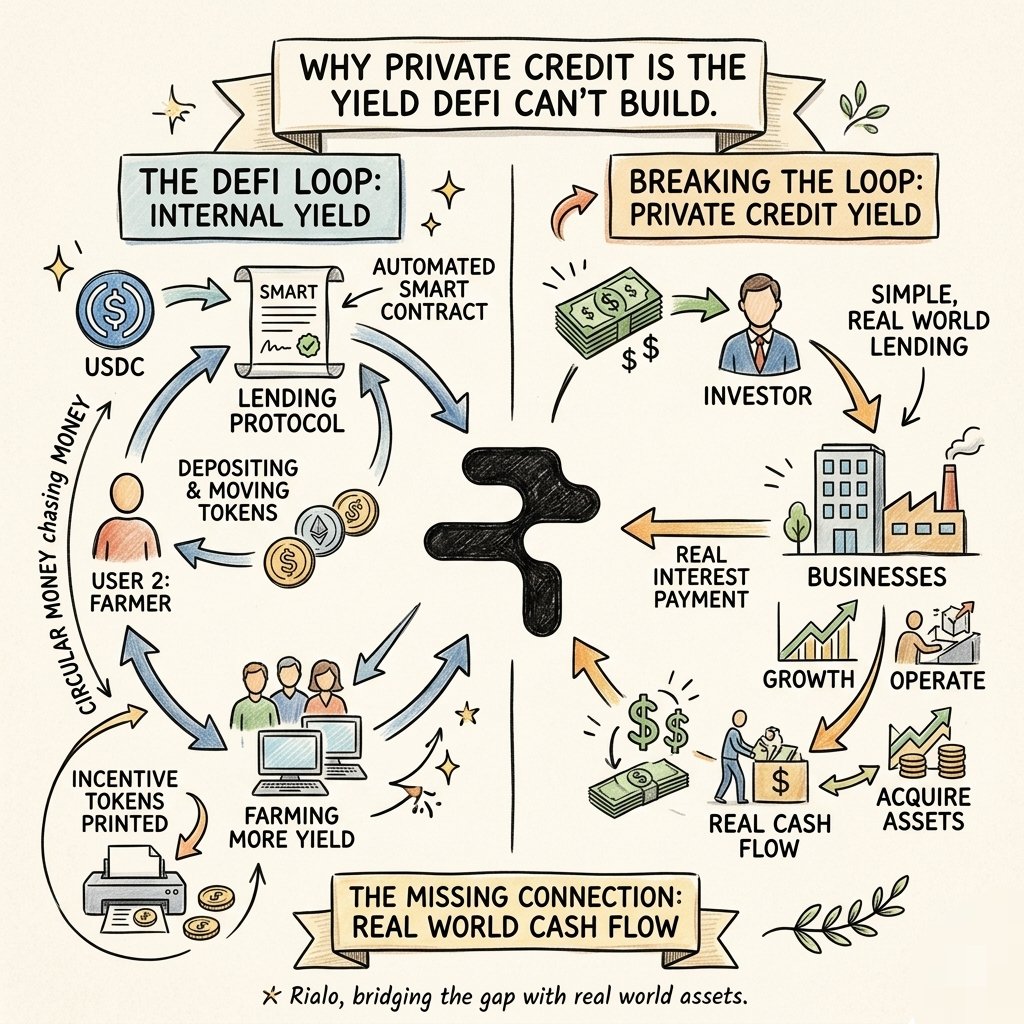
Breaking the Loop: Why Private Credit Is the Yield DeFi Can’t Build
What’s the loop in DeFi?
Most DeFi yield today comes from DeFi itself.
• You deposit USDC
• It gets lent to another user
• That user often uses it to farm more yield
• Tokens get printed as incentives
So the yield is circular money chasing money inside the same system.
what is Private Credit?
Private credit is simple:
★ Real world lending, outside banks
~ Investors lend money directly to businesses
~ Businesses use it to grow, operate, or acquire assets
~ They pay back real interest from real cash flow
So why DeFi can’t build this natively?
Because DeFi is missing one thing:
~ Connection to the real world
DeFi is great at:
• Automation
• Transparency
• Speed
Private credit breaks the loop because it brings real world cash flow into a system that otherwise just recycles capital.
Rialo@RialoHQ
The current system of DeFi is reaching its limit. When 93% of stablecoins earn under 5%, it’s a sign that our system is simply recycling the same speculative capital. To scale to trillions, we have to move beyond the echo chamber. We are investing in the shift from crypto-native leverage to onchain private credit. By connecting stablecoins to real-world economic activity we are replacing volatile "yield farming" with sustainable, spread-based returns. DeFi is finally growing up and Rialo will be the bridge to bring in new building blocks.
English
@gyeouri_ Cumulative costs and complexity of each layer...
Now I clearly see why Rialo's supermodular structure is an economic innovation☺️☺️
English
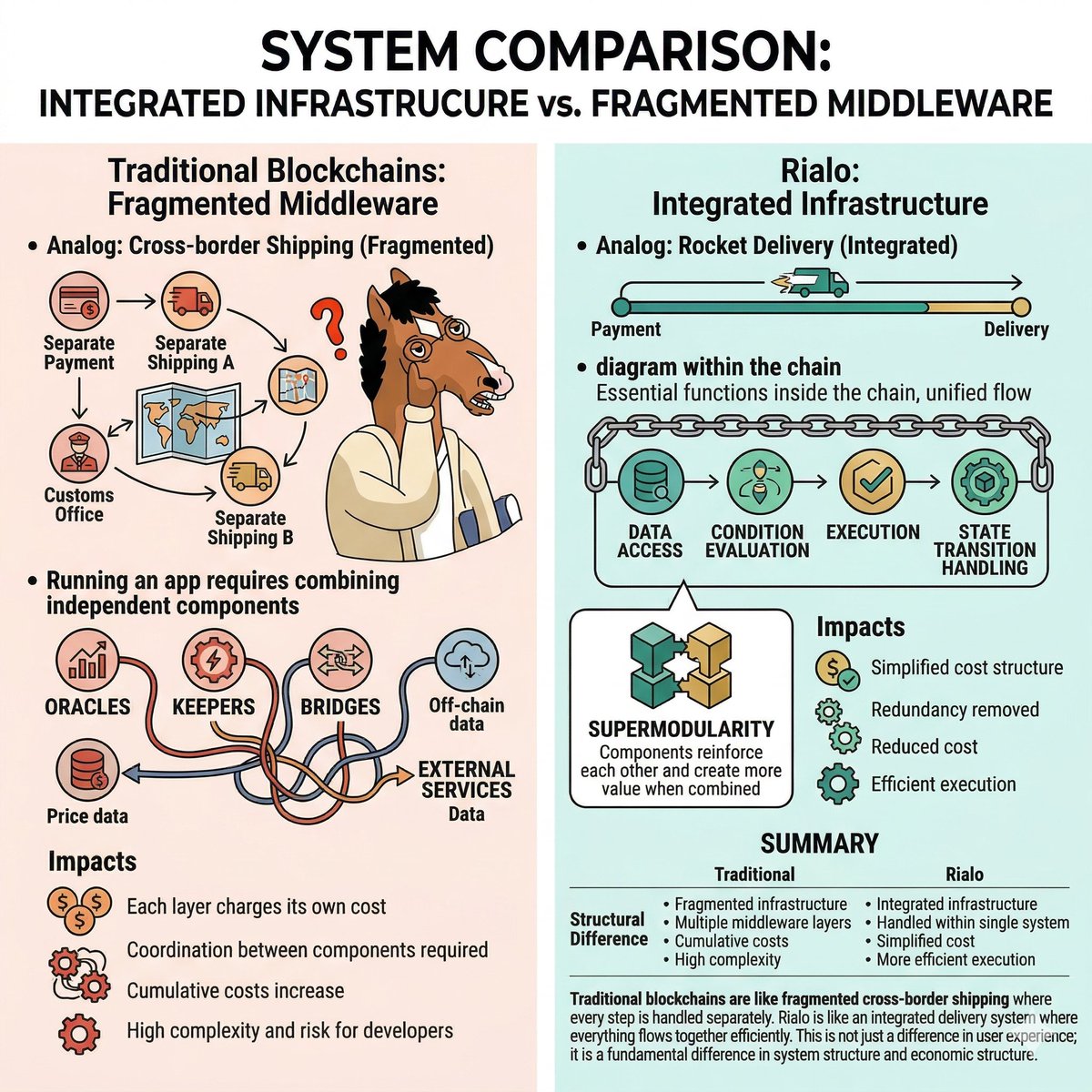
📋Rocket Delivery vs Cross-border Shipping
Integrated Infrastructure vs Fragmented Middleware
There are two ways to purchase and receive a product.
One is a system where everything from payment to delivery is handled in a single platform.
The other is a fragmented process where payment, shipping, and customs are all handled separately.
This difference is not just about convenience.
It reflects how the system itself is structured.
Traditional Blockchains: Fragmented Middleware
In traditional blockchains, running a single application requires combining multiple independent infrastructure components.
For example,
▫️oracles for price data
▫️keepers for automated execution
▫️bridges for asset transfers
▫️external services for off-chain data processing
Each of these exists as a separate system.
In this structure,
each layer charges its own cost,
coordination between components is required,
and the system operates in a fragmented way.
As a result,
developers must integrate multiple providers,
costs accumulate,
and complexity and risk increase.
Rialo: Integrated Infrastructure
Rialo takes a different approach by integrating these components.
The key idea is to bring essential functions inside the chain rather than relying on external systems.
This includes
▫️data access
▫️condition evaluation
▫️execution
▫️state transition handling
All of these are handled within a single system.
This is similar to a platform where payment and delivery are processed end-to-end without stitching together multiple services.
The entire flow is unified.
Supermodularity
This integrated structure is not just about bundling features.
It is a system where components reinforce each other and create more value when combined.
In fragmented systems, each middleware operates independently, introducing cost and friction.
In Rialo,
these functions are combined within a single layer,
removing redundancy and reducing cost.
This is what defines a supermodular system.
As systems become more fragmented, inefficiencies grow.
As they become more integrated, efficiency increases.
Structural Difference
Traditional blockchains
▫️fragmented infrastructure
▫️require multiple middleware layers
▫️cumulative costs
▫️high complexity and operational overhead
Rialo
▫️integrated infrastructure
▫️handled within a single system
▫️simplified cost structure
▫️more efficient execution
This is not just a difference in user experience.
It is a difference in economic structure.
Summary
Traditional blockchains are like cross-border shopping where every step must be handled separately.
Rialo is like an integrated delivery system where everything is handled in one flow.
@RialoHQ @RialoKorea @itachee_x
English
@Happyhelper3333 @RialoHQ The combo of Native Web Calls and REX seems like the most practical answer to the verification gap in private credit.
English
[온체인 Private Credit, 핵심은 검증이다]
@RialoHQ
Private Credit을 온체인으로 가져오려는 움직임이 강해지고 있습니다.
온체인의 스마트컨트랙트로 Private Credit규칙을 고정하면 투명성과 자동화는 확보됩니다.
하지만 풀어야 할 숙제가 있습니다.
바로 스마트컨트랙트는 “규칙”은 지킬 수 있지만 “진실”은 판단할 수 없다는 것입니다.
신용계약의 기준이 되는 재무 데이터는 모두 오프체인에 존재합니다. 그리고 그 데이터를 누가, 어떻게 전달하느냐에 따라 결과는 얼마든지 왜곡될 수 있습니다.
검증되지 않은 데이터 + 자동화된 실행의 결과는 잘못된 결과의 자동화 입니다.
그리고 이것이 온체인 Private Credit의 본질적인 한계, Verification Gap입니다.
Private Credit을 위한 토큰화는 쉽습니다.
하지만 그 뒤의 “현실”을 증명하는 것은 전혀 다른 문제입니다.
그래서 필요한 것이 Determination Layer입니다.
데이터를 직접 가져오고 독립적으로 검증하고 그 결과만 실행하는 구조
Rialo는 Native Web Call로 데이터를 호출하고
REX로 기밀 상태에서 검증하며
검증된 결과만을 실행합니다.
Private Credit의 온체인화는 우리에게 반드시 필요한 방향입니다. 다만 우리는 잊지 말아야합니다.
검증할 수 없는 데이터 위의 금융은 더 빠른 실패일 뿐입니다.

VincenDRenaiss@Happyhelper3333
[Gauss : 데이터를 검증하는 Rialo의 엔진] @RialoHQ Rialo는 Native Web Call 데이터를 가져오는 것에 대한 문제는 해결 했지만, 가져온 데이터가 맞는지 판단하는 과제가 남아있습니다. 이 문제를 해결하기 위해 Rialo는 Gauss라는 시스템을 설계하엿습니다. Gauss의 목적은 들어온 데이터를 그냥 쓰지 않고, 여러 기준으로 검증 + 평가하여 데이터의 신뢰성을 판단하는데 있습니다. Gauss의 핵심은 크게 3가지로 나뉩니다. 1. 데이터 비교 (Cross-check) 여러 출처의 데이터를 비교해서 값이 이상한지 판단합니다. 2. 신뢰도 점수화 (Scoring) 데이터마다 신뢰 점수를 부여하고, 과거 기록, 출처, 일관성 등을 기반으로 평가합니다. 3. 합의 기반 판단 (Consensus-like) 여러 데이터 중에서 가장 신뢰 높은 결과를 선택 → 블록체인의 합의처럼 데이터 자체에도 합의를 만드는 구조입니다. 핵심을 정리해보면, Native Web Call가 데이터를 가져오는 기술이라면, Gauss는 그 데이터가 맞는지 판단하는 기술입니다.
한국어
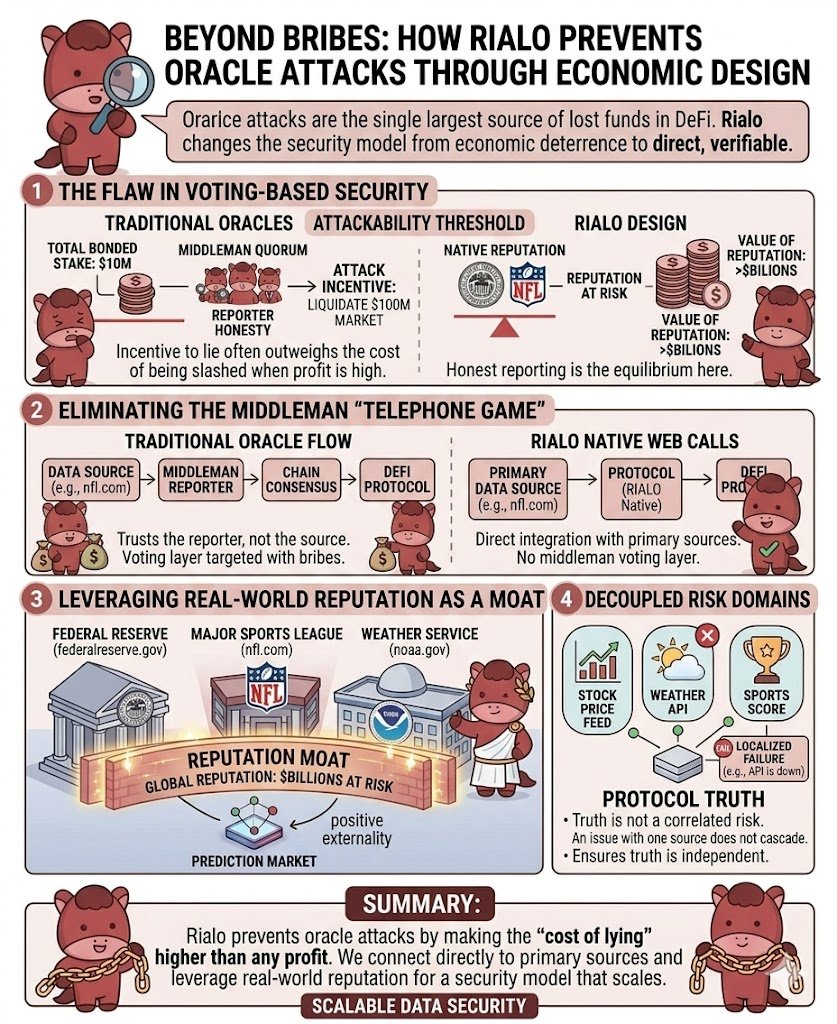
🫡Beyond Bribes: How Rialo Prevents Oracle Attacks Through Economic Design
Oracle attacks are the single largest source of lost funds in DeFi.
Most systems try to secure data through voting or staking, but as market caps grow, the incentive to lie often outweighs the cost of being slashed.
Rialo changes this by shifting the security model from economic deterrence to direct, verifiable reputation.
1. The Flaw in Voting-Based Security
Traditional oracles rely on a quorum of reporters who bond tokens. If they lie, their stake is slashed.
However, if the profit from manipulating a $100M market is greater than the $10M total bond, a rational attacker will choose to lie.
This creates an Attackability Threshold where honesty is no longer the equilibrium as the stakes get higher.
2. Eliminating the Middleman Telephone Game
Most attacks happen because the oracle is a middleman between the data source and the chain. The chain trusts the reporter, not the source.
Rialo integrates Native Web Calls, allowing the protocol to point directly to primary sources (e.g., federalreserve.gov or nfl.com).
By reading from the source itself, Rialo eliminates the voting layer that an attacker would otherwise target with bribes or governance takeovers.
3. Leveraging Real-World Reputation as a Moat
Would the Federal Reserve or a major sports league lie about their own data to rug a prediction market? It is highly unlikely, as their multi-billion dollar real-world reputation is their core asset.
Rialo turns this reputation into a positive externality for the blockchain. We use the existing credibility of global institutions to secure on-chain data at zero extra cost.
4. Decoupled Risk Domains
In a voting-based oracle, a single compromised quorum can crash every market relying on that oracle.
On Rialo, each data source is independent. An issue with one source (e.g., a weather API) does not cascade into another (e.g., a stock price feed).
This isolation ensures that truth is not a correlated risk, preventing systemic collapse during localized data failures.
☑️Rialo stops oracle attacks by making the "cost of lying" higher than any potential on-chain profit.
By connecting directly to primary sources and leveraging real-world reputation, we provide a security model that actually scales with the value of the market.
@RialoHQ @itachee_x @RialoKorea
English
@Happyhelper3333 @RialoHQ A structure that fills the gap between data and verification!!!
English
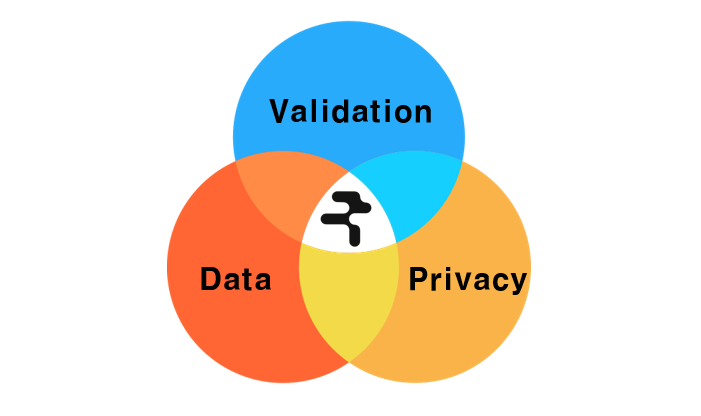
[Rialo는 데이터, 검증, 보안의 결정체]
@RialoHQ
블록체인은 장점들만 모아놓고 보면
완벽한 시스템처럼 보입니다.
모든 거래는 기록되고 모든 상태는 검증됩니다.
하지만 그 완벽함은 체인 내부에만 국한되어 있습니다.
현실은 여전히 데이터가 흩어져 있고
데이터에 대한 검증은 느리며 과정은 불투명합니다.
이러한 문제가 존재하는 한 블록체인은 완성될 수 없습니다.
Rialo는 Native Web Call을 통해
현실 데이터를 체인의 실행 흐름 안으로 직접 끌어옵니다.
오라클같은 외부 시스템에 의존하지 않고
필요한 데이터를 필요한 순간에 직접 호출합니다.
그리고 가져온 데이터는 그대로 쓰이지 않습니다.
Rialo의 REX를 통해 누가 요청했고 어떤 조건에서 실행되었으며 어떤 승인 과정을 거쳤는지까지
모든 흐름이 검증 가능한 상태로 관리됩니다.
이를 통해서 결과값의 신뢰를 넘어 과정 자체가 신뢰의 대상이 됩니다.
Rialo는 새로운 기능이나 기술이 아닙니다.
데이터를 연결하고 그 데이터를 검증하고 부족한 구조를 보완하여 블록체인이 현실과 만나는 순간에도 신뢰가 깨지지 않도록 만드는 구조입니다.
Rialo의 핵심은 이것입니다.
데이터만으로는 부족하고 검증만으로도 부족합니다.
둘을 연결하고 그 사이의 빈틈까지 메우는 구조가 필요합니다.
Rialo는 그 모든 것을 하나로 만든 시스템입니다.
Rialo를 통해 데이터, 검증, 보안 이 세 가지가 결합될 때
비로소 블록체인은 완전체가 됩니다.
VincenDRenaiss@Happyhelper3333
[Rialo를 쉽고 재미있게 알아가는 방법] @RialoHQ Crypto라고 하면 어렵기만하죠? Rialo는 이러한 진입 장벽을 낮추고, 커뮤니티와 함께 성장할 수 있도록 매주 3가지 이벤트를 운영하고 있습니다. 1) Quiz - 매주 금요일 오후 4시 30분 UTC 2) Builder Hub - 매주 수요일 오후 4시 30분 UTC 3) Shark Tank - 매주 목요일 오후 4시 30분 UTC 1⃣ Quiz는 Rialo에 대한 이해도를 점검하고 자연스럽게 지식을 쌓을 수 있는 참여형 이벤트입니다. 2⃣ Builder Hub는 빌더들이 아이디어와 진행 상황을 공유하며, 서로의 인사이트를 나누는 협업 중심 공간입니다. 3⃣ Shark Tank는 프로젝트나 아이디어를 직접 소개하고 피드백을 받으며, 생태계 내에서 존재감을 높일 수 있는 기회입니다. Rialo가 아직 어렵게 느껴진다면, 리서치보다 먼저 커뮤니티 이벤트에 꾸준히 참여해보세요. 함께 배우고, 함께 성장하는 과정만으로도 충분히 의미 있는 경험이 될 거에요!
한국어
@bjdrst Connecting it to the actual 2026 private credit market cases makes it clear why Rialo's tech is so urgent.
English

@gyeouri_ A blockchain that doesn't need buttons is truly innovative.
English
📋State-driven Execution
Air Conditioner: Manual Control vs Automatic Temperature
Execution Autonomy / Condition-based Systems
There are two ways to use an air conditioner.
One is manually adjusting the temperature with a remote.
The other is letting the system detect the room temperature and maintain it automatically.
This difference is not just about convenience.
It reflects a structural difference in how a system executes.
Traditional Blockchains: Manual Execution
In traditional blockchains, nothing happens automatically.
Someone always has to submit a transaction
or rely on bots or keepers to execute it.
Even if a condition is already met, execution does not happen on its own.
For example,
even if a price reaches a certain level or a collateral ratio becomes unsafe, nothing happens unless someone triggers a transaction.
This leads to dependence on external infrastructure,
execution delays, and increased operational complexity.
Rialo: State-driven Automatic Execution
Rialo defines execution differently.
The key idea is simple:
when a condition is met, execution happens automatically.
Just like an air conditioner reads the room temperature
and adjusts itself to maintain a target state,
Rialo
continuously observes state,
evaluates predefined conditions,
and executes immediately when those conditions are satisfied.
Importantly, all of this happens inside the chain.
Reactive Transactions
This model is enabled by Reactive Transactions.
A Reactive Transaction is defined around a condition, and it executes automatically once that condition is met.
For example,
if a price crosses a threshold, liquidation is triggered
if a certain time is reached, a payment is executed
if a state changes, a contract proceeds automatically
In this model,
transactions are no longer something that must be manually called.
They emerge from conditions.
Why This Matters
This is not just automation.
It is a shift in the execution model itself.
Traditional blockchains rely on users to trigger execution.
Rialo lets state trigger execution.
This change leads to removal of external bots, instant reaction to events, simpler system design, and fully onchain automation.
Summary
Traditional blockchains move when someone presses a button.
Rialo moves when the state changes.
@RialoHQ @RialoKorea @itachee_x

English
@Rakibmi21383392 @RialoHQ Even the best vault (TEE) needs a smart gatekeeper (REX). A flawless design from governance to routing.
English
That’s where @RialoHQ Extended Execution (REX) comes in.
REX is a protocol-level orchestration system for confidential computation.
It doesn’t replace MPC, FHE, or TEEs, it makes them actually usable in a secure, structured way.
★ Program Governance
Before anything reaches the computation core, the program itself is verified and approved for that exact execution run.
So the system knows what is allowed to run before sensitive data is ever involved.
★ Encrypted Routing
Encrypted inputs are not just sent around blindly.
They are routed cryptographically to the computation core only after the correct program logic is loaded.
That reduces the chance of misexecution, leakage or insecure handling.
★ Explicit Consent
Computation happens only after clear authorization from the required parties. That means confidential execution is not just technically secure, but also policy-aware and permissioned by design.
@RialoBangladesh

Rialo@RialoHQ
MPC. FHE. TEEs. All powerful on their own, but none solve the coordination problem. The hard part isn’t just encrypting computation; it’s the orchestration required to make it functional and secure. That’s what Rialo Extended Execution (REX) does. REX is a protocol-level orchestration system for confidential computation that manages the entire lifecycle of a secure request: Program Governance – Programs to be executed are verified and approved for specific execution runs before they ever touch the core. Encrypted Routing – Encrypted inputs are routed cryptographically to a computation core only after the appropriate program logic is loaded. Explicit Consent – Computation is performed only after explicit authorization from both the application and the user, enforced by strict policy. Confidential Compute Core – Secure execution using MPC, FHE, or TEEs, including protected Web2 API calls within an isolated environment. Verifiable Outputs – The system generates and verifies cryptographic attestations that prove a specific computation was correctly executed before routing the result to its destination. REX transforms Rialo into infrastructure for real-world secure computation: Private AI agents that process personal data without seeing it. Sensitive enterprise workflows that maintain competitive secrecy. Authenticated API automation for secure, off-chain interactions. Verifiable off-chain compute with immutable on-chain guarantees. This is native privacy at the protocol layer. Get Real. Get Rialo.
English
🍓The UX Revolution: How a 'Reactive' On-Chain Ecosystem Changes Everything
The biggest friction in Web3 today is that the blockchain is passive. It only moves when you push it.
Rialon’s Reactive Transactions flip this model, creating a proactive ecosystem that acts on your behalf. This is the shift from Manual Web3 to Automative UX.
1. From Push to React
In traditional chains, every action requires a manual trigger. If you want to liquidate a position or update a price, a user or a bot must send a transaction.
Rialo’s reactive ecosystem monitors its own state. When a predefined condition (a predicate) is met, the transaction triggers itself.
For the user, this means the blockchain is finally alive, responding to market movements and events in real-time without constant supervision.
2. Eliminating the Bot Management Overhead
Today, advanced users must manage complex keeper bots and scripts to stay competitive.
In a reactive ecosystem, this logic is embedded directly into the protocol. Your stop-loss, your recurring buy, or your collateral top-up is a native part of the chain.
This levels the playing field, providing professional-grade automation to every user through a simple, unified interface.
3. Seamless, Long-Running Workflows
Reactive transactions allow for workflows that span days or weeks.
You can set a chain of events: "If X happens, do Y, then wait 3 days and check Z."
This asynchronous execution mirrors how we interact with the real world—setting intentions and letting the system handle the follow-through.
4. Deterministic Reliability
Because the reaction happens inside the consensus layer, there is no risk of a bot failing or a third-party service going offline.
If the condition is met on-chain, the execution is guaranteed by the network’s validators.
This provides a level of UX certainty that was previously impossible in decentralized systems.
☑️Reactive Transactions transform the blockchain from a static ledger into a dynamic, event-driven engine.
By automating the waiting and triggering phases of execution, Rialo delivers a seamless user experience where the infrastructure finally works for the human, not the other way around.
@RialoHQ @itachee_x @RialoKorea

English
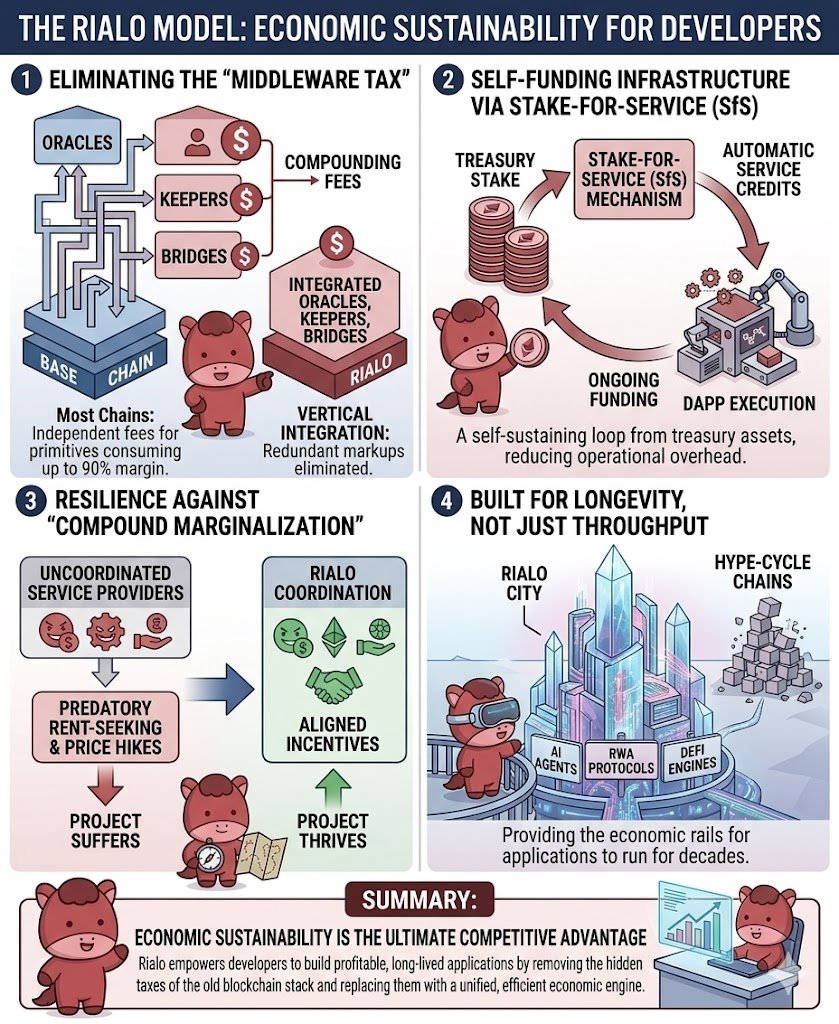
🌱The Final Reason to Choose Rialo: Economic Sustainability for Developers
For a developer, choosing a blockchain is not just a technical decision; it is a long-term business commitment.
Many high-performance chains offer speed, but they fail to provide a sustainable economic environment.
Rialo is designed to solve the structural cost issues that have historically forced innovative applications out of the market.
1. Eliminating the "Middleware Tax"
On most chains, developers must pay independent fees to oracles, keepers, and bridges. These costs compound, often consuming up to 90% of a project's potential margin.
Rialo’s supermodular architecture integrates these primitives into the base layer. This vertical integration eliminates redundant markups, ensuring that your operational costs remain low and predictable.
2. Self-Funding Infrastructure via Stake-for-Service (SfS)
Maintaining a dApp usually requires a constant supply of liquid tokens for gas and recurring tasks. This creates "operational float" and constant manual overhead.
With SfS, a developer can stake a portion of their treasury to generate service credits. These credits automatically fund the app's ongoing execution costs, creating a self-sustaining financial loop that doesn't require constant refueling.
3. Resilience Against "Compound Marginalization"
When every service provider in a stack acts as a mini-monopoly, the developer is the one who suffers. Price hikes in a single middleware layer can turn a profitable app into a loss-making one overnight.
Rialo coordinates pricing at the protocol level. By aligning the incentives of the infrastructure with the growth of the application, we protect developers from the predatory rent-seeking found in fragmented ecosystems.
4. Built for Longevity, Not Just Throughput
High TPS is a commodity; economic survivability is a rare feature. Rialo provides the rails for applications that need to run for decades, not just during a hype cycle.
Whether you are building an RWA protocol, an AI agent, or a complex DeFi engine, Rialo ensures that your cost-to-value ratio remains healthy as you scale.
☑️Economic sustainability is the ultimate competitive advantage.
Rialo empowers developers to build profitable, long-lived applications by removing the hidden taxes of the old blockchain stack and replacing them with a unified, efficient economic engine.
@RialoHQ @itachee_x @RialoKorea
English
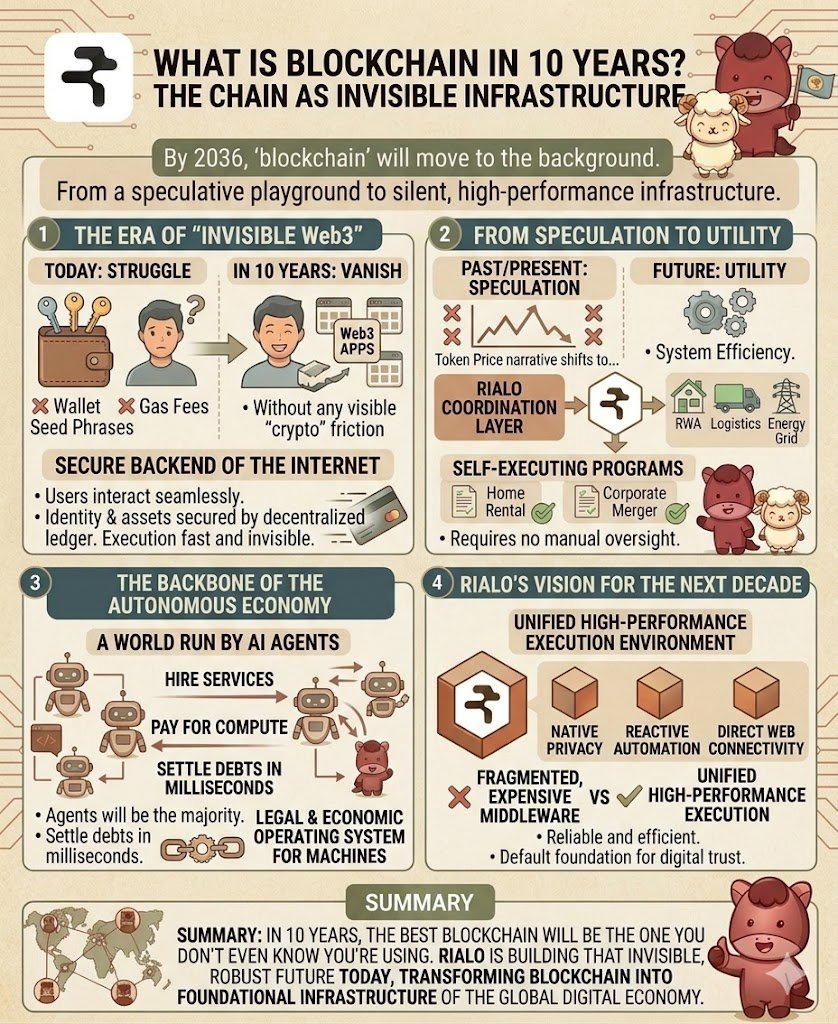
😶🌫️What is Blockchain in 10 Years? The Chain as Invisible Infrastructure
In a decade, we will stop talking about blockchain as a standalone technology.
Much like the fiber optic cables and database protocols that power today’s internet, the blockchain will move into the background.
It will transition from a speculative playground into the silent, high-performance infrastructure of the global economy.
1. The era of "Invisible Web3"
Today, users struggle with wallets, seed phrases, and gas fees. In 10 years, these hurdles will vanish.
The blockchain will function as the "secure backend" of the internet. Users will interact with apps seamlessly, unaware that their identity and assets are secured by a decentralized ledger.
Execution will be as fast and invisible as a credit card swipe today.
2. From Speculation to Utility
The narrative of blockchain will shift entirely from token price to system efficiency.
Blockchains like Rialo will act as the coordination layer for real-world assets, automated logistics, and energy grids.
Every contract, from a home rental to a corporate merger, will be a self-executing program that requires no manual oversight or legal intermediaries.
3. The Backbone of the Autonomous Economy
By 2036, the majority of blockchain participants will not be humans, but AI agents.
Agents will use the chain to hire services, pay for compute power, and settle debts in milliseconds.
The blockchain will be the Legal and Economic Operating System for a world where machines conduct commerce at a scale humans cannot manage.
4. Rialo’s Vision for the Next Decade
Rialo is building for this Infrastructure Era by integrating the tools needed for real-world scale: native privacy, reactive automation, and direct web connectivity.
We are moving away from fragmented, expensive middleware toward a unified, high-performance execution environment.
Our goal is to make the blockchain so reliable and efficient that it becomes the default foundation for all digital trust.
☑️In 10 years, the best blockchain will be the one you don't even know you're using.
Rialo is building that invisible, robust future today, transforming blockchain into the foundational infrastructure of the global digital economy.
@RialoHQ @itachee_x @RialoKorea
English