Runlayer

51 posts

Runlayer banner
Runlayer

Runlayer

@runlayer

ALL IN ON AI AI enablement, security, and control in one platform. The default for AI-native teams like Instacart, Gusto, Lemonade, Decagon

NYC & SF Katılım Eylül 2025
16 Takip Edilen1.7K Takipçiler
Sabitlenmiş Tweet
Runlayer
Runlayer@runlayer·
Companies shouldn’t have to choose between reckless AI power use and AI as a glorified text editor. Runlayer is the golden path: secure AI enablement, agents where teams work, identity-aware controls, observability, runtime security, cost optimization, and shadow AI visibility.
English
6
4
53
276.9K
Runlayer retweetledi
Andy Berman
Andy Berman@berman66·
This is exactly what we enable our customers to do. Our process is basically Uber's on steroids. 1. We pair an FDE with your AI champion. Every rollout starts by embedding one of our forward-deployed engineers with the person on your team actually building agents 2. We see what's already running. A discovery scan maps every AI client, MCP, and shadow connector across the company. In almost every org, 3–5 MCPs drive 85%+ of agent traffic, so we know exactly what to build on. 3. You build agents with your team, live. Working sessions where your team drives. They build the agent in a local session (Claude Code, Codex), wire in your connectors, then use the platform to see what it did, audit the run, and iterate. We end this with a working agent, not a bad prototype. 4. The platform makes the good agents reusable. Build a skill privately, iterate on it, then share it org-wide and invoke it from Slack. Literally, one person's S-tier workflow becomes everyone's. 5. The platform also optimizes every run. An agent optimizer audits each run for tool usage, prompt quality, and model choice, right-sizing Opus down to Sonnet where it holds up. 6. Now (and only now) do we turn controls on. Never as a hard stop: start in alert mode, build the allow-list, flip to enforce once a better path exists. RBAC on every agent, full session visibility, nothing yanked. TL;DR is let the most AI-pilled experts go crazy, give them a platform, and share their agents and expertise with everyone else at the company. Everyone else learns from these experts. Using @Runlayer, we almost always find the biggest wins hiding in plain sight. They're with your most AI-forward engineers. But the best agents beyond that are hidden in the processes your SMEs know by heart. It should be dead simple for them to turn that process into an agent. That's who we enable to run on a golden path to AI adoption. x.com/praveenTweets/…
Praveen Neppalli@praveenTweets

Agentic AI adoption is on fire at @Uber, and it's changing the way we build, not just in engineering, but across the entire company. Today, 99% of our engineers use AI tools. More than 70% of pull requests are attributed to local or cloud agents. And our engineers have built 2,500+ agent skills across the software development lifecycle. Those numbers are exciting, but they led us to a much bigger question: How do we bring agentic AI beyond engineering? Finance. Legal. Operations. Marketing. Customer Support. HR. Procurement. These functions run on complex workflows that are often manual, highly nuanced, and spread across dozens of systems. You can't automate them effectively by looking at process diagrams or documentation. You have to understand how the work actually gets done. So we created something called Agentic Pods. The idea is simple. We handpicked ~30 of our most AI-proficient engineers (people with deep knowledge of Uber's systems) and paired each of them with a domain expert from a business function. Then we gave every pod just two weeks. • Days 1 – 2: Shadow the expert. Observe every step. Document workflows. Ask questions. Build intuition. • Day 3: Prioritize opportunities based on scale, repetition, business impact, and data availability. • Days 4 – 5: Build a working agent alongside the person doing the job. • Days 6 – 9: Validate with several others performing the same work. Does it generalize? Does it actually make their job better? • Day 10: Ship. In just the past two months, we've run 16 Agentic Pods across 16 different business functions. • Capital allocation across 150 cities: 15 hours → 30 minutes. • Financial pacing reports: 2 days → 10 minutes. • Marketing web quality assurance: 2 weeks → 50 minutes. • Support workflow creation: 9,000 manual workflows → self-service automation. The productivity gains are impressive, but what surprised us most wasn't the speed. • It was how quickly engineers embedded in unfamiliar domains uncovered opportunities that had been hiding in plain sight. • The biggest wins rarely come from automating one task. They come from rethinking an entire workflow. Once you redesign the workflow around AI, you often eliminate handoffs, remove unnecessary approvals, replace legacy tooling, reduce vendor spend, and dramatically accelerate decision-making. • The workflow becomes the unit of automation - not the individual task. • The most impactful agent skills cut across teams, orgs, functions, tools, and systems. The biggest lesson? The best AI opportunities are rarely visible from the outside. You discover them by sitting next to the people doing the work, understanding every friction point, and building with them, not for them. We're now forming a dedicated team to scale this further and go deeper. They'll deeply understand the work, redesign it from the ground up, and use AI to fundamentally change how the business operates. It's exciting times!

English
7
7
210
49.8K
Runlayer retweetledi
Andy Berman
Andy Berman@berman66·
Runlayer takes AI Engineer World's Fair in SF this week! Here's what's happening: - @rafalwilinski giving a talk on Self-Improving Agents, one of Runlayer's hottest new products, today at 12pm pt - Raffles for swag, including iPads & custom Nikes, at our booth. All you have to do is stop by (next to AWS & Microsoft) - Premier sponsor this year, so every attendee gets a lanyard with our logo. reminder that every company attending can become AI-native with @runlayer
Andy Berman tweet mediaAndy Berman tweet media
English
1
3
19
1.6K
Runlayer
Runlayer@runlayer·
Fortune featured @Runlayer and interviewed our CEO, Andrew Berman, on our latest fundraise, the future of AI enablement, and how Runlayer is the “Switzerland business, a neutral, cross-provider control layer” for the future of agents performing work. Link in the first reply.
Runlayer tweet media
English
2
0
11
3.7K
Runlayer retweetledi
Andy Berman
Andy Berman@berman66·
Today, we’re announcing Runlayer has raised $30M from Felicis and Khosla Ventures to help companies go all in on AI. Runlayer is the golden path for AI: enablement, security, and control in one platform. So, how does it give your team the right tools for AI? 🧵
English
157
112
826
801.2K
Runlayer retweetledi
Andy Berman
Andy Berman@berman66·
The 3rd-most used agent at Runlayer creates a living graph of our entire company. We couldn't operate without it. How it works (bookmark this): - Pulls from meeting transcripts, publicly accessible emails, public Slack channels, Linear tickets, and GitHub commits on a daily basis - Reads this activity and spawns sub-agents to record it all - Generates a knowledge graph of the company's decisions, action items, blockers, and key updates - Inserts this into a living database that's constantly updating The core idea is to record Runlayer's core systems and activity across the graph. Then, synthesize that information to help with higher-level work. A few sub-agents we run using this context graph: - Product overview agent: updates a product overview page based on shipped work so it reflects what Runlayer offers, day-of, for GTM - Messaging agent: continuously updates a Notion page with core messaging it hears across sales calls that is resonating - Competitive battlecard agent: detects competitor mentions from sales calls, Slack, and emails, adds missing competitors, and updates battlecards with reasons they position themselves as better Now, we have a constantly-updating database which employees (and agents) can reference. We can learn from this memory layer to make decisions, prioritize features, and find out what repetitive tasks should become an agent. Runlayer gives our employees a golden path to build agents like these, and this is the direct result. Follow if you're interested in seeing more agents - I'll be publishing stuff like this every week. I'll probably post the top 2 next week.
Andy Berman tweet media
English
1
3
32
2.9K
Runlayer retweetledi
Andy Berman
Andy Berman@berman66·
You can't make an AI-native company by mandate. When you try, 5% of people run with AI. The other 95% hit the valley of despair, and give up. Buying Claude licenses is the first step, but it's a smoke screen. Your employees hit the valley of despair next. - They want to connect Claude to sensitive tools and systems. - They want to build and share skill files. - They want to build agents. That’s the part that gets hard. Adding Claude doesn't magically change your workflows. Companies succeed by making the right way to use AI the easy way. Concretely: 1. Right path: Golden path for every employee, not just power users 2. Right platform: enablement AND control in one platform. Security platforms stifle adoption. They're not built for actual usage. 3. Right choice: a platform used by actual AI-native companies, not laggards. This is how we designed @Runlayer. This is how AI-native customers like Gusto and Instacart use Runlayer. Those executives mandated AI usage, sure. They also gave every single employee a golden path.
Andy Berman tweet media
English
0
2
14
3.2K
Andy Berman
Andy Berman@berman66·
Anthropic just shipped MCP Tunnels. @Runlayer supports them on day one, after months of close work with the @AnthropicAI team. The Anthropic tunnel carries Claude's MCP calls into your network. The Runlayer Gateway is where they land: one endpoint in front of every MCP server you run, applying identity, policy, security, and logging on every call.
Andy Berman tweet media
English
5
8
69
7.6K
Runlayer retweetledi
Andy Berman
Andy Berman@berman66·
"Who uses Runlayer at Gusto? Everybody." Legal, HR, finance, engineering and the executive team. "Take this data in Salesforce, send this Slack, draft this email, go!" One interface, one conversation. Works with whatever client they're in: Codex, Claude Code, take your pick. Once people see what's possible, they don't go back. Watch Mike Wittig, Gusto's CISO & CIO, break it down in 80 seconds. 👇
English
2
2
20
2.2K
Runlayer
Runlayer@runlayer·
@gakonst proprietary security scanning models trained on AI specific attacks like prompt injection runlayer.com
English
0
0
0
31
Georgios Konstantopoulos
Who's got the best solutions to prompt injections? Say I have a container that's got access to sensitive stuff, and eventually it calls out to some bad website which tries to reverse extract everything by making the container POST sensitive data to it. What do you do? Filter?
English
37
1
69
13.6K
Runlayer retweetledi
Granola
Granola@meetgranola·
If your team is running MCP through @runlayer, your meeting notes are ready.
English
1
5
23
7K
Runlayer
Runlayer@runlayer·
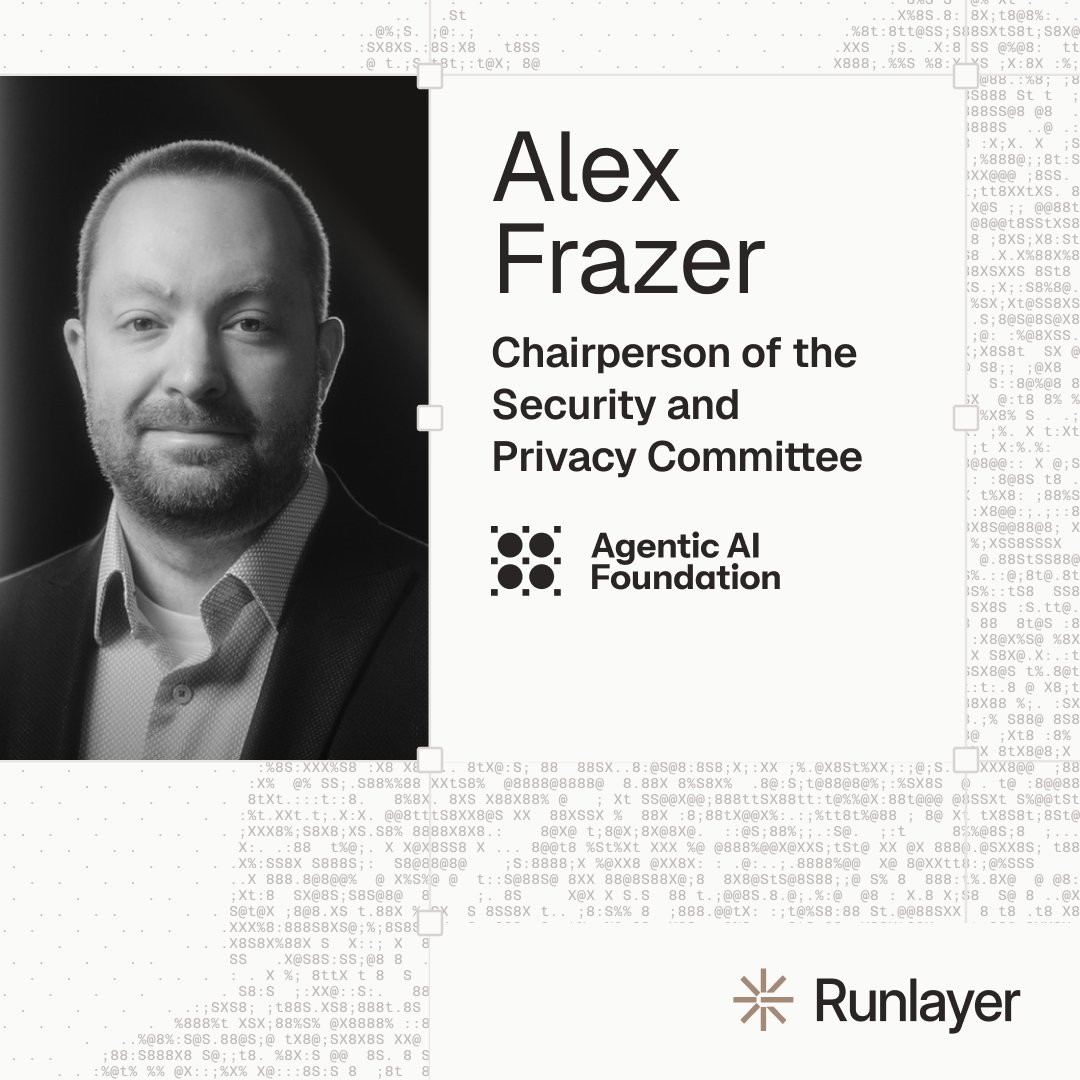
We are thrilled to announce that our very own Alexander Frazer has been appointed Chairperson of the Security & Privacy Working Group for the Agentic AI Foundation @AgenticAIFdn. As the foundation governs pivotal protocols like MCP, AGENTS[.]md, and goose, Alex’s leadership comes at a critical inflection point. The future of MCP depends entirely on robust security, and we couldn't think of a better person to lead this charge alongside industry leaders like Google, AWS, Anthropic, OpenAI, Microsoft, and @Runlayer. We're proud to help shape the future of Agentic AI.
Runlayer tweet media
English
0
4
8
1.2K
Runlayer
Runlayer@runlayer·
@frankdegods Checkout Runlayer. Works across all clients including Cursor, Claude, Codex (:
English
0
0
0
42
Runlayer retweetledi
Tal Peretz
Tal Peretz@talperetz_·
Talked to an engineering leader at a $14B company. Nearly 1,000 repos containing AI skills and plugins. Two people approve all of them.
English
1
1
6
738