

@florianederer I watch the dialysis industry closely 😉
Clayton, MO 🇺🇸 English
Ryan McDevitt
2.8K posts

@ryanmcdevitt
Professor of Economics @WashUOlin & School of Public Health

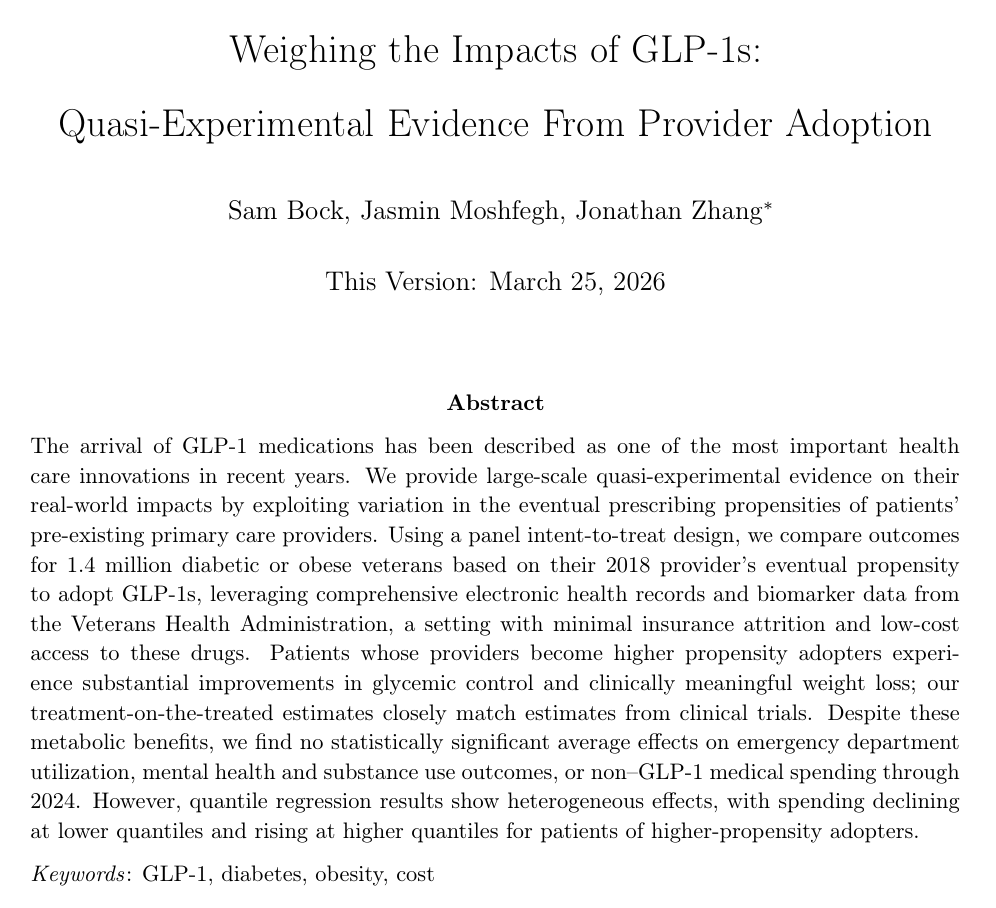
Retatrutide phase 3 obesity trial just came out and the results are genuinely insane: - 28.3% bodyweight lost on 12mg over 80 weeks - 70.3 pounds on avg. or 31.9 kg - 45.3% of patients hit 30%+ weight loss (this is bariatric surgery territory) - 30.3% weight loss (85 lbs) at 104 weeks in higher-BMI patients - 65.3% of 12mg patients dropped below the obesity BMI threshold - 19% loss on 4mg over 80 weeks (47.2 lbs) with fewer dropouts than placebo (4.1% vs 4.9%) - significant drops in blood pressure, triglycerides, non-HDL cholesterol, waist circumference, and hsCRP - no cardiac or liver signals Retatrutide is going to completely overshadow tirzepatide and semaglutide, and take the throne as the best-selling drug of all time.


A surprising number of people refuse to understand that idealized Oxbridge-style teaching and exams are incompatible with the mass higher ed that Americans invented and now take for granted.



Find out which hospitals in the US are owned by private equity here: pestakeholder.org/pesp-private-e…







I’m excited to share our new paper (Editor’s Choice) in Health Affairs Scholar on private equity acquisitions of US hospitals. We address a core limitation in the literature: the lack of a standardized, validated dataset of PE transactions. Key findings: • We identify 141 unique PE deals involving 555 short-term acute care hospitals (across 721 hospital–deal observations), which is more than have ever been reported before. • Existing commercial databases differ substantially in deal coverage, deal type, and reporting level. • Reliance on a single source can omit valid deals and produce biased or incomplete analytic samples. • Linking transactions to stable hospital identifiers requires substantial manual verification due to system-level deals, inconsistent reporting, and identifier changes over time. Overall, accurate study of PE ownership in hospitals requires multi-source data construction, transparent validation, and careful linkage to stable identifiers; many published studies inadvertently miss a large number of deals. We make the data and code publicly available to support more accurate, transparent, and replicable research: - Paper: academic.oup.com/healthaffairss… - Data & code: github.com/sungilkim94/Ki… Special thanks to my incredible co-authors for this collaboration: Mark Naslund, Sally Wang, Abid Hasan, Elijah Huang, Hyong-gu Hwang, @ambarlaforgia, @rileyleague, @ryanmcdevitt, and Kelly Kaili Yang
I’m excited to share our new paper (Editor’s Choice) in Health Affairs Scholar on private equity acquisitions of US hospitals. We address a core limitation in the literature: the lack of a standardized, validated dataset of PE transactions. Key findings: • We identify 141 unique PE deals involving 555 short-term acute care hospitals (across 721 hospital–deal observations), which is more than have ever been reported before. • Existing commercial databases differ substantially in deal coverage, deal type, and reporting level. • Reliance on a single source can omit valid deals and produce biased or incomplete analytic samples. • Linking transactions to stable hospital identifiers requires substantial manual verification due to system-level deals, inconsistent reporting, and identifier changes over time. Overall, accurate study of PE ownership in hospitals requires multi-source data construction, transparent validation, and careful linkage to stable identifiers; many published studies inadvertently miss a large number of deals. We make the data and code publicly available to support more accurate, transparent, and replicable research: - Paper: academic.oup.com/healthaffairss… - Data & code: github.com/sungilkim94/Ki… Special thanks to my incredible co-authors for this collaboration: Mark Naslund, Sally Wang, Abid Hasan, Elijah Huang, Hyong-gu Hwang, @ambarlaforgia, @rileyleague, @ryanmcdevitt, and Kelly Kaili Yang