

Blue Army
27.8K posts

Blue Army
@sack_chasser
Data analytics(ALX)💯 . Accountant by profession👏🏾. Chelsea Fan💙💙💙. Pay Critical attention to every little details👌. God's child🙏🏾
Here Katılım Eylül 2019
1K Takip Edilen1.1K Takipçiler


Let's all take note
TheSophisticatedDumbTechGuy@TheDumbTechGuy
Guys, please take note of the change in time.
English
That’s a fair accountability question, and the minister should share the current registration numbers. But low numbers at an early stage do not automatically mean the target cannot be achieved since large programs scale in phases. Also, budget allocation is not automatic spending; disbursement depends on implementation and participation levels.
English

@sack_chasser @tech_twi Can the minister share the number of registered people, then projections can be made if less than 50K people have registered their is not way they’d hit the target of 1 million and in this country budget allocation is always spent one way or the other.
English

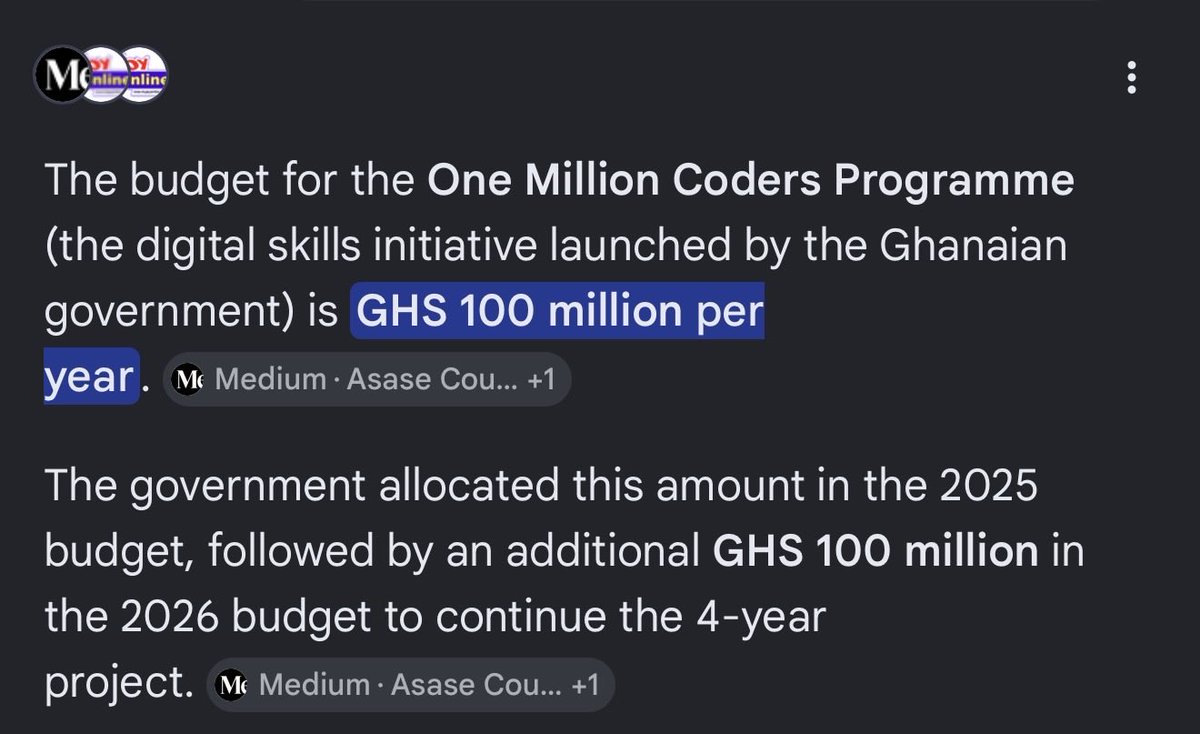
So hold on, the One Million Coders budget wasn’t even GHS 100,000,000 but rather GHS 200,000,000 combined for both 2025 and 2026, with plans that could even extend it to GHS 400,000,000 over 4 years. If that happens, it might become one of the biggest political money heists of the century.
English
The initiative from the start was “1 Million Coders for 1 Million Youth,” with enrollment expected to scale over time. So using doubt alone to claim even 50K may not enroll is not enough evidence to call it a political heist.
Also, a budget allocation does not automatically mean all the money will be spent. Budgets are projections tied to implementation and participation. If enrollment numbers do not reach the target, the full allocation is unlikely to be disbursed.
The proper focus should be on transparency, actual enrollment figures, delivery, and measurable outcomes and not assumptions alone.
English
@sack_chasser @tech_twi 1 million coders over the course of 4 years means 250K coders per year. Lemme ask you how many people are on the program as at now. Let’s say 50K of which I highly doubt. So you wanna tell me we’re going to get 950K in the next 3 years. This is a political heist
English
This is what my tech guys don't want to understand. With smaller businesses, young developers or perhaps startups are definitely going to get some exemptions. Definitely this regulations are going to be categorized and not just like a blanket fees for all. Thanks my brother
opana_tyga@TYGARAW_1
You’re not wrong boss bout tech being the engine of global economies, and Ghana definitely needs to aggressively support innovation rather than choke it with red tape. But there’s a fine line. Even the US, EU, and China heavily regulate their tech sectors (look at the EU's antitrust laws or the US Congress grilling tech CEOs). The goal shouldn't be 'no control,' but rather smart regulation that protects citizens without killing the hustle of local innovators. We need policies that enable, not disable.
English
People keep mentioning Apple, Google, Tesla and other big tech companies as though regulation never existed when they started. But let’s be honest and objective about history.
Apple started in a garage. At the beginning, they did not need a software developer license before building computers. They first built a product, tested the market, and scaled gradually. However, as they grew, regulations naturally increased around consumer safety, taxes, patents, public investments, privacy and data protection.
Google also started as a university project. No prior certification was needed to create a search algorithm. But as the company expanded into advertising, data collection, cloud systems and AI, regulations around privacy, copyright, cybersecurity and antitrust laws became necessary.
Tesla too faced regulations mainly around vehicle safety, environmental standards and public deployment, not restrictions stopping innovation itself.
So yes, regulations existed back then, but mostly around:
safety standards,
tax and business registration,
consumer protection,
public risk management.
What generally did NOT exist were:
excessive blanket licensing barriers for every innovator,
treating student developers like multinational corporations,
shutting experimentation before innovation could even begin.
That is why context matters in this current debate.
The policy framework being discussed today is clearly not a blanket “everybody pay the same fee” structure as some people are making it look. There are categories and frameworks:
student developers,
startups,
SMEs,
enterprises,
high-risk operators.
A student building a simple app is obviously not treated the same way as a telecom giant or a major fintech company handling sensitive public data.
There are also exemptions and phased compliance structures which globally are normal practices:
startup waivers,
reduced compliance burdens,
temporary exemptions,
gradual regulation as companies scale.
This is exactly how modern innovation ecosystems operate across the world.
And let’s be honest again: technology today is far more powerful than it was in the 1970s or 1990s. Modern technology can influence:
elections,
banking systems,
cybersecurity,
national security,
digital fraud,
personal data and privacy.
That is why governments globally now push for:
accountability,
cybersecurity standards,
data protection,
platform responsibilities.
So the issue should not be “regulation is bad.” The real discussion should be: “How do we regulate without killing innovation?”
Constructive criticism is important, but portraying every regulation or certification framework as evil is not being objective either.
Even the criticism about the One Million Coders Programme should be balanced. People mention the GHS100 million allocation without context. If the goal is to train one million young people, that averages roughly around GHS100 per head. How exactly is that outrageous in a digital economy push?
People mention platforms like Coursera as alternatives, but are those courses entirely free? Even ALX foundation programmes often require monthly commitments and other learning costs. Quality digital training, infrastructure, mentorship, certifications and support systems require investment.
Criticism is healthy, but it should be informed, balanced and factual.
And to be fair to the Minister, one thing many people can acknowledge is that he has consistently shown willingness to engage the public directly, listen to concerns and even has decided to join X Spaces personally to clarify misunderstandings and explain policies further. That openness to engagement is something we should encourage in governance instead of turning every discussion into pure propaganda or outrage politics.
Regulation itself is not the enemy. Poor implementation is the real danger. That is why stakeholder engagement, exemptions, affordability and clarity matter.
Tech In Twi@tech_twi
Drop that bill and enable the youth.
English
Blue Army retweetledi

We wish to inform the general public and all stakeholders that the proposed X Space discussion on the new NITA Bill has been rescheduled.
🗓️ New Date: Tuesday, 26th May 2026
⏰ Time: 1:00 PM GMT
The rescheduling is to allow for broader /1

English
@Gee_Brown_ @tech_twi Emotions at play. Learn, read and understand. Innovations doesn't mean lack of regulations. You all are just stuck with insults and making no meaningful contributions.
English

They even posted this pricing in dollars, and after the backlash, they took the page down. These NDC people are just cowards. They can’t even change the position of a single person in their own party, but they act tough in opposition talking about arresting members of other parties.
English
Innovation and regulation are not opposites, every serious digital economy has both. Proper regulation is defined by clear categories, fair thresholds, startup exemptions, and user protection, not blanket restrictions.
The real discussion should stay on whether the policy is well-designed and balanced, not on assumptions about intent and the agenda written all over your TL. You guys don't even understand anything just talking with emotions and following blindly 🤣🤣🤣
English
Standards and certification are indeed different, but that does not mean certification has no place in regulation. In many sectors globally, certifications are used for accountability, cybersecurity, consumer protection, and professional credibility, especially where sensitive data and digital infrastructure are involved.
The key debate should be about how certification is implemented, not pretending certification itself is abnormal. Are we saying globally, developers and companies don't go through forms of approval, compliance checks, licenses, audits, and platform verification which depends on the industry they operate in? So regulation with certification components is not automatically anti-innovation and that is my line of argument boss
English

@sack_chasser @BigAfellay Standards and certification are two different things
Standards are enforced all over the world without certification
English

Is it not the same as teachers, nurses, lawyers and other professionals who need license before they work?
You guys want the country to work until it’s time to okay your role.
Tyson.nie 📸@tysonphotoo
go to university read IT related courses pay school fees for 4yrs get a certificate from the university do your national service after national service look for jobs jobs say they need 4 years experience start something for yourself using your IT skills NITA says it’s illegal so come and pay them so the evaluate you and give you certificate to certify that you are an iT specialist. think of doing remote IT jobs. NITA says that’s illegal too because they haven’t certified you. you start to wonder why you went to the university in the first place.
English
Calling it a “political money heist” without context is a stretch. A 4-year nationwide digital skills programme targeting up to one million people will naturally require massive infrastructure, trainers, internet access, devices, learning platforms, certifications, administration, and regional training centres.
If the allocation is GHS 100 million per year, that averages roughly GHS 100 per person annually if they truly reach one million learners over time — which is not outrageous for a national tech-skilling initiative. Many countries spend far more on digital transformation and workforce development.
The real issue shouldn’t be the headline figure alone, but transparency and results:
How many people are actually trained?
What skills are being taught?
How many get jobs or start businesses?
How is the money audited and distributed?
Criticism is fair, but branding every large public digital investment as a “heist” before implementation or audits can also discourage long-term innovation and tech development in Ghana. You are a tech guy and you should know this
Tech In Twi@tech_twi
So hold on, the One Million Coders budget wasn’t even GHS 100,000,000 but rather GHS 200,000,000 combined for both 2025 and 2026, with plans that could even extend it to GHS 400,000,000 over 4 years. If that happens, it might become one of the biggest political money heists of the century.
English

@tech_twi That guy will definitely get arrested when there is change of government.
English
Innovation and regulation are not opposites—every serious digital economy has both. Proper regulation is defined by clear categories, fair thresholds, startup exemptions, and user protection, not blanket restrictions.
The real discussion should stay on whether the policy is well-designed and balanced, not on assumptions about intent and the agenda written all over your TL
English
Strong disagreement is fine, but calling the process “rubbish” or assuming bad intent doesn’t replace the need for a factual discussion.
Policy and bills go through multiple stages drafting, consultations, revisions, and parliamentary scrutiny because the goal is to balance innovation with regulation, security, and consumer protection.
If there are specific clauses or impacts that are problematic, the productive route is to point them out clearly and propose alternatives, not dismiss the entire process as an agenda or insult everyone involved.
You can challenge policy without turning the conversation into personal attacks. You guys are so quick to jump on anything
English

@sack_chasser @GhanaSocialUni @joyce_bawah @JDMahama Masa Comot for the and your politically correct tone. It went through all these phases and this is the rubbish they produced? You all part of Ghanas infection. You can’t say truth to power.
English

Hello Auntie @joyce_bawah does the President @JDMahama know what Sam George is doing at the ministry of communications with the NITA and Cybersecurity Bills et al?! Or you people have just left him to fool?!
English
These figures and conclusions are being mixed together in a way that doesn’t reflect how policy and funding actually work.
Investments in AI or training programs like “1M Coders” are meant to build skills, infrastructure, and capacity in the tech ecosystem, while regulation is meant to set standards, accountability, cybersecurity safeguards, and consumer protection rules. They serve different purposes, not opposing ones.
It’s also important to separate budget allocations from legislative proposals, one is about development funding, the other is about creating a structured legal framework that goes through review, consultation, and possible revision.
Strong opinions are fine, but calling for sackings based on combined and unverified interpretations doesn’t help a constructive tech policy debate.
English
You have a budget of over 2,520,000,000.00 GHC for AI and 100,000,000.00 GHC for the 1M Coders program, and then a few days later, you draft a bill that will make it harder for developers in the country to deploy. Meeeehn, these people have no idea what they are doing. It’s all just for the money. Sack them all ASAP!
English
@alimoemma @tech_twi Bro just allow him to keep on fooling. You think he doesn't know. He knows very well. He is just an agenda mission
English

Reshuffle Sam George immediately before he even drops that bill. We do not want someone who thinks drafting such a bill is a good idea in the first place.
English
This comparison is misleading and driven more by emotion than facts.
Tools like the Dumsor Tracker show why innovation thrives but they don’t exist outside any legal or policy environment. Even in open ecosystems, developers still operate under basic laws around data, security, and public platforms.
Framing regulation as “permission to innovate” is a false narrative. The real issue is whether rules are fair, transparent, and startup-friendly, not whether they exist at all.
Also, the growing trend of personal attacks and selective examples points more to bias and agenda-driven framing than a balanced policy discussion. Serious tech policy deserves facts, not outrage and you as a tech guy should know better
English
Imagine if the smart guy who developed the Dumsor Tracker had to seek permission before deploying the project. Meeehn, fuck that. Sack Sam George and his team immediately.
English