Sit down, please. Disruption incoming 💥 xPortal has acquired @alphalink_xyz, a Berlin-based Web3 startup simplifying crypto and financial investing. But there’s way more 👇 cointelegraph.com/press-releases…
Salameche ⚡
3.3K posts

@salameche172
🇧🇪 crypto & NFT degen living in 🇦🇺. Into $EGLD since it was called $ERD. HT: salameche

Sit down, please. Disruption incoming 💥 xPortal has acquired @alphalink_xyz, a Berlin-based Web3 startup simplifying crypto and financial investing. But there’s way more 👇 cointelegraph.com/press-releases…

Outreach. Users. Revenue. Feels surprising, but it's just first principles, and common sense. The next wave belongs to founders, builders, ecosystems, who get this, and reorient around it. Onward.


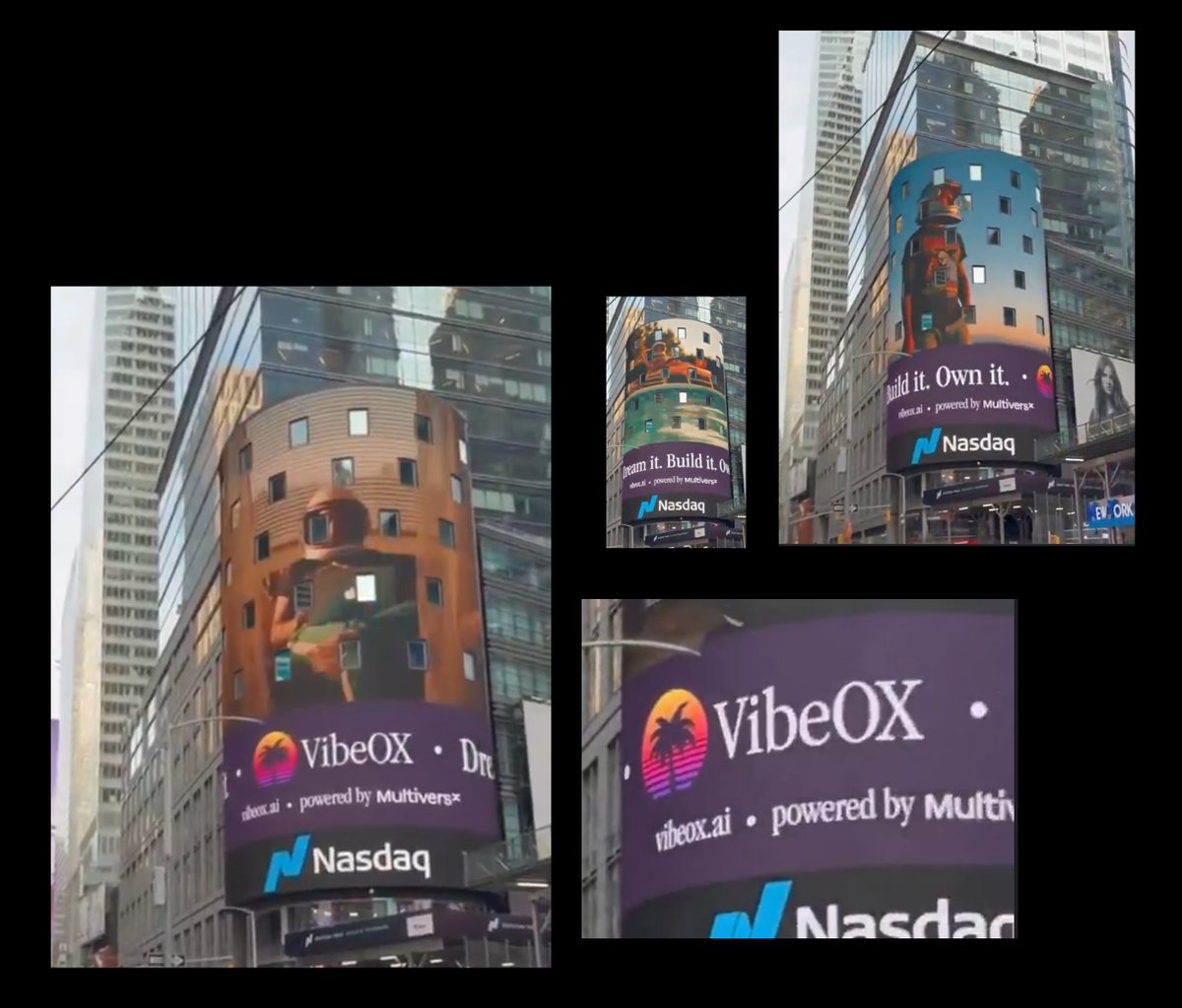
We're playing ball. Big league. MultiversX. VibeOX -- in Time Square. 🔥 U.S. chapter begins.🇺🇸

MvX is THE MOST SCALABLE BLOCKCHAIN NETWORK in the world TODAY. ♥️

What is Andromeda? Understanding the MultiversX upgrade targeting single-slot finality and opening the path for sub-second speeds. Presented by @DBCrypt0 📺


With USH live on Mainnet for almost 24 hours, it's time for an update on key metrics and the steps ahead. In less than a day, close to $7 million $USH have been minted, and over $10.4 million in liquidity has been provided across @xExchangeApp and @ash_swap, reinforcing market depth and stability. With almost $10 million worth of LP tokens deposited in the USH Staking Module, users are earning triple and even quadruple-digit APYs on their positions. While we are still working on integrating APR displays from exchanges into our front end, which will soon be visible directly in the Staking Module, it is important to remember that in addition to rewards from the Staking Module, all liquidity providers are also earning trading fees and farm rewards from DEXs. For example, current yields include: • USH-EGLD: Up to 248% APY through the USH Staking Module, plus an additional 40% APR on @xExchangeApp • USH-USDC: Up to 261% APY through the USH Staking Module, plus an additional 52% APR on @ash_swap • USH-USDT: Up to 137% APY through the USH Staking Module, plus an additional 64% APR on @ash_swap At launch, the Redemption Mechanism was intentionally left inactive to analyze market dynamics and evaluate the efficiency of soft peg mechanisms, such as arbitrage between liquidity pools, organic liquidity provisioning, and natural market forces, before activating the Redemption Mechanism. Redemption Threshold Adjustment Plan Now that liquidity has stabilized and $USH has gradually moved back toward $0.97, we are increasing the redemption threshold to further reinforce the peg. To ensure a smooth and controlled restoration of the $1 peg, we will implement a gradual increase in the redemption threshold as follows: 🔹 Phase 1: Immediate increase from $0.95→ $0.965 🔹 Phase 2: Increase from $0.965 → $0.97 🔹 Phase 3: Increase from $0.97 → $0.975 🔹 Phase 4: Increase from $0.975 → $0.98 🔹 Phase 5: Monitor market conditions to determine if further adjustments are needed The first phase takes effect immediately, while subsequent phases will be spaced 40 minutes apart, allowing the system to rebalance gradually without introducing unnecessary volatility. How Redemption Works The Redemption Mechanism helps restore USH’s peg when it trades below a set threshold for a sustained period. Instead of triggering instantly, the system ensures that the depeg is persistent before opening a redemption window by tracking two moving averages: • A short-term moving average (last 5 minutes) • A long-term moving average (last 20 minutes) Both moving averages must remain below the threshold before a depeg window can be opened. This prevents unnecessary activations due to short-term price fluctuations and ensures that other peg-stabilizing mechanisms, such as arbitrage between liquidity pools, have a chance to correct the price first. Once a depeg window is opened, after a delay of currently 5 minutes, if the depeg still persists, redemptions are activated. Once active, a redeemer supplies $EGLD to the redemption smart contract, which purchases $USH from the EGLD-USH liquidity pool. The protocol then selects up to 10 borrowers with the highest risk profiles (but still above liquidation thresholds) and repays their $USH debt. The equivalent amount of collateral is seized and transferred to the redeemer, while the burning of $USH reduces its circulating supply, supporting price stability. Borrowers are not penalized, as both their debt and collateral decrease proportionally, and a share of the arbitrage profit is distributed between redeemers and affected borrowers to maintain fairness. With this strategy in place, we are confident that the USH Redemption Mechanism will not only restore the peg efficiently but also reinforce trust in the system, attracting more arbitrageurs to help stabilize the price of USH in the long term. In the coming days, we will provide the community with a fresh update on what’s next for Hatom, outlining key milestones we aim to achieve in the next few months. With the launch of $USH, completing the three core pillars of our ecosystem, our focus now shifts to improving our products, optimizing yield opportunities, and expanding passive income streams for our users. At the same time, we are working to simplify the user experience and improve onboarding into the Hatom ecosystem. As part of this initiative, we are working on a major revamp to our dApp designed to simplify dashboards, enhance usability, and create a more intuitive experience for all users. This upgrade will streamline navigation, improve accessibility, and make it easier to interact with all core products within the Hatom ecosystem. We are thrilled to witness our products' growth and the impact they will have on the #MultiversX ecosystem!

The first native fully-decentralized stablecoin on @MultiversX is here! Following the launch of $USH yesterday by @HatomProtocol, we're excited to announce that it's now live on our Tradesilvania Ramp! 🎉 Experience the ease of buying $USH with fiat and having it in any wallet you want. 👉 ramp.tradesilvania.com

$USH it, load it, tap it, go! 💳 Your xPortal Card now runs with $USH, making crypto spending smooth as whoosh! Because your money should move as fast as you do.

With USH live on Mainnet for almost 24 hours, it's time for an update on key metrics and the steps ahead. In less than a day, close to $7 million $USH have been minted, and over $10.4 million in liquidity has been provided across @xExchangeApp and @ash_swap, reinforcing market depth and stability. With almost $10 million worth of LP tokens deposited in the USH Staking Module, users are earning triple and even quadruple-digit APYs on their positions. While we are still working on integrating APR displays from exchanges into our front end, which will soon be visible directly in the Staking Module, it is important to remember that in addition to rewards from the Staking Module, all liquidity providers are also earning trading fees and farm rewards from DEXs. For example, current yields include: • USH-EGLD: Up to 248% APY through the USH Staking Module, plus an additional 40% APR on @xExchangeApp • USH-USDC: Up to 261% APY through the USH Staking Module, plus an additional 52% APR on @ash_swap • USH-USDT: Up to 137% APY through the USH Staking Module, plus an additional 64% APR on @ash_swap At launch, the Redemption Mechanism was intentionally left inactive to analyze market dynamics and evaluate the efficiency of soft peg mechanisms, such as arbitrage between liquidity pools, organic liquidity provisioning, and natural market forces, before activating the Redemption Mechanism. Redemption Threshold Adjustment Plan Now that liquidity has stabilized and $USH has gradually moved back toward $0.97, we are increasing the redemption threshold to further reinforce the peg. To ensure a smooth and controlled restoration of the $1 peg, we will implement a gradual increase in the redemption threshold as follows: 🔹 Phase 1: Immediate increase from $0.95→ $0.965 🔹 Phase 2: Increase from $0.965 → $0.97 🔹 Phase 3: Increase from $0.97 → $0.975 🔹 Phase 4: Increase from $0.975 → $0.98 🔹 Phase 5: Monitor market conditions to determine if further adjustments are needed The first phase takes effect immediately, while subsequent phases will be spaced 40 minutes apart, allowing the system to rebalance gradually without introducing unnecessary volatility. How Redemption Works The Redemption Mechanism helps restore USH’s peg when it trades below a set threshold for a sustained period. Instead of triggering instantly, the system ensures that the depeg is persistent before opening a redemption window by tracking two moving averages: • A short-term moving average (last 5 minutes) • A long-term moving average (last 20 minutes) Both moving averages must remain below the threshold before a depeg window can be opened. This prevents unnecessary activations due to short-term price fluctuations and ensures that other peg-stabilizing mechanisms, such as arbitrage between liquidity pools, have a chance to correct the price first. Once a depeg window is opened, after a delay of currently 5 minutes, if the depeg still persists, redemptions are activated. Once active, a redeemer supplies $EGLD to the redemption smart contract, which purchases $USH from the EGLD-USH liquidity pool. The protocol then selects up to 10 borrowers with the highest risk profiles (but still above liquidation thresholds) and repays their $USH debt. The equivalent amount of collateral is seized and transferred to the redeemer, while the burning of $USH reduces its circulating supply, supporting price stability. Borrowers are not penalized, as both their debt and collateral decrease proportionally, and a share of the arbitrage profit is distributed between redeemers and affected borrowers to maintain fairness. With this strategy in place, we are confident that the USH Redemption Mechanism will not only restore the peg efficiently but also reinforce trust in the system, attracting more arbitrageurs to help stabilize the price of USH in the long term. In the coming days, we will provide the community with a fresh update on what’s next for Hatom, outlining key milestones we aim to achieve in the next few months. With the launch of $USH, completing the three core pillars of our ecosystem, our focus now shifts to improving our products, optimizing yield opportunities, and expanding passive income streams for our users. At the same time, we are working to simplify the user experience and improve onboarding into the Hatom ecosystem. As part of this initiative, we are working on a major revamp to our dApp designed to simplify dashboards, enhance usability, and create a more intuitive experience for all users. This upgrade will streamline navigation, improve accessibility, and make it easier to interact with all core products within the Hatom ecosystem. We are thrilled to witness our products' growth and the impact they will have on the #MultiversX ecosystem!

With USH live on Mainnet for almost 24 hours, it's time for an update on key metrics and the steps ahead. In less than a day, close to $7 million $USH have been minted, and over $10.4 million in liquidity has been provided across @xExchangeApp and @ash_swap, reinforcing market depth and stability. With almost $10 million worth of LP tokens deposited in the USH Staking Module, users are earning triple and even quadruple-digit APYs on their positions. While we are still working on integrating APR displays from exchanges into our front end, which will soon be visible directly in the Staking Module, it is important to remember that in addition to rewards from the Staking Module, all liquidity providers are also earning trading fees and farm rewards from DEXs. For example, current yields include: • USH-EGLD: Up to 248% APY through the USH Staking Module, plus an additional 40% APR on @xExchangeApp • USH-USDC: Up to 261% APY through the USH Staking Module, plus an additional 52% APR on @ash_swap • USH-USDT: Up to 137% APY through the USH Staking Module, plus an additional 64% APR on @ash_swap At launch, the Redemption Mechanism was intentionally left inactive to analyze market dynamics and evaluate the efficiency of soft peg mechanisms, such as arbitrage between liquidity pools, organic liquidity provisioning, and natural market forces, before activating the Redemption Mechanism. Redemption Threshold Adjustment Plan Now that liquidity has stabilized and $USH has gradually moved back toward $0.97, we are increasing the redemption threshold to further reinforce the peg. To ensure a smooth and controlled restoration of the $1 peg, we will implement a gradual increase in the redemption threshold as follows: 🔹 Phase 1: Immediate increase from $0.95→ $0.965 🔹 Phase 2: Increase from $0.965 → $0.97 🔹 Phase 3: Increase from $0.97 → $0.975 🔹 Phase 4: Increase from $0.975 → $0.98 🔹 Phase 5: Monitor market conditions to determine if further adjustments are needed The first phase takes effect immediately, while subsequent phases will be spaced 40 minutes apart, allowing the system to rebalance gradually without introducing unnecessary volatility. How Redemption Works The Redemption Mechanism helps restore USH’s peg when it trades below a set threshold for a sustained period. Instead of triggering instantly, the system ensures that the depeg is persistent before opening a redemption window by tracking two moving averages: • A short-term moving average (last 5 minutes) • A long-term moving average (last 20 minutes) Both moving averages must remain below the threshold before a depeg window can be opened. This prevents unnecessary activations due to short-term price fluctuations and ensures that other peg-stabilizing mechanisms, such as arbitrage between liquidity pools, have a chance to correct the price first. Once a depeg window is opened, after a delay of currently 5 minutes, if the depeg still persists, redemptions are activated. Once active, a redeemer supplies $EGLD to the redemption smart contract, which purchases $USH from the EGLD-USH liquidity pool. The protocol then selects up to 10 borrowers with the highest risk profiles (but still above liquidation thresholds) and repays their $USH debt. The equivalent amount of collateral is seized and transferred to the redeemer, while the burning of $USH reduces its circulating supply, supporting price stability. Borrowers are not penalized, as both their debt and collateral decrease proportionally, and a share of the arbitrage profit is distributed between redeemers and affected borrowers to maintain fairness. With this strategy in place, we are confident that the USH Redemption Mechanism will not only restore the peg efficiently but also reinforce trust in the system, attracting more arbitrageurs to help stabilize the price of USH in the long term. In the coming days, we will provide the community with a fresh update on what’s next for Hatom, outlining key milestones we aim to achieve in the next few months. With the launch of $USH, completing the three core pillars of our ecosystem, our focus now shifts to improving our products, optimizing yield opportunities, and expanding passive income streams for our users. At the same time, we are working to simplify the user experience and improve onboarding into the Hatom ecosystem. As part of this initiative, we are working on a major revamp to our dApp designed to simplify dashboards, enhance usability, and create a more intuitive experience for all users. This upgrade will streamline navigation, improve accessibility, and make it easier to interact with all core products within the Hatom ecosystem. We are thrilled to witness our products' growth and the impact they will have on the #MultiversX ecosystem!


The best time to plant a tree—or ship Ethereum 2.0—was in 2018. The second best time? Today. Here’s a thought: What would it be worth to Ethereum if full-blown ETH 2.0, with state-of-the-art specs (full state sharding, sub sec finality), were live and running by the end of 2025? Would it unlock 100B, 500B, or 1T in cumulative value, relevance and momentum? It can be done. I know a team. This is what I’d call war mode. Here to help. @VitalikButerin @IOHK_Charles @ethereumJoseph @no__________end @tkstanczak

We are thrilled to announce that USH is now live on Mainnet, marking a monumental event for the #MultiversX ecosystem. $USH is the first decentralized stablecoin designed to maintain a stable value, pegged to the U.S. Dollar, and native to the #MultiversX blockchain. Unlike centralized stablecoins like $USDC or $USDT, which are bridged from other chains, $USH is minted and managed within #MultiversX, reducing dependency on external chains and mitigating potential security risks related to wrapped assets. We invite everyone to actively participate in the launch and take advantage of the incredible APYs available for USH LP stakers through the USH Staking Module. While these high yields will be available at launch, they will naturally adjust as more participants join and deposit liquidity. In the first few hours, early participants will have the opportunity to capture some of the highest APYs ever distributed. Based on our calculations, even with $50 million in liquidity deposited in the USH Staking Module, we expect to maintain over 60% APY, assuming all positions are equally boosted. Since not all participants will maximize their boost, even triple-digit APYs are expected in the first hours of launch, providing a significant advantage for early stakers. We are bringing back the high-yield days of DeFi, built in a sustainable way to ensure long-term stability and growth for the $MultiversX ecosystem. To start participating, you can mint $USH through two main Facilitators, each with their unique dynamics and fees: Lending Protocol Through this Facilitator, users can mint $USH by collateralizing their assets in Hatom’s Lending Protocol at a fixed minting fee per asset as follows: • $USDC & $USDT: 10% • $WBTC, $WETH, $UTK, $HTM, $MEX: 15% Isolated Pools Through the Isolated Pools, users can deposit $EGLD , $wTAO, and their Liquid Staking Tokens ( $sEGLD and $swTAO) to mint $USH without any minting fees. However, depositing Liquid Staking Tokens shifts the user’s exposure to the underlying asset ( $EGLD or $wTAO), and the collateral will no longer earn staking rewards. Please use the following links to engage with USH: • Mint USH through the Lending Protocol: app.hatom.com/lend (make sure to switch to the USH Pool) • Mint USH through the Isolated Pools: app.hatom.com/ush • Provide liquidity for USH on @xExchangeApp: xexchange.com/liquidity • Provide liquidity for USH on @ash_swap: app.ashswap.io/pool • Once you create LP or Farm Tokens, stake them in the USH Staking Module to take advantage of the $USH staking yield: app.hatom.com/ush The first few hours after $USH launches might be more volatile, and $USH will need some time to fully stabilize. Therefore, we encourage everyone to focus on pairing $USH with $EGLD or another asset for liquidity provision rather than minting $USH and selling half of it to buy the other asset for liquidity. However, if this isn’t feasible, we recommend carefully checking slippage, price impact and adjusting accordingly to ensure the best trading experience. As a reminder, during the Private Mainnet period, Hatom generated almost $300,000 in revenue, which was used to buy back $HTM from the open market. These funds will be distributed as incentives within the USH Staking Module. Here is a breakdown of the total incentives allocated across different pairs: • USH/EGLD → 52% • USH/USDC → 35% • USH/USDT → 3% • USH/HTM → 3% • USH/MEX → 3% • USH/UTK → 2% • USH/FOXSY → 1% • USH/ASH --> 1% Booster V2 We are also thrilled to announce the launch of Booster V2 on the Mainnet, working in perfect harmony with USH to create a synergistic ecosystem designed to accelerate the growth of our products, with our $HTM token at its core. The new Booster V2 eliminates all previous restrictions, enabling users to stake an unlimited amount of $HTM in the Booster. This introduces a "battle of the yield" concept, where the more you stake, the greater the incentives you can earn, proportional to the liquidity you provide. But that’s not all, as users can now also stake LP Tokens, Farm Tokens, or even Dual Farm Tokens for the HTM-EGLD pair, as well as Staked HTM from @xExchangeApp, reaping the benefits of trading fees, farm rewards, dual farm rewards, and Boosted Rewards! A key feature to highlight is that there’s no need to unstake your $HTM from the Booster to create LPs or Farm Tokens and have a 7-day cooldown period. All liquidity provisioning can now be managed directly through the xExchange Dashboard within Booster V2, allowing users to utilize their staked $HTM in order to create the LP tokens. With an integration directly into @xExchangeApp via Booster V2, users can now: • Provide liquidity directly from the Booster Dashboard without leaving the Hatom website • Upgrade or downgrade their positions • Lock $MEX to boost their Energy and enhance rewards for providing liquidity • Manage their Energy positions, including charging, discharging, removing, merging, or transferring Energy • Claim all rewards generated from LPs deposited in the Booster In Booster V1, users could only deposit single $HTM tokens, earning no yield beyond the incentives distributed by Hatom through the Booster. With Booster V2, this limitation is gone as users can now generate up to an additional 22.92% APR by creating a Dual Farm position on @xExchangeApp for HTM-EGLD (fully boosted with Energy), all while earning Hatom’s Boosted Rewards in different modules such as Lending or USH Staking. This upgrade significantly boosts capital efficiency for users and strengthens $HTM liquidity pools, enhancing the trading experience across the ecosystem, maximizing returns and flexibility, and offering a superior solution for all participants. USH Airdrop We’re happy to announce that the snapshots for the USH Airdrops have now concluded, and we want to express our gratitude to everyone who participated in this event, designed as a meaningful way to reward our token holders. Moving forward, we will provide an update regarding the distribution of the prizes by the end of this week, highlighting each step in the process. USH Market Page We’re excited to unveil the new USH Markets page, designed for full transparency. Now, anyone can explore key metrics for USH Facilitators, including collateralization ratios, total USH minted, and the collateral backing all the minted assets, plus much more, all in one place. Our Dune Dashboards will also be updated to reflect all the most important USH metrics. Please access the Market Page here: app.hatom.com/markets-ush We’ve come a long way in our journey, and it’s amazing to see $USH, one of the products with the greatest potential in the #MultiversX ecosystem, finally live! With the entire #MultiversX ecosystem poised for a period of tremendous growth, we are thrilled to be at the forefront of this transformation. We thank you for your support on this journey and look forward to $USH driving real value and activity in the #MultiversX ecosystem, reaching new milestones together. Your backing has been crucial; this is yet another big step for Hatom and #MultiversX. Let’s keep pushing forward together!