Michael Saylor

7.8K posts

Michael Saylor banner
Michael Saylor

Michael Saylor

@saylor

Bitcoin is https://t.co/KbbYe74DgB | $BTC Hodler | @Strategy Founder & Chairman | bio https://t.co/9Zlq0oHYnP | free education https://t.co/4L1s0ix7FE | $MSTR $STRC

Miami Beach, FL Katılım Ocak 2011
814 Takip Edilen5.1M Takipçiler
Sabitlenmiş Tweet
Michael Saylor
Michael Saylor@saylor·
Bitcoin has won. Global consensus is that $BTC is digital capital. The four-year cycle is dead. Price is now driven by capital flows. Bank and digital credit will determine Bitcoin’s growth trajectory. The biggest risk is bad ideas driving iatrogenic protocol changes.
English
3.9K
4.3K
30.4K
4.6M
Michael Saylor
Michael Saylor@saylor·
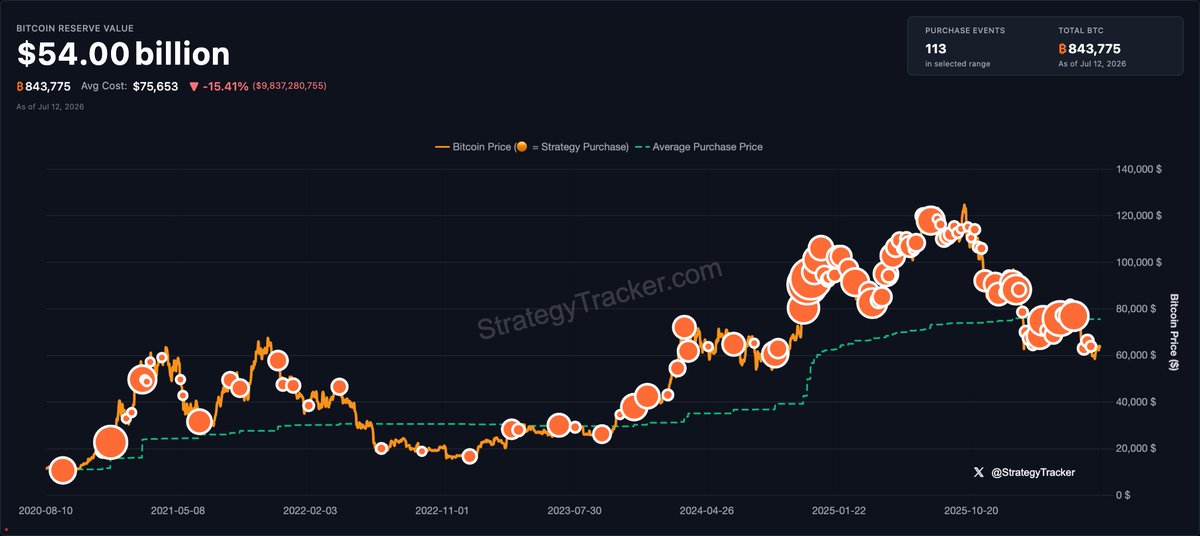
Orange dots tell only part of the story.
Michael Saylor tweet media
English
1.2K
991
10.1K
948.2K
Michael Saylor
Michael Saylor@saylor·
Bitcoin is an emergent network of wallets weighted by satoshis, nodes weighted by commerce, and miners weighted by hashrate, with capital, consensus, and security held in dynamic equilibrium. $BTC
English
800
626
6.4K
463.7K
Michael Saylor
Michael Saylor@saylor·
There are 110 things more dangerous to Bitcoin than spam. BIP 110 turns a spam dispute into a consensus change that would invalidate some currently valid, fee-paying transactions. That precedent is the danger. We should save our energy for threats that really matter. $BTC
Adam Back@adam3us

On the filter fork topic. I don't usually have time, but this morning listened to one of the twitter spaces from earlier in the week, with some well meaning relative bitcoin newcomers, that humanized them, and their concerns and thoughts for why they thought that made it logical to support 110. My feeling after listening, is if these are the people with #110 in their handles, I'm sad to see them about to fork off and get disillusioned without understanding why bitcoin rejected 110 robustly. So here's a more empathetic, constructive higher level version of explaining why not. I hope it's high-level and first-principles enough that everyone can follow. They seem to want to understand what makes people tick, and are suspicious of intent. So, if someone asked me why is Bitcoin important and what is it, I'd say my (personal) mission and hope for bitcoin is to build the cypherpunk future, that "Snow Crash" was a blueprint, and work backwards from there. Bitcoin I hope leads to fully free markets via bearer unseizable, hard mathematically dependable money. Not everyone is comfortable with that level of freedom, but that's my view. And at this point, I believe that surprisingly, even now many governments have come to understand and value bitcoin's gold-like mathematical assurance, a positive development. Others may have milder views than myself, but still like hard censorship resistant money. Because of motive suspicion, if it's not obvious: I hate spam with a passion, that's how I came to design hashcash while researching decentralized bearer money with others, and running nodes in privacy related cypherpunk p2p networks nearly three decades ago. People seem upset about the default op return policy change in bitcoin. I will just assert, there are extremely robust and simple reasons for bitcoin changing default relay policy, and most just didn't do their research, so don't know what those are, or maybe not technical enough to fully understand though there have been 1000s of posts trying to explain in various simplified ways. So that lack of understanding lends itself to shared build-up of false narratives. So here's my back-to-basics higher level explanation. The decentralization needed to create cypherpunk money has implications a: side effect of decentralization is that you can't impose your views on others. The very decentralization mechanism that helps that, is working against what BIP 110 wants, which at it's most basic is a quest to police other people. I understand supporters don't see their intent like that, but introspect deeper. You can modify your software, but not anyone else's. Another critical and incredibly robust technical bitcoin immune system is bitcoin can't have people who don't understand technology basics insist on eroding security, decentralization robustness and core properties. That would end badly, fast, and so people will fight you on that. So the message is Bitcoin respectfully says "no" to what you want. Sorry, and bitcoiners do genuinely understand and empathize that you mean well, have high level thoughts that make emotional sense, and articulate sensible bitcoin-defensive high level ideas, but they are not grounded and without you seeing it, the way you propose to achieve your ideas, hard-conflict with free cypherpunk permissionless money. My advice is to listen to more experienced people who understand the system and why it works the way it does, to whatever detail you want to understand the grounded reasons for why this is the implication of decentralization and cypherpunk money. I guarantee you the developer and protocol ecosystem shares and exceeds your views on bearer hard money (and dislike of spam). You may not agree with individual developers choices, views, way of expressing themselves etc, BUT you also need to understand the IETF-like decentralized technical consensus process creates a protective change resistance, that is highly effective at protecting bitcoin mission. The implication of which is no developer can change anything without technical consensus from hundreds of other developers and protocol observers who are pedantic and extremely knowledgeable clever people who won't let any unaddressed technical question past. The protective change resistance is robust and decentralized in an amplifying way because of this technical consensus. And the many highly technical mainline developers' cypherpunk mission mindsets are probably far more determined than you can even handle on clarity of understanding and views about freedoms on permissionless networks, as many of you are probably still subconsciously inured by the matrix, where they have transcended that, and grew up immersed in it decades ago. They think natively in this space, while you are just grappling with the surface. Many wont have internalized or have the experience to know how this internet physics works, where there is no policeman, no policy authority, just mathematics, free market and hard money. That has implications for your views also, unfortunately. Now the tough pill, which is unfortunately true: If you won't listen to reason, educate yourself, learn, the same radical freedom applies to you: your permissionless recourse is to club together and create a fork. But bitcoin won't be joining it. (With respect and no sleight intended.) Please rejoin bitcoin now, or later if you're not convinced and need to experience 110 forking off and fizzling for yourself to start that journey of introspecting and learning. It would be sad if bitcoin lost people disillusioned due to simple lack of understanding of what's going on there, we're all trying to defend bitcoin and keep it on mission. Including btw the 110 technical promoters, just they wandered off plot somehow. Join the cypherpunks on bitcoin, come cypherpunk summer🌞 in a few weeks.

English
1K
799
5.9K
944.5K
Michael Saylor retweetledi
Strategy
Strategy@Strategy·
$BTC is bigger than any single buyer or seller.
Strategy tweet media
English
162
215
1.8K
164.1K
Michael Saylor retweetledi
Matt Cole
Matt Cole@ColeMacro·
A discussion between @macroleverageTP, @PhongLe, and me on why Bitcoin Treasury Companies exist, what the first real stress test for Digital Credit taught us, and the opportunity ahead for Bitcoin-backed financial innovation. TIMESTAMPS 0:04 - Why Bitcoin Treasury Companies Exist 7:22 - Financial Engineering Vs. Financial Innovation 14:24 - What Makes Bitcoin Treasury Companies Durable 18:42 - Does Bitcoin Need Treasury Companies? 22:20 - Addressing Bitcoin Treasury Company Criticism 26:46 - Growing Demand For Bitcoin-Backed Products 30:11 - What Has Surprised The CEOs Most 36:06 - The Evolution Of Digital Credit Products 45:10 - Lessons From The First Market Stress Test 53:10 - Bitcoin Market Depth And Liquidity 55:21 - Why Selling Bitcoin Is Not A Contradiction 1:03:37 - The Future Of Bitcoin Treasury Companies $MSTR $ASST $STRC $SATA $BTC
English
73
89
557
91.7K
Michael Saylor
Michael Saylor@saylor·
I joined @kornelijalaura at the @xapobankapp Conference in London on July 1 for a fireside chat on Bitcoin as Digital Capital, the emergence of Digital Credit, and the path to Bitcoin-backed Digital Money. Fix the money, fix the world. $BTC 00:42 — Bitcoin below $60K and the mission: “Fix the money, fix the world” 01:27 — Bitcoin as the dominant Digital Capital network and the next great digital transformation 02:55 — Bitcoin Dominance approaching 69–70% and why “the flippening” debate is over 04:21 — The next layers: Digital Credit and Digital Money built on Bitcoin 06:56 — Strategy as an institutional gateway: attracting $64–65B into Bitcoin across equity, derivatives, credit, and money markets 12:28 — $STRC: bitcoin-backed preferred equity designed to create asset-backed Digital Credit 15:33 — The $STRC breakthrough: potential tax-deferred credit dividends backed by unrealized Bitcoin gains 18:18 — Digital Credit on Digital Capital: the killer app of a $50B bitcoin-backed balance sheet 19:48 — Digital Money: zero-volatility, fiat-pegged, yield-bearing bitcoin-backed assets 22:32 — Stress testing $STRC through deeper Bitcoin drawdowns 25:51 — $STRC vs. Bitcoin in the bear market: stripping ~90% of Bitcoin’s downside volatility 27:04 — Transparent Digital Credit: modeling risk from Bitcoin price and volatility every 15 seconds 30:34 — The builder roadmap: “If you want to make money, make the money” 32:27 — $STRC, $SATA, and the credit layer behind bitcoin-backed Digital Money 36:20 — Wrapping Digital Money as accounts, funds, public products, or tokens 41:27 — Creating Digital Credit on Digital Capital, then Digital Money on Digital Credit 43:00 — 2026 headwinds: geopolitics, the Fed, AI capital rotation, and digital asset regulation 44:54 — Potential catalysts: $STRC returning to par, Digital Credit reaccelerating, and capital flowing back to Digital Capital 46:01 — Why current market conditions may be a strong entry point for Digital Money builders
English
325
491
3.6K
437.5K
Michael Saylor retweetledi
Strategy
Strategy@Strategy·
Join us for our Q2 2026 Earnings Call on Thursday, July 30 at 5 PM ET. The call will be livestreamed on Zoom, X, and YouTube. $MSTR $STRC strategy.com/press/strategy…
English
117
127
1.2K
120.4K
Michael Saylor
Michael Saylor@saylor·
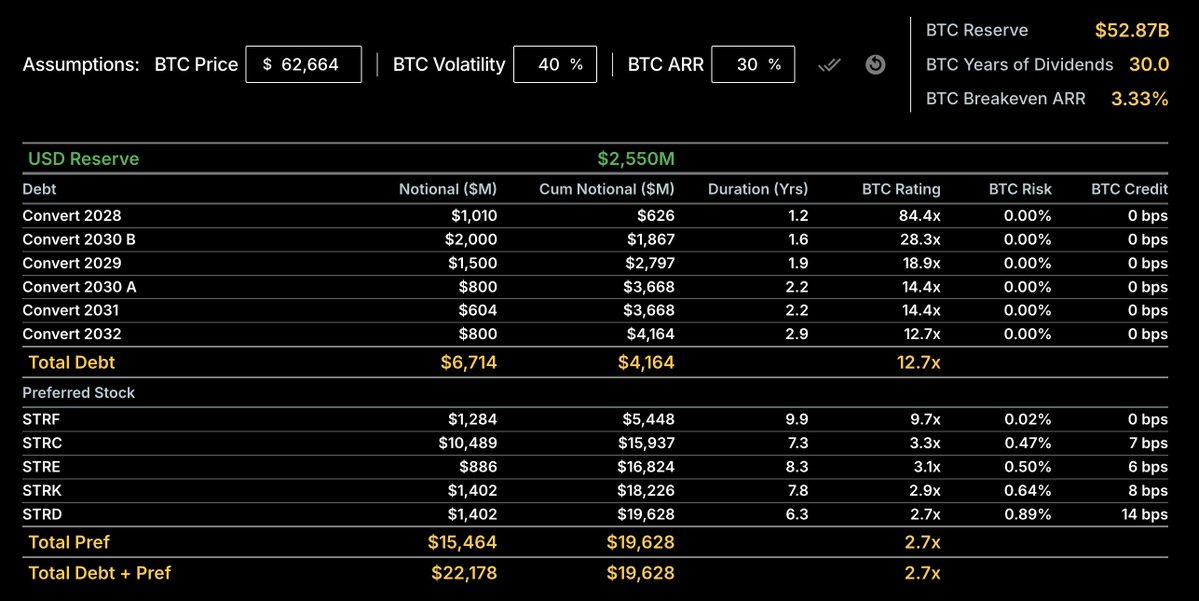
We have published our own credit model, allowing anyone to input BTC price, volatility, and ARR assumptions to evaluate model-implied BTC Risk, BTC Credit spreads, BTC Years of Dividends, and BTC Breakeven ARR. strategy.com/credit
English
64
86
878
72.1K
Michael Saylor
Michael Saylor@saylor·
Digital Credit is transparent because the principal market risk factor is Bitcoin, an observable, homogeneous asset. Analysts can assess BTC-related credit risk continuously, and investors can apply their own statistical models to inform valuation and trading decisions. $STRC
Michael Saylor tweet media
English
464
613
4.8K
369.4K
Michael Saylor retweetledi
Strategy
Strategy@Strategy·
Bitcoin doesn't rest. Now, strategy.com doesn't either. Pre- and post-market price and volume, live across our securities. $MSTR $STRC
Strategy tweet media
English
103
159
1.9K
148.8K
Michael Saylor retweetledi
Joe Burnett, MSBA
Joe Burnett, MSBA@IIICapital·
BTC Breakeven ARR tends to break brains, and I think it is important to understand why. There are three broad Bitcoin views: 1. Bullish Bitcoin (Amplified Bitcoin) These investors believe Bitcoin will appreciate significantly. If they can borrow long duration capital at <20% and believe Bitcoin's future CAGR will be above that, they are willing to raise capital to buy more Bitcoin. 2. Neutral Bitcoin (Digital Credit) These investors have a much lower required Bitcoin hurdle rate. Per @saylor's post, if Bitcoin grows at just 3.3% per year, they can fund current dividends forever from Bitcoin capital gains. That is a very different bet than “Bitcoin will compound at 20%+.” For context, historical USD M2 supply growth has been ~7% annually. BTC is a perfectly scarce monetary asset with 0% long-term supply growth. So the digital credit buyer does not need to be a massive Bitcoin bull. They mostly need to believe Bitcoin doesn't die and stays somewhat inline with USD inflation. That is a much broader audience. In fact, this may be the global consensus view on Bitcoin at this point. 3. Bitcoin bears If you believe Bitcoin is going down forever, there are also ways to express that view. You can short Bitcoin or short Amplified Bitcoin. That is what makes this situation so interesting. Capital now has three clear expressions: Bullish Bitcoin: own Bitcoin and Amplified Bitcoin. Neutral Bitcoin: own Digital Credit. Bearish Bitcoin: short Bitcoin or Amplified Bitcoin. Every major capital allocator now has a Bitcoin-linked instrument that maps to their worldview. That is how $1,000T+ of global capital starts to move into Bitcoin.
Michael Saylor@saylor

One of the most misunderstood $MSTR metrics is BTC Breakeven ARR. If BTC appreciates faster than 3.3% over time, BTC capital gains can fund $STRC dividends indefinitely.

English
58
55
441
114.7K
Michael Saylor
Michael Saylor@saylor·
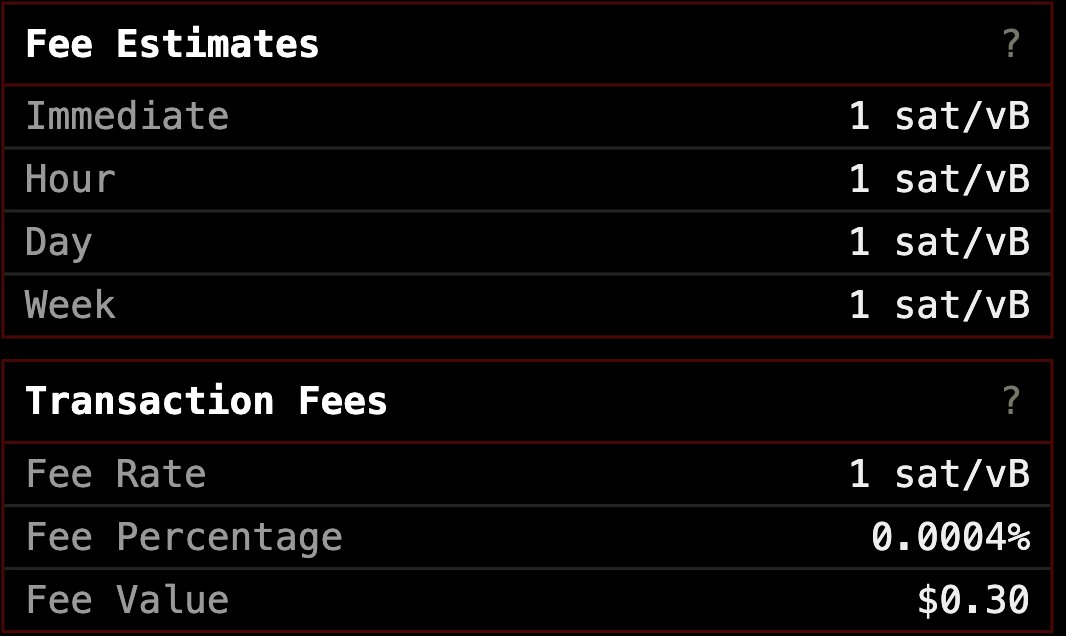
After a decade of blockspace fears and non-monetary-use panics, Bitcoin still has no spam problem. Fees are 1 sat/vB: anyone can move any amount globally with immediate processing for ~$0.30. The free market has always solved Bitcoin’s blockspace challenges. $BTC
Michael Saylor tweet media
English
1K
1.1K
8.7K
922.6K
Michael Saylor
Michael Saylor@saylor·
$BTC is Digital Capital. $STRC is Digital Credit. $MSTR is Digital Equity. Different instruments for different investors. One Bitcoin Strategy.
English
1.2K
974
9.2K
700.6K
Michael Saylor retweetledi
Phong Le
Phong Le@phongle·
For the 3 months April 6 to July 6, 2026, we increased our Bitcoin holdings 10% to 843,775 Bitcoin, increased our USD reserve 13% to $2.55B, and more than doubled YTD BTC Yield from 3.7% to 7.8%. $MSTR $BTC strategy.com/purchases
English
234
285
3.2K
176.3K
Michael Saylor retweetledi
The Hurdle Rate Podcast
The Hurdle Rate Podcast@HurdleRatePod·
Welcome Back to The Hurdle Rate Episode 64: Building The Track Record In this week’s Hurdle Rate, the crew breaks down Strategy’s sale of Bitcoin to fund dividend payments and why the market’s reaction may signal growing confidence in Bitcoin as a liquid capital asset. We explore how Strategy and Strive are using balance sheet management, digital credit, and capital markets access to keep their models moving through volatility. We also dig into SATA’s short interest, the idea of a “controlled burn,” and how Strive is thinking about protecting shareholders while allowing the market to function. We close with a broader discussion on patience, positioning, and building durable structures in the Bitcoin capital markets era. Here's the latest with @TimKotzman, @ColeMacro, @PunterJeff, and @Werkman. Time Stamps: 00:00 Welcome to the Hurdle Rate 03:20 Why Selling Bitcoin Helps STRC Confidence 05:37 Matt Cole on Strategy’s Long-Term Move 09:05 Bitcoin Absorbs the Sale 13:53 Bitcoin Liquidity Compared to Real Estate 17:29 Why the Model Still Works Without Capital Markets 19:03 Bitcoin CAGR + Balance Sheet Strength 23:14 Strive’s Dividend Math Compared to Strategy 27:40 SATA Short Interest + “Controlled Burn” 34:20 Jeff Explains Controlled Burns and Wildfire Incentives 41:56 Why Strive May Let SATA Trade Freely 44:05 Patience, Positioning, and Market Discipline 45:07 Closing Thoughts
English
41
42
301
95.8K