Samantha Boardman MD

9.6K posts

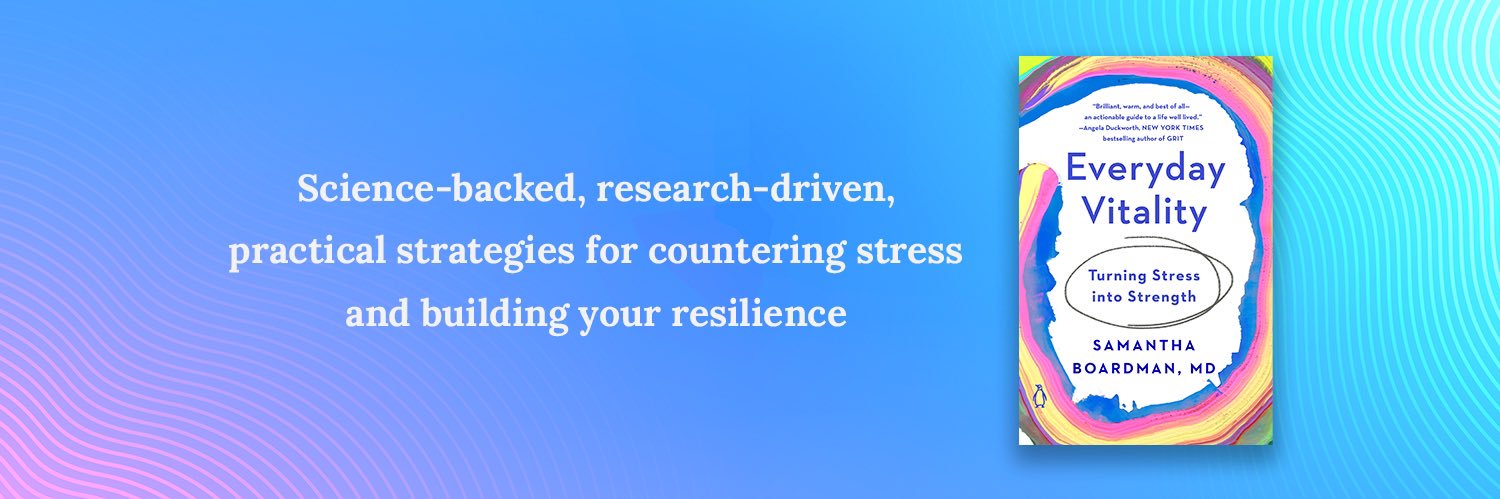
Samantha Boardman MD banner
Samantha Boardman MD

Samantha Boardman MD

@sambmd

Positive Psychiatrist @WeillCornell, APA Distinguished Fellow & author of #EverydayVitality

New York, NY Katılım Haziran 2011
839 Takip Edilen6.4K Takipçiler
Samantha Boardman MD
Samantha Boardman MD@sambmd·
@FreeRangeKids Thank you Lenore! I am working on it! In many cases being fluent in the language of mental health is silencing healthy conversations.
English
0
0
2
94
Lenore Skenazy
Lenore Skenazy@FreeRangeKids·
HOW PSYCHOBABBLE IS RUINING RELATIONSHIPS SUCH a smart article. Deserves to be a BOOK: all the psych concepts we throw around--trauma, boundaries, narcissism--allow us to categorize relationships as this or that and dismiss real paths forward. @sambmd positiveprescription.com/how-psychobabb…
English
4
4
26
3.3K
Samantha Boardman MD retweetledi
Lenore Skenazy
Lenore Skenazy@FreeRangeKids·
Feeling down? Do the OPPOSITE of what feels right: "Just because you feel like retreating & disconnecting doesn’t mean you should. The truth is that the last thing you feel like doing is often what will fortify you." From @sambmd drsamanthaboardman.substack.com/p/take-the-opp…
English
1
4
13
1.5K
Samantha Boardman MD
Samantha Boardman MD@sambmd·
When you’re overwhelmed, don’t shut down. The instinct is understandable. But it’s not restorative. Engagement, not escape, is the antidote.
English
1
1
1
130
Samantha Boardman MD
Samantha Boardman MD@sambmd·
Feeling scattered, overwhelmed, and ready to hide under the covers? You’re not alone—but your instinct to retreat might be making things worse. Here are 3 counterintuitive but powerful questions that can help you handle life’s chaos: 🧵
English
1
0
2
221
Samantha Boardman MD
Samantha Boardman MD@sambmd·
The next time you find yourself falling into the pessimism pothole — these three phrases will help you gain some perspective, build real time resilience, and get better at turning lemons into lemonade. 🍋 Read more on @Yahoo creators.yahoo.com/lifestyle/stor…
English
1
2
2
219
Samantha Boardman MD retweetledi
Scott Barry Kaufman ⛵
Scott Barry Kaufman ⛵@sbkaufman·
Twist on the famous "Marshmallow Test": adding a second child helps resist temptation of the marshmallow. New study finds that children are more likely to wait for a larger reward if they have a buddy who has pledged to hold out than if they’re alone. gizmodo.com/new-twist-on-f…
English
13
32
146
9.3K
Samantha Boardman MD
Samantha Boardman MD@sambmd·
Feeling your feelings is healthy. Fixating on them, however, might be what’s holding you back. Emotions are data, not direction — you don’t need to understand every feeling to keep moving forward. The real key to resilience is action over analysis. drsamanthaboardman.substack.com/p/its-time-to-…
English
1
1
2
95
Samantha Boardman MD retweetledi
Jonathan Haidt
Jonathan Haidt@JonHaidt·
Yes! Teachers are speaking up about the damage that smartphones, laptops, and tablets have done to education. Each of those things is a distraction machine. A book is an attention-enhancing machine.
Anthony Bradley@drantbradley

“Shivey” Brooks is a high school teacher. He’s begging schools to do two things if we want better schools: 1) ban cell phones during the school day and 2) ditch the tablets in the classroom. Bring back books. Will we listen to practitioners?


English
65
316
2K
105.8K
Samantha Boardman MD
Samantha Boardman MD@sambmd·
Here are 3 ways to help a friend who struggles with anxiety (from people who have anxiety).
English
1
0
3
131
Samantha Boardman MD retweetledi
Josh Whiton
Josh Whiton@joshwhiton·
Halfway through university I was diagnosed with clinical depression. After a battery of tests and interviews with psychologists I eventually met with the psychiatrist who was to dispense my medication. Instead he asked me a question that no one had ever asked. "Why are you depressed?" So I told him about the meaninglessness of life in an accidental universe where all life was just the product of chance. "You want me to put you on medication because you're an intellectual?" he said. Then he said the wildest thing: "My concern is that your depression is part of a process and the drugs will slow it down." He told me to go home and observe all the thoughts in my mind instead of trying to escape from them. If in three days I still wanted the drugs, to come back and he'd give them to me. So I went home and spent three days journaling, had three epiphanies about the nature of reality, and the year-long depression immediately lifted. I wonder about all the kids like me who got the drugs instead.
English
401
1.1K
11.7K
654.8K
Samantha Boardman MD retweetledi
Scott Barry Kaufman ⛵
Scott Barry Kaufman ⛵@sbkaufman·
ADHD Isn’t A Trauma Reaction. Newer approaches to ADHD are shedding light on its complex origins, challenges, and gifts. It's time to fundamentally change the ADHD victim narrative that is so prominent in our culture. Here are 17 points in support of my argument: 1. ADHD is not laziness or a trauma response. It's neither! These falsehoods are so popular, yet so wrong. We need a more accurate narrative about ADHD, one that recognizes the complex etiology of this diagnosis as well as the potential strengths and weaknesses of ADHD. 2. ADHD is a combination of different extreme personality traits that are related to each other but exist on a continuum *among all of us*. This includes low organization and attentional control and high impulsivity and risk-taking. 3. A growing number of psychologists and psychiatrists are moving toward a continuum and symptom-focused approach to understanding ADHD as well as other traditional psychiatric classifications. This is a paradigm shift! pmc.ncbi.nlm.nih.gov/articles/PMC57… 4. This newer approach acknowledges that ADHD is not an illness. It argues that deviations from the norm in neural functioning may serve as a risk factor for psychopathology but are not in themselves necessary nor sufficient to identify psychopathology: pubmed.ncbi.nlm.nih.gov/37126056/ 5. Research clearly shows that ADHD has a very strong genetic basis. In fact, ADHD is among the most heritable psychiatric diagnoses— twin and family studies have estimated that the heritability of ADHD is between 72 and 88 percent across the lifespan. pubmed.ncbi.nlm.nih.gov/24107258/ 6. Dr. Gabor Maté argues that no gene for ADHD exists. He’s wrong! Twenty-seven specific genetic variants have been identified for ADHD. The specific genes that confer risk for ADHD are not just general "sensitivity" genes". nature.com/articles/s4158… medrxiv.org/content/10.110… 7. Early childhood parenting style has very little effect on the development of ADHD. Dr. Maté may have the causality exactly backwards: ADHD-related traits predict subsequent adverse childhood experiences. In many cases, a bidirectional relationship exists. As one team of researchers put it, “bidirectional relationships between ADHD and ACEs may ensnare children in developmental pathways predictive of poor outcomes.” psycnet.apa.org/buy/2010-02209… acamh.onlinelibrary.wiley.com/doi/abs/10.111… 8. Chaotic and stressful early family environments can ABSOLUTELY exacerbate ADHD-related traits. But this is not the same thing as saying that ADHD is primarily the result of trauma in childhood. For those with a different genetic proclivity, trauma may affect them differently. 9. While childhood trauma "changes the brain" and can have long-lasting biological effects, *anything* that affects us persistently can change our brain and biology! That includes a variety of techniques to “rewire our brain” and help us learn, grow, and find healing. 10. I agree with Dr. Maté about the potential for healing among adults diagnosed with ADHD but I don't believe his ADHD victim mindset narrative is likely to empower someone to pursue healing and self-acceptance. 11. Dr. Maté ’s narrative marks the parent of a child diagnosed with ADHD as a bad parent and marks the child (or adult) with an ADHD diagnosis as a person with a history of family trauma— even though most people diagnosed with ADHD have no history of family trauma! 12. Dr. Maté's narrative also treats ADHD as an illness. While ADHD is associated with a range of adverse life outcomes, there are also a lot of benefits in our society to people who do not conform, who are risk-takers, who do not “play nice”, and who have a rich imagination. 13. For some people diagnosed with ADHD, their divergent thinking and difficulties with rule-following actually allow them to think outside the box more creatively. Their overactive "Imagination brain Network" can enable them to think more creatively. huffpost.com/entry/the-crea… 14. Many people diagnosed with ADHD report the ability to “hyperfocus” on things they intrinsically care about, getting into the flow state for very long periods of time. Being highly intelligent and also having an ADHD diagnosis may increase your chances of creative thinking! 15. In summary, all personality traits have trade-offs, and ADHD traits are no different. ADHD is not a superpower (but can be), nor is it a disorder (but it can be). The complex truth is far more empowering and likely to lead to the self-acceptance, agency, and healing. 16. I believe the complex truth about ADHD offers more hope for human agency than either environmental determinism or genetic determinism. Who would want to be completely at the mercy either of society or of our genetics? Thankfully, we aren’t completely subject to either. 17. To all those with an ADHD diagnosis, may you live long and thrive, not trying to find “blame” for who you are, but taking responsibility for your psychological makeup and steering the course of your life in the way you truly want with self-compassion and creativity. For more references and additional nuance, see: psychologytoday.com/us/blog/beauti… @PsychToday
Scott Barry Kaufman ⛵ tweet media
English
28
41
254
29.6K