
Sabitlenmiş Tweet
🐘🔗 sam.arweave.dev
7.9K posts

🐘🔗 sam.arweave.dev
@samecwilliams
Founder and inventor of Arweave and AO. Hacker and CEO @fwdresearch. PhD drop-out.
The permaweb Katılım Kasım 2011
932 Takip Edilen35.7K Takipçiler
Happy birthday, Arweave!
Today marks the 8th anniversary of the launch of Arweave mainnet.
Over the last year, the centralized training wheels of the permaweb have come off. Gateways, bundlers, and the query layer are all now open to be run by anyone, and incentives are coming into place.
Today there are...
1️⃣ Trustless, verifiable gateways: The main gateways to Arweave now all serve their data in trustless, verifiable form. Every response comes with all of the information needed to verify that the content that they asked for is the data that they received.
2️⃣ Incentives for gateway operators: Anyone can join a gateway and permissionlessly start to earn for serving content to users. This gateway has started to take over serving a small portion of Arweave . net’s end-user traffic, scaling up over time.
3️⃣ Decentralized bundlers: You can now upload data through a decentralized network of bundlers which anyone can join and start to serve permaweb user requests through. Node operators can earn by running nodes in this network permissionlessly, and users can trust the LapEE(/TEE) implementations, not the node operators themselves.
4️⃣ Decentralized indexers: Those community run LapEE/TEE nodes can even now be used to index and query data on Arweave, inheriting the same trust-minimization properties as bundlers. No public router for this just yet, but try it on your own node — it works 🙂.
A year ago none of these were possible. Each was a hard fought battle and there is still a long way to go to make them the defaults in the ecosystem, but the bedrock is now in-place.
Where next?
8 years is a long time, and while the mission of Arweave remains immutable the structure of the web itself is shifting: From discrete apps each with a separate team, to a world of agent-built services customized for each user. The next web will not look like the last.
I am truly excited about this because Arweave’s permaweb is the perfect substrate for a web that is no longer defined by static, siloed UIs, but instead morphs and mutates at the speed of user’s wishes. For many years we have focused on creating a web that enables composability through…
➡️ Open content: Owned by users, accessible in every app – rather than any single company/service.
➡️ Open infrastructure: Shared between every app, permissionlessly utilized to back every app, not any single particular application.
…and now this stack is finally able to be decentralized, too.
This architecture just so happens to offer exactly the mix of attributes needed to create an open version of the agent-driven web. When a useful/fun app is just an afternoon’s work, rather than a year’s, creators (no longer just limited to devs) do not want to run specific infrastructure or hire a team just for that single service. Instead, an existing open catalogue of content, matched with open infrastructure they can simply start to send calls to, is the perfect place to build.
Can’t wait to see this in practice. More soon.
Onwards! 🙂
English


Very excited about this launch. Introducing:
➡️ PermawebOS nodes: A bootable, multi-architecture HyperBEAM instance.
➡️ LapEEs: Pretty Good Security via swarms of widely available commodity hardware.
➡️ Decentralized bundlers: A first alpha deployment for LapEEs.
Demanding the most recent high-end server chips or ~$100k as an entry ticket to contribute hardware just isn't a path to decentralized networks.
To actually decentralize the web we are going to need to enable wide participation. The PermawebOS is how we think we get there. Big day 🙂.
To be clear: This is a huge ship and it is definitively, categorically an alpha. We have been running and using LapEEs ourselves at @fwdresearch for weeks, but you shouldn't jump on this today unless you are ready for: A. Nothing to work as you expect. B. The very real possibility that you brick your machine.
Stability and ease-of-use will improve over time, so unless you love self-guided firmware flashing adventures it is best to hang tight for now.
Further down the track, it also looks like Android deployments of the PermawebOS may be possible, too, using kernel software isolation and some of their security hardware. Running a bundler on your phone that you genuinely do not know how to tamper with even if you wanted to is pretty remarkably.
Brick by brick.
ao@aoTheComputer
Introducing LapEE - the first laptop-native PermawebOS image: boot from USB, run a bundler, and move Arweave uploads toward a decentralized model. The alpha goes live today. x.com/aoTheComputer/…
English
Details: github.com/permaweb/Hyper…
The `on/event` API is open so if you have an idea to improve the HB DevX, just ask your agent to write a device for it and there are good odds it get it right first try. The forge gives you a framework to easily ship your builds directly to Arweave now, too.
We are living in the first moments of abundance of technical intelligence. It has never been easier to experiment. Have fun 🙂.
English

[1]: Building a trust-minimized (TEE-backed) oracle provider in a single GET request by chaining device calls👇
x.com/aoTheComputer/…
HyperBEAM has ~80 devices today. Can't wait to see what people do with it when there are thousands more!
ao@aoTheComputer
After a year of building, here's the first public demonstration of AO Core. 60+ composable devices. Every state addressable and remixable. Your URL bar as programmable, verifiable infrastructure. @samecwilliams walks through the PermawebOS, the complete decentralized web stack, trustless, in one box. Show don't tell.
English
AO devices are like *nix tools: Simple, infinitely remixable, and open for all to build.
This is why you can build things like trust-minimized oracles in a single HTTP URL (yes, really [1]).
But building devices used to suck.
Yesterday, the device forge flipped that. Details👇
ao@aoTheComputer
HyperBEAM just underwent a major change, shifting from a monolithic repo to the permaweb's kernel, with hot-loadable devices. Device Forge makes it easy to ship devices that slot into this minimal core as we build the operating system of the permaweb. x.com/aoTheComputer/…
English

@bryanbrinkman @totdgbtagb Been working on an ipfs node with Arweave permanence. Not easy, but not impossible.
@samecwilliams
English

In light of Foundation's announcement that you have one year to pin your content before 🪦:
Bryan Brinkman@bryanbrinkman
ARTISTS - How to secure your digital art via IPFS Nodes (Easy way) As time goes on, many minted artworks are at risk, and it's up to us to secure them. So here's a simple way to add a layer of security to them by adding additional pins.
English
Temper your expectations, expect bugs, but $AO staking is now live in alpha for node availability.
First service: Community-run Arweave+AO data access 👇
ao@aoTheComputer
We’re rolling out the first staking program to decentralize the permaweb. Introducing the Network Availability Staking Alpha. Run a HyperBEAM node and earn $AO by providing data for AO and Arweave gateways. Arweave node operators – register here: x.com/aoTheComputer/…
English
🐘🔗 sam.arweave.dev retweetledi

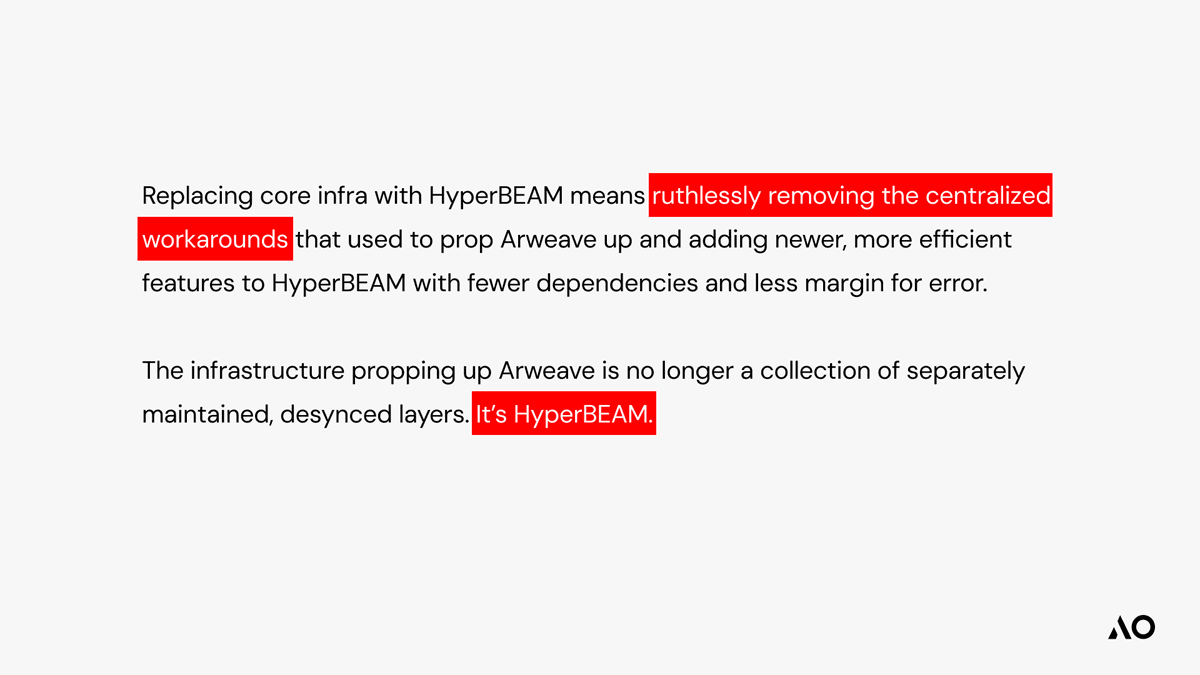
The blockweave is the only source of truth.
Serving it through HyperBEAM is the only way to serve it verifiably.
ao.arweave.net/#/blog/going-c…
English
This was just a small Sunday hack. There are many, many other ways offset resolution could work, too.
For example: why not base36 encode the offsets so that they are shorter? What about block-tx-bundle numbers? Or even time offsets, too?
If you can think of a better system, you can simply build an AO-Core device for it and configure your gateway to use it. Everything is flexible and open now, across the permaweb stack.
English

Arweave gateway addresses have always been long and kind of confusing to read. Part of the reason for this is the security sandbox subdomain each ID needs.
Arweave . net, the main community gateway, is now fully AO-Core native, so we built a simple device to fix this.
Enter offset references: Now all items on Arweave have a short URL as well as an ID. 👇
ao@aoTheComputer
~name@1.0 is here arweave.net now supports short names for transaction IDs based on byte offset. Names you don't need to buy, renew, or assign because they are deterministically created at the protocol level for every new transaction 👇 x.com/aoTheComputer/…
English
🐘🔗 sam.arweave.dev retweetledi
Routers turn AO from a collection of computers -> a decentralized network.
A single gateway -> the gateway mesh.
With the gateway stack migration complete, we're looking at how requests reach the right node. This enables a fully decentralized permaweb.
x.com/aoTheComputer/…
ao@aoTheComputer
English
@CryptosHaven > Arweave competes on something else entirely:
> Permanence.
Arweave offers a backbone for cyberspace. A solid grounding for our fluid world.
English

Most storage networks compete on price and speed.
Arweave competes on something else entirely:
Permanence.
In a world where AI, finance, and institutions depend on data integrity, the ability to store information once, forever is not a feature.
It’s infrastructure.
$AR

English

Just wait until you see how we're leveraging it. World changing proof in the era of Ai fakery. Only possible on AO/HB Arweave.
ao Computer Club@aoComputerClub
This is a big deal. AO is now powering access to data on Arweave, the permanent "hard drive" for our most valued data. When you have decentralized access to decentralized data, you get a powerhouse of information. This is a feat of engineering and opens up a new chapter.
English
@wouter_burrea @ArweaveEco It literally is my life's mission.
English

Big news from @samecwilliams and the @ArweaveEco team. Upgrades an news. These guys are building like it’s their life’s mission. Proud to be a part of this. Keep building !
And some more retail focussed marketing 😉
🐘🔗 sam.arweave.dev@samecwilliams
Huge shift here. Thanks to everyone on the @OdyseeTeam, @dh_association, and @fwdresearch teams who made this possible -- as well as @ar_io_network for all their help in the transition. But what does this shift mean? tl;dr: Arweave dot net now runs on AO-Core. So... 1⃣ Every response from .net is now verifiable, right to the end-user. This is the fundamental building block of decentralization. When you get a reply from an AO-Core node its headers contain everything that you need in order to verify the data atomically. No need for consensus, querying multiple nodes, etc., just fully trustless cryptographic verification. Additionally, all of the useful tags and metadata that have always been attached to content on Arweave is now available to callers. Users can now process this information and act upon it, just like 'body' data. You can think of Arweave as a permanent database, with each item being a row. Now the whole content of each of those rows can be accessed by users, not just the largest field. 2⃣ Data served from .net is now directly sourced from Arweave nodes. Previously, there needed to be caches in between the user and the nodes, which made gateways heavier to run and 'separated' from the dataset. This detachment introduces points of software and operations dependence in the caches themselves. While .net is still importing some of the data from the legacy gateway (and will be over the next few weeks), these caches have now been removed from the data serving flow. This also opens the opportunity for... 3⃣ ...Permissionless nodes operating .net. Because each AO-Core node serves everything needed to verify each response it gives by default, the next step is to let anyone register to provide the data for IDs to the gateway, then verify their responses before relaying them to users. This alone is a big deal. In time we expect it will provide an additional incentive for Arweave miners to serve (and also store) data, as well as improve performance (by routing to and rewarding the fastest providers) and reliability (by removing points of failure). Further down the track there is a clear path to even decentralizing the operation of these verification+routing nodes, so that every Arweaver can take part in running those, too. We can achieve this by letting TEE nodes register with one another and share private TLS credentials, allowing them to directly serve end-user traffic routed by the DNS layer. We have tests of this flow working in principle, but principle -> practice-at-scale will take some time. 4️⃣ Compute-Over-Arweave-Data just dropped. AO-Core is a protocol to orchestrate a decentralized supercomputer. In this deployment we are making heavy use of AO-Core's codec devices, but it is now possible to do so much more than that. More on this soon. Upshot? Decentralization and trustlessness of data access on Arweave just took a huge leap. Trustless verification of content -> Permissionless data serving -> Decentralization of data access and transformation. Congrats again everyone 🫡.
English
Huge shift here. Thanks to everyone on the @OdyseeTeam, @dh_association, and @fwdresearch teams who made this possible -- as well as @ar_io_network for all their help in the transition.
But what does this shift mean?
tl;dr: Arweave dot net now runs on AO-Core. So...
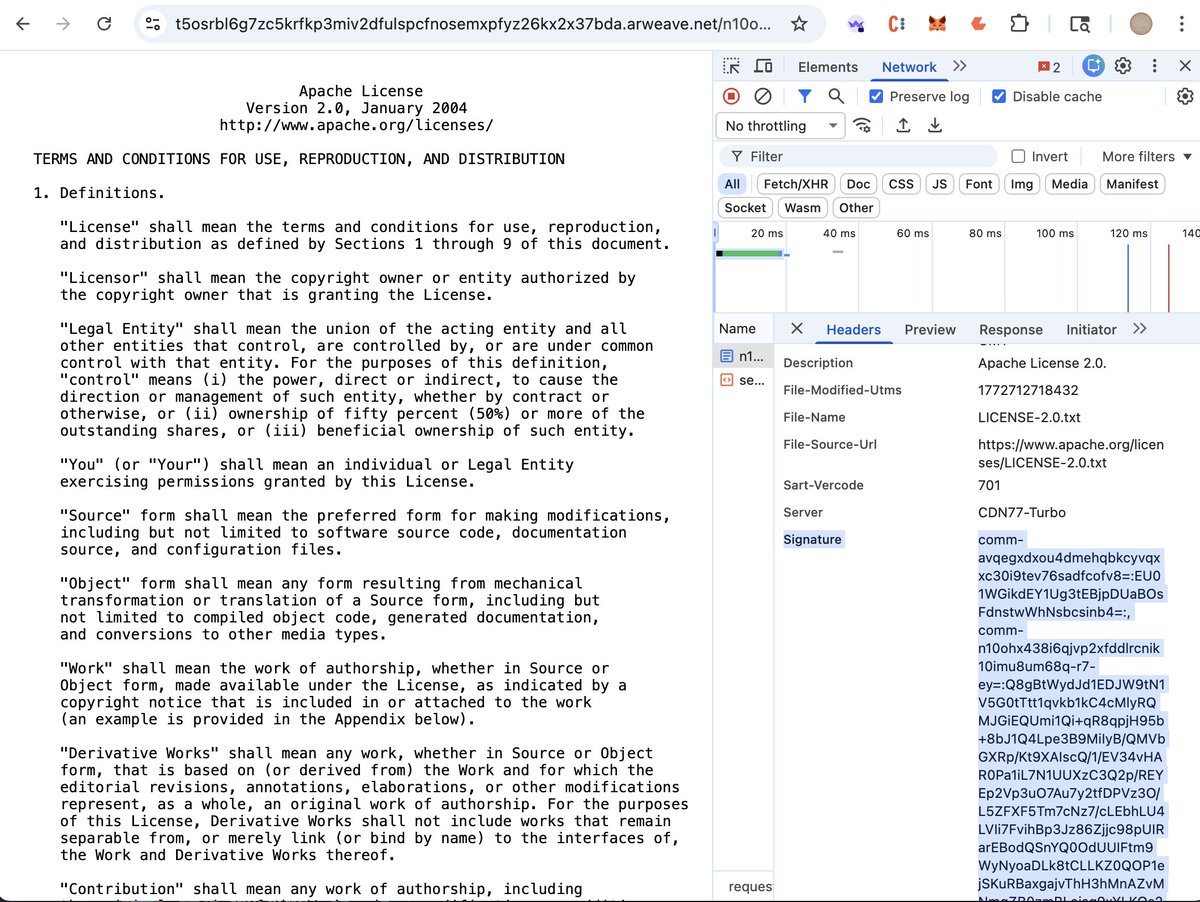
1⃣ Every response from .net is now verifiable, right to the end-user. This is the fundamental building block of decentralization. When you get a reply from an AO-Core node its headers contain everything that you need in order to verify the data atomically. No need for consensus, querying multiple nodes, etc., just fully trustless cryptographic verification.
Additionally, all of the useful tags and metadata that have always been attached to content on Arweave is now available to callers. Users can now process this information and act upon it, just like 'body' data. You can think of Arweave as a permanent database, with each item being a row. Now the whole content of each of those rows can be accessed by users, not just the largest field.
2⃣ Data served from .net is now directly sourced from Arweave nodes. Previously, there needed to be caches in between the user and the nodes, which made gateways heavier to run and 'separated' from the dataset. This detachment introduces points of software and operations dependence in the caches themselves. While .net is still importing some of the data from the legacy gateway (and will be over the next few weeks), these caches have now been removed from the data serving flow. This also opens the opportunity for...
3⃣ ...Permissionless nodes operating .net. Because each AO-Core node serves everything needed to verify each response it gives by default, the next step is to let anyone register to provide the data for IDs to the gateway, then verify their responses before relaying them to users.
This alone is a big deal. In time we expect it will provide an additional incentive for Arweave miners to serve (and also store) data, as well as improve performance (by routing to and rewarding the fastest providers) and reliability (by removing points of failure).
Further down the track there is a clear path to even decentralizing the operation of these verification+routing nodes, so that every Arweaver can take part in running those, too. We can achieve this by letting TEE nodes register with one another and share private TLS credentials, allowing them to directly serve end-user traffic routed by the DNS layer. We have tests of this flow working in principle, but principle -> practice-at-scale will take some time.
4️⃣ Compute-Over-Arweave-Data just dropped. AO-Core is a protocol to orchestrate a decentralized supercomputer. In this deployment we are making heavy use of AO-Core's codec devices, but it is now possible to do so much more than that. More on this soon.
Upshot? Decentralization and trustlessness of data access on Arweave just took a huge leap.
Trustless verification of content ->
Permissionless data serving ->
Decentralization of data access and transformation.
Congrats again everyone 🫡.
Forward Research@fwdresearch
arweave . net has transitioned to HyperBEAM infrastructure. For years permaweb access has been served through gateway infrastructure. Over the past couple weeks we’ve introduced a distributed network of @aoTheComputer HyperBEAM nodes that can serve the same functionality. This removes a major point of centralization in the stack. Requests can now be served by nodes that produce verifiable responses about how data was retrieved and computed. Transitions like this are never perfectly smooth, and some edge cases may still surface as the new system settles. But the direction is clear: arweave . net is now just one entry point into a decentralized network. Thanks to everyone who bore with us through the migration.
English