I built an auth system where you don’t write auth
OIDC + Auth Infra + SDK
→ install
→ add env
→ auth.login()
Done
Handles PKCE, tokens, sessions, roles, logout
You still control routes + access
3 min → production ready auth
oaauth.onrender.com
Watch demo @Hiteshdotcom
🚨 Someone just open-sourced a 2B parameter TTS model that does what ElevenLabs charges $330/month for.
> Zero-shot voice cloning.
> 48kHz studio-grade audio.
> 30+ languages and including 8 Chinese dialects.
So guys , please focus on the communication skills also .
I regretted in the hackthon (missed the 20000 rupees with lack of communication , now I will improve my commutation skills .
I hope you too. ♥️
🚀 Day 5/ 60 GeeksforGeeks X NPCI
Solved today’s Problem of the Day: Union of Arrays with Duplicates
💡 Approach:
Leveraged the Set data structure to handle the union of two arrays efficiently.
Since a Set only stores unique elements, it automatically eliminates duplicates from both arrays.
Iterated through both arrays, inserting all elements into an unordered_set.
Converted the final set back into a result vector/list.
⏱️ Time Complexity: O(n + m)
📦 Space Complexity: O(n + m)
✅ All test cases passed
@geeksforgeeks@NPCI_NPCI#geekstreak60#npci#codinglife#cpp
🚀 Day 4/ 60 – GeeksforGeeks POTD
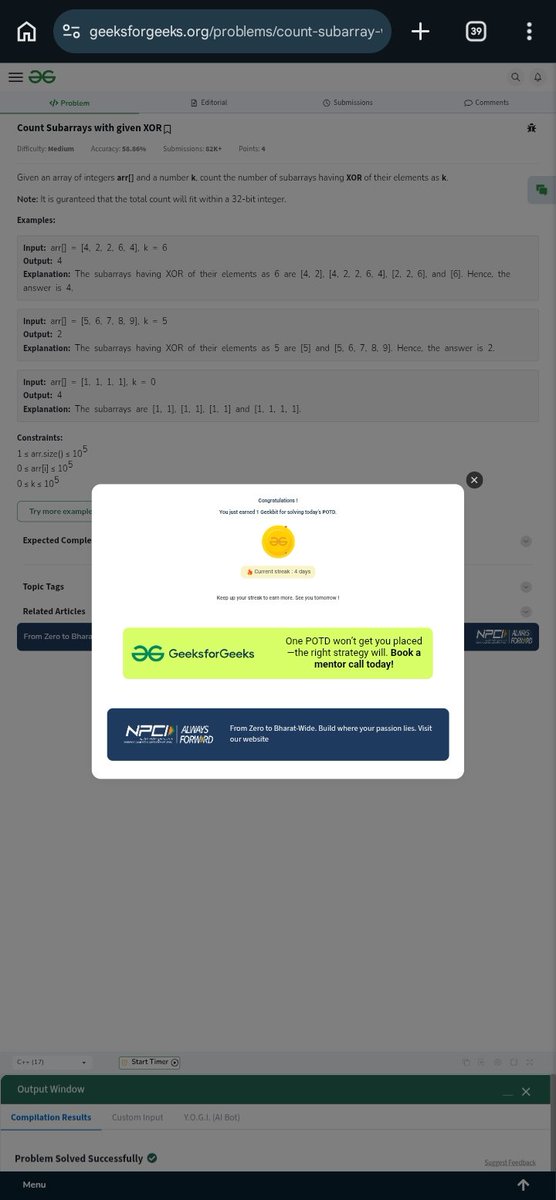
Solved today’s Problem of the Day: Count Subarrays with Given XOR
💡 Approach:
Used Prefix XOR to maintain running XOR of elements
Applied the key property:
If prefixXor ^ k = previousPrefix, then the subarray between them has XOR = k
Stored prefix frequencies using an unordered_map
For every element:
Updated running prefix XOR
Checked how many times (prefixXor ^ k) appeared before
Added that frequency to the answer
Initialized freq[0] = 1 to handle subarrays starting from index 0
⏱ Time Complexity: O(n)
📦 Space Complexity: O(n)
✅ All test cases passed
@geeksforgeeks@NPCI_NPCI#geekstreak60#npci
🚀 Day 3 / 60 – GeeksforGeeks POTD X NPCI
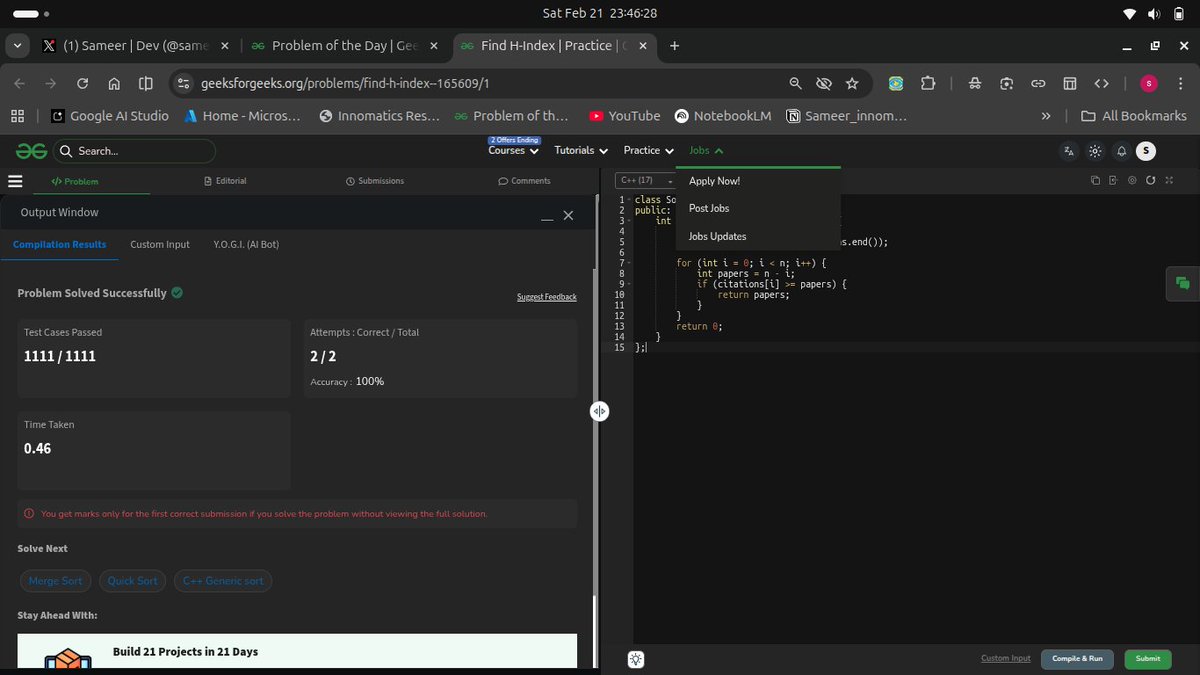
Solved today’s Problem of the Day: Find H-Index
💡 Approach:
Sorted the citations array in ascending order
For each index i, calculated the number of papers with citations ≥ current value
Used the condition:
If citations[i] ≥ (n - i) → valid H found
Returned the maximum possible H
Also explored the optimized O(n) counting approach (without sorting).
✅ All test cases passed
🔍 Key Learning:
H-Index is a threshold problem.
It’s about finding the largest number H such that at least H papers have ≥ H citations.
#geekstreak60#npci@geeksforgeeks@NPCI_NPCI
🚀 Day 1 / 60 – GeeksforGeeks POTD × NPCI
💡 Key Insight :
Normal descending sort doesn’t work.
Instead, compare:
(a + b) vs (b + a)
If (a + b) > (b + a), then a should come first.
That custom comparator makes all the difference.
✅ 1111 / 1111 test cases passed
⚡ Time Complexity: O(n log n)
🎯 Accuracy: 100%
@geeksforgeeks@NPCI_NPCI#geekstreak60#npci
🚀 Day 1 / 60 – GeeksforGeeks POTD × NPCI
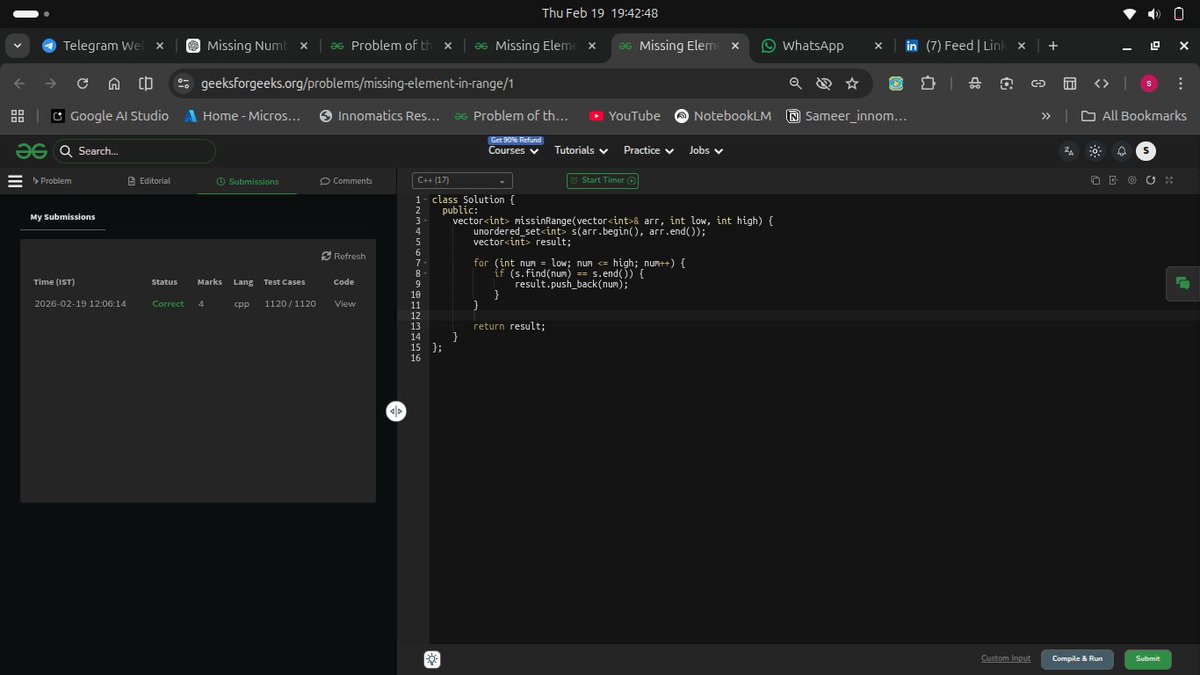
Solved today’s Problem of the Day: Missing Element in Range
💡 Approach:
Used a C++ unordered_set to store array elements for O(1) average lookups
Iterated from low to high
Checked and collected missing values efficiently
✅ 1120 / 1120 test cases passed
@geeksforgeeks and @NPCI_NPCI#geekstreak60#npci