Sami

1.6K posts

Sami banner
Sami

Sami

@samisapient

Bridging Traditional Finance and Digital Assets | Exploring DeFi, Infrastructure & RWA Tokenization

Katılım Nisan 2010
734 Takip Edilen512 Takipçiler
Sami
Sami@samisapient·
The real opportunity for Web3 is not just higher yields. It is giving underserved communities better access to financial markets, better tools, and better education. For Muslim communities, that also means products aligned with their values. That’s why I like what @NawaFinance is building on @ZIGChain - it feels less like another DeFi narrative and more like an actual use case.
English
1
0
3
44
Nawa
Nawa@NawaFinance·
Nawa is being recognized as the new standard for ethical yields. @cryptonews_eng highlights the launch of our USDC vault, including our focus on top-tier security audits and providing a credible alternative to speculative defi. Here is the editorial with the full picture: cryptonews.net/editorial/news…
Nawa tweet media
English
2
1
24
309
yosoymario
yosoymario@yosoymario91·
Average balkan diet is like Breakfast: coffee and cigarette Lunch: coffee and cigarette Dinner: 2kg grilled meat, bread, baklava, 2 liters of rakija from a coca cola bottle with a sprite cap Life expectancy: 90 years
English
376
2.2K
41.7K
1.4M
Sami
Sami@samisapient·
The technical design space is huge, but I think the harder part is not decomposing the instrument itself. It is making sure each separated component still has clear legal enforceability, proper servicing, transparent disclosures and enough investor understanding. Otherwise we may create more tradable risk slices, but not necessarily better capital markets.
English
1
0
1
59
Kayla Phillips
Kayla Phillips@kay_phillips_·
Most tokenized RWAs today are just on-chain copies of tradfi instruments. Same structure, new wrapper. The real opportunity isn't tokenizing the existing bond. It's that the next generation of credit instruments might never *be* a bond in the traditional sense. When you buy a corporate bond, you're forced to buy the full package: credit risk, duration, coupon income, governance rights, liquidity premium, tax treatment. All together, whether you want exposure to all of these individual risks or not. Tradfi built workarounds (CDS, IRS, tranching, securities lending) but they're OTC, institution-only, bolted on after the fact, and come with legal and operational costs. On-chain, these components can be separated at origination. Each piece independently priced and traded from day 1. We've seen some of this with crypto-native assets in defi: - Pendle: yield vs. principal - Strata & Royco: senior vs. junior credit - Cork: depeg risk as a tradable instrument But not yet for tokenized RWAs. This is where the real white space is: 1. Decomposing assets tradfi never could. Tokenized private credit where each loan's credit risk, prepayment risk, and coupon stream trade separately from issuance. Real estate where rental income, appreciation rights, and governance over property decisions are three distinct tokens. Music royalties where mechanical, performance, and sync rights are independently priced. 2. Programmable, dynamic (de)composition. On-chain, a position can start out bundled, automatically separate into credit + duration + yield exposures when it crosses a threshold, and recombine on redemption. No tradfi settlement layer can do this. 3. Retail access to institutional-only markets. Democratized access to these markets for the first time -> more participants & better price discovery. 4. Risk markets that have no tradfi equivalent. What's the swap on a defi protocol's solvency? On a stablecoin's reserve composition changing? On a specific oracle going offline? These don't exist in tradfi because the underlying risks don't exist there. --- The companies positioned for this don't exist in robustness or scale yet. To the founders wondering what role they can play in this next chapter of institutional defi, I'd look here. If you're building in this space, lets chat. My DMs are open.
English
14
2
54
5.3K
Sami
Sami@samisapient·
The equation is simple: Tokenized assets need tokenized collateral. Tokenized collateral needs financing markets. Financing markets need digital cash settlement. And all of that needs privacy and regulatory controls. Not just tokenization as a product, but tokenization as capital markets infrastructure.
English
0
0
3
125
Sami
Sami@samisapient·
SME financing is such an underrated RWA use case at all. And this is not only relevant for the Middle East. Europe has an estimated SME credit gap of up to €365bn per year, while the broader investment gap is even larger. Connecting real businesses with global liquidity through compliant onchain infrastructure could be a big unlock.
English
0
0
4
102
ZIGChain
ZIGChain@ZIGChain·
There’s a $250 billion SME funding gap across the Middle East. For more than a decade, @beehiveFintech has been building the infrastructure to close it, evolving from a peer-to-peer lending platform in 2012 into one of the region’s most established regulated lenders. The next phase of that growth is global. ZIGChain brings the distribution layer, giving Beehive access to DeFi liquidity pools and global capital markets that were previously out of reach, all within the infrastructure and regulatory framework needed to scale sustainably. Philipp Caspers Pabst (@phil_cp) from ZIGChain’s Global Markets team on why this partnership is the natural next step 👇
English
19
16
125
3.9K
Sami
Sami@samisapient·
Big step forward. Tokenized stocks had zero governance layer. Now @Broadridge is plugging proxy infrastructure directly into @OndoFinance's 250+ tokens. Not perfect - holders express preferences, the issuer still votes. But the direction is right and the plumbing is getting serious. Full announcement in the comments 👇
Sami tweet media
English
4
3
38
1.5K
BULL.ZIG
BULL.ZIG@bull_zig·
My brother @ARafayGadit summed up private credit as "yeild streaming"... and I love him for it but between that spelling and the 20 telegram groups still asking "what is private credit" I felt like breaking it down today. Private credit is just lending money without a bank in the middle. Businesses need cash, banks say no, and private lenders step in. The borrower gets funded, the lender earns interest for taking that risk. Well, why does it pay more than your savings account? Because the risk is higher and your money is usually locked up longer, that's the tradeoff. For decades this was a elite people game. You needed serious capital to get in, your money was locked for years, you couldn't sell your position easily, and once you were in you were basically flying blind. Worked great for the elite but everyone else? Door was closed. Not anymore with tokenization. Tokenization doesn't change what private credit is. The loans are still real, the contracts are still legal and borrowers still make repayments. What changes is, no minimum $ amount to invest and how ownership is tracked. On the blockchain instead of through paperwork and back office systems nobody can see into. Same loan, upgraded rails. But here's what tokenization can't do: remove risk. If borrowers stop paying, you take losses. If everyone rushes for the exit at once, liquidity dries up. The tech doesn't protect you from bad loans and probably never will. So before you start slamming dollars into any private credit product ask some questions: Who is borrowing? How are the loans backed? How do you get your money back? Why does the yield exist? Private credit isn't hype, it's one of the largest lending markets in the world moving onto better infrastructure. Quoting ARG: “Private credit, will be THE biggest thing to watch. I wouldn’t be surprised if 50% of private credit is tokenized by 2032” That's why so many r talking about it, and that's why you should actually understand it before you ape in. ~ Bull. ZIG
Abdul Rafay Gadit@ARafayGadit

@ZeusRWA Real estate might eventually happen but in a very very different shape and form PC is like yeild streaming.. people love that thing 👀

English
13
9
83
3.1K
Sami
Sami@samisapient·
Agree with the core point: information sensitivity will be one of the main sorting mechanisms for tokenized assets. Sensitive institutional flows need privacy by design, not as an afterthought. But that doesn’t make public chains irrelevant for RWAs. More likely, we will see a dual-rail market: privacy-focused infrastructure for institutional flows, and public chains for retail access, distribution, composability and broader participation. This is also where custodians may become important again as connectivity, compliance and settlement bridges across different DLT environments.
English
0
0
0
141
RWA Llama 🦙
RWA Llama 🦙@RwaLlama·
🏦 @BlackRock just filed for two new tokenized money market funds. Not extensions of BUIDL. Two separate products, different TAs, different chains, different buyers. I read both SEC filings. The details change the picture. 🧵
English
4
2
17
1.9K
Sami
Sami@samisapient·
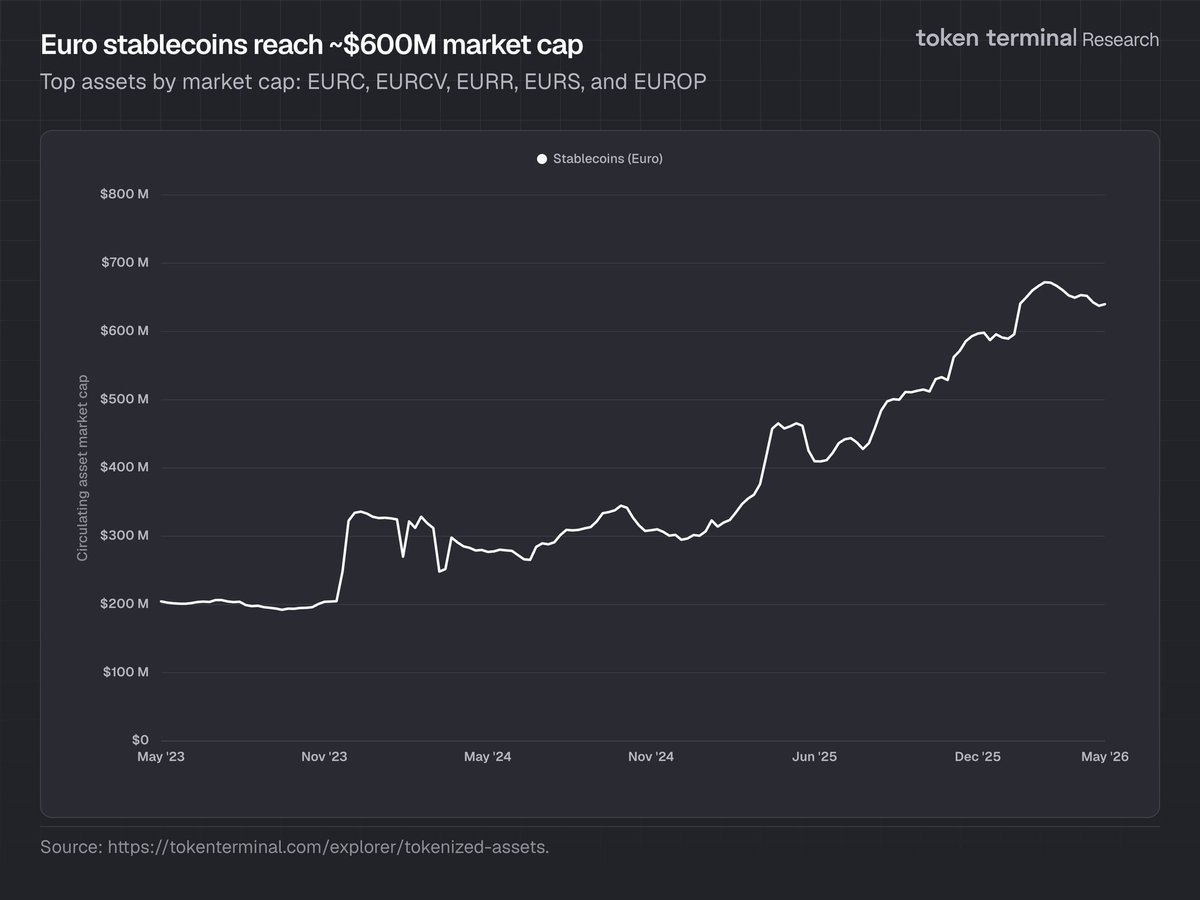
I do think non-USD stablecoins will come, but probably not at the same scale as USD stablecoins. For Europe, the main hurdles are still e-money regulation and the uncertainty created by the ECB around a potential retail digital euro. If a state-backed retail EUR really becomes a priority, it would be hard for private issuers to compete. That said, there are promising initiatives like Qivalis, where 11 banks are working on a euro stablecoin. Maybe that is exactly what is needed to increase trust and adoption.
English
0
0
0
31
Zeus 🇬🇧
Zeus 🇬🇧@ZeusRWA·
We all know how dominant USD stablecoins are. They’ve become the default currency of crypto. But it does make you wonder… is there actually a big future for non-USD stablecoins, or is the market already decided? Use cases would include > Local payments > FX settlement > Regional trade > Reducing USD dependence > Bringing local currencies onchain Chart of euro Stablecoins via @tokenterminal
Zeus 🇬🇧 tweet media
English
13
7
66
4K
Sami
Sami@samisapient·
Exactly. And this is also what makes valuation in crypto so difficult. In traditional markets, prices are also driven by expectations, but those expectations are usually anchored in clearer ownership rights, cash flows or residual economic claims. In crypto, tokens often play several roles at once: utility asset for using the network, proxy for expected protocol growth, governance instrument and speculative asset driven by narratives and liquidity. So even if a chain has real usage and economic activity, the hard question is how much of that value actually accrues to the token. Without that link, activity alone does not automatically translate into sustainable token value.
English
0
0
0
19
Abdul Rafay Gadit
Abdul Rafay Gadit@ARafayGadit·
@samisapient yes so its the more advanced level of the same problem. Even most L1s have this problem, the economic activity isnt passed on properly
English
1
0
7
102
Abdul Rafay Gadit
Abdul Rafay Gadit@ARafayGadit·
In your view, what is the most broken thing in the world of crypto? For me, most tokens not getting benefit of the underline economic activity & growth is a self inflicting failure! Have your say?
GIF
English
21
10
85
3.7K
Sami
Sami@samisapient·
@Ucan_Coin Totaly agreee. The endgame is not that everyone talks about blockchains. The endgame is that nobody has to!
English
0
0
0
26
𝖀𝖈𝖆𝖓
𝖀𝖈𝖆𝖓@Ucan_Coin·
We’ve talked a lot recently about RWAs, stablecoins and on-chain finance. How capital is starting to move how financial systems are slowly shifting on-chain and how this is changing the underlying infrastructure But there’s still something I think most people are missing. The real shift might only become obvious when people stop saying “I’m using on-chain finance” at all. Right now, most of this is still treated like a “technology layer”. People talk about which chain, which protocol, which on-chain settlement layer. That’s still where most of the discussion sits. But over time, I don’t think any of that will matter to the end user. It will just fade into the background. Like the internet did. Nobody thinks about which protocol is running when they send an email. Nobody really asks how settlement works when money moves through a system. People only care about one thing did it work or not I think on-chain finance is slowly moving in the same direction. People will just expect money to move on-chain. Not how it happens. Not what system is running in the background. Just that it works. And this shift isn’t random. The growth of RWAs, stablecoins becoming a payment layer and capital steadily moving into on-chain systems are all pushing this forward. Because the more something gets used, the less visible the infrastructure becomes. But there’s a point here that matters. This doesn’t just make the system more efficient. It shifts where value actually sits in the market. Because invisible systems don’t disappear. They usually become the system itself. And in the end, the winners are not the most talked about ones, but the least visible but most essential layers that actually keep the system running. And maybe the clearest truth is this: The more invisible a system becomes, the more irreplaceable it becomes.
English
33
4
124
8.5K
Sami
Sami@samisapient·
A lot of people still frame tokenization as a pure blockchain problem, while in reality much of the challenge is operational coordination between existing financial market participants. Custodians are likely to play a much bigger role than many expect. As digital securities evolve, they increasingly become the bridge between traditional market infrastructure and onchain environments by managing settlement paths, compliance, safekeeping, and connectivity to digital rails. If that interoperability layer is solved well, fragmentation decreases and liquidity can finally move more seamlessly across ecosystems.
English
0
0
0
16
sebby_d
sebby_d@sebbydavies·
@samisapient The part people underestimate is how much "infrastructure" in RWAs is actually just workflow management. If custodians can bridge the gap between transfer agents and on-chain registries, we finally solve the fragmented liquidity problem.
English
1
0
1
44
Sami
Sami@samisapient·
Interesting discussion. One thing that may happen over time is that custodians increasingly become the coordination layer between issuers, transfer agents, investors, and multiple chains. Since many already perform TA-related functions today, they may ultimately support several compliance models in parallel rather than the market converging on a single approach.
English
0
0
0
12
Sami
Sami@samisapient·
Excellent deep dive on one of the most important questions in tokenized finance: how compliance works across chains. Highly recommended read for anyone following RWAs, institutional adoption, and cross-chain infrastructure 👇
RWA Llama 🦙@RwaLlama

x.com/i/article/2036…

English
2
0
14
675