
Samharison retweetledi
Samharison
496 posts

Samharison
@samx_sm
The way of innovation is a direction of development @earth
Katılım Ağustos 2024
278 Takip Edilen23 Takipçiler

Samharison retweetledi

STARSHIPS WERE MEANT TO FLY
Truthful🛰️@Truthful_ast
NICKI MINAJ JUST SHOWED UP ON THE STARSHIP STREAM???
English
Samharison retweetledi

Starship can reach Mars.
But stainless steel mass makes return impossible.
And now TeraFab’s orbital AI compute is becoming the enabling layer that closes the gap.
The moment you attempt a crewed round-trip, you need:
• 2,400 metric tons of ISRU propellant on the Martian surface
• Structural mass trimmed by microns across millions of design permutations
• Radiation-hardened autonomy that survives years in deep space
• First-wave construction before any humans arrive
• Launch cadence that collapses cost to ~$100/kg
TeraFab is evolving into the silicon backbone for true multiplanetary capability.
- $119B Texas facility producing 1 terawatt of custom silicon per year
- 80% radiation-hardened D3 chips powering orbital simulation clusters
- Millions of Starship variants digitally flown in weeks
- 20% AI5 edge chips for Optimus legions that build propellant plants
- 135 Starship flights/day delivering orbital compute
- Revenue loop that self-funds the Mars fleet
This is much bigger than “just a chip factory”
It’s the bridge that turns an engineering impossibility into a scheduled logistics problem and moves manufacturing off Earth’s gravity well forever.
English
Samharison retweetledi

SpaceX is such a bad ass company. In their IPO filing, they wrote this:
• The first private company to develop and launch a liquid-fuel rocket to reach orbit (2008)
• The first private company to successfully dock a private spacecraft with the International Space Station (2012)
• The first to successfully propulsively land (2015) and refly orbital-class rocket boosters (2017)
• The first to begin deploying a large-scale LEO broadband satellite constellation (2019);
• The first private company to transport astronauts to orbit, returning America's ability to fly astronauts to and from the International Space Station (2020)
• The first to manufacture consumer-grade phased-array user terminals at scale (2022);
The first to deploy a large-scale LEO satellite-to-mobile constellation (2025)
• The first to build a gigawatt-scale Al training cluster and largest coherent supercomputer (2026)
• The first gigawatt-scale Megapack battery installation (2026); and
• The only company capable of building orbital AI compute at scale.
BOOM.


English
Samharison retweetledi

Samharison retweetledi


Samharison retweetledi

Samharison retweetledi

Starlink is boldly extending its network all the way to the Moon!
They're building a Lunar Relay Shell linked to low Earth orbit satellites for high-speed internet on the lunar surface
This will deliver blazing gigabit speeds for rovers, habitats & astronauts on future missions
English
Samharison retweetledi
Samharison retweetledi
Samharison retweetledi

The all black paint on the base looks cool
øtherside🚀@otherside_X42
insane to see side by side
English
Samharison retweetledi
Samharison retweetledi

Samharison retweetledi

Silver Swan Automaton… no motors, built in 1773 and still working perfectly.
The Silver Swan is powered entirely by mainsprings and brass clockwork gears.
Why did we stop creating such elegant engineering and beautiful pieces of art… timeless and built to last?
English
Samharison retweetledi
What if Your Neural Network Was Forced to Obey Physics?
Physics-Informed Neural Networks (PINNs) are neural networks trained to satisfy a differential equation by building the PDE residual directly into the loss. They emerged from a very practical problem...classical PDE pipelines can be brilliant, but they often demand heavy discretization work (meshes, stencils, stability tuning), and the method you build is usually tied to one geometry and one solver setup. A PINN flips the workflow by representing the solution itself as a smooth function uᵩ(x,t) and enforcing the physics everywhere you choose to sample the domain.
People often meet PINNs in the least helpful way...via a flashy solution plot, and almost no explanation of what was enforced to get it.
In this series we keep the enforcement visible. We pick a differential equation, represent the unknown solution as a flexible function, measure how well that function satisfies the equation across the domain, and train it to reduce that mismatch everywhere we sample.
A normal neural net learns from labels...you give it inputs and target outputs. A PINN learns from a differential equation...you give it inputs (x,t) and it gets punished whenever its output fails the PDE.
By punish we mean that the loss increases when the mismatch is large we reward it if the loss decreases as the mismatch gets smaller.
The network isn’t replacing physics, it’s becoming a flexible function that is forced to satisfy the same calculus you’d impose on any candidate solution.
The math breakdown:
We start with a PDE we want to solve on a domain Ω. Write it as
uₜ(x,t) + N(u(x,t), uₓ(x,t), uₓₓ(x,t), …) = 0 for (x,t) in Ω
A PINN replaces the unknown function u with a neural network output
uᵩ(x,t)
Now define the physics residual by plugging uᵩ into the PDE
rᵩ(x,t) = ∂uᵩ/∂t + N(uᵩ, ∂uᵩ/∂x, ∂²uᵩ/∂x², …)
If uᵩ were an exact solution, we would have rᵩ(x,t) = 0 everywhere.
We may also have data points (xᵢ,tᵢ,uᵢ) from measurements or a known initial condition. The training objective is just a weighted sum of squared errors
L(ᵩ) = L_data(ᵩ) + λ L_phys(ᵩ) + L_bc/ic(ᵩ)
with
L_data(ᵩ) = meanᵢ |uᵩ(xᵢ,tᵢ) − uᵢ|²
L_phys(ᵩ) = meanⱼ |rᵩ(xⱼ,tⱼ)|² where (xⱼ,tⱼ) are the collocation points in Ω
L_bc/ic(ᵩ) = penalties enforcing boundary conditions and initial conditions
The key technical step is that the derivatives inside rᵩ are computed by automatic differentiation
∂uᵩ/∂t, ∂uᵩ/∂x, ∂²uᵩ/∂x², …
So we can differentiate the total loss L(ᵩ) with respect to ᵩ and train with gradient descent.
This is the whole idea behind PINNs. Learn a function, but make the PDE part of the loss, so the network is trained to be a solution, not just a curve-fitter.
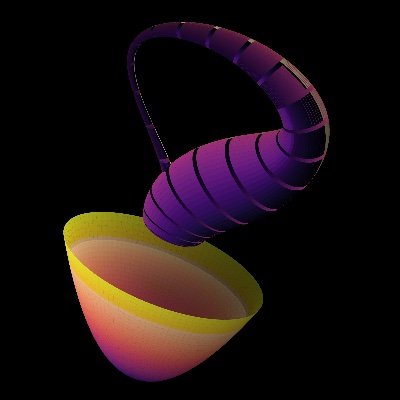
In the render, the main 3D surface is the network’s current guess uᵩ(x,t), drawn as a living sheet over the (x,t) plane. Hovering above is the neural scaffold...a visible graph of feature nodes and connections. The bright tension threads are the physics residual rᵩ(x,t): each thread tethers a collocation bead on the sheet up to the scaffold, and it thickens and brightens exactly where |rᵩ| is large (color encodes the sign). As training runs, those threads go slack across the domain not because we hid the error, but because the network has actually been pushed toward rᵩ(x,t) ≈ 0.
#PINNs #PhysicsInformedNeuralNetworks #ScientificMachineLearning #PDE #DifferentialEquations #Optimization #MachineLearning #AppliedMath #ComputationalPhysics
English
Samharison retweetledi

Samharison retweetledi
Samharison retweetledi
Starship launch next week!
SpaceX@SpaceX
Starship’s twelfth flight test will debut the next generation Starship and Super Heavy vehicles, powered by the next evolution of the Raptor engine and launching from a newly designed pad at Starbase. The launch is targeted as early as Tuesday, May 19 → spacex.com/launches/stars…
English
Samharison retweetledi

NASA’s #MissionToPsyche – on its way to explore a rare, metal-rich asteroid – is about to get a speed boost from Mars. 🚀🏁
On May 15, spacecraft will harness the Red Planet’s gravitational pull as a slingshot to increase its speed and adjust its trajectory. 1/2
English
Samharison retweetledi
