Sayan De

9.9K posts

Sayan De banner
Sayan De

Sayan De

@sayandedotcom

Full Stack AI Developer | Expertise in Full-Stack・AI・DevOps・Microservices・Cloud | Opinions are my own

[email protected] Katılım Haziran 2020
1.3K Takip Edilen349 Takipçiler
Sabitlenmiş Tweet
Sayan De
Sayan De@sayandedotcom·
📢Hey Everyone, I am excited to unveil my SaaS tweakleaf.com first product demo video 📽️! Your feedback needed! Tweak your LaTeX resumes and cover letters with AI Agents with Tweakleaf ! Launched 28th Oct, and has ~250 DAU
English
3
2
12
5.2K
Sayan De
Sayan De@sayandedotcom·
Chat Automation Platform: an "AI-Powered Tool Orchestration via Autonomous Agents." [ 20+ MCP ] Tech Stack:- Next.js 16, React 19, TailwindCSS, Express, tRPC, FastAPI, LangGraph, LangChain, MCP, PostgreSQL, Prisma, Docker, AWS • Architected a full-stack monorepo with a real-time chat interface using Next.js 16 / React 19 frontend and Express/tRPC backend, enabling seamless bidirectional communication. • Engineered an autonomous AI agent system using LangGraph with Plan → Route → Execute pattern, dynamically orchestrating 20+ MCP tools to execute complex multi-step workflows. • Reduced LLM token consumption by 90% through intelligent context management, implementing selective tool binding and conversation state pruning. • Achieved 80% faster response times by implementing smart model routing and prompt compression, dynamically selecting LLMs based on task complexity. • Decreased hallucinations by implementing a Human-in-the-Loop (HITL) system with state-based approval workflows for safe execution of critical actions. • Ensured 99.9% system uptime by deploying production infrastructure on AWS EC2 with automated CI/CD pipelines and containerized microservices. Demo Working:- youtu.be/QBlWBrueJYA?si… Code:- github.com/sayandedotcom/… Engineering Blog:- sayande.hashnode.dev/building-an-au…
YouTube video
YouTube
English
0
0
0
160
Pratham
Pratham@insanekrishnaa·
HIRING | Software Engineer – Fully Remote at Mercor | Remote (India) | $50 to $70/hour is hiring Enterprise Software Engineers to work with some of the world’s leading AI research labs and frontier technology teams. Backed by names like Peter Thiel, Jack Dorsey, Adam D’Angelo, Benchmark, and General Catalyst, Mercor is building one of the fastest growing talent networks in AI and engineering. This role is ideal for engineers who love solving hard production problems across multiple languages, systems, and architectures. What You’ll Work On • Enterprise engineering tasks across large scale production systems • Toolchains and systems programming using C and Rust • JVM ecosystem engineering with Kotlin, Scala, Swift, and C# • Production scripting and backend optimization with Ruby, PHP, and Perl • Scientific and quant computing workflows using R • Performance optimization, edge cases, and system design tradeoffs Why This Opportunity Stands Out • Fully remote contract role • $50 to $70/hour compensation • Work directly with frontier AI labs and research teams • Exposure to real world large scale engineering problems • Strong focus on deep technical reasoning and production quality systems What They’re Looking For • Strong expertise in at least one major programming domain • Deep understanding of systems, tooling, and language internals • Ability to reason about scalability, performance, and architecture decisions • Engineers who can work independently and asynchronously If you’re a strong backend, systems, JVM, infra, or low level engineer looking to work on globally impactful AI aligned projects, this is a serious opportunity. Interested candidates can directly reply to this post, and the application link will be shared in your DM 👇🏻 Don’t forget to follow before replying so I can continue sharing more high quality opportunities directly with you.
Pratham tweet media
English
24
1
48
4K
Sayan De
Sayan De@sayandedotcom·
> be Andrej Karpathy > born in Slovakia, move to Canada at 15 > start coding at 15. instantly obsessed > become YouTube famous... for Rubik's cube tutorials > get PhD at Stanford under Fei-Fei Li > co-found this tiny startup called OpenAI > Elon calls you "arguably #2 in computer vision in the world" > go build Tesla Autopilot for 5 years > leave. come back to OpenAI. leave again > coin the term "vibe coding" casually in a tweet > it ends up in the New York Times > build an AI education company > 9.3M people watch your next move Today he joined Anthropic to lead pretraining research. The man never stops.
Andrej Karpathy@karpathy

Personal update: I've joined Anthropic. I think the next few years at the frontier of LLMs will be especially formative. I am very excited to join the team here and get back to R&D. I remain deeply passionate about education and plan to resume my work on it in time.

English
0
0
1
68
Marcia Ong
Marcia Ong@Marcia_Ong·
Anyone knows a cracked frontend focus full stack AI enabled dev? I’m doing exploratory search 👀 Salary can up to 10k+/m
English
48
0
52
5.4K
Ayush Singh
Ayush Singh@ayusingh693·
I need AI Full Stack developers to connect.
English
18
0
14
912
NestJS Forge | Jatin
NestJS Forge | Jatin@jatingupta9905·
I got a call from HR regarding a Full Stack Developer opening. They’re specifically looking for someone based in Kolkata since the interview process is inoffice. Sharing this within my network in case anyone is currently looking for an opportunity around kolkata. All the best
English
1
0
8
930
Sayan De
Sayan De@sayandedotcom·
Depressed !! After building projects, Senior Devs, I am still struggling to get interview calls. 😢☹️ Up for Full Stack AI Engineer role ! I don't like my current job!
Sayan De@sayandedotcom

Hey network! 👋 I’m currently looking for a Full Stack AI Engineer role, preferably something heavily focused on AI systems, agents, orchestration, or applied LLM workflows. I’ve previously worked with funded startups, built production-grade AI systems, and have also been in interview loops with YC startups. Most of my work has been around shipping end-to-end products across AI, backend systems, and modern full-stack development. What I’m looking for: • AI-heavy engineering roles • AI agents / multi-agent systems • LLM infrastructure & workflows • Full-stack AI product development • Fast-moving startup teams with high ownership A Project to pitch to you? My best Project is: Chat Automation Platform: an "AI-Powered Tool Orchestration via Autonomous Agents." [ 20+ MCP or 80+ tools ] Tech Stack:- Next.js 16, TailwindCSS, Express, tRPC, FastAPI, LangGraph, LangChain, MCP, PostgreSQL, Prisma, Docker, AWS • Architected a full-stack monorepo with a real-time chat interface using Next.js 16 / React 19 frontend and Express/tRPC backend, enabling seamless bidirectional communication. • Engineered an autonomous AI agent system using LangGraph with Plan → Route → Execute pattern, dynamically orchestrating 20+ MCP tools to execute complex multi-step workflows. • Reduced LLM token consumption by 90% through intelligent context management, implementing selective tool binding and conversation state pruning. • Achieved 80% faster response times by implementing smart model routing and prompt compression, dynamically selecting LLMs based on task complexity. • Decreased hallucinations by implementing a Human-in-the-Loop (HITL) system with state-based approval workflows for safe execution of critical actions. • Ensured 99.9% system uptime by deploying production infrastructure on AWS EC2 with automated CI/CD pipelines and containerized microservices. Demo Working:- youtu.be/QBlWBrueJYA?si… Code:- github.com/sayandedotcom/… Engineering Blog:- sayande.hashnode.dev/building-an-au… My DMs are open..
English
0
0
0
84
Sayan De
Sayan De@sayandedotcom·
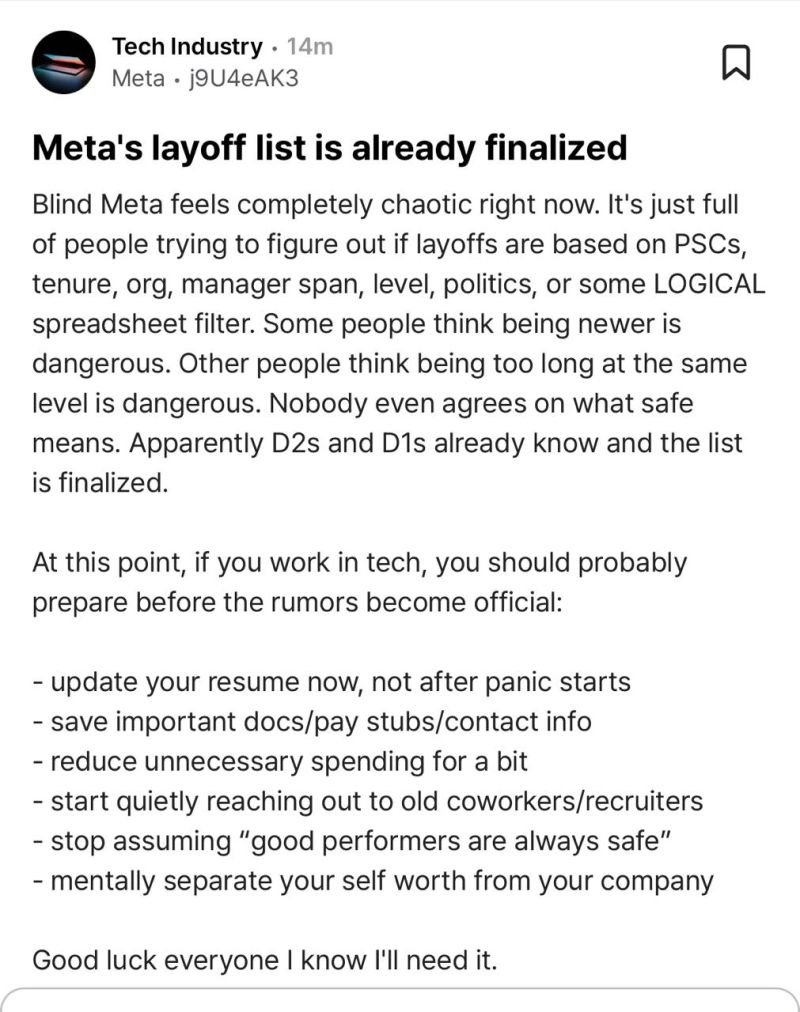
Meta's layoff list is already finalized. According to a Blind thread from someone inside Meta, the list is done. D2s and D1s already know. People are scrambling to figure out if the cuts are based on performance scores, tenure, org structure, level, or just some spreadsheet logic that nobody fully understands. The layoffs are expected to hit around May 20. Roughly 8,000 people. But here is what I want to talk about. Not Meta specifically, but the part that nobody pays attention to until it is too late. Layoffs do not happen overnight. They are planned weeks, sometimes months in advance. And if you pay attention, the signals are usually there before the announcement. Here is what those signals look like: → Your skip-level suddenly wants to "understand what everyone is working on." → Meetings about team structure start showing up on calendars that never had them before. → Hiring freezes in your org while other teams keep growing. → Your manager gets quieter than usual, or starts being unusually nice. → Projects you were leading get "reprioritized" or merged into something else. → Reorgs get announced with vague language about "streamlining" and "focusing on high-impact work." → Senior leaders start leaving, and nobody replaces them. None of these guarantees a layoff. But when you see three or four of them happening at the same time, that is not a coincidence. That is a pattern. The mistake most people make is assuming that good performance protects them. It does not. Layoffs are not performance reviews. They are spreadsheet exercises. Entire teams get cut because the business decided to move in a different direction. Your rating does not override a budget decision. So if you are seeing these signals at your company right now, do not wait for the calendar invite from HR to start thinking about what is next. The best time to prepare is when you still have a job, a paycheck, and the emotional bandwidth to think clearly. Not the morning after. Repost this to help others. P.S. If you have been impacted by layoffs or struggling to land interviews in this market, DM me. Let's build a plan that gets you hired in the next 90 days.
Sayan De tweet media
English
0
0
1
1K
Yuan (Terry) Tang
Yuan (Terry) Tang@TerryTangYuan·
The job market is tough right now, especially for new graduates and talented people impacted by layoffs. I have several free 2-month LinkedIn Premium invites available, and I’d love to share them with people who could genuinely benefit from the extra visibility, networking tools, and learning resources. If you’re: • searching for a new role • exploring a career pivot • or figuring out your next step Comment below or send me a message, and I’ll make sure these go to good use. Also if you know someone who could use this, tag them or repost to help more people see it. #JobSearch #CareerGrowth #LinkedInPremium #Networking #OpenToWork #Layoffs #OpenRoles #TechJobs #EngineeringJobs #GrowthOpportunities #HiringTalent #CFBR #Hiring #WereHiring #NowHiring #JoinOurTeam #JobOpening
English
25
2
26
2.7K
Sayan De
Sayan De@sayandedotcom·
Thanks for the response and the reach-outs!! I’m specifically interested in AI-focused engineering roles rather than purely traditional full-stack, Front-End, or Backend development. I’m especially excited about roles that combine full-stack engineering with building AI-powered systems, including AI Agents, RAG architectures, vector databases, LLM applications, agentic workflows, embeddings, prompt engineering, fine-tuning, AI automation, and scalable AI infrastructure. Would love to explore opportunities aligned with that space. My Resume:- drive.google.com/file/d/1PS-72m… My GitHub:- github.com/sayandedotcom My Blogs:- sayande.hashnode.dev Thanks !!!
Sayan De@sayandedotcom

Hey network! 👋 I’m currently looking for a Full Stack AI Engineer role, preferably something heavily focused on AI systems, agents, orchestration, or applied LLM workflows. I’ve previously worked with funded startups, built production-grade AI systems, and have also been in interview loops with YC startups. Most of my work has been around shipping end-to-end products across AI, backend systems, and modern full-stack development. What I’m looking for: • AI-heavy engineering roles • AI agents / multi-agent systems • LLM infrastructure & workflows • Full-stack AI product development • Fast-moving startup teams with high ownership A Project to pitch to you? My best Project is: Chat Automation Platform: an "AI-Powered Tool Orchestration via Autonomous Agents." [ 20+ MCP or 80+ tools ] Tech Stack:- Next.js 16, TailwindCSS, Express, tRPC, FastAPI, LangGraph, LangChain, MCP, PostgreSQL, Prisma, Docker, AWS • Architected a full-stack monorepo with a real-time chat interface using Next.js 16 / React 19 frontend and Express/tRPC backend, enabling seamless bidirectional communication. • Engineered an autonomous AI agent system using LangGraph with Plan → Route → Execute pattern, dynamically orchestrating 20+ MCP tools to execute complex multi-step workflows. • Reduced LLM token consumption by 90% through intelligent context management, implementing selective tool binding and conversation state pruning. • Achieved 80% faster response times by implementing smart model routing and prompt compression, dynamically selecting LLMs based on task complexity. • Decreased hallucinations by implementing a Human-in-the-Loop (HITL) system with state-based approval workflows for safe execution of critical actions. • Ensured 99.9% system uptime by deploying production infrastructure on AWS EC2 with automated CI/CD pipelines and containerized microservices. Demo Working:- youtu.be/QBlWBrueJYA?si… Code:- github.com/sayandedotcom/… Engineering Blog:- sayande.hashnode.dev/building-an-au… My DMs are open..

English
1
0
3
283
Sayan De
Sayan De@sayandedotcom·
A man once sent over $100M in fake invoices to Google and Facebook. Random miscellaneous business expenses. Completely fraudulent. And somehow... Every single invoice got paid. He kept the scheme running for years by impersonating a legitimate hardware vendor and sending realistic invoices through email. No hacking. No malware. Just social engineering and broken internal processes. Eventually the operation collapsed and he was arrested for fraud. One of the craziest reminders that sometimes the biggest security vulnerability isn’t technology. It’s humans.
Sayan De tweet media
English
0
0
0
41
Sayan De
Sayan De@sayandedotcom·
I was searching for AI jobs recently, and honestly, the hiring market needs a serious reality check. Almost every second job post wants: an ML Engineer, a Data Engineer, a Data Scientist, a GenAI Engineer, a Backend Engineer, sometimes even a DevOps Engineer… ALL in one person. And then they simply call it: “AI Engineer” On top of that, many of these job posts ask for years of Generative AI experience. How is that even possible? Mainstream Generative AI only became widely adopted around 2022. Frameworks like LangChain, modern RAG pipelines, AI agents, MCP workflows, multimodal systems etc all of this is still relatively new. So where exactly are engineers supposed to get years of GenAI experience from? Build ChatGPT during school? This hiring trend is becoming absurd. Junior engineers and freshers are spending months: building AI applications, deploying models, understanding inference and RAG, working with FastAPI, Redis, Kafka, async systems, experimenting with agentic AI frameworks only to get filtered out by impossible requirements written by people who often don’t understand the timeline of the technology itself. The harsh reality is: GenAI is moving so fast that a developer actively building AI systems for the last 1–2 years can be more relevant than someone with 10 years of traditional software experience but zero exposure to modern AI infrastructure. Companies say: “There’s a shortage of AI talent.” But then create job descriptions that eliminate the very people who are actually learning and building in this space. At this point, some job posts feel less like hiring requirements and more like science fiction.
Sayan De tweet media
English
2
0
2
224
Marcia Ong
Marcia Ong@Marcia_Ong·
Glad that I did my part, onboarded my whole family to Claude. Yes even my 60++ father is using Claude for work
Kyle@zeroxkyle

It appears Singapore is now #1 user of Claude in the world. GIC also led the $30 Billion Series G in Anthropic, by the way. Majulah. Singapura.

English
1
0
2
338
Sayan De
Sayan De@sayandedotcom·
How are you scanning reddit ? "Reddit scanned 100+ business subreddits scraped every day. Every frustrated post captured. r/freelancescanned r/entrepreneurscanned r/realtorsscanned r/dentistry"... i am also building a another saas based on reddit and reddit is not giving me their API access
English
1
0
0
505
Haider
Haider@HaiderMakess·
Find Me Idea is live now. Go and make your next saas
English
24
37
596
799.7K
Toni Lopez
Toni Lopez@tonilopezmr·
The latest candidates are very promising ✨ We're doubling our team! check out the Careers page at karumi .ai You still have the opportunity to become a Founding Engineer!
Karumi (YC F25)@KarumiAI

We are hiring.

English
8
1
25
4.7K
Sayan De retweetledi
Trisha Singh
Trisha Singh@TrishaSing1084·
URGENT 🚨 My father (49) is fighting for his life in ICU on ventilator at Yashoda Hospital & Research Centre, Ghaziabad since a month after a severe heart attack. We have exhausted all our savings and running out of funds. I need your help. Please read this thread. 🙏
Trisha Singh tweet mediaTrisha Singh tweet media
English
199
2K
3.5K
301.2K
Sayan De
Sayan De@sayandedotcom·
How to Run an AI Full-Stack Developer That Actually Ships... Not Just Loops I've been working with AI for close to four years. The last year and a half specifically with AI agents... the kind that operate autonomously, make decisions, execute tasks, and report back. In that time I've learned one thing that almost nobody talks about: The agent is not the problem. Most people buying better models, switching tools, tweaking prompts... they're debugging the wrong thing. The real issue is almost always structural. It's in how the agent is set up to work. This post is about that structure. Specifically: how I run a full-stack AI developer that actually ships software instead of looping endlessly on the same broken file. I'm going to walk through the full framework. At the end I'll drop the exact AGENTS.md file I use, which you can copy directly into your own setup. But read through the whole thing first. The file is useless without understanding why it's built the way it is. quick tip: if you feel this TLDR... just point your agent to it and ask it for to implement and give you the summary and the golden nuggets 😉 The Core Problem: No Plan Before the Code Here is what most people do with an AI developer agent: They describe what they want. The agent starts building. Something breaks. They describe it again. The agent tries a different approach. Something else breaks. The loop starts. Sound familiar? The agent isn't incompetent. It's operating without a plan. It's making architectural decisions on the fly, building on top of previous attempts that were already wrong, and accumulating technical debt with every iteration. The fix is not a smarter model. The fix is a gate system that prevents the agent from writing a single line of code until the plan is locked. Discovery before design. Design before architecture. Architecture before build. An AI developer should work the same way real software teams do. The Six Phases Every project goes through six phases in order. No skipping. No compressing. Each one requires explicit approval before the next begins. Phase 1: Discovery and Requirements Before anything else gets touched, you need to know exactly what you're building and what you're not building. What the agent does in this phase: Defines the problem clearly Identifies the users States what's in scope and what's explicitly out of scope Surfaces any ambiguities and resolves them before moving forward Produces a written summary for your approval Document Everything in markdown format... I mean Everything. Nothing moves to Phase 2 until you read that summary and say go. How to implement — add this to your AGENTS.md: "Phase 1 is complete only when I have explicitly approved the problem definition, user scope, and in/out scope list. Do not proceed to Phase 2 without that approval" The key word is explicitly. The agent should not interpret silence as a green light. Phase 2: UX/UI Design No code. Not yet. This phase is purely about designing the experience. Every screen. Every user flow. Every edge case the user might hit. Written specs minimum. Wireframes when complexity demands it. Why this matters: most AI developers skip straight to code because that's what they're good at. But building the wrong UI and trying to fix it mid-build is one of the most expensive mistakes in software development. Ten minutes of design work here saves hours of refactoring later. How to implement: "Phase 2 is complete only when I have approved every screen and user flow. Do not write code until approval is received." Phase 3: Architecture and Technical Planning Stack selection. Data model. API choices. How the components connect. Where state lives. This is where you make the big technical decisions before you're locked into them by existing code. Every stack option should come with trade-offs and a recommendation. The full build spec is assembled here. Data model goes first. Always. Types, schemas, relationships. Everything else in the architecture depends on getting this right. How to implement: "Present 2-3 stack options with trade-offs. Recommend one with reasoning. Architecture must be approved before any code is written." Phase 4: Development (Build) Now you build. But not all at once. Remember this CLARIFY → DESIGN → SPEC → BUILD → VERIFY → DELIVER (more on that later) Session-based sprints. One working piece at a time. I do not recommend running tracks in parallel unless you know exactly what you are doing. Frontend and backend can run in parallel — that is manageable. But mixing database changes into a parallel track is where things break. Schema changes cascade. If your data model shifts while frontend and backend are both in motion, you are debugging three things at once instead of one. My recommendation: finish the data model, lock it, then run frontend and backend in parallel if you want. Keep the database track sequential until the schema is stable. The rule that kills the loop: three failed fixes in a row means stop. Revert to the last working commit. Rethink from scratch. Do not let the agent keep trying variations of the same broken approach hoping for a different result. This sounds obvious. It almost never happens without it being explicitly written into the agent's instructions. How to implement: "Cascade prevention: one change at a time. After each change, verify it works before moving to the next. Three consecutive failed fixes = revert to last good commit and rethink the approach entirely." Phase 5: Quality Assurance and Testing Nothing ships until it passes. Functional testing. Regression testing. Performance. Security. User acceptance testing. Testing should start during Phase 4 but intensifies here. The tests written in Phase 3 define what "done" means. If they pass, you ship. If they don't, you fix. Phase 6: Deployment and Launch Production environment setup. Domain configuration. SSL. Final smoke tests. The agent documents how to run the application, what environment variables are required, and what comes next. Phase 4 in Practice: The Seven Gates CLARIFY → DESIGN → SPEC → BUILD → REVIEW → VERIFY → DELIVER Phase 4 is where most people lose control of the build. It looks simple from the outside: write the code, fix the bugs, ship it. What actually happens without structure is a compounding loop of partial builds and guesswork. The key to making Phase 4 work: sprints, not timelines. AI development doesn't run on a calendar. It runs on sessions. Each session is a sprint. Keep sprints small. 3 to 5 per session maximum. Keep sessions under 250,000 tokens. Past that, the agent starts drifting from its own instructions. (More on that in Part 2 of this series.) Each sprint follows seven gates in order. Every gate is contextually aware of what's being built. A frontend sprint runs these gates from a frontend perspective. A backend sprint runs them from a backend perspective. The gates don't change — what flows through them does. CLARIFY (Collaborative — Main Agent and User) This is not re-doing discovery. Phases 1 through 3 already locked the plan. This step clarifies what's being built in this sprint specifically. 3 to 5 targeted questions maximum. The main agent asks. The user answers. No assumptions. Nothing moves to DESIGN VALIDATION until the sprint scope is clear and agreed. DESIGN VALIDATION (Main Agent — User Approves) This is not Phase 2. There is no UX/UI design happening here. This gate validates that the overall technical design still holds for this specific sprint. The data model, the architecture, the component structure — do they still stand when you zoom in to exactly what is being built right now? Are there edge cases in the technical flow that were not visible at the architecture level? If something has shifted — a dependency, a schema detail, a component boundary — this is where it surfaces. Before the spec is written. Finding gaps here costs minutes. Finding them in BUILD costs sessions. SPEC (Main Agent — User Approves) The technical specification for this sprint. Frontend and backend, broken down step by step based on exactly what's being built. Endpoints. Components. Data flow. State management. Edge cases. Tests that define done. If you can't write a test for it, it hasn't been spec'd clearly enough. The spec is the contract. BUILD executes against it. REVIEW validates against it. BUILD (Builder Sub-agent) The Builder receives the spec. It builds against it. One change at a time. One working commit per change. The main agent does not touch the code. It spawns the Builder with a clear task and waits for the output. This keeps the main session's context window clean. The heavy execution happens in an isolated sub-agent. Three consecutive failed fixes = stop. Revert to the last good commit. Bring the issue back to the main agent. Rethink before trying again. REVIEW (Reviewer Sub-agent) The Reviewer receives the Builder's output and validates it independently against the spec. It checks: Does the code do what the spec says it should? Are the edge cases handled? Are there logic errors, security gaps, or performance issues the Builder missed? Does it break anything that was previously working? The Reviewer is not the Builder. It has no stake in the output being correct. That independence is the whole point. Bugs that a Builder misses because it wrote the code get caught by a Reviewer reading it fresh. The main agent does not integrate the output until the Reviewer has cleared it. VERIFY (Main Agent) The main agent runs final validation before anything surfaces to the user. Code runs. Tests pass. Linter is clean. Every edge case in the spec is covered. UI components have screenshots. API endpoints are tested with actual requests. If anything fails here, it routes back through the gates until VERIFY passes. The user never sees a broken output. DELIVER (Main Agent) Delivery is always the main agent's job. Always visual. Always verifiable. Not "it's done." Not a text summary of what was built. A screenshot the user can see. A link the user can click. A running endpoint the user can test themselves. The user verifies the output with their own eyes. If it passes, the sprint is closed. If it doesn't, the main agent routes the issue back through the gates. The Main Agent: Orchestrator, Not Builder This is the part most people get wrong when they set up an AI developer. The main agent is the one talking to you. It receives your input, plans the work, runs the gates, and delivers the result. It does not write the code. It does not review the code. It orchestrates the agents that do. Think of it as the technical lead on a software team. The tech lead doesn't sit at a keyboard writing every function. They direct the team, review the output, and own the delivery. The main agent works the same way. This separation matters for two reasons. First, it keeps the main session lean. Every line of code generated in the main context window costs tokens. Those tokens push your foundation files further back and accelerate drift. When the Builder and Reviewer do their work in isolated sub-agents, your main session stays light for the full project duration. Second, it keeps the main agent focused on what it's actually good at: understanding the problem, communicating clearly, making architectural calls, and verifying that what was built matches what was asked for. How to implement: The main agent plans, orchestrates, and delivers. It never writes code directly in the main session. All execution is delegated to Builder and Reviewer sub-agents. The main agent integrates and delivers only after Reviewer sign-off. Delivery is always visual: a screenshot or a link. Never just a description. Model Routing: Match the Model to the Task Not every task requires the same model. Using your most capable model for everything is expensive and slower than necessary for routine work. For architecture decisions, complex debugging, and code review: Use your most capable model (Opus or equivalent). These are the decisions where a wrong call is expensive. Depth matters more than speed. For daily implementation, writing code, testing, and refactoring: A mid-tier model (Sonnet or equivalent) handles the majority of build work well. This is the workhorse model. For research, search, summarization, and checkpoint sub-agents: A fast, lightweight model (Haiku or equivalent) is sufficient. High volume, low reasoning requirement. The rule: never run complex architectural reasoning on a lightweight model. Never waste your best model on boilerplate. How to implement: Model routing: - Architecture decisions, code review, complex debugging: [your best model] - Daily build, testing, implementation: [your mid model] - Research, search, checkpoint sub-agents: [your fast model] Why the File Alone Won't Fix It At the end of this post is the exact AGENTS.md I use for my AI developer. Copy it. Adapt it. Use it. But understand this first: the file is a set of rules. Rules only work if someone enforces them. You have to hold the gate. If you approve Phase 2 before Phase 1 is actually complete because you're excited to see something built, the whole structure collapses. The agent learns the gates are soft. Hold the line on every phase. You have to correct drift immediately. The moment your agent skips a step, delivers without going through VERIFY, or starts making assumptions: correct it in that message. Not the next one. Drift that goes uncorrected for two or three exchanges becomes the new normal. It compounds. You have to reset when the session gets long. As a session grows longer, the agent's foundation files get pushed further back in the context window and carry less weight. The protocol starts slipping around the 150k to 200k token mark. That's not the model getting worse. That's distance. Run /compact before you hit that point. (Covered in depth in Part 2 of this series.) You are the operator. The agent is the executor. The agent does not decide what gets built. You do. The agent does not decide when a phase is complete. You do. The agent does not decide when to ship. You do. The moment you step back from those decisions, the agent fills the vacuum. Sometimes well. Usually not. The agents that actually ship are the ones with operators who stay in the loop. The (AGENTS.md) You can find the exact file I use for my AI developer agent in the comments. AND Yes, this post was written with the help of one of my AI agents. The agent that helped write it runs on a similar framework like the one described above. I'm the author. The experience, the failures, the years of figuring out what actually works... that's mine. The agent handled the copy. A ghostwriter doesn't make the book less real. Neither does this AI AGENT.
English
0
0
0
42