@AryHHAry Nanya bang, kan kayanya kita hidup di 4 dimensi. Lalu mengapa "waktu" kita itu irreversible? Kaya kurus aja kedepan ga bisa kebelakang, kesamping
Scientiz
78 posts


@AryHHAry Nanya bang, kan kayanya kita hidup di 4 dimensi. Lalu mengapa "waktu" kita itu irreversible? Kaya kurus aja kedepan ga bisa kebelakang, kesamping

The Kardashev Scale ranks civilizations by energy control, from planetary (Type I) to stellar (Type II) to galactic (Type III). Proposed in 1964 by astrophysicist Nikolai Kardashev, it envisions future tech levels of advanced civilizations.


A common theme on the SAT exam is the idea of exploiting a problem's structure to reduce the amount of time and effort it takes to solve problems. The difference can mean precious minutes saved when students are under immense time pressure. Take this example from the SAT bank. There's a quick-and-easy way to solve it, and there's a harder way. Let's discuss the harder way first. Some students will look at this problem and say to themselves, "Systems of equations, great! I know how to solve those". They'll then spot the parentheses in the second equation and immediately think, "The distributive law, great! I know what to do here". They'll then "simplify" the second equation and then proceed to solve the resulting system. These are exactly the skills taught in a standard curriculum, and the student has every reason to think that this is the correct approach. But here's the problem - they've unwittingly made the problem more difficult! Solving it this way turns out to be more time-consuming and error-prone than the quick-and-easy way, and this mistake could cost them precious minutes and points on the exam. On the other hand, some students will immediately spot the quick-and-easy way. This involves observing that (2x + 3y) is present in both equations. Students simply need to replace (2x+3y) with 5 in the second equation, and the resulting equation can be solved in just a couple of seconds! One of our goals in developing the missing middle is to train students to develop automaticity in recognizing and exploiting structure within equations. Dealing with the "missing middle" in this case means providing students with explicit, scaffolded practice, helping them to spot structures within equations and exploit them in a wide variety of scenarios. Developing automaticity in recognizing structure plays an important role, too. The goal is for this kind of pattern recognition to be automatic, especially when we want students to be able to generalize this concept to other types of problems. It's of no use if students learn this and subsequently forget it, or revert to previous methods when the pressure is on. In other words, automaticity is key!

udah tamat aku ogah pelajarin kalkulus dan logaritma 😊 ak sudah agak mual skrg kalo disuruh mgerjain pk kayanya ak prior subtes yang aku cintai deh

picking strawberries tapi di tawangmangu 🍓🌿

In a stunning breakthrough, electrons in graphene have exhibited behavior long considered impossible by physicists. At the material's Dirac point—a critical electronic state where graphene is neither fully a metal nor an insulator—the electrons cease behaving like individual particles and instead flow collectively as a nearly perfect quantum liquid. This strange fluid is extraordinarily smooth, with a viscosity so low it rivals the ultra-hot plasma that existed in the early universe or is recreated in modern particle accelerators—far smoother than any known behavior in ordinary solid matter. The most shocking discovery: heat and electric charge decoupled completely, resulting in the largest violation ever observed of the Wiedemann–Franz law. This fundamental rule, which has held for over a century in all conventional metals, states that heat and electrical conductivity should move in lockstep. In graphene's quantum fluid, however, the ratio deviated by more than 200 times from the expected value. This makes graphene far more than just a wonder material—it serves as a remarkable laboratory for exploring extreme quantum phenomena once thought observable only in black holes, quark-gluon plasmas, or the conditions inside massive particle colliders. Beyond its fundamental importance, this ultra-clean, highly responsive quantum behavior could lead to revolutionary applications, including next-generation ultra-sensitive sensors capable of detecting minute electrical or magnetic fields with unprecedented precision. ["Universality in quantum critical flow of charge and heat in ultraclean graphene." Nature Physics, 13 August 2025]


Kesalahan terbesar ngajarin fisika tuh karena seolah it’s all rumus buat ngerjain soal diketahui ditanyakan, padahal di belakangnya ada logika yang harus kenceng. Lama-lama matematika juga kayak gitu hm. Commodification of eksak ig 😭😭


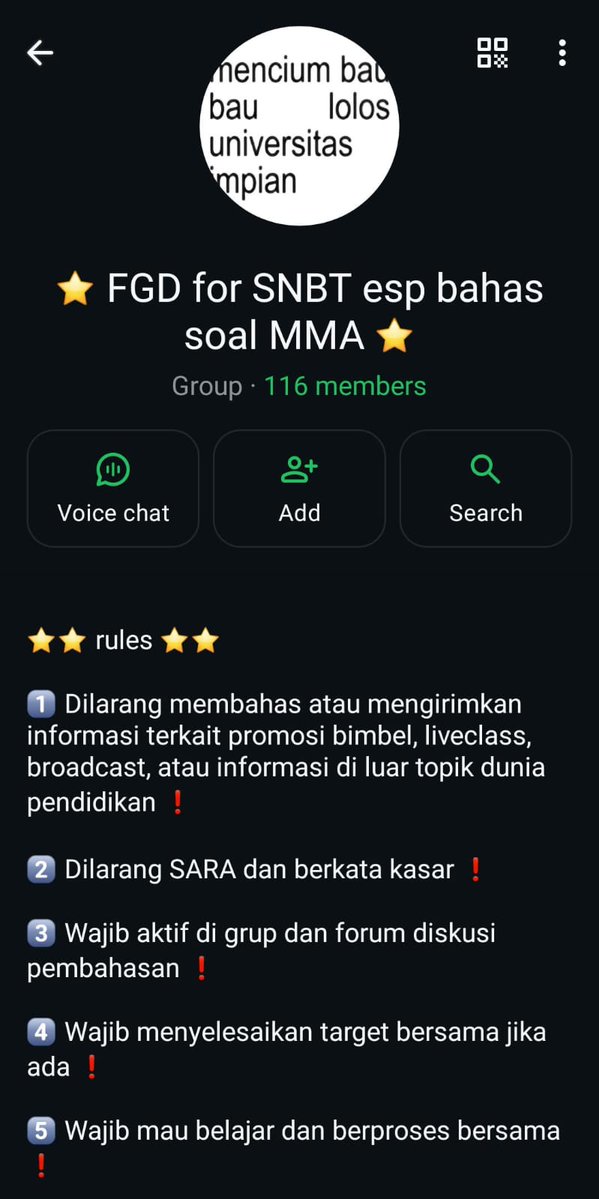
Ges kalian ada yg mau ga kalo etmin kumpulin tips2 ngerjain soal utbk yg beneran tips bermanfaat (bukan tips yg ujung-ujungnya jualan platform/bimbel)?

Hmm.. pernah tdk kamu tiba2 diam dan terpikir: “Kok aku mikir begini ya?" "Knp aku takut?" "Knp aku memilih ini?” Ternyata itu namanya metacognition, kemampuan untuk berpikir tentang pikiran kita sendiri. Para ilmuwan blg, ini adalah jenis kecerdasan paling tinggi yg dimiliki manusia. Bkn hanya pintar menjawab pertanyaan, tapi pintar memahami diri sendiri: knp kita suka begini, knp kita takut begitu, dan bgmn kita bisa jadi lebih baik. Ya bayangkan saja kalau AI quantum kita nanti juga bisa seperti itu.. bisa “mikirin dirinya sendiri”, seperti manusia. Mungkin itu yg akan membuat dunia benar2 berubah. Hmm.. kamu sering berpikir tentang cara berpikirmu sendiri tdk? Cerita dong.. Semakin dlm kita paham diri, semakin luas semesta kita.

Gak tau pernah dibahas di sini atau belum, tapi aku ada trik buat nurunin betuk akar yang pasti kepakai di #utbk Jangan lupa tonton sampai habis supaya kalian paham trik ini datangnya dari mana ya! #studytwt


Its not Simcity, but business school students who were good at Civ V also turn out to be better planners, organizers, and problem-solvers in this small experiment.