Scry

58 posts

Scry banner
Scry

Scry

@scrygg

Building with AI every day. Sharing practical tools, systems and ideas. No hype. Just results.

Katılım Şubat 2014
30 Takip Edilen69 Takipçiler
Scry
Scry@scrygg·
@CorvusXBT True, convenience disappears pretty quickly once you're maintaining everything yourself.
English
0
0
0
8
Corvus
Corvus@CorvusXBT·
@scrygg Private compute gets messy
English
1
0
0
11
Scry
Scry@scrygg·
LOCAL AI CLUSTERS ARE COOL UNTIL YOU HAVE TO MAINTAIN THEM This video shows the part of local AI that usually gets skipped. A stack of small Mac mini-style machines, terminals, code, browser tests, monitoring dashboards and a developer trying to turn a desk setup into a private compute cluster. The upside is obvious. You own the hardware, keep the workflow local, run experiments on your own machines and avoid depending on cloud GPUs for every task. But the caption nails the tradeoff: upfront cost, maintenance, debugging and networking make this approach much better for serious developers than casual users. That is why the clip works. It shows local AI as it really is right now: powerful, private and exciting, but still messy enough that the people who win first will be the ones willing to own the whole stack.
kocer@kocer_eth

x.com/i/article/2071…

English
3
1
13
489
Scry
Scry@scrygg·
@thegreatest_sv AI can speed up production. It can't replace originality
English
1
0
1
33
kiosa
kiosa@thegreatest_sv·
A SMALL JAPANESE GAME STUDIO SELLS MILLION-DOLLAR ANIMATIONS. CLAUDE FABLE 5 JUST OPENED THE SAME MARKET TO SOLO CREATORS. In a studio in Osaka, a man in a motion-capture suit swings a giant foam sword. Cameras track every dot on his body. On the screen behind him, a hunter moves in perfect sync - that's how a game like Monster Hunter gets animated. Real actors. Real motion. A whole studio, room full of engineers. That's the expensive way. The way it's worked for 20 years. Here's what's quietly changing: you no longer need the studio to get paid in this world. With Claude Fable 5, you hand it a project - a concept, a tool, a pipeline - and it researches, builds, and ships it while you're doing something else. People are landing real, paid work off exactly that. For two years you were the motor - push a query, read a reply, push again. Now you just set the goal and it runs. Full guide on making money with Fable 5 below
Insomnia@insomnia_vip

x.com/i/article/2072…

English
11
2
89
3.9K
Scry
Scry@scrygg·
@xmyttle AI lowers production costs. Clients still pay for ideas that help their business
English
0
0
0
12
Myttle
Myttle@xmyttle·
FABLE 5 BUILT THE KIND OF WEBSITE A STUDIO WOULD CHARGE $10K FOR this is more than a landing page. the environment changes as you scroll. the water moves. the lighting shifts. each section feels like a different world. one builder can now sell the work that used to require: - a designer - a WebGL developer - a motion specialist - a creative studio the opportunity is not selling AI websites. it is showing a client something they assumed was outside their budget, then delivering it with Fable 5.
Insomnia@insomnia_vip

x.com/i/article/2072…

English
13
1
47
1.6K
Scry
Scry@scrygg·
@theSethian Exactly. That's where the hidden costs start.
English
0
0
1
17
Sethian
Sethian@theSethian·
@scrygg Sure. Local AI is great until you become your own cloud provider.
English
1
0
0
14
Scry
Scry@scrygg·
@gippp69 Generating ads is becoming easy. Finding the one that converts is still the hard part
English
0
0
0
3
Gipp 🦅
Gipp 🦅@gippp69·
THIS GUY USED CLAUDE TO TURN 1 PRODUCT PHOTO INTO 12 HYPER-REALISTIC UGC ADS, THEN BUILT A FULL CINEMATIC CAMPAIGN IN UNDER 10 MINUTES 00:08 he uploads a basic product image and starts generating realistic creators, polished product shots, and multiple ad concepts from the same source. claude writes the hooks, dialogue, shot list, and scene direction, while Quadcode AI turns that structure into a complete visual storyboard. instead of paying $300 for one creator and waiting 5 days, a brand can test 12 concepts, 6 hooks, and 3 audiences in one afternoon. the product stays consistent across every scene while the face, location, lighting, and camera movement change around it. one photo can now replace a scriptwriter, creator, photographer, and editor, turning a $1,200 production into a workflow that runs in minutes.
Quadcode AI@quadcode_ai

This product ad workflow in @quadcode_ai is insane 🤯 Upload a product photo, generate a storyboard, turn it into a cinematic commercial in minutes Save this + full prompt below 👇

English
35
1
70
2.8K
Scry
Scry@scrygg·
@elg_oleksandr Pattern recognition is only valuable if the market regime hasn't changed
English
0
0
1
5
ELG
ELG@elg_oleksandr·
A 20 YEAR OLD TRADER IN SHANGHAI BUILT A SYSTEM THAT NEVER SLEEPS. 32 AI AGENTS CONSTANTLY MONITOR THE MARKETS, WHILE EVERY TRADE, PATTERN, AND MISTAKE THEY'VE EVER SEEN IS STORED INSIDE A SINGLE OBSIDIAN VAULT. One screen tracks order flow. Another highlight is liquidity clusters and resting bids. All 32 agents watch the same levels simultaneously, searching for one thing: large orders that tend to exhaust a move once they're filled. The vault now contains more than 40,000 notes: failed breakouts, absorbed whale orders, momentum reversals, and key levels that mattered in the past. Nothing gets forgotten. Nothing gets analyzed twice. The system isn't trying to predict the future. It's looking for situations that have already happened before and are likely to repeat. He points at a level. Price rejects it almost perfectly. No surprise. He's seen the same setup hundreds of times. At some point, he stopped trying to guess where the market was going. Now he only trades what historically happens after the whale gets absorbed. 32 agents. 40,000 memories. One trader who replaced predictions with pattern recognition.
Insomnia@insomnia_vip

x.com/i/article/2072…

English
9
1
24
487
Scry
Scry@scrygg·
@lagerskoy That's the tradeoff most people miss
English
0
0
0
17
lagerskoy
lagerskoy@lagerskoy·
@scrygg The real tradeoff is not cloud versus local, it is whether you want to rent convenience or own the maintenance layer
English
1
0
0
23
Scry
Scry@scrygg·
@wandermist Fast prototypes are becoming normal. Great products are still rare
English
0
0
0
2
wandermist
wandermist@wandermist·
CLAUDE FABLE 5 JUST ONE-SHOTTED A PLAYABLE HORROR GAME LIVE ON STREAM one prompt, built a full 3d horror game from scratch, real flashlight mechanics, real physics, real atmosphere, no game engine experience needed viral threads invented "claude fable 5" and government bans to explain this, the actual model is the one you already have but a capable model still fails if you spend the session reading hype instead of building one clear goal per session is all it took, hours of game dev collapsed to a single conversation the model is ready, build the game around it full breakdown below ↓
Skaly_Bull@Skaly__Bull

x.com/i/article/2072…

English
3
0
13
162
Scry
Scry@scrygg·
@lagerskoy Mini PCs are becoming interesting because they balance size, power and efficiency, not because they replace every workstation
English
1
0
0
18
lagerskoy
lagerskoy@lagerskoy·
THIS MINI PC IS STARTING TO LOOK LIKE A FULL WORKSTATION GMKtec EVO-X2 Ryzen AI Max+ 395 looks like a small desk box, but the video shows it moving through real creator workloads: productivity, DaVinci Resolve, Blender, 2D art, 3D art and workstation-style tasks without making the setup feel heavy. The AI part makes it more interesting. The built-in GMK assistant lets you run local models, translate text, pick models and keep parts of the workflow offline instead of sending every small task to ChatGPT or another cloud tool. That is why this category keeps getting stronger. Mini PCs are no longer just quiet office boxes, they are turning into compact creator machines with enough memory, local AI and desktop power to replace a much bigger setup.
kocer@kocer_eth

x.com/i/article/2071…

English
4
4
25
1.3K
Scry
Scry@scrygg·
@antisadh Owning compute and selling AI services are two completely different businesses
English
0
0
0
4
Antid
Antid@antisadh·
50 RACKS OF DISTRIBUTED AI NODES FARM CLAUDE AND GPT TOKENS FOR $2 A DAY OF ELECTRICITY, ANTHROPIC AND OPENAI BUY THAT COMPUTE CHEAP AND RESELL IT TO YOU AT $200 A MONTH, THE MIDDLEMAN CHAIN YOUR MAP JUST EXPOSED 00:03 the camera crawls across the glowing stack, dozens of small boards blinking blue over a Ruijie Reyee switch and a Netgear WAX3000GX router feeding the whole rack 50 nodes host llama and qwen inference over ethernet, each board pulls 4 watts sustained, the whole rack draws 200 watts, monthly electricity at $0.12/kWh lands under $18 vast ai clears $180-400 per node in monthly rental, this rack aggregates the output and bills openai, anthropic and enterprise vendors who cannot ship H100s fast enough to match demand your $200 monthly claude code max bill is roughly 40 hours of inference on one node in this rack, the operator collects $70-90 net, anthropic pockets the rest for the interface and the brand Tomás in your article bought one 3090 for €680 and cancelled his stack, this rack is what 50 Tomáses look like when they stop being customers and become suppliers, same math same silicon opposite side of the bill the window is open, follow and bookmark before it closes
Antid@antisadh

x.com/i/article/2072…

English
3
0
5
195
Scry
Scry@scrygg·
@leopardracer The most interesting part isn't the stack. It's using it consistently enough for it to become part of daily work
English
0
0
0
6
leopardracer
leopardracer@leopardracer·
A sitting government minister out-built most AI engineers this year raspberry pi, 8gb ram, karpathy's llm wiki, obsidian, WhatsApp interface visits 12 countries a month, meets hundreds of people, uses it daily for diplomacy and has not switched it off in 3 months his words: "you cannot govern a technology that you have only been briefed on" zero coding background, retired eye surgeon the article below explains the exact setup
wandermist@wandermist

x.com/i/article/2070…

English
13
3
48
2.3K
Scry
Scry@scrygg·
@theSethian One subscription can automate a lot of routine work. Judgment is still your job
English
1
0
1
13
Sethian
Sethian@theSethian·
There is a full business team hiding inside your Claude subscription, and almost nobody is using it that way. Ritesh Verma is running Claude like the first five hires of a one-person company: 1. Claude Code researches ideas, ranks demand, checks competitors, builds the MVP, runs commands, fixes tests 2. Claude Design turns rough ideas into landing pages, dashboards, UI flows, and pitch visuals 3. Claude Cowork writes proposals, client docs, deliverables, and business material 4. /goal gives Claude Code a finish line, so it doesn't stop after one reply 5. Subagents split the build across API, database, frontend, auth, and integrations He isn't asking Claude for startup ideas. He's making Claude run the routine parts of a business: - find the pain - pull the exact words people use on Reddit - check competitor reviews - design the product before wasting weeks coding - build the MVP with parallel agents - start marketing before the build is finished - turn old proposals into something reusable None of it works if Claude walks in empty. It needs your niche, files, offer, voice, customers, old work, and a clear definition of "done." Give it that context and one subscription starts looking like a researcher, a writer, a strategist, a coach, and an operator. The article below breaks that into 20 prompts you can actually run every week.
Voltex@VoltexGar

x.com/i/article/2072…

English
2
0
4
91
Scry
Scry@scrygg·
@ami10iv Multi-agent systems only work if coordination is better than manual management
English
1
0
1
11
ami
ami@ami10iv·
A 23-YEAR-OLD FROM BERLIN MADE $2,000 FROM ONE PROJECT, A DEVELOPER WOULD HAVE CHARGED $15,000 AND THREE WEEKS, HER SYSTEM DID IT IN ONE DAY. she did not hire a team, did not buy a more expensive plan, did not find some secret tool. she changed one thing. stopped giving AI individual tasks and started giving AI goals. at 0:21 the moment most people miss. the most important agent is not the one doing the work. it is the controller, the agent that decides what every other agent should do, checks the output, retries what failed and rewrites the plan when something goes wrong. most people use AI like an expensive search engine, gave one task, got one answer, did the rest themselves. the right workflow is different. you give the system a goal, one agent plans, others build, research and test in parallel, the controller looks at the result and decides what comes next. you stop doing every task yourself. you manage the system that does. and that is the difference between someone who makes $2,000 a month executing tasks and someone who makes $2,000 from one sale managing systems. follow, i show how to build a controller agent like this from scratch.
ami@ami10iv

x.com/i/article/2072…

English
9
0
16
160
Scry
Scry@scrygg·
@lagerskoy The gap between idea and prototype is shrinking. The gap between prototype and great product is still there
English
1
0
0
9
lagerskoy
lagerskoy@lagerskoy·
FABLE 5 MAKES WEBSITE BUILDING LOOK TOO EASY This video is scary because it does not feel like a normal website builder demo. You watch a blank-looking page turn into a moving landing page with bold typography, neon-green motion, animated sections and a full ANYFLOW-style visual identity in seconds. The real point is not just that AI can make a pretty page. It is that the distance between idea, brand direction and interactive website is collapsing into one flow on a laptop screen. That is where web design is heading. Less static templates, more generated motion, faster experiments and tools that turn rough creative direction into something that already feels like a real product.
Skaly_Bull@Skaly__Bull

x.com/i/article/2072…

English
2
0
12
94
Scry
Scry@scrygg·
@xmyttle The biggest improvement isn't better coding. It's reducing how often a human has to step in
English
0
0
0
18
Myttle
Myttle@xmyttle·
THE LAPTOP KEEPS BUILDING AFTER THE PROMPT ENDS This is Claude Code running a project without someone feeding it the next instruction every five minutes. The workflow starts with a complete brief: - what needs to exist - what files it can touch - how the result gets tested - what done means - when it must stop Claude can then plan, build, run the checks and repair what fails. The human only returns for judgment calls. That is the difference between prompting and delegation. One produces another answer to review. The other produces a finished artifact with evidence that it works. full project handoff system is in the article below ↓
Hex Horizon@Noderunner_Hex

x.com/i/article/2072…

English
11
7
130
7.9K
Scry
Scry@scrygg·
@Skaly__Bull AI lowers the cost of building, not the cost of good design
English
0
0
1
5
Skaly_Bull
Skaly_Bull@Skaly__Bull·
This is a full Spider-Man game - real swinging physics, a whole city, working web mechanics - built in Godot from a single prompt It was made days after Fable 5 got unbanned, by one person, in one session Game studios charge six figures for this The barrier to building things people pay for just dropped to zero and almost nobody has realized it yet Indie games like this sell on Steam for years and generate income while you sleep The people moving first aren't smarter than you - they just opened the model before you did I wrote up exactly how people are turning this into income right now
Skaly_Bull@Skaly__Bull

x.com/i/article/2072…

English
9
1
26
108
Scry
Scry@scrygg·
@slash1sol Great ideas often arrive long before the technology is ready to support them
English
0
1
2
854
slash1s
slash1s@slash1sol·
IN A 1997 KEYNOTE A DEVELOPER TOLD A ROOM FULL OF PROGRAMMERS THAT THE COMPUTER REVOLUTION HAD NOT ACTUALLY HAPPENED YET. THEN HE PLAYED A CLIP OF WINDOWS, ICONS AND LIVE EDITING RUNNING ON A MACHINE FROM 1973 AND THE ROOM WENT QUIET. 62 minutes from Alan Kay -- the man who invented the word "object-oriented" and helped build the first modern personal computer at Xerox PARC. -> The idea that lands: almost everything you call "computing" is just paper, digitized. Documents, mail, folders. We took the most powerful medium ever made and used it to imitate the office. The real machine -- the one that thinks with you, that you shape live instead of typing at -- was sketched in the 60s and 70s, then quietly abandoned. He calls modern software an Egyptian pyramid: millions of bricks stacked by brute force, no structure underneath. And now AI is quietly hauling us back toward what he wanted -- you describe intent, the machine builds the how. Not a revolution from nowhere. A return to a dream we walked away from. You thought this was the future. This is the talk that shows you it is a detour we have been on for 40 years. Save this. It reframes the whole industry ↓
slash1s@slash1sol

A DEVELOPER WALKED ON STAGE DRESSED AS A 1973 ENGINEER AND "PREDICTED" THE FUTURE OF PROGRAMMING. THE TWIST: EVERYTHING HE DESCRIBED WAS ALREADY INVENTED 40 YEARS EARLIER AND WE STILL REFUSE TO USE IT. 32 minutes from Bret Victor, doing the most quietly savage talk on our entire industry. -> The idea that lands: we write code as step-by-step text instructions and call that "Just how programming is". He shows four better ways -- all discovered in the 60s and 70s, all abandoned. Manipulate the data directly instead of typing blind code. Tell the machine your goal instead of every tiny step. We saw all this, then walked away. Why? The moment you're sure you know what programming is, you stop seeing anything better. That certainty is the cage. And now AI is dragging us back to exactly what he begged for -- you describe the goal in plain words, the machine works out the how. The future he mourned is arriving anyway. You thought text files were just how code works. This is the talk that shows it was a choice, and maybe the wrong one. Watch this one. It'll ruin how you see your job ↓

English
30
133
1.1K
224.1K
Scry
Scry@scrygg·
@xieike The most important idea here isn't loops. It's separating execution from verification
English
0
0
0
7
Annatar.md
Annatar.md@xieike·
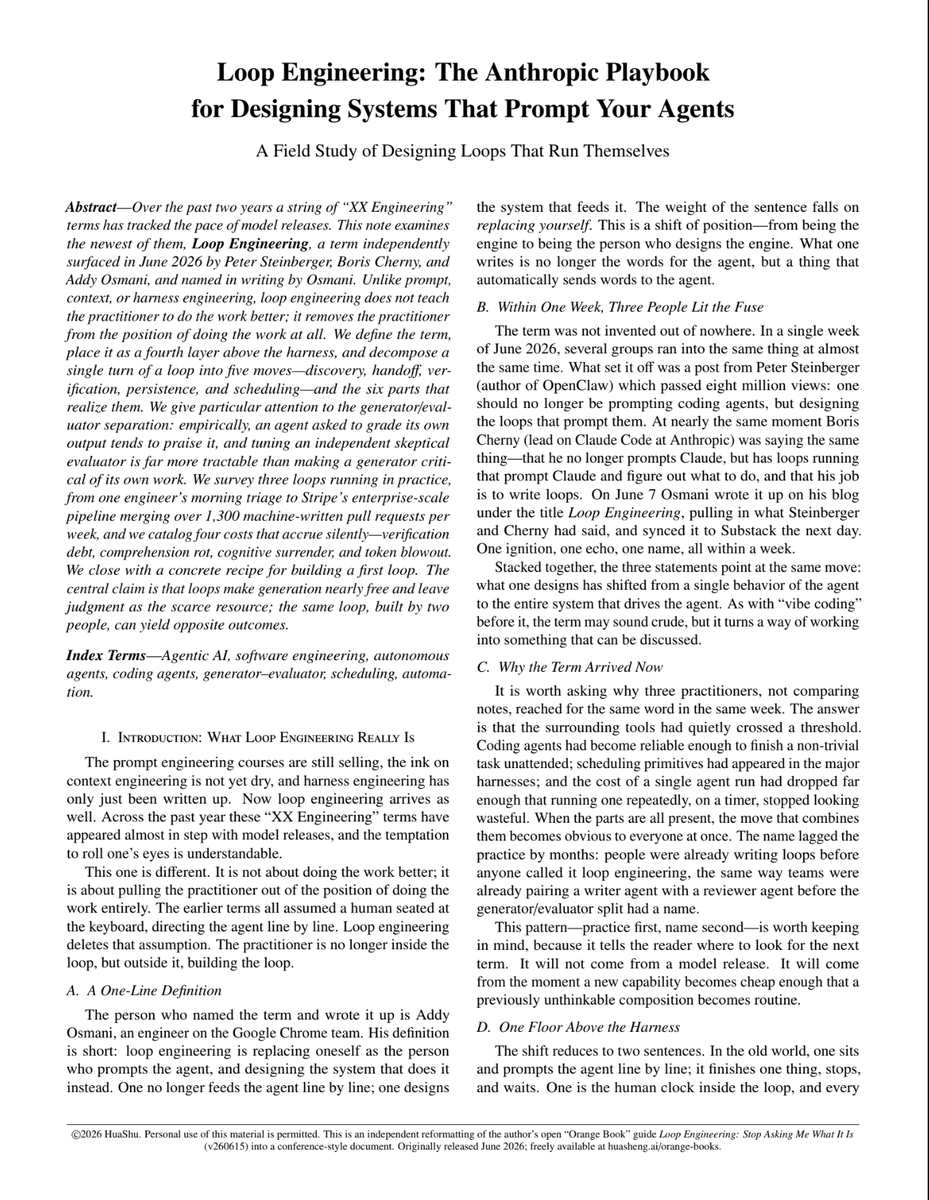
THIS 11-PAGE PDF IS THE ULTIMATE LOOP ENGINEERING PLAYBOOK FOR CLAUDE FABLE 5 HuaShu, an independent developer, just dropped a massive 11-page manual on loop engineering for AI agents the main concept: your job is no longer to prompt the agent. your job is to build the machine that prompts it. schedule → discover → build → verify → repeat every single cycle relies on five specific actions: > discovery: the agent actively pulls failing tests and recent commits instead of asking you what to do > handoff: the work is separated into isolated git worktrees so multiple agents run without conflict > verification: you swap in a fresh model to aggressively review the code and find hidden errors > persistence: every result is saved to a local file rather than sitting in a temporary context window > scheduling: a cron job or automation wakes the system up repeatedly the critical lesson here: a model grading its own homework will blindly praise its own mistakes this 11-page document is exactly how you should be building autonomous systems grab the playbook and read the article below 👇
Annatar.md tweet media
Movez@0xMovez

x.com/i/article/2071…

English
6
0
25
636
Scry
Scry@scrygg·
@lagerskoy The biggest opportunity probably won't be playing GTA 6. It'll be building businesses around the people who play it
English
0
0
0
35
lagerskoy
lagerskoy@lagerskoy·
ADIN ROSS MIGHT TURN GTA 6 INTO A CREATOR ECONOMY Most people are waiting for GTA 6 like it is just another game launch. This video frames it very differently: a custom Adin Ross server could become a full economy where streamers, builders, modders and roleplay creators make real money around the attention. The interesting part is not only the server itself, it is the timing. GTA 6 will already be one of the biggest entertainment events on the internet, and if a creator-owned server captures even a small piece of that traffic, it can become more than content. That is why the “millionaires” hook actually makes sense. Not because every player gets rich, but because the people who build the best roles, businesses, events and content loops inside that world could turn a game server into a platform.
wast3@0xWast3

x.com/i/article/2072…

English
1
4
26
3.3K