Sebastiano Cultrera di Montesano

45 posts

Sebastiano Cultrera di Montesano

Sebastiano Cultrera di Montesano

@sebacultrera

Postdoc at @Schmidt_Center within @Broadinstitute

Boston, MA Katılım Şubat 2022
232 Takip Edilen87 Takipçiler
Sabitlenmiş Tweet
Sebastiano Cultrera di Montesano retweetledi
Anshul Kundaje
Anshul Kundaje@anshulkundaje·
Strongly recommend folks be extremely skeptical of "virtual cell" models until they are independently vetted. This shud be the case for all scientific claims but the virtual cell literature in particular has an unfortunate history of misleading & massive overhyping.
English
5
19
262
10K
Sebastiano Cultrera di Montesano retweetledi
Math, Inc.
Math, Inc.@mathematics_inc·
We are pleased to share that using Gauss, we have completed a ~200K LOC formalization of Maryna Viazovska’s 2022 Fields Medal theorems on optimal sphere packing in dimensions 8 and 24. This is the only Fields Medal-winning result from this century to be completely formalized, and is the largest single-purpose Lean formalization in history. We are honored to have assisted @SidharthHarihar1 and the rest of the sphere packing team in this achievement. math.inc/sphere-packing
English
45
341
2.3K
397.5K
Earvin Magic Johnson
Earvin Magic Johnson@MagicJohnson·
Now I think it’s going to be the Detroit Pistons and New York Knicks in the Eastern Conference Finals. The Cleveland Cavaliers and Philadelphia 76ers will be their main competition but, let’s not forget about the Boston Celtics. Especially the way Jaylen Brown has been playing, the Celtics know how to win.
English
205
99
1.3K
205.8K
Sebastiano Cultrera di Montesano retweetledi
antisense.
antisense.@razoralign·
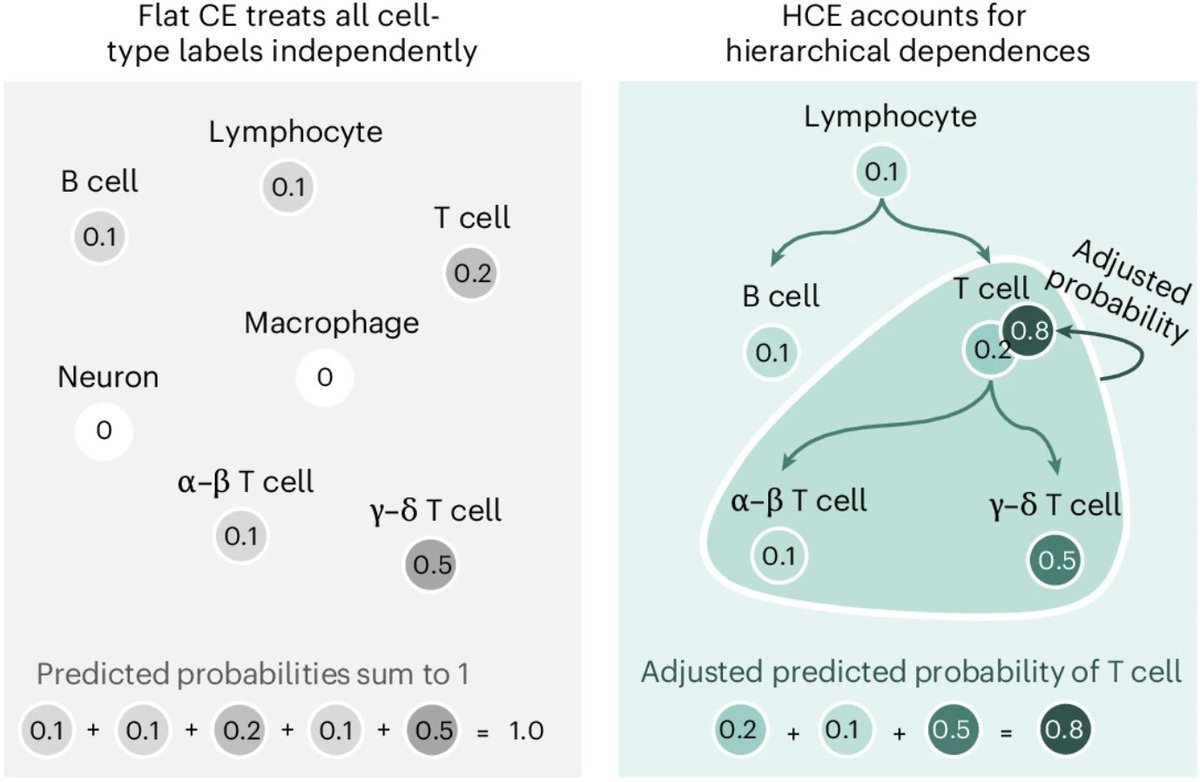
HCE: Improving atlas-scale single-cell annotation models with hierarchical cross-entropy loss nature.com/articles/s4358…
antisense. tweet media
English
2
8
30
1.9K
Jorge Bravo Abad
Jorge Bravo Abad@bravo_abad·
Hierarchical loss functions for cell-type annotation at atlas scale Automated cell-type annotation is foundational for single-cell RNA-seq analysis—and it's fundamentally a classification problem with structured labels. Cell types form a hierarchical ontology: 'leukocytes' contain 'lymphocytes', which contain 'B cells' and 'T cells'. But standard cross-entropy loss treats these labels as flat and independent, ignoring the biological relationships that define them. This mismatch becomes acute when models encounter new data. Sebastiano Cultrera di Montesano and colleagues trained linear classifiers, MLPs, and TabNet on 15.2 million cells from CELLxGENE spanning 164 cell types. In-distribution performance was strong (80–84% macro F1). But when evaluated on 2.6 million cells from 21 newly released studies—same cell types, same assays—performance dropped by 24–32%. The models had memorized study-specific patterns rather than learning generalizable cell-type signatures. The fix is elegant: a hierarchical cross-entropy (HCE) loss that propagates probability mass up the ontology DAG. For any cell type, the adjusted score equals its raw probability plus the probabilities of all its descendants. This encodes a consistency constraint: predicting 'CD4+ T cell' should increase the probability of 'T cell' and 'lymphocyte'. Implementation requires only a reachability matrix multiplication—no architecture changes, no hyperparameter tuning. The results are remarkable. HCE improves out-of-distribution macro F1 by 12–15% across all three architectures, recovering roughly half the performance drop. Gains concentrate in internal nodes embedded in densely connected regions of the ontology, where hierarchical signal can propagate across related types. The improvement is architecture-agnostic—linear models benefit as much as transformers. The broader message challenges current trends: rather than scaling model complexity, aligning training objectives with biological structure yields consistent generalization gains. For atlas curation, this suggests prioritizing studies that increase ontology connectivity in underrepresented regions over simply adding more cells. Paper: nature.com/articles/s4358…
Jorge Bravo Abad tweet media
English
6
19
101
7K
Sebastiano Cultrera di Montesano retweetledi
Lorin Crawford
Lorin Crawford@lorin_crawford·
Excited to see our hierarchical cross-entropy strategy for improved cell type annotation out in @NatComputSci today! Congratulations to the team! Check out @sebacultrera's original breakdown of our approach here: x.com/sebacultrera/s…
Nature Computational Science@NatComputSci

📢Out now! @sebacultrera, @davide_dascenzo, @avapamini, @peterswinter, @lorin_crawford, and colleagues present a hierarchical cross-entropy loss that improves performance of single-cell annotation models. nature.com/articles/s4358…

English
1
2
8
623
Sebastiano Cultrera di Montesano retweetledi
Models, Inference & Algorithms at Broad
📅Wednesday, September 24 🎤Primer, 9 am: Infrastructure and modeling challenges in single-cell omics 💬@davide_dascenzo 🏢Polytechnic University of Turin 🎤Seminar, 10 am: When more isn’t better: rethinking scale in single-cell foundation models 💬@lorin_crawford 🏢@MSRNE
Models, Inference & Algorithms at Broad tweet media
English
1
6
9
2.6K
Sebastiano Cultrera di Montesano retweetledi
Tavor Baharav
Tavor Baharav@TBaharav·
Unique Molecular Identifiers (UMIs) in RNA-seq are supposed to be… unique. But what if they don’t have to be? In our new preprint w/ Dylan Agyemang + @rafalab, we show that UMIs can be shorter—if you use the right estimator. 1/12
Tavor Baharav tweet media
English
2
6
17
2.9K