아니 센서님이 말아준 측가센먹고너무배불러서이제반년동안또 살아갈수있는힘이생겼어요 너무너무 행복한 얼굴로 웃고있는 둘을 보는것만으로도세상에는빛이존재하고삶이존재하고행복이있네요,,,,
이렇게나 많이ㅠㅠ ㅠㅠㅠㅠ
둘의 앨범 훔쳐보는기분들어서너무사랑스럽고.좋아요ㅠ. ..ㅠ.ㅠ...
#DrSTONE Behind Story 07 (2/2)
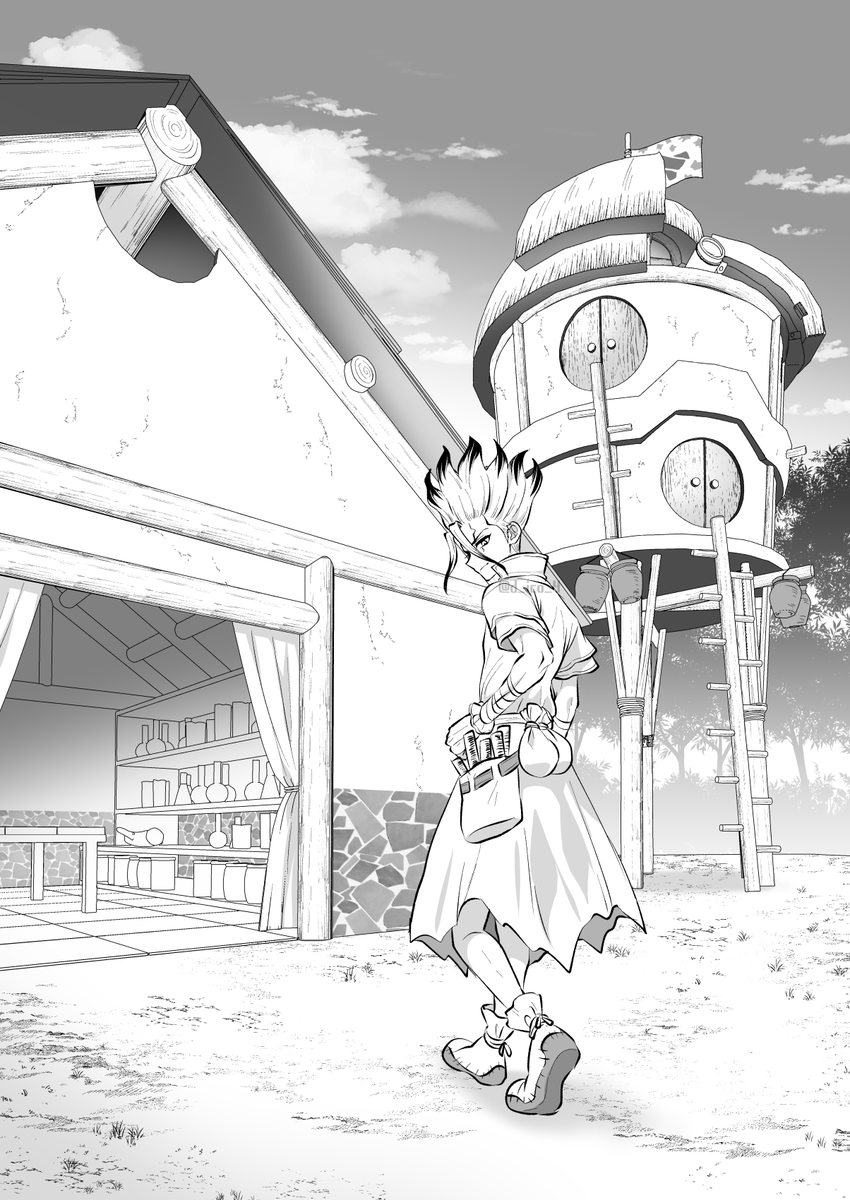
A village I designed after hearing that Ishigami Village would appear in the story.
To express the power of a civilization that has continued for 3,700 years, I imagined it as an artificial lake.
At the time, I was told they were descendants of astronauts, so I imagined the remains of a spacecraft lying beneath the lake.
Most of these ideas were not used in the final story,
but that is not a problem at all.
The role of the artist is to create visuals that can support the story,
while the final decisions belong to the original author.
In Dr. STONE, Inagaki-sensei often incorporated my ideas into the story,
which made the experience truly enjoyable and rewarding.
Ishigami Village setting 1.
instagram.com/p/DXw_y9HFAGz/
Ishigami Village setting 2.
instagram.com/p/DXw_6ZelJ_8/
Ishigami Village setting 3.
instagram.com/p/DXxALukFEHL/
Basic structure of the houses in Ishigami Village.
The design was inspired by ancient Germanic houses and the circular village imagery seen in 7 Samurai.
Smoke gathers toward the top of the conical roof and flows out.
Some houses also feature dedicated ventilation structures.
#DrSTONE Behind Story 07 (1/2)
“Izu and Ishigami Village”
When I heard that Senku and his friends would leave Tokyo (Chōfu) and head to the Izu Peninsula, I was thrilled.
Izu is a place I love—I had visited it many times for research and had taken many photos there.
They move across the Kanto Plain and into a world of mountains and cliffs.
Most of Japan is mountainous.
The Kanto Plain is actually quite different from what you might call “typical Japan.”
In a sense, this is the moment when the background shifts to a more “authentic Japanese landscape.”
In fact, I didn’t depict the Kanto Plain as completely flat.
Once human control disappears, I imagined that not only forests but even the land itself would become more diverse.
I also wanted to suggest that many events had taken place over a long period of time.
If that’s the case, then Izu should be even more so.
So when the story moved to Izu, I tried to avoid flat terrain as much as possible—having the characters constantly moving up and down hills.
Though, as an artist, I never feel fully satisfied with how well I portrayed it.
Ishigami Village was something I worked on with great excitement.
Because it is “a village inhabited by a small tribe for 3,700 years,”
I created many hidden settings of my own.
After all, a single culture and a single power structure lasting for 3,700 years
would be unprecedented in human history.
In terms of our civilization, it would be like a group surviving continuously from ancient Egypt to the present day.
How much could accumulate over time?
What would become possible through the power of time?
Thinking about these questions, I enthusiastically built many hidden details.
One core concept—never directly stated in the story—is that Ishigami Village is located around an artificial lake.
Did the relationship between the village and the lake ever feel slightly unnatural?
That’s because it’s an artificial lake.
In fact, the village sits atop two mountain peaks.
If you follow the lake downward and along the river, it eventually leads to the sea.
Why is the upper part of the village flat?
That was a design choice I included in case it could be used in the story.
When collaborating with a writer, I often add many such elements—
things that can be used if needed, or simply left unused.
The more fun I’m having, the more I tend to add.
Although the reason for the flat mountaintop wasn’t explained in the story,
there were other elements—like a kind of “relativity formula”—that Inagaki-sensei incorporated into the narrative.
He was someone who deeply respected the imagination of the artist and often reflected it in the story.
The houses of Ishigami Village were designed by blending several ideas:
a sense of fear toward the outside world, the concept of “the village of the 7 samurai,” ancient Germanic-style houses, natural ventilation of smoke, and even inspiration from Asitaka’s village(Princess Mononoke).
When the villagers go out and establish new settlements, they build them in the same style as Ishigami Village—whether in South America or in Europe.
That reflects their attachment to their homeland.
And at the same time, it also reflects my own feelings as the artist who drew them.
To be continued