Cyberspace Sam 🤠

3.9K posts

Cyberspace Sam 🤠 banner
Cyberspace Sam 🤠

Cyberspace Sam 🤠

@semateos

Creative Technologist: AI, XR, Games, and Immersive Art

San Carlos, CA Katılım Ocak 2010
3K Takip Edilen1.1K Takipçiler
Cyberspace Sam 🤠
Cyberspace Sam 🤠@semateos·
I enjoy writing code because I find it fun to solve logic puzzles (akin to solving sudoku). But I also love building things and power tools. I think it’s awesome when someone builds beautiful things using ancient hand-powered tools. Personally I’ll opt for a skill-saw. That doesn’t mean that hand-saws suck.
English
1
0
1
20
gfodor.id
gfodor.id@gfodor·
It might just be a bad choice of words here but I think the idea that loving computers is conflated with loving programming is going to be looked back on as an incomprehensible error. Of *course* programming by hand sucked, the goal is to get computers to do what you want!
LaurieWired@lauriewired

I’m convinced that a large % of programmers don’t actually like computers. As a side effect, are also perfectly happy to throw away their reasoning to a model as soon as they can. I don’t get it, at ALL. Don’t you *LIKE* understanding the magic of the machine? You do realize hand-programming (I hate that I even have to specify hand now) is fun…right?

English
9
1
35
5.3K
Nima Zeighami
Nima Zeighami@NimaZeighami·
I have a new Apple Vision Pro app coming out this week! If you're interested in Beta testing it, reply to this tweet!
English
31
1
61
3.8K
Nima Zeighami
Nima Zeighami@NimaZeighami·
Soft robotics is wild. I’m at a meetup focused explicitly on tentacle design😭 Shape, material selection, actuation, payload, the whole nine yards. Anime enthusiasts would be proud. Anyone dare me to ask the speaker about consumer usecases?
English
9
1
48
3.6K
Cyberspace Sam 🤠 retweetledi
XH
XH@xhfloz·
A good creative tool should let people make ugly but unexpected things, I think. Any new capability that yields only beautiful things is a subtle kind of tyranny.
English
14
72
510
48.8K
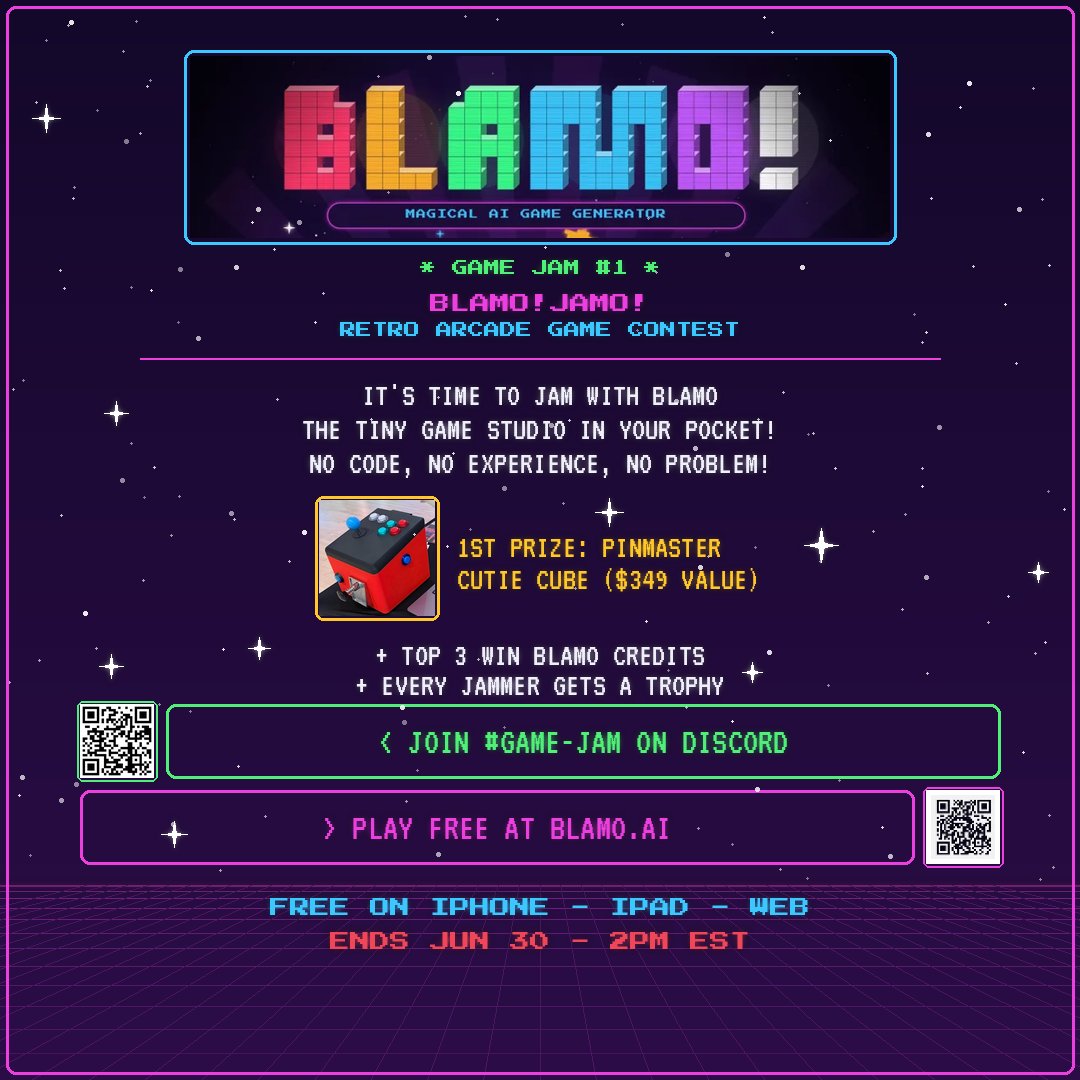
Blamo
Blamo@BlamoInc·
Blamo tweet media
ZXX
1
1
2
251
Cyberspace Sam 🤠
Cyberspace Sam 🤠@semateos·
@iBrews I find that all of the AVP environments feel cold. It seems like an odd but intentional choice.
English
1
0
0
29
Alex Coulombe 🔜 SIGGRAPH
LOVE the new Apple Immersive Environment of THORSMORK. Cold weather and mountains and water and wind and northern lights yes directly into my veins thank you very much.
English
3
2
59
3.2K
16VC
16VC@16vchq·
pitch me your company in 1 word.
English
899
10
338
91.9K
Hubert Thieblot
Hubert Thieblot@hthieblot·
Anyone who surfed the early web between 1995-2010. What’s the one website/app you still think about?
English
17.4K
540
11.2K
4.9M
Cyberspace Sam 🤠
Cyberspace Sam 🤠@semateos·
Huh! Funny, I haven’t thought of virtual social experiences as training for a long while. But I just remembered that, as a teenager, I wrote an essay about that very idea because of my experiences in LambdaMOO (a text-based virtual world of the early internet). I learned many important lessons there.
English
0
0
1
85
Wu Xu
Wu Xu@xuwu·
I’ve always felt that the essence of VR is not just Ready Player One. It is closer to Ender’s Game. It is not simply a virtual world that lets people escape reality. It is a low-cost, high-frequency, diverse training ground with fast feedback. People go through repeated experiences and receive repeated feedback, until their understanding of something reaches a depth that is very hard to achieve in the real world. The same is true of relationships in VRChat. Those encounters, moments of closeness, pain, separation, and self-repair may look like emotional exhaustion inside a virtual world, but they are also a form of high-density interpersonal training. So the deepest value of VR is not escaping reality, but helping people understand reality faster.
ぽめち@Pomechi8080

VRChatの人間関係は、とにかくサイクルが速い。毎晩のように誰かと出会い仲良くなって、合わなくなったりアンフレして、また次へ。リアルじゃありえない速さで関係が回っていく。その中で別れや拒絶の数も増えるから、心をすり減らす人が多いのも本当だと思う。でも本当にそれだけなのかなと思って、関連しそうな研究をいくつか読んでみた。 まず、人と仲良くなるには思っているより時間がかかる。Hall(2019)の研究では、ただの知り合いから友人になるまでに約50時間、親友と呼べる関係になるには200時間以上の共有時間が必要だとされている。リアルだと友達と週に何時間も一緒にいるのは難しいけど、VRCなら毎晩何時間も、時には一晩中一緒にいられる事も珍しくない。リアルなら何年もかかる時間が、VRCだと数ヶ月で貯まるわけだから、仲が深まるのが速く感じるのは気のせいではなく単純に一緒にいる時間が貯まりやすいからだと言えるだろう。 しかもVRCでは、合わなければいつでもアンフレしたり、ワールドを移ればいいという気軽さがあって、これは所詮はバーチャル世界での関係だと希薄な行動に見えるけど、VRChatを調べたDeighan(2023)の研究だと、この「いつでも抜けられる」という安心感こそが、人が安心して弱さや本音を見せられる土台になっていると報告されている。いつでも切れるからこそ、深く入れる。希薄さと濃さは矛盾してるんじゃなくて、コインの裏表のような表裏一体を成しているわけだ。 ただ、サイクルが速いぶん、拒まれたり別れたりする回数もどうしても増えるから、拒絶に敏感な人ほど消耗して燃え尽きやすい、というのも複数の研究が示している(VRC民を直接調べたものではないから、あくまで近い話としてだけど)。だからVRCで病む人が多い事にも納得感がある。 で本題はここからで、Slotter(2010)という研究では、人は誰かと深く関わるとその相手を自分の一部として取り込んでいて、別れるとそのぶん「自分が何者か」が一時的に揺らぐ、ということがわかっている。そして著者たちは、このつらい揺らぎについて「これは回復に必要な、むしろ適応的な反応なのかもしれない」と、今後の研究課題として書いている。つまり誰かと別れて自分が分からなくなる感覚は、壊れてるんじゃなくて、自分を作り直してる最中なのかもしれない。 そう考えると、VRCで重ねた出会いと別れは、ただ消耗してるだけじゃない。誰かと関わるたびに、自分のコミュニケーションが他者にどう受け取られるかのフィードバックが貯まって、別れるたびに自分が少しずつ再編されていっている。その全部が、いつか本当に出会うべき人――伴侶や一生ものの真の友人に出会えたときに、ちゃんと向き合うための積み石になってる気がするんだよな。 VRCでふにゃったりエロがったり同性同士で愛を育むことが生産性のない無意味な行為だと揶揄する意見を時折耳にするが、そういった心と心のふれあいの本質は出会いと交流の経験の蓄積であって、それは言い換えると、誰かと会って、喋って、たまに傷ついて、それでもまた会いに行くこと自体が、無意味なわけがないと思うんだよね。 参考文献 Hall, J. A. (2019). How many hours does it take to make a friend? Journal of Social and Personal Relationships, 36(4), 1278-1296. DOI: 10.1177/0265407518761225 Deighan, M. T., Ayobi, A., & O'Kane, A. A. (2023). Social Virtual Reality as a Mental Health Tool. CHI 2023. DOI: 10.1145/3544548.3581103 Slotter, E. B., Gardner, W. L., & Finkel, E. J. (2010). Who Am I Without You? PSPB, 36(2), 147-160. DOI: 10.1177/0146167209352250

English
1
0
25
2.9K
Cyberspace Sam 🤠
Cyberspace Sam 🤠@semateos·
@gfodor I tend to say “we made this” and name who worked on it with me. Like my agent and I built this. Or Claude and I came up with this plan. Because it really couldn’t have done it without me and vice versa. It would be sad if my judgement is no longer valuable but that’s not today.
English
0
0
1
129
gfodor.id
gfodor.id@gfodor·
Thread. I thought I was immune from ever feeling hollowed out by AI as a programmer, because I've always gotten far more enjoyment from shipping, getting users, and solving problems than indulging in the art of coding. As the LLMs have eaten deeper and deeper into our field, I've empathized with my peers who've expressed a sense of loss and disillusionment as the art of programming has become more and more automated. But, I've always seen myself as someone who saw coding as a means to an end to solve problems. Not something whose craftsmanship, culture, methodologies, and fads were worth getting too hung up on, beyond what was needed to adeptly deliver value to others and not fall behind the (frankly, rare) genuine advancements over the years. This all changed for me over the last week. The frontier probably shifted a bit earlier than today, but I didn't see it until now. The change has come about for me because GPT-5.5 was able to build complex software I needed built autonomously for 2-3 days at a clip. Work that would have taken me months, or even years if you include learning the requisite languages, libraries, and tooling, being completed over a weekend. This isn't something I think anyone who has been programming as long as I have can really be prepared for, this kind of velocity jump is just mindboggling. This is truly superhuman performance - it's not perfect, and there certainly is a level of simplicity and clarity that would come in the hands of the world's best programmers, but that margin is so small so as to be unnoticable when contrasted with the sheer volume of working software that it can produce per unit time. So, why has this caused a shift in the way I feel about these technologies, after all this time not having felt it as each subsequent model advanced closer to what we see now? There are two reasons. First, it's clear that the age of humans understanding how software works is over. Yes, humans will need to understand things, at least for a few more years, but we are now at a kind of escape velocity where the % of lines of code that are created every year that are even read, nevermind understood, by humans, is now permanently declining. But the real shift, is I am no longer a programmer, I am a manager. Good managers do not take credit for the work of their team - they see themselves in service of their team. Up until now, claiming "I built this" still felt true when talking about things I had created with the help of LLMs. But now, when the LLMs are writing thousands of lines of code, and I am simply providing guidance, direction setting, and oversight to catching the bigger errors, I found myself in the bizarre situation (that many will be in soon, I presume) of no longer feeling entitled to take credit for the work being done. Not being able to say "I built this" when sharing something whose basic conception came from my own mind, but under the tireless effort of these insane machines to actually reason through and materialize into a working solution, is devastating. Not because of the fact it doesn't feel truthful now, but because I know it will never be truthful again for myself and soon for all of the rest of us.
English
74
24
529
61.6K
Cyberspace Sam 🤠
Cyberspace Sam 🤠@semateos·
One of my favorite creations on BLAMO started with the prompt “monkeys throwing bananas” and led to this adorable Atari style two button runner, Monkey Kong! Play it here: blamo.ai/vibes/1993a92e…
English
0
1
5
81.3K
Tev
Tev@fruitwithnop·
@semateos Or you could just play games made by people (orders of magnitude more fun) & not support dogshit AI drivel 👍
English
1
0
0
8
Cyberspace Sam 🤠
Cyberspace Sam 🤠@semateos·
It’s a big bucket of slop! But it turns out that it’s also fun to make and play games this way. The speed of trying out ideas. Seeing the weird shit your friends make. Being spontaneously creative with code while waiting in line. Certainly a better way to spend your time than writing dogshit comments.
English
1
0
0
25
Tev
Tev@fruitwithnop·
@semateos Oh boy a dogshit generator
English
1
0
3
32