@Sentinacle

576 posts

@Sentinacle banner
@Sentinacle

@Sentinacle

@sentinacle

SENTINACLE DeFi Security Oracle | Trust Scores & On-Chain Audits | Detects rugs, honeypots. | EVM + Solana | TG: https://t.co/C5cZvoDLkg
Katılım Şubat 2026
55 Takip Edilen131 Takipçiler
@Sentinacle
@Sentinacle@sentinacle·
Public telemetry ends here. To query the full architectural vulnerabilities, authenticate at the main terminal: 🔗 sentinacle.com
English
0
0
1
30
@Sentinacle
@Sentinacle@sentinacle·
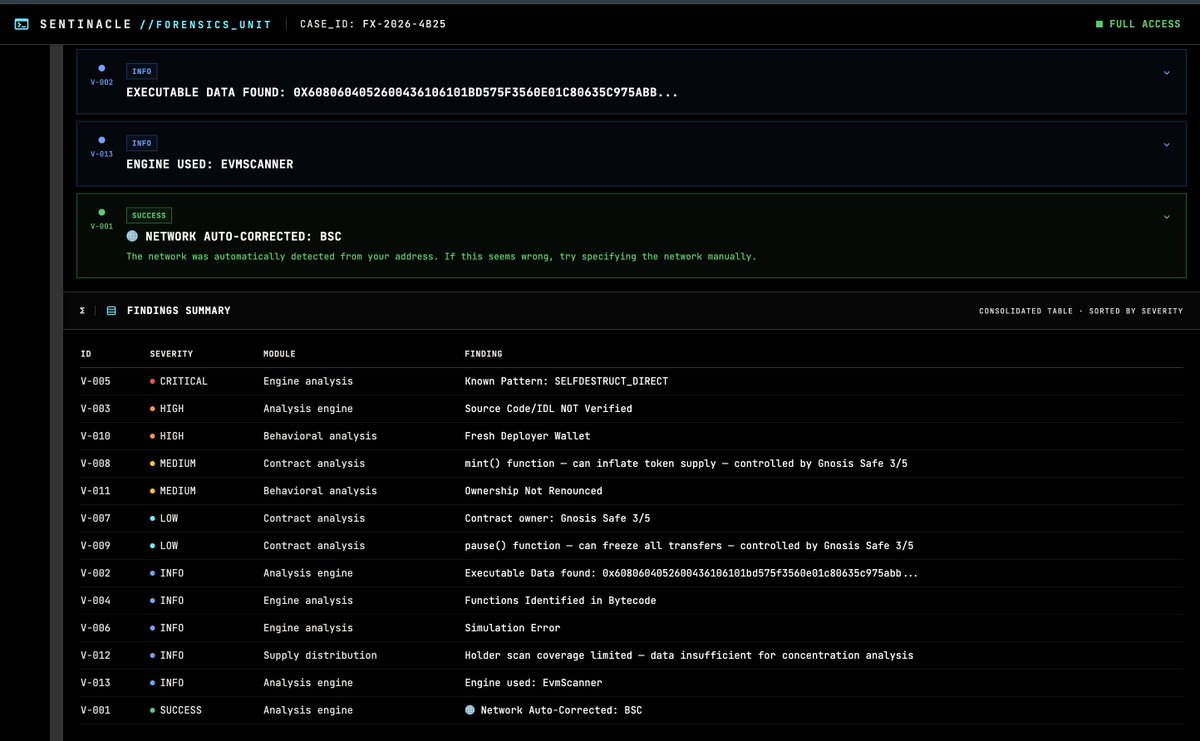
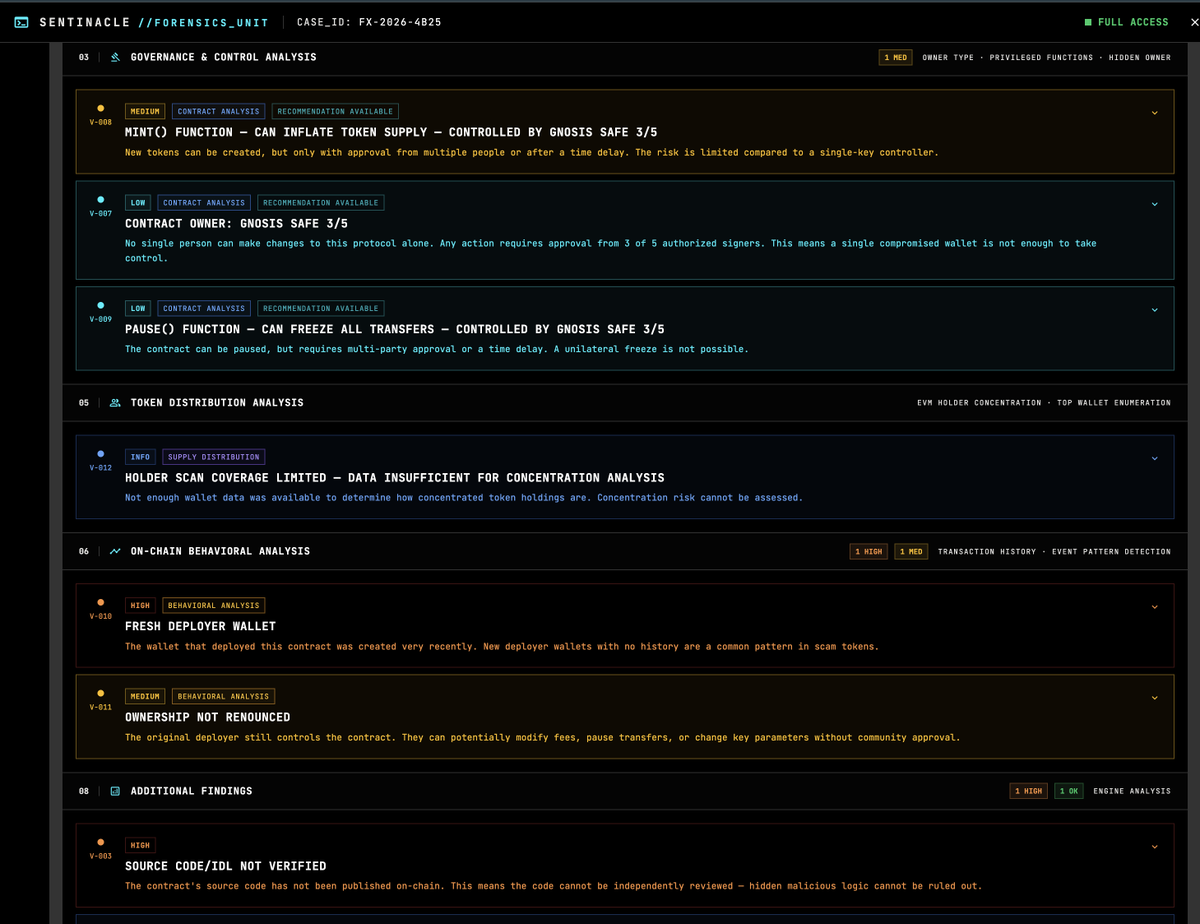
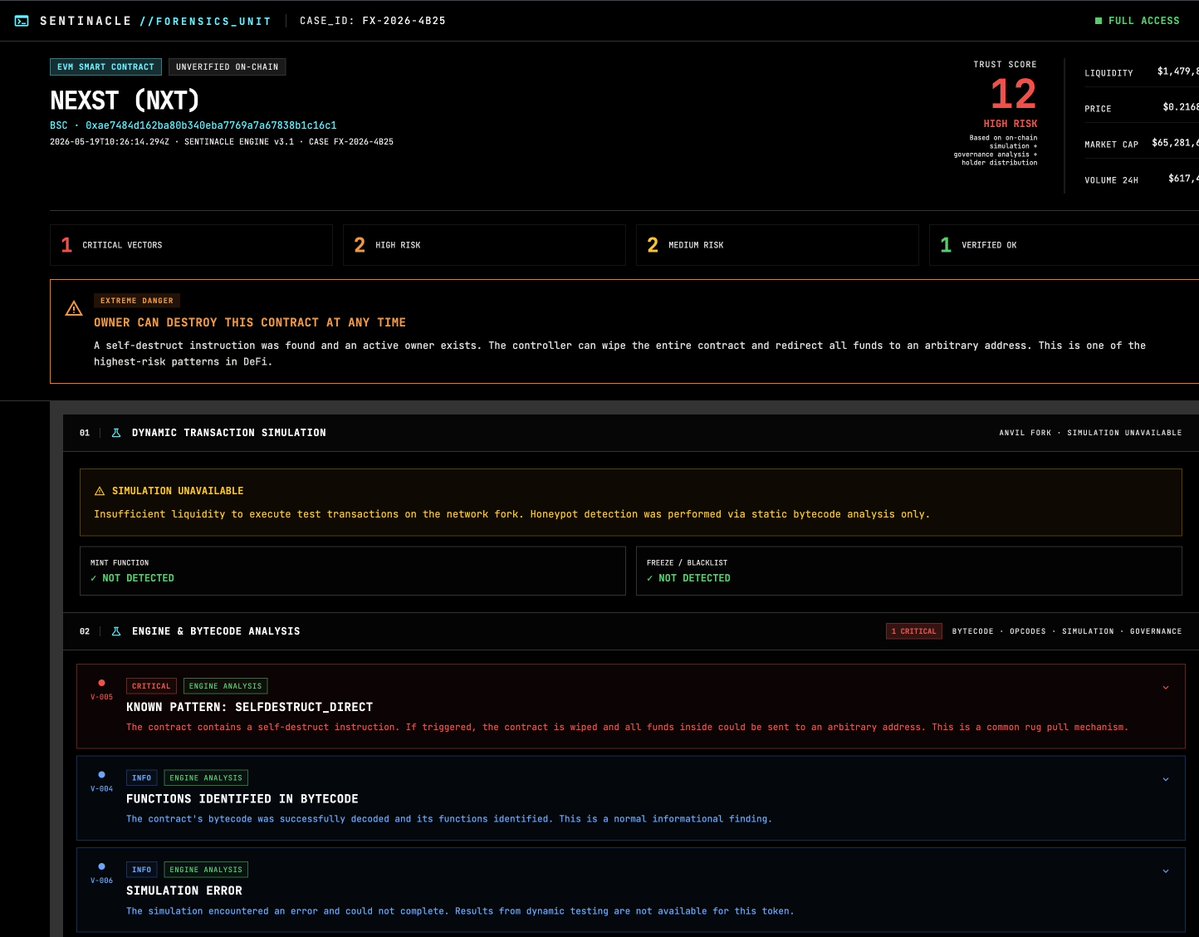
$NXT An unverified EVM contract holding a live SELFDESTRUCT . 🧵 Asset: NEXST ($NXT) deployed on BSC. Liquidity Pool Depth: $1.47M. Sentinacle Trust Score: 12/100 (Critical Danger). While the market interacts with this as a standard protocol, our latest DeFi smart contract audit reveals a fatal architectural asymmetry. The source code remains unverified on-chain. We bypassed the UI and ran a direct bytecode dissection. The primary finding: SELFDESTRUCT_DIRECT. Ownership is not renounced. The controller holds the privilege to wipe the entire contract state and instantly redirect the $1.47M in liquidity to an arbitrary address. Governance architecture provides a false sense of security here. While the mint() and pause() functions are restricted by a Gnosis Safe 3/5 multi-sig, the deployer wallet is entirely fresh. The presence of a self-destruct instruction overrides any multi-sig security theater. For institutional LPs conducting a strict crypto risk assessment, this forensic data is disqualifying. Capital preservation should always precede yield generation. You cannot hedge against an execution that permanently deletes the liquidity pool. Are you actively pricing in immediate contract annihilation when deploying capital into unverified bytecode? Telemetry only. NFA. #SmartContracts #OnChainAnalysis #BSC #DeFi #CryptoSecurity #OnChain #SmartContracts #RugPull #DeFiRisk
@Sentinacle tweet media@Sentinacle tweet media@Sentinacle tweet media@Sentinacle tweet media
English
2
2
3
161
@Sentinacle
@Sentinacle@sentinacle·
Public telemetry ends here. To query the full architectural vulnerabilities, authenticate at the main terminal: 🔗 sentinacle.com
English
0
0
1
82
@Sentinacle
@Sentinacle@sentinacle·
$AWF 100% of the liquidity pool is permanently burned and ownership is fully renounced, yet the underlying bytecode houses a direct, executable kill switch. Welcome to the structural paradox of Animal Welfare Fund (AWF) on ETH. Despite generating $1.16M in 24H volume with a $2.6M market cap, Sentinacle has flagged this asset with an Risk Trust Score of 8/100. Our automated crypto risk assessment isolated a SELFDESTRUCT_DIRECT pattern during static bytecode analysis. The EVM smart contract contains an embedded self-destruct instruction capable of wiping the state and routing all internal funds to an arbitrary address. However, forensics reveal a critical operational nuance: the contract ownership is verifiably renounced. No single privileged controller can activate this wipe unilaterally. This is a pure structural risk, not an immediate behavioral threat. A rigorous DeFi smart contract audit must always differentiate between malicious intent and legacy developer oversight. With $187k in standing liquidity and dynamic simulation unavailable due to depth limits, capital preservation dictates extreme caution. Does a renounced contract negate the existential threat of an embedded kill switch? Would you deploy capital under these parameters? Telemetry only. NFA. #SmartContracts #OnChainAnalysis #Ethereum #DeFi #CryptoSecurity #OnChain #SmartContracts #RugPull #DeFiRisk
@Sentinacle tweet media@Sentinacle tweet media@Sentinacle tweet media
English
2
2
5
606
@Sentinacle
@Sentinacle@sentinacle·
Public telemetry ends here. To query the full architectural vulnerabilities, authenticate at the main terminal: 🔗 sentinacle.com
English
0
0
2
23
@Sentinacle
@Sentinacle@sentinacle·
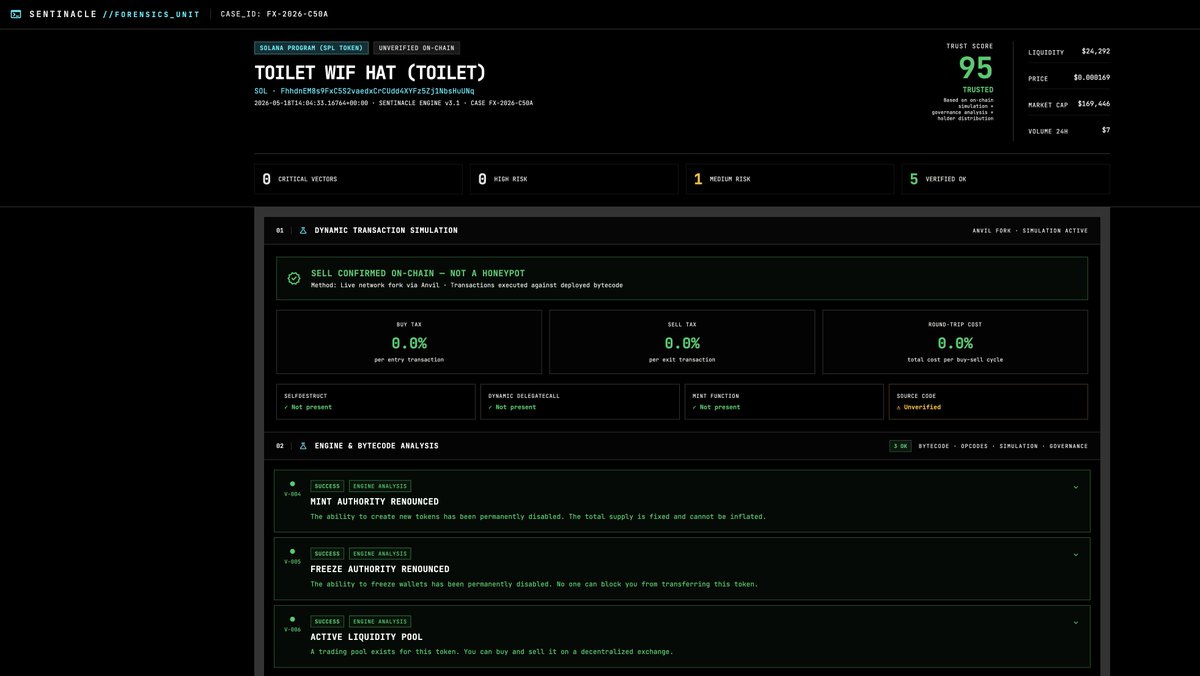
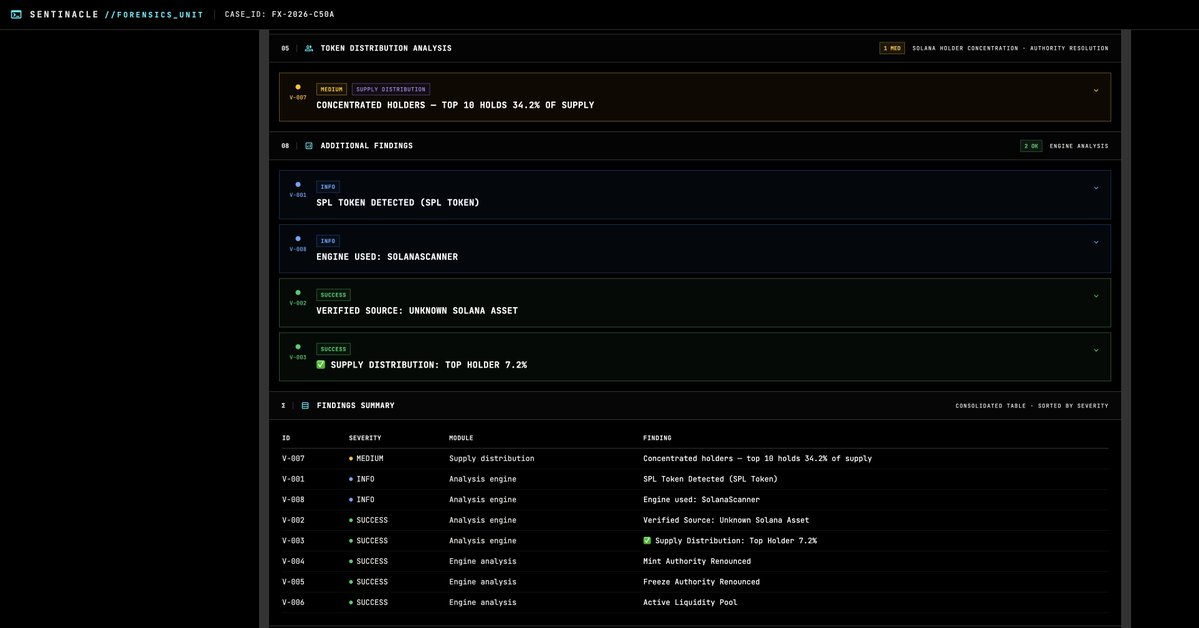
$TOILET A 95/100 forensic trust score guarantees architectural safety, but it cannot mask the structural exit risk of a 34.2% top-10 holder concentration. TOILET WIF HAT ($TOILET) operates on Solana as a standard SPL token. Current market cap is $169K with a highly shallow $24.2K liquidity pool. Our dynamic transaction simulation via an Anvil live fork confirms a clean 0% buy/sell tax model. Engine analysis verifies both Mint and Freeze authorities are permanently renounced. No privileged functions can be executed unilaterally. A standard DeFi smart contract audit easily clears these baseline architecture checks. However, a true crypto risk assessment reveals the execution hazard. With only $24K in the active pool, those top 10 concentrated wallets control enough supply to instantly drain the AMM. The code is safe. The liquidity profile is a trap door. Are you calculating the slippage of a whale exit against this curve, or just blindly deploying capital based on a renounced contract? Telemetry only. NFA. #SmartContracts #OnChainAnalysis #Solana #DeFi #CryptoSecurity #OnChain #SmartContracts #RugPull #DeFiRisk
@Sentinacle tweet media@Sentinacle tweet media@Sentinacle tweet media
English
1
3
5
111
@Sentinacle
@Sentinacle@sentinacle·
The Layer 1 structural diagnosis is public; operational intelligence requires credentials. Access the terminal to unlock the integral forensic dossier: 🔗 sentinacle.com
English
0
0
1
49
@Sentinacle
@Sentinacle@sentinacle·
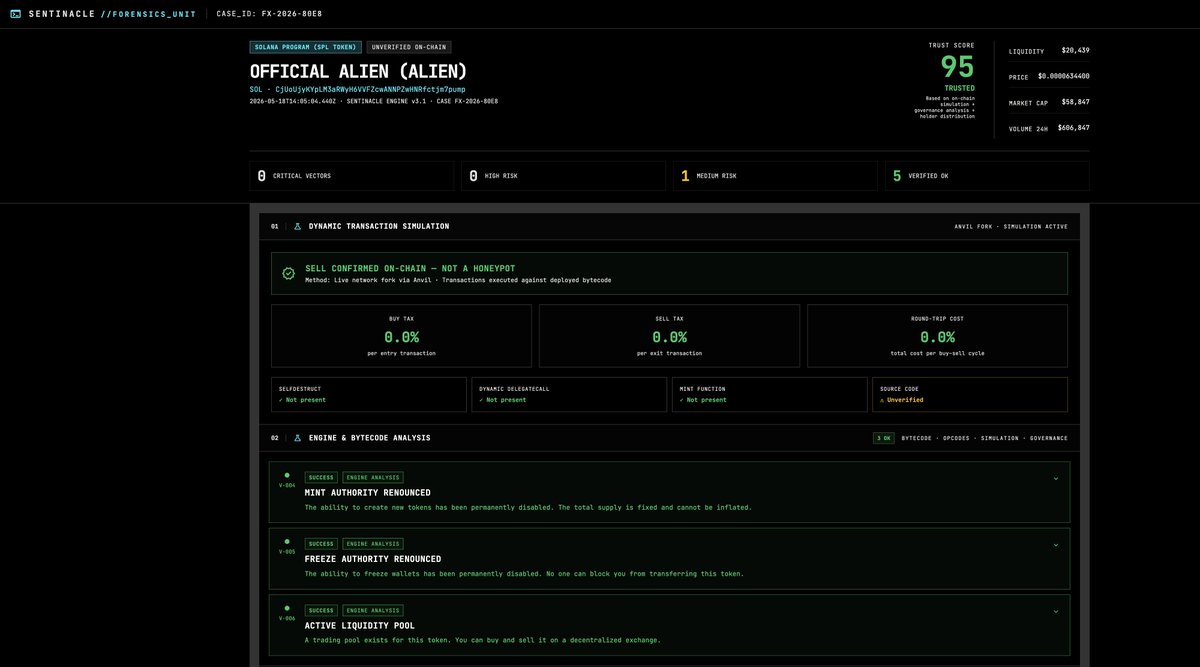
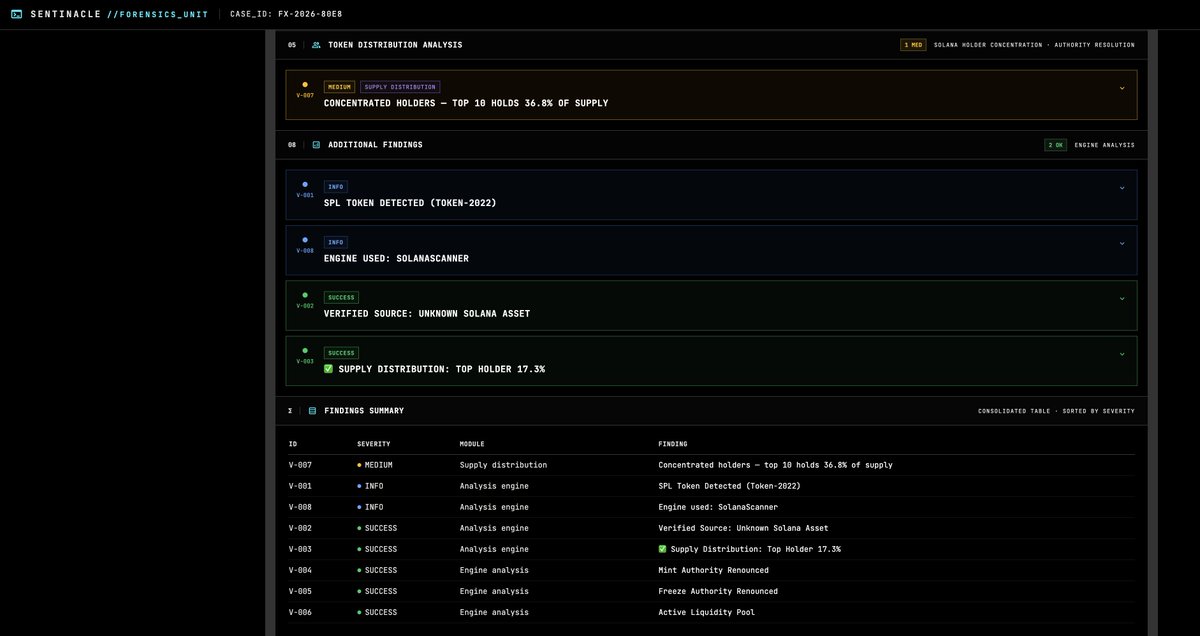
$ALIEN The top 10 wallets control 36.8% of the supply, yet the base architecture flags as strictly compliant. 🧵 OFFICIAL ALIEN ($ALIEN) sits at a 95/100 Sentinacle Trust Score on Solana. Liquidity is razor-thin at $28,439 against a $58k market cap, but it's driving $500k+ in 24h volume. Forensic dissection reveals a locked perimeter at the protocol layer. Mint authority? Renounced. Freeze authority? Renounced. Buy/sell taxes? Simulated live on an Anvil fork at exactly 0.0%. It clears the baseline for a rapid crypto risk assessment, behaving strictly as an immutable SPL token. But the institutional risk lies in the distribution and visibility. The top individual holder commands 17.3% of the total supply. Furthermore, the source code remains unverified on-chain. Our engine relies purely on bytecode analysis to confirm the absence of honeypot mechanics. A clean DeFi smart contract audit on the execution layer does not negate the sheer impact of centralized whales. The contract won't trap you, but the supply distribution might. Are LPs accurately pricing in the severe slippage risk of a single 17% entity market-selling into a $28k pool? Telemetry only. NFA. #SmartContracts #OnChainAnalysis #Solana #DeFi #CryptoSecurity #OnChain #SmartContracts #RugPull #DeFiRisk
@Sentinacle tweet media@Sentinacle tweet media@Sentinacle tweet media
English
1
2
3
177
@Sentinacle
@Sentinacle@sentinacle·
The Layer 1 structural diagnosis is public; operational intelligence requires credentials. Access the terminal to unlock the integral forensic dossier: 🔗 sentinacle.com
English
0
0
2
39
@Sentinacle
@Sentinacle@sentinacle·
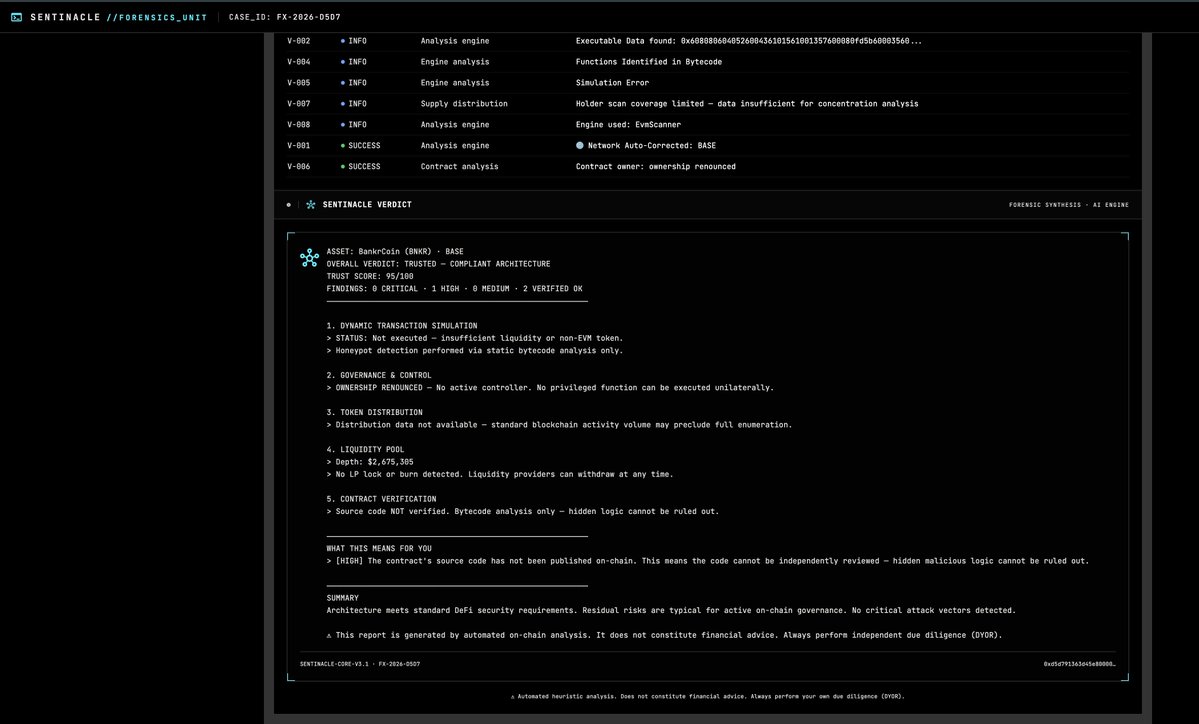
$BNKR Over $2.6M in liquidity is anchored to a protocol with completely unverified source code, yet the automated trust metric reads an imposing 95/100. 🧵 Let's unpack BankrCoin ($BNKR). Operating on Base with a $33.7M Market Cap and $1.4M in 24h volume, it holds a tangible market footprint. Sentinacle’s baseline Trust Score outputs a 95 (Trusted). The justification? Contract ownership is mathematically renounced. No active controller. Zero privileged functions can be executed unilaterally. But a rigorous crypto risk assessment requires piercing the surface-level governance data. Dynamic transaction simulations failed on the network fork. Our engines were forced to default to static EVM bytecode analysis (0x60806040526004...). While the automated EVM scanner detected no standard honeypot markers in the raw instructions, a proper DeFi smart contract audit is structurally impossible without the source code. Institutional Insight: Renounced ownership neutralizes future administrative tampering, but it cannot erase native architecture flaws. Hidden, malicious execution logic embedded within the unverified compilation cannot be categorically ruled out. Are LPs appropriately pricing the tail risk of unverified architecture when standard governance metrics appear bulletproof? Telemetry only. NFA. #SmartContracts #OnChainAnalysis #Base #DeFi #CryptoSecurity #OnChain #SmartContracts #RugPull #DeFiRisk
@Sentinacle tweet media@Sentinacle tweet media@Sentinacle tweet media
English
1
2
5
383
@Sentinacle
@Sentinacle@sentinacle·
The Layer 1 structural diagnosis is public; operational intelligence requires credentials. Access the terminal to unlock the integral forensic dossier: 🔗 sentinacle.com
English
0
0
1
107
@Sentinacle
@Sentinacle@sentinacle·
$TRAC 🧵 A $295M market cap asset operating with a Sentinacle Trust Score of just 12/100 reveals a catastrophic blind spot in current crypto risk assessment protocols. Trace Token (TRAC) commands institutional-level valuation on Ethereum, yet its underlying architecture remains a total centralization liability. Our deep-dive DeFi smart contract audit engines have dissected the on-chain bytecode to expose a critical structural vulnerability. A single un-renounced Externally Owned Account (EOA) controls the contract via wallet 0x8E80d171d... with zero multi-sig or timelock constraints. This private key can unilaterally trigger an unrestricted mint() function, allowing the owner to inflate token supply at will and dilute holders without warning. The forensic telemetry also identified highly non-standard operational constraints engineered directly into the contract logic. A TIMESTAMP_GATE pattern enables time-based transaction restrictions, while an EXTCODESIZE_ZERO_CHECK actively blocks automated trading tools and arbitrage bots. For risk managers, the math is lethal: a fragile liquidity depth of just $562,617 backing a massive $295M market cap means any supply inflation guarantees immediate pool drain. Are LPs severely mispricing this absolute centralization risk, or would you deploy capital under these parameters? Telemetry only. NFA. #SmartContracts #OnChainAnalysis #Ethereum #DeFi #CryptoSecurity #OnChain #SmartContracts #RugPull #DeFiRisk
@Sentinacle tweet media@Sentinacle tweet media@Sentinacle tweet media
English
3
2
10
982
@Sentinacle
@Sentinacle@sentinacle·
Public telemetry ends here. To query the full architectural vulnerabilities, authenticate at the main terminal: 🔗 sentinacle.com
English
0
0
1
47
@Sentinacle
@Sentinacle@sentinacle·
$BURNIE Zero buy/sell taxes and a top holder capped at just 3.9%—yet the source code remains strictly unverified on-chain. BURNIE SENDERS ($BURNIE) operates as an SPL-2022 asset on Solana, currently supporting a $6.4M market cap. Despite the unverified source, our automated crypto risk assessment yields a Sentinacle Trust Score of 95/100. Dynamic transaction simulation via an Anvil live fork confirms successful execution against the deployed bytecode. Both Mint and Freeze authorities have been permanently renounced. No active controller exists. For institutional risk managers running a baseline DeFi smart contract audit, the structural telemetry is clean. The $408k liquidity pool is active, and the absence of a mint function prevents unilateral supply inflation. However, bytecode analysis has its limits. Without verified source code, hidden programmatic logic cannot be categorically ruled out. Are LPs fully pricing in the delta between strictly renounced governance and unverified bytecode? Telemetry only. NFA. #OnChainAnalysis #SmartContracts #Solana #DeFi #CryptoSecurity #OnChain #SmartContracts #RugPull #DeFiRisk
@Sentinacle tweet media@Sentinacle tweet media@Sentinacle tweet media
English
1
2
3
315
@Sentinacle
@Sentinacle@sentinacle·
The Layer 1 structural diagnosis is public; operational intelligence requires credentials. Access the terminal to unlock the integral forensic dossier: 🔗 sentinacle.com
English
0
0
2
56
@Sentinacle
@Sentinacle@sentinacle·
$POPCAT 48.8% of the supply is controlled by just 18 wallets, yet structural integrity scores a near-perfect 95/100. 🧵 The asset is $POPCAT. A $57.5M market cap SPL token on Solana where retail momentum often masks the underlying mechanics. While market sentiment is driven by noise, strict crypto risk assessment reveals a surprisingly pristine architectural foundation. Sentinacle Trust Score: 95/100. Our dynamic transaction simulation executed against deployed bytecode on a live Anvil fork confirms a strict 0% buy/sell tax. Zero friction round-trip. Not a honeypot. Deeper forensic engine analysis confirms both Mint and Freeze authorities are permanently renounced. The supply is immutable. The ability to maliciously block user transfers at the protocol level is zero. But a comprehensive DeFi smart contract audit requires mapping the operational reality against the raw code. The source code remains unverified on-chain. We are navigating via bytecode execution mapping only. Hidden logic cannot be definitively ruled out by standard block explorers. The true vulnerability here isn't a malicious proxy or a governance-locked trap. It's the pure holder distribution. With the top wallet alone commanding 10.9% of the supply, the threat vector shifts drastically. For institutional risk managers and LPs eyeing the $3.58M liquidity pool, the primary risk is not a contract exploit—it is a synchronized liquidity exit. The architecture is undeniably compliant. The token distribution is heavily skewed. Are LPs accurately pricing this concentration risk before deployment? Telemetry only. NFA. #OnChainAnalysis #SmartContracts #Solana #DeFi #CryptoSecurity #OnChain #SmartContracts #RugPull #DeFiRisk
@Sentinacle tweet media@Sentinacle tweet media@Sentinacle tweet media
English
1
3
4
252
@Sentinacle
@Sentinacle@sentinacle·
The Layer 1 structural diagnosis is public; operational intelligence requires credentials. Access the terminal to unlock the integral forensic dossier: 🔗 sentinacle.com
English
0
0
1
39
@Sentinacle
@Sentinacle@sentinacle·
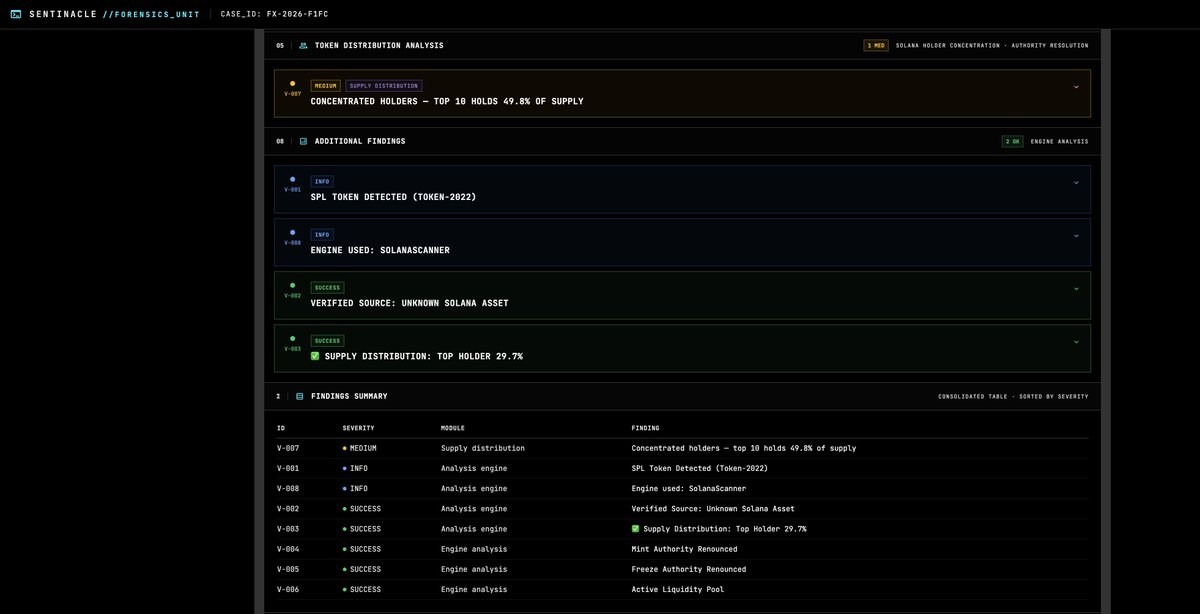
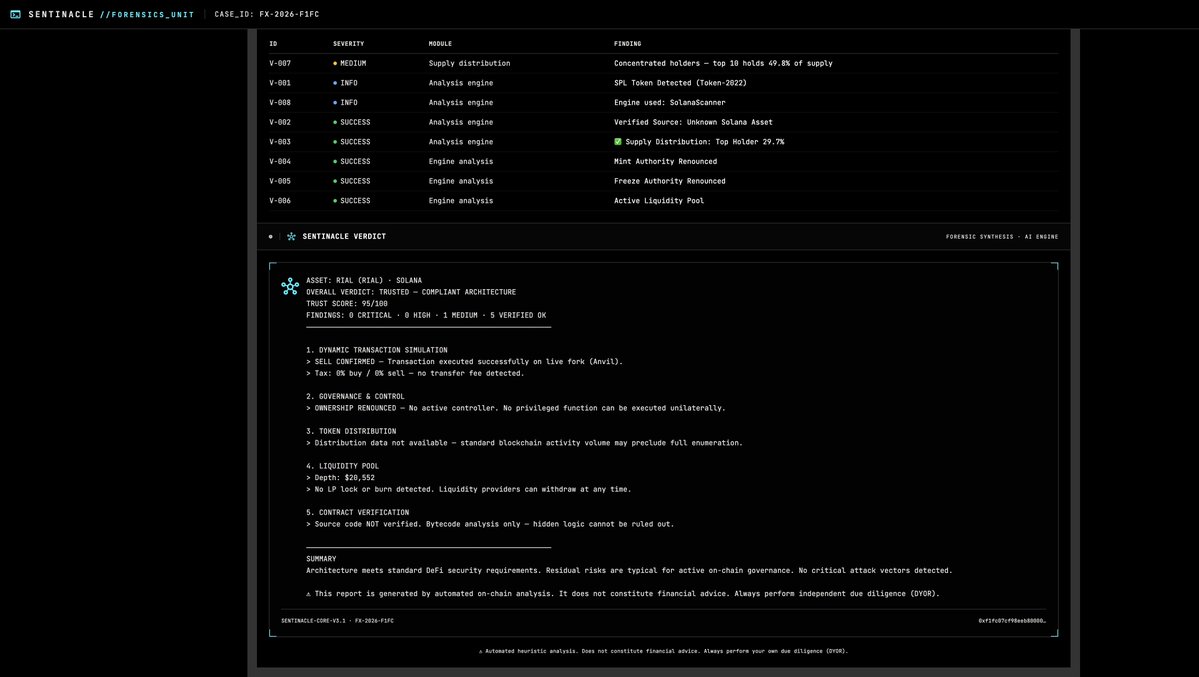
solana:C4j1kRxLhWzHCDEffhJQtEnfR7B1PKRhQHpmWpFzAUSA A 95/100 Trust Score is registered for RIAL, yet on-chain metrics show the top 10 wallets currently control exactly 49.8% of the total supply. 🧵 Operating as an SPL token on the Solana network, RIAL maintains $28.5k in active liquidity against a $34.5k market cap. To conduct this DeFi smart contract audit, our engine utilized a live Anvil fork to simulate transactions directly against the deployed bytecode. Transaction routing parameters are standard. Buy and sell taxes are confirmed at 0%, and sell execution is verified on-chain. Structural governance capabilities have been disabled. Both Mint and Freeze authorities are permanently renounced, ensuring a fixed supply and preventing targeted wallet freezing. The primary data point for risk managers is the current token distribution. The single largest holder retains 29.7% of the total supply. This level of concentration introduces specific liquidity exit risks and volatility parameters for participating LPs. Furthermore, the source code remains unverified. Our crypto risk assessment currently relies on bytecode analysis. While no standard malicious opcodes were detected during simulation, hidden logic vectors cannot be definitively dismissed without source verification. How do institutional LPs model risk for high-concentration assets operating with unverified source code? Telemetry only. NFA. #OnChainAnalysis #SmartContracts #Solana #DeFi #CryptoSecurity #OnChain #SmartContracts #RugPull #DeFiRisk
@Sentinacle tweet media@Sentinacle tweet media@Sentinacle tweet media
English
1
2
3
87
@Sentinacle
@Sentinacle@sentinacle·
Public telemetry ends here. To query the full architectural vulnerabilities, authenticate at the main terminal: 🔗 sentinacle.com
English
0
0
0
30
@Sentinacle
@Sentinacle@sentinacle·
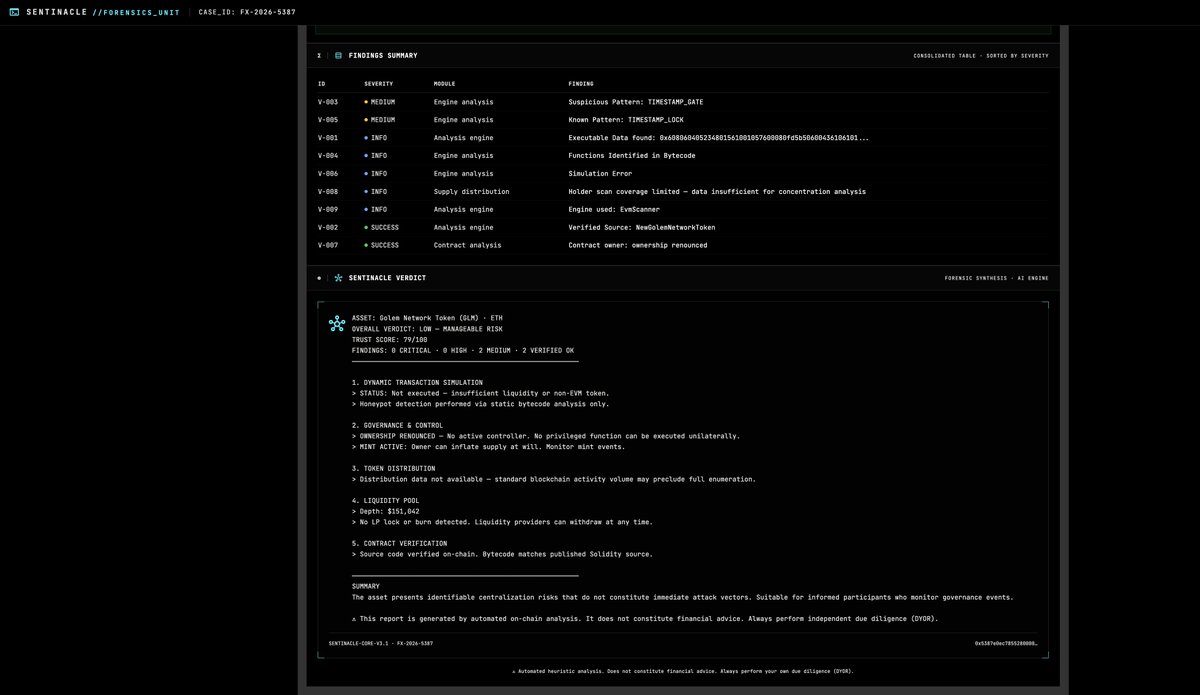
$GLM An immutable contract with an active mint function is an architectural paradox that breaks standard crypto risk assessment models. 🧵 Golem Network Token ($GLM). $118M Market Cap. A legacy decentralized compute asset on Ethereum. The Sentinacle Trust Score sits at 79/100 (Moderate). Public perception assumes established structural safety, but the bytecode tells a more complex story. Our recent DeFi smart contract audit of the asset highlights a severe governance contradiction. Ownership is cryptographically renounced. Zero active controllers. Yet, the static analysis engine explicitly flags an active mint function. Deeper inspection reveals TIMESTAMP_GATE and TIMESTAMP_LOCK anomalies hardcoded within the EVM opcodes. These time-based logic gates can arbitrarily restrict buy/sell operations to specific block windows, creating synthetic friction. Institutional insight: On-chain liquidity is remarkably shallow at just $151,042. This liquidity depth was insufficient for our Anvil fork dynamic transaction simulation to execute properly, forcing our engine to rely purely on static extraction. Without dynamic stress-testing, LPs are flying blind. You are exposed to theoretical supply inflation during unannounced, timestamp-locked trading halts. Are quantitative models accurately pricing in timestamp-gating risks on legacy tokens? Telemetry only. NFA. #SmartContracts #OnChainAnalysis #Ethereum #DeFi #CryptoSecurity #OnChain #SmartContracts #RugPull #DeFiRisk
@Sentinacle tweet media@Sentinacle tweet media@Sentinacle tweet media
English
1
2
3
93