Whitfield Lewis, MD 🇦🇬🇺🇸@whitfieldlewis6
Guys! Know this slide for your boards.
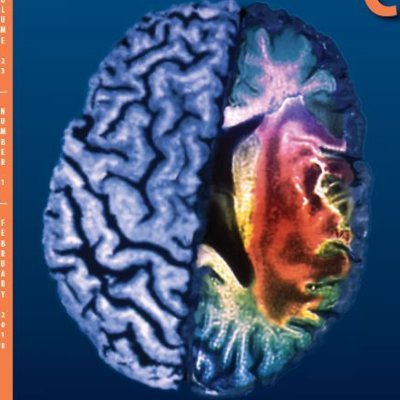
This is a histologic section of the rostral midbrain.
First, recognize the stain.
This is Luxol fast blue, which stains myelin.
Thus, myelinated white matter appears dark, whereas gray matter (cell bodies and nuclei) appears pale.
Even in this black-and-white image, that contrast is preserved.
The first image highlights the ventral tegmental area (VTA) in blue.
As I showed in my prior post using a gross specimen, the VTA appears relatively dark on direct inspection due to neuromelanin from active dopamine production.
This small collection of neurons plays a critical role in motivating behavior. It drives the reward response when an action is beneficial for survival, such as eating calorie-dense food or reproduction.
Unfortunately, in today’s environment of caloric excess, this same system is now a major driver of food addiction, along with other addictive behaviors.
There is always a push for balance in the body.
You eat. Satiety hormones such as GLP-1, CCK, PYY, and insulin rise. These signals reach the brain and tell you to stop.
GLP-1 receptors are widely distributed in the brain, including within the ventral tegmentum.
Here, GLP-1 helps modulate dopamine output. Food should feel rewarding, but not endlessly so.
As GLP-1 signaling increases, dopamine output from the VTA decreases.
Food becomes less rewarding, less pleasurable, and less palatable. You stop eating. You lose interest. That is the system working as intended.
This is a key part of how GLP-1 agonists like semaglutide (Ozempic) work.
They reduce the reward signal. And this effect is not limited to food. It likely explains why these medications can also blunt alcohol and cocaine cravings, by reducing the reinforcing dopamine signal that drives addictive behavior.
Now let’s walk the anatomy. This is testable.
P (red) → Periaqueductal gray
R (red) → Red nucleus
M → Medial geniculate body
L → Lateral geniculate body
S → Superior colliculus
Question for you:
Can you spot the MLF?
There is one more critical nucleus here.
If you lesion it:
Ptosis
Pupillary dilation
Impaired eye movement
Which nucleus is it?
Remember:
Cranial nerve nuclei III, VI, and XII are midline
And nuclei appear pale on this stain
Let’s keep building.
See my previous post on dopamine and the reward circuitry 👇👇
References:
Duke Neurosciences — Lab 2: Spinal Cord & Brainstem
PMID: 26675243