

Shadow Lord 👻
8.2K posts

Shadow Lord 👻
@shadowlord_VN
Community Builder
California, USA Katılım Ekim 2023
1.4K Takip Edilen2.2K Takipçiler


**Poker Night Announcement**
Another poker night is coming!
🃏 **When:** Friday, 20 March 2026 at 21:00
🔔 Button will be published 2 hours before start
📝 **Register here:** #register (read channel instructions first, then click play to complete)
@SeismicSys
@Heathclcliff @Verified
@NoxxW3

English
English

Prismax Project – Building the Infrastructure for the Physical AI Era
While language models have transformed the digital world, the next wave of AI is moving beyond text and images.
Artificial intelligence is starting to interact with the real world through robots, sensors, and physical environments.
The Prismax project aims to build the infrastructure for this new era a foundation where robots, data, and humans are connected in a single ecosystem designed for Physical AI.
✨ The Vision: A Base Layer for Real-World Intelligence
One of the biggest limitations in robotics today is fragmentation.
Each company:
Collects its own data
Trains its own models
Builds its own control systems
As a result, robot intelligence does not scale the way language models do.
Prismax is designed to solve this by creating a shared service layer for robotics, where:
Robots can share data
Models can be reused
Humans can control robots remotely
Data can continuously train foundation models
The long-term goal is to create a system where robot intelligence improves over time across deployments.
✨ The Three Pillars of Prismax
Prismax is built around three core components.
Data – Fuel for Robot Intelligence
Unlike LLMs, robotics suffers from a lack of large-scale training data.
Language models have trillions of tokens.
Robots only have limited hours of real-world interaction.
Prismax builds a data engine that collects information from:
Real robot operations
Human demonstrations
Teleoperation sessions
Simulation environments
This data is standardized and prepared for training robot foundation models.
Teleoperation – Humans in the Loop
One unique feature of Prismax is remote robot operation.
Users can:
Log into the platform
Control real robots remotely
Perform tasks
Generate training data
The system supports multiple robot types, including:
Robotic arms
Humanoid robots
Quadrupeds
Mobile robots
This creates a feedback loop:
Human → Robot → Data → Model → Smarter Robot
Models – Foundation Models for Robotics
Prismax follows a flywheel approach:
More data → better models
Better models → more automation
More automation → more data
This cycle allows robots to move toward general-purpose intelligence instead of task-specific programming.
The goal is similar to what foundation models did for NLP and vision, but applied to the physical world.
@PrismaXai

Cao Thần Quang@caothanquang369
Robotics is no longer just about machines - it is becoming a real-world AI problem. 1️⃣ Main idea of the article The article Intro to AI for Robotics explains that the new wave of robotics is being driven by AI-native systems. Instead of relying only on fixed programming, robots are now being designed to see, understand, plan, and act in changing environments. 2️⃣ Why this matters A key point in the article is that traditional robots work well only in highly controlled settings. But in the real world, conditions are never perfectly stable. Objects move, lighting changes, and environments are unpredictable. That is why robotics today is shifting from rigid automation to adaptive intelligence. 3️⃣ How modern robotics works The article describes robotics as a continuous loop: observe → plan → act → observe again This is important because it means robots are no longer just following pre-set instructions. They are learning how to adjust their actions based on what is happening in real time. 4️⃣ The role of AI One of the strongest ideas in the article is that AI helps robots move beyond simple rule-based behavior. With end-to-end learning, robots can learn from data and past actions, then decide what to do next. This makes them more flexible and much closer to operating effectively in real-world situations. 5️⃣Why data is the real bottleneck The article also points out that the biggest challenge in robotics today is not only hardware — it is data. To train robots well, companies need large amounts of high-quality real-world data. This is often collected through teleoperation, where humans control robots remotely so the system can learn from those examples. 6️⃣ A practical perspective Another valuable point is the difference between viral robot demos and real business value. Flashy movements like dancing or flipping may look impressive, but they do not always solve useful problems. The article suggests that the true potential of robotics lies in practical tasks such as: - cleaning - restocking - delivery - food preparation - manufacturing support 7️⃣ Overall analysis What makes this article strong is that it presents robotics in a clear, realistic, and business-focused way. It avoids hype and emphasizes what really matters: robots must be able to adapt, learn from data, and handle messy real-world environments. 8️⃣ Conclusion Overall, this article is a simple but insightful introduction to AI for robotics. Its central message is clear: the future of robotics will not be defined by how human-like robots look, but by how effectively they can solve real-world problems with AI. @PrismaXai
English

Amid complex infrastructure, heavy compute, and AI models 🤖⚙️, @ritualnet isn’t just about speed or technology, it’s about building things naturally, with rhythm 🌿
Siggy playing, blowing bubbles 🫧… just like how Ritual is creating small, light pieces of value step by step 🧩
Not loud, not rushed but everything has its place in a bigger picture 🌌✨
@RitualVietnam @joshsimenhoff @Jez_Cryptoz @ericgudboy

ngandoan99@DoanjNgan35654
Siggy is chilling on the journey with Ritual🍿 Watching everything pass by, while behind the scenes a quiet shift is happening AI becoming verifiable, on-chain, and truly useful 🚗🌿 No need for hype, @ritualnet is moving forward step by step. @RitualVietnam @joshsimenhoff @Jez_Cryptoz @ericgudboy
English

Confidential stablecoin payments on Tempo mainnet, powered by Fairblock, are now live and running successfully. From here, use cases like confidential payroll, corporate treasury management, merchant payments, and B2B transactions have officially gone live on mainnet.
Congrats to @tempo and Fairblock!
@0xfairblock

Fairblock@0xfairblock
Congrats to the @tempo team on the mainnet launch! Fairblock enabled confidential stablecoin payments on the Tempo testnet from day one, and we're excited to bring confidential payroll, corporate treasury, merchant checkouts, and B2B payments to mainnet.
English

📢Last night’s Physical AI & Robotics Salon at Stanford left me with one clear takeaway: real progress in robotics is coming from first-principles system design, not just hype.
Here’s what stood out to me most 👇
1️⃣ Robotics is still a full-stack systems problem
🔹The core question across both sessions was simple: what actually determines how robots move, learn, and scale?
🔹The answer was not just better models, but the tight connection between hardware, control, data, and learning.
2️⃣ Actuator design matters more than people think
🔹Session 1 made it clear that actuators do not just create motion.
🔹They shape control quality, efficiency, responsiveness, and system limits.
“Better” hardware is not just more torque - it is better overall system behavior.
3️⃣ Small hardware choices create big downstream effects
🔹Topics like reflected inertia showed how deep engineering details directly affect robot performance.
🔹A lot of real progress in robotics comes from solving these hidden system-level tradeoffs.
4️⃣ Humanoids are interesting for practical reasons
🔹Session 2 showed that humanoids are not just gaining attention because they look familiar.
🔹They matter because the world is already built for the human form, which makes them a practical interface for real environments.
5️⃣ Hardware, data, and models cannot be separated
🔹This was probably the biggest theme of the night.
🔹Hardware decisions shape:
- what data can be collected
- how models can be trained
- and what capabilities are even possible
In robotics, the body directly affects the intelligence.
6️⃣ Vision and simulation are useful, but not magic
🔹Integrating vision into control is not just about perception - it is about turning perception into reliable action.
🔹And while simulation helps with speed and scale, it still breaks when real-world complexity shows up.
7️⃣ The Q&A and historical comparison added real depth
🔹The extended Q&A pushed into edge cases and practical constraints, which made the discussion feel far more grounded.
🔹The comparison from the MIT Mini Cheetah to today’s systems was also a great reminder that robotics progress has come from years of improvements across the full stack, not one isolated breakthrough.
Robotics progress today feels less like a race for bigger AI models, and more like a race to build better integrated systems. The teams that win will likely be the ones that understand how mechanical design, control, perception, and learning all work together.
@PrismaXai

Nana | VN (❖,❖)@elliei43134
💥Teaching robots with labels is like teaching humans by memorizing answers - it works, but it never truly scales. 🔷GR00T Part 2 - Labels Without Labels (Refined X Post) 1️⃣ The Bottleneck of Supervised Learning Supervised learning has powered modern AI - but it breaks in robotics: - Labeling real-world data is expensive and time-consuming - Many actions (e.g., “grasp gently”) are hard to define precisely - Static labels fail to capture dynamic, physical interactions ➡️ As robots move into the real world, labeled data becomes the main limitation, not the model 2️⃣ A Shift to Self-Supervised Learning Instead of relying on human annotations, models learn directly from raw data: - Predict future frames in a video - Reconstruct missing or corrupted inputs - Learn temporal consistency across sequences 👉 These objectives may seem simple—but they force models to learn how the world actually works 3️⃣ Learning Representations, Not Categories The goal is no longer to assign labels, but to build meaningful representations: - Encode visual + physical structure - Capture relationships between objects and actions - Organize the world into patterns and similarities 💡 Over time, the model forms an internal “world model” - a compressed, structured understanding of reality 4️⃣ Why This Is Naturally Aligned with Robotics Robotics is uniquely suited for this paradigm: - The world provides continuous streams of data (video, motion) - Every action produces feedback over time - Physics itself becomes a form of supervision ➡️ Instead of labeling data, we let models learn directly from experience 5️⃣ The Core Insight The goal is not to describe the world with labels - it is to learn a representation that makes the world predictable. Once this representation is strong: - New tasks require minimal additional data - Models can adapt across environments - Skills become reusable and transferable Final Line: The future of robotics won’t be built on labeled datasets - but on systems that learn by observing, predicting, and understanding the structure of the world itself. @PrismaXai
English

GM @PerleLabs Fam !!!
Everything is moving fast right now.
The airdrop check is officially live:
👉 register.perle.xyz
If you’ve been grinding through Season 1, now’s the time to check your allocation.
Feels like things are lining up quickly, snapshot done, airdrop checking live…
we’re getting closer to the $PRL TGE.
Good luck to everyone who participated.
Let’s see how this plays out
@PerleLabs
@stwghthaiquocx
@Eazyxbt
@alivinex2
@xlordiot
@ThiagoGoooooon

Otis (❖,❖)@09_thanh86106
Hello @PerleLabs Fam !!! Season 1 snapshot is officially complete What we’ve seen over the past phase isn’t just activity it’s proof of how strong the Perle community really is. Real users, real contributions, real data being built. Now everything is locked in. But let’s be honest… this doesn’t feel like an ending. It feels like the start of something bigger. Rewards, next chapters, new opportunities, all loading. The ones who stayed consistent will understand why it matters. For now, we wait. But not for long. @PerleLabs @stwghthaiquocx @Eazyxbt @alivinex2 @xlordiot @ThiagoGoooooon
English

All Shroomies are interconnected, each with its own task forming a single whole
@0xfairblock

English
AI Agents may work perfectly on a laptop.
But what happens when 100,000 users try to access them at the same time?
Session #6 goes beyond the tinkering phase and into real-world deployment.
Together with @boredabdel, this session will break down how to deploy AI Agents on Kubernetes (K8s) and what it takes to make them scalable, reliable, and production-ready. 👇
🗓️ March 31, Tuesday
⏰ 20:00 TRT | 19:00 CEST | 17:00 UTC | 01:00 PM ET
📍 Set your reminder here: X Live
See you there!
@ericgudboy
@ritualfnd
@joshsimenhoff
@Jez_Cryptoz
@SaintLee04

Nana | VN (❖,❖)@elliei43134
Ritual is a technology project built around the idea of depth, structure, and symbolic connection. Inspired by the image of an ancient book, the project represents knowledge that is carefully preserved, layered, and passed forward with purpose. The visual identity combines a mysterious, classic aesthetic with a strong central symbol, reflecting both tradition and innovation. At its core, Ritual is about creating meaningful systems rather than temporary solutions. It suggests technology that is intentional, refined, and built with long-term value in mind. The name itself evokes focus, discipline, and repeated excellence-turning complex ideas into a clear and powerful experience. @ericgudboy @ritualfnd @joshsimenhoff @Jez_Cryptoz @SaintLee04
English

Congrats to the @tempo team on the successful mainnet launch! 🎉
From day one on testnet, Fairblock has powered confidential stablecoin payments.
Now we’re thrilled to bring privacy-first use cases to mainnet:
- Confidential payroll
- Corporate treasury management
- Merchant checkouts
- B2B payments
This unlocks fast, stable, and truly private on-chain payments — perfect for businesses and open finance.
Excited for what’s next from Tempo × Fairblock! 🚀
@0xfairblock @tempo

English

Grialo Fams !!!
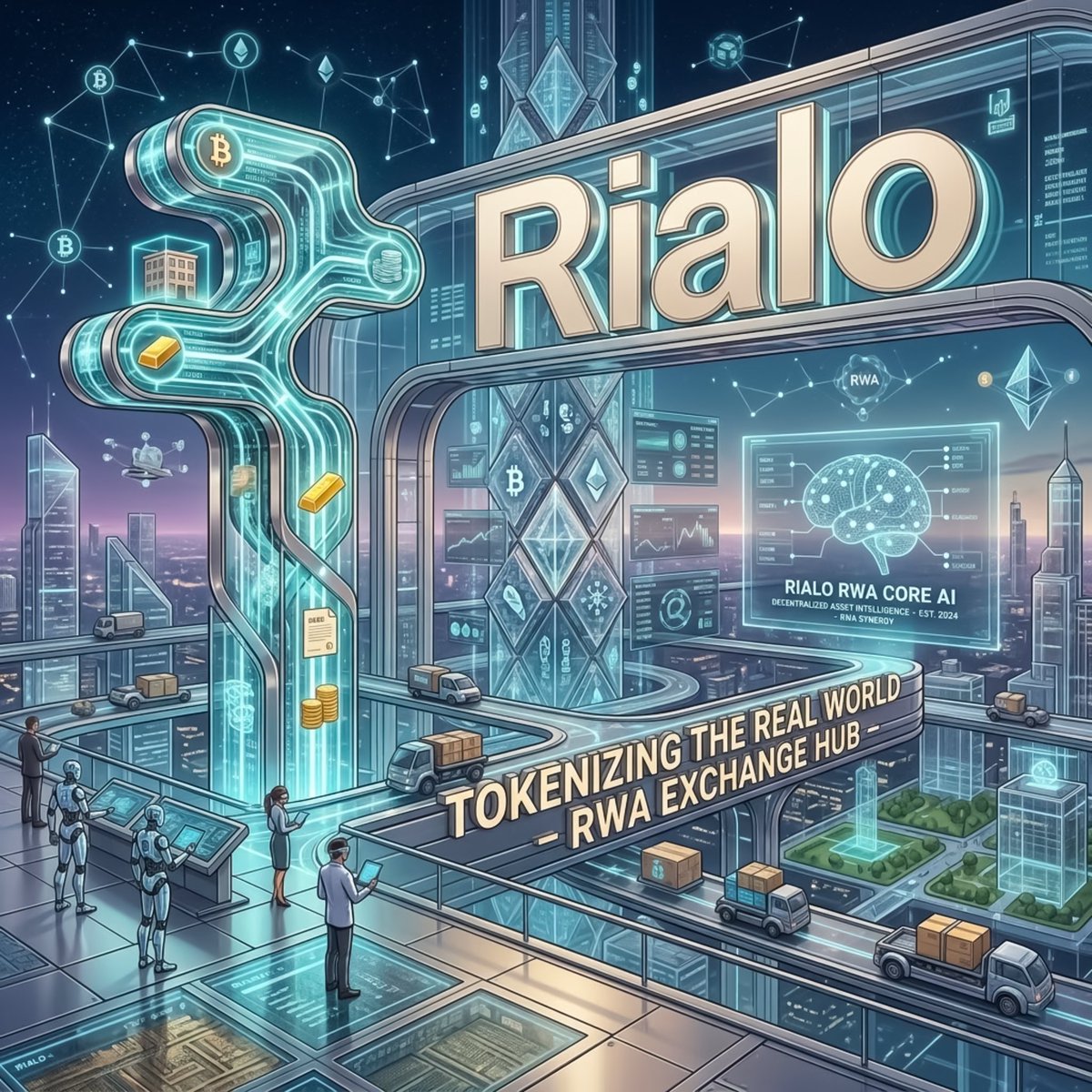
RWA isn’t just a trend it’s the bridge between real world value and Web3.
As the crypto market shifts toward real utility, Real World Assets (RWA) are emerging as one of the most important narratives. @RialoHQ is positioning itself right at the center of this transformation.
Unlike platforms that stop at basic tokenization, Rialo is building a full RWA Exchange Hub where assets like real estate, commodities, and business cash flows can be digitized, traded, and managed transparently on chain.
What stands out is @RialoHQ integration of AI and data analytics to evaluate and optimize asset value. This helps address two of the biggest challenges in RWA: risk management and liquidity.
While ecosystems like Ethereum and Polygon provide the infrastructure layer, @RialoHQ is going a step further by focusing on a dedicated application layer for RWA.
If executed well, @RialoHQ could become a true bridge between traditional finance and Web3 where real-world assets are not just tokenized, but actively utilized to generate value.
Bulish On Rialo 🚀
@RialoHQ @aqccapital @Richardx122 @khant1506
Duno 🍌(❖,❖)@DngDZ16
In the race to bring real world assets on chain, many overlook a critical truth: tokenization is not the destination it’s just the outer shell. This is exactly the gap @RialoHQ is addressing by building infrastructure that directly connects real world data with Web3. Putting an asset on chain only creates a representation. For that representation to have meaning, it must be continuously fed with live data: NAV, exchange rates, interest rates, and the underlying asset’s status throughout its entire lifecycle, whether it’s being traded or used as collateral. The core issue lies in the mismatch between two worlds: blockchain is deterministic, while real world data is constantly changing. Without a reliable mechanism for real time updates, data quickly becomes stale. And that gap between on chain and off chain isn’t just a technical flaw it becomes systemic risk: mispricing, faulty liquidations, and liquidity imbalances. @RialoHQ tackles this by enabling smart contracts to call off chain APIs directly via HTTPS, making real time data a native part of on chain logic. This reduces latency and unlocks a new class of financial products tightly coupled with real world signals. The next phase of Web3 won’t be defined by how many assets are tokenized, but by how accurately and continuously they are maintained. Tokenization is the starting point. Data is the foundation of value and infrastructure like @RialoHQ makes it real. @RialoHQ @aqccapital @Richardx122 @khant1506
English


@0xBon7 @0xfairblock Nhìn gia đình nấm hạnh phúc quá sir ơi
Tiếng Việt

Back home after a laid-back trip… and yeah, it’s already wednesday 😅
Shroomie is on the way back to @0xfairblock
GIF
Bon@0xBon7
Happy sunday guys Take some time to touch grass this weekend guys, there are plenty of fun things waiting for you out there. Sleep, relax, grab some good food… just do whatever makes you happy this weekend. (Credits to the amazing community artists whose artworks appear on the small posters in the background)
English
Tiếng Việt

Like an archaeologist lost in space ,I have found the rarest gemstone…
Not gold, not diamond, but @SeismicSys
@NoxxW3 - @xealistt - @heathcliff_eth

Junn (❖,❖)@junn_17425737
♟️ Seismic Chess Tournament is comingggg ♟️ Rocky isn't punching today… Rocky is playing chess! 😆 Are you guys ready? One wrong move and you're instantly "checkmate"! 📅 Wednesday 9:00 PM ⏳ Registration opens 2 hours in advance Remember to read the instructions carefully before joining, otherwise you'll be kicked out before you even understand what's going on! @SeismicSys @NoxxW3 - @xealistt - @heathcliff_eth
English

🧠 Product Research – Rialo (Day 29)
From Logic → To Agents
If blockchains start behaving like runtimes,
the next layer isn’t just logic.
It’s agents.
Not contracts waiting to be triggered, but systems that:
✅ observe the world
✅ make decisions
✅ take actions continuously
Traditional smart contracts are passive.
They execute *when called*.
But in a runtime-driven architecture like Rialo:
→ logic persists over time
→ state evolves continuously
→ execution is no longer momentary
This opens the door to **on-chain agents**.
Think about systems that:
• monitor price feeds and rebalance portfolios
• react to news events in real-time
• manage credit based on off-chain behavior
• coordinate supply chains without human input
The shift is subtle, but massive:
from "if X happens → execute Y"
to "continuously watch → decide → act"
At that point, we’re no longer writing contracts.
We’re designing behaviors.
And the blockchain becomes:
not a ledger, but an environment where autonomous systems live.
Rialo doesn’t just make this possible.
It makes it native.
And once agents become first-class citizens on-chain, the question is no longer:
"what can we build on blockchain?"
but:
"what systems can we let run by themselves?"
#Rialo #Web3 #Blockchain
@RialoHQ
@khant1506
@Richardx122
@aqccapital

nanini🍊,💊🍚 ⛓@Navtq0808
🧠 Product Research – Rialo (Day 28) If Blockchain Becomes a Runtime If blockchain evolves into a runtime, the focus shifts away from transactions and toward systems. It’s no longer about speed or cost. It becomes about: ✅ what workflows can run ✅what processes can operate autonomously ✅ what real-world systems can move on-chain Architectures like Rialo point toward this shift: from executing transactions → to running logic over time At that point, blockchain is no longer just infrastructure. It becomes a computational layer for coordinating real-world processes. #Rialo #Web3 #Blockchain #Infrastructure @RialoHQ @khant1506 @Richardx122 @aqccapital
English
Tiếng Việt
Some days, we are just like Siggy quietly existing in the middle of a fast-paced life, not needing to say much, just needing a moment to feel ourselves. We don’t always have to be strong or cheerful; sometimes, simply being who we are is already enough.
@ritualfnd
@joshsimenhoff
@Jez_Cryptoz
@ericgudboy

Cao Thần Quang@caothanquang369
Under the soft glow of shimmering lights, Siggy gently drifts across the calm water, enjoying every peaceful moment. No rush, no noise just the quiet ripple of the water and tiny glowing lights guiding dreamy thoughts. @ritualfnd @joshsimenhoff @Jez_Cryptoz @ericgudboy
English