Sharad Thaper

4.5K posts

Sharad Thaper

Sharad Thaper

@sharadthaper

New York, NY Katılım Nisan 2017
333 Takip Edilen12.7K Takipçiler
Sharad Thaper
Sharad Thaper@sharadthaper·
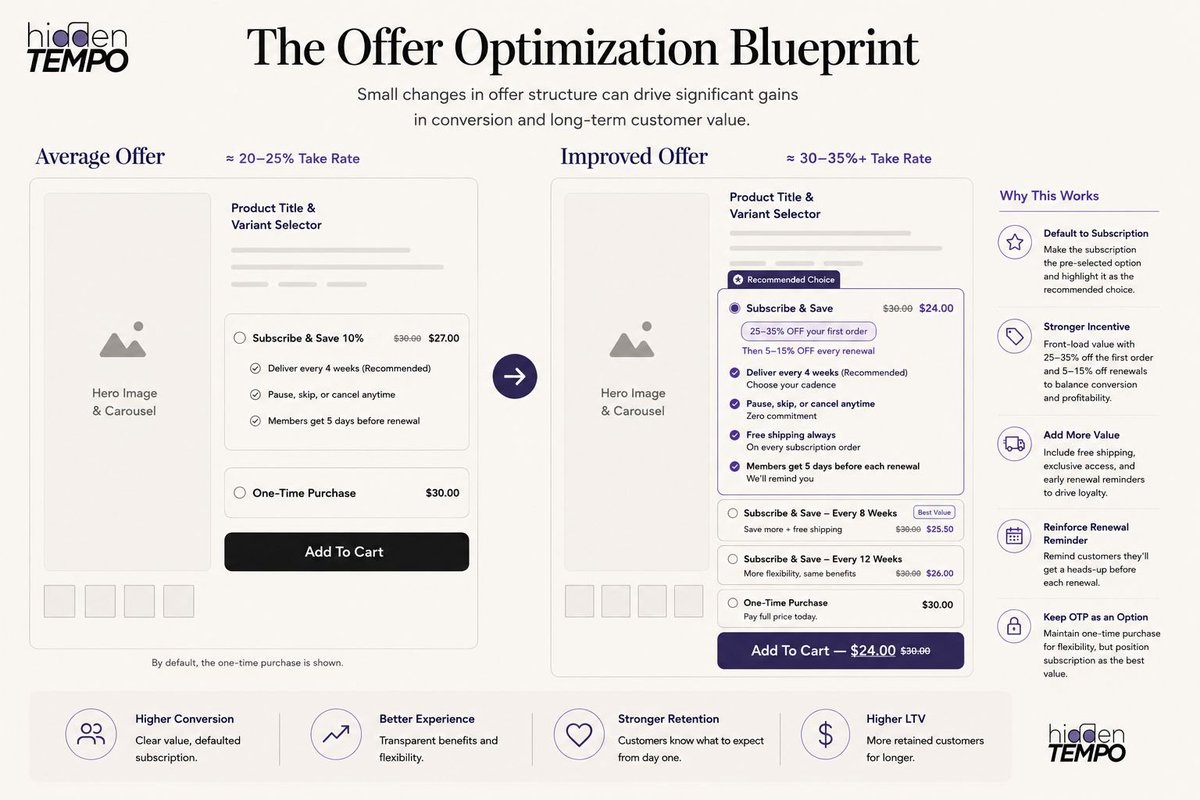
Structuring your subscription offer the right way has a dramatic impact on how many first-time buyers opt in. To go from the average 20% to 35%+ take rate, optimize your product page as follows: 1. Default to subscriptions (don’t leave it to chance and have users actively opt into it) 2. Front-load the incentive (strong offer for the first order) 3. Show flexibility and remove risk from subscribing (show ability to skip, pause, cancel and any money back guarantee) 4. Improve choice architecture (multiple subscription options that anchor on the middle option) 5. Make value obvious (not just price) 6. Match customer behavior (match cadence to how customers actually use the product)
Sharad Thaper tweet media
English
2
0
8
1.4K
Sharad Thaper
Sharad Thaper@sharadthaper·
@kamal_razzak In a similar situation. Client's new agency has launched brand awareness ads for a low 8 fig brand. Many outdated media buying strategies still being used even today.
English
0
0
1
138
Kamal Razzak
Kamal Razzak@kamal_razzak·
Media buying is more important that I previously thought Lost a long term client (still friends w/ and helping them out) but they wanted a change up New agency has done everything backwards - turning off high cpa ads (some of these ads have spent multiple millions each), increasing spend on campaigns which naturally talk to returning customers. Account went from spending 25k a day w/ a 1.8 NCROAS Now spending less than 10k at a .7 NCROAS (overall MER is down too, ofc) dramatic difference and simply because they are media buying badly, they had the exact same tools we had (they have all my ads) - just fumbling it hopefully it turns out well as I want this brand to do well
English
10
0
19
2.7K
Taylor Lagace
Taylor Lagace@TaylorLagace·
That 10x ROAS screenshot on DTC Twitter is a raging red flag. Any brand that needs a 10x ROAS to survive has cost centres so broken and LTV so poor that they're getting quietly destroyed by their competition on every other front. The screenshot looks great. But the P&L is bleeding and every founder that sees it and thinks "I need to hit that" just got led straight off a cliff by someone optimizing for LinkedIn likes. We recently onboarded a brand running a 0.18 aMER target. Nobody's heard of that. It works because their LTV is through the roof and their cost centres are completely dialled in, which means they can outbid almost every competitor in their category and still hit their profitability goals. That is what winning actually looks like. A business so well built that you can afford to acquire customers at a price nobody else in your category can touch. Chasing a competitor's ROAS or trying to beat last year's number is the wrong game entirely. The right question is how low can I get my new customer aMER while still hitting my overall profitability goal. First, fix your LTV and your cost centres. Then go take every customer your competitors can't afford to bid on. The 10x ROAS guy won't even see you coming. PS - If you want someone to blow up your current strategy and rebuild it from the ground up, book a call. Fair warning though, we're going to ask questions your last three agencies never bothered to. Link's in bio.
Daniel Fazio@danielfazio

Give me the confidence of the guy flexing 10x+ ROAS on google ads but it’s actually all branded search

English
4
0
5
1.5K
Sharad Thaper
Sharad Thaper@sharadthaper·
A solid mini-VSL ad. 1. Strong unique mechanism tied to Native American rituals and backed by science 2. Opening could be a little stronger by promising a bigger payoff, but the ad works and has been scaling 3. Doesn't introduce the product until after 2 min in
English
1
1
15
1.5K
Sharad Thaper
Sharad Thaper@sharadthaper·
Great article. A few related thoughts: 1. A higher AOV isn't always the best idea. As your AOV increases, the audience pool that is likely to buy at that given moment shrinks. Sometimes it's easier to scale at a lower AOV. 2. Many times, more ad impressions are needed to convert that smaller audience at the higher price point, leading to higher frequencies and higher CACs (which is also being driven by the higher CPMr). However, a higher CAC isn't always a bad thing (see point 3 below)... 3. Not only do CRO and media buying need to be tied together, but retention and LTV modeling also need to be a part of the same conversation. It's easy to declare a “winner” based on CAC/ROAS/conversion rate, but that can be misleading if you’re not looking at the downstream effects of the ads, landing pages, and offers. Sometimes, a landing page variant with a higher CAC can lead to a better 3-month/6-month LTV.
Phil Kiel@PhilKiel

A brand told me they improved their offer structure, increased their first order AOV, shortened their payback period, sounds like a winner right? CAC went up with the higher offer, obvious right? CPMr started climbing, ok if payback was better right? But reach started to drop. Then their funnel started to dry up. New customer volume started to shrink. YoY growth was a distance memory. Read the full article to find out why →


English
2
2
16
3.6K
Sharad Thaper
Sharad Thaper@sharadthaper·
Posted a 4+ hour long video on building advertorials with AI on YT. Link in bio.
English
0
1
8
699
Jordan Menard
Jordan Menard@jordanhaswings·
@sharadthaper I’ve been playing with suno - AI can’t write lyrics at all. For the same reason I think it can’t write DR copy well on its own. Direct response doesn’t speak to the logical brain - it speaks to the lizard brain. And AI knows but it can’t “feel”
English
1
0
5
395
Jordan Menard
Jordan Menard@jordanhaswings·
"Claude by itself does not produce the greatest copy. Not even close. But in the hands of someone who is extremely skilled and knows what great copy actually looks like? It becomes a force multiplier that is hard to comprehend." this is exactly right. claude on it's own won't make anything worth running. claude in the hands of a capable, trained copywriter solves the biggest problem in copywriting - the time it takes to write. speed is everything - and claude + great copywriter = 1 great copywriter can produce what would take 20 great copywriters just 2 years ago.
Jason Akatiff@smaxor

Had a conversation with a copywriter friend of mine today about another copywriter who is world renowned. At least in our small space. I told him that this world class copywriter has gone all in on using Claude to write his copy. And watching his face he really looked shocked. And I think this is where people get it wrong. Claude by itself does not produce the greatest copy. Not even close. But in the hands of someone who is extremely skilled and knows what great copy actually looks like? It becomes a force multiplier that is hard to comprehend. This copywriter told me he wrote one of his best video sales letters a year or two ago. Took him the better part of six months. Six months of pain. Back and forth editing. Retooling. Ideating. All the things it takes to write copy that actually moves people. You know how long it took him to write the VSL he is MORE proud of than that one? 18 days. Let that sink in. It is not that Claude is writing the copy. The copywriter is writing the copy. He is just using Claude as a tool that lets him move 10x faster while maintaining the quality bar that made him world class in the first place. But here is the part nobody wants to hear. The reason it works is because HE knows what amazing copy looks like. He can spot when something is off. He can push it. He can shape it. He can feel when a line lands and when it falls flat. If you do not know what you are doing and you just ask an LLM to produce something for you, you have no idea whether what comes back is good or bad. Chances are it is OK. Maybe even decent. But it is far from amazing. And amazing is what separates good from great. You have probably heard it said that AI is not going to take your job. A human who knows how to use AI better than you is going to take your job. That is not a threat. That is just the reality of where we are headed. So here is what I think is coming over the next 5 to 10 years as we shift from the information age to the AI age. Love AI? Join us on free on Telegram. Link in first comment.

English
4
2
59
12.3K
Grace Kaajir
Grace Kaajir@Pretty_Doose·
@sharadthaper Started my email list yesterday 🥹 I have 10 subscribers already Baby steps
English
1
0
1
11
Sharad Thaper
Sharad Thaper@sharadthaper·
Most brands simply don't send enough emails. This is true in nearly all cases. However, there is one exception. Sending more emails works to a point. Then at a certain threshold, sending more emails to more segments has diminishing returns as your costs increase. Here’s how to figure out if you’re sending enough emails: 1. Create a segment of a random sample of your list 2. Divide the segment in half 3. Increase the sending volume of campaigns for one half of the segment while keeping the sending volume the same for the other half 4. Continue this holdout test for the next 30 to 60 days If more revenue is generated from the half with the increased sending volume, in most cases, it indicates that you’re not sending enough emails. Otherwise, it will demonstrate that increasing the number of emails will not mean more profit.
English
1
0
6
475
Sharad Thaper
Sharad Thaper@sharadthaper·
@hewhoships Yup a lower CAC may result in a lower LTV. Need to focus on the long-term view.
English
0
0
0
23
Anks
Anks@hewhoships·
@sharadthaper this is the trap nobody talks about. picking the variant that gets cheaper conversions can absolutely repel the customers who would've stayed for years. need to look at 90-day cohort behavior not just first click.
English
1
0
1
13
Sharad Thaper
Sharad Thaper@sharadthaper·
Have seen landing page tests where a variant with worse CAC actually led to better LTV over time. Easy to declare a “winner” based on CAC/ROAS/conversion rate, but that can be misleading if you’re not looking downstream.
Alex@heyitsalexP

Few in CRO will be honest about this (but Harry is): A deeper promo is always going to win a split test. Margin & LTV-dilutive tactics are some of the only quick CRO wins that are brand-agnostic. CRO "quick wins" kill LTV. You need the judgement to avoid these tests entirely.
English
2
1
7
2.1K
Sharad Thaper
Sharad Thaper@sharadthaper·
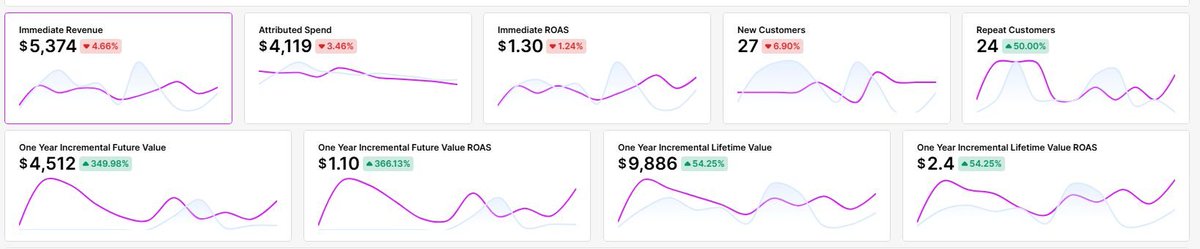
Stop looking at ad spend and ROAS in isolation. It's so important to look at the future value created by your current ad spend. This means looking at the LTV created by your current ad spend 3 months, 6 months, and 12 months into the future. Here's how: 1. Start with Attributed Spend This is what your platform thinks drove conversions ($4.1K here, trending down slightly). As a marketer, this is your baseline, and it tells you where credit is being assigned, not necessarily where value is created. 2. Immediate ROAS At 1.3x and slightly declining, this tells you that campaigns are still profitable/break even, but momentum is softening How to use it: Great for tactical decisions (budget shifts, creative tests) Don’t overreact to small dips (this metric is volatile) Pair with customer mix: fewer new customers = future risk 3. New vs Repeat Customers If the volume of repeat customers is rising but the number of new customers is falling, scale new customer acquisition. Immediate ROAS may look fine while future growth quietly declines due to the lack of new customers being acquired. 4. Incremental Value Understand how your campaigns are far more valuable than immediate ROAS suggests. How to use it: - Justify higher CAC on channels driving long-term value - Identify campaigns that look “meh” short-term but win long-term - Shift budget toward incrementality, not just platform attribution The playbook from this view: - Don’t optimize purely on immediate ROAS - Protect and scale campaigns with strong incremental lift - Fix new customer acquisition before it impacts future revenue - Use attributed spend as a guide, not a source of truth
Sharad Thaper tweet media
English
0
0
5
431