

Shelly Palmer
66.1K posts
Shelly Palmer
@shellypalmer
Prof of Advanced Media in Residence, Newhouse School, Syracuse University | CEO The Palmer Group | #ai #marketing #media
New York, NY Katılım Kasım 2007
2.5K Takip Edilen42.8K Takipçiler
My Sunday essay explores a winning leadership strategy developed in the 1950s by Air Force pilot John Boyd. He had a standing bet with his students: from any disadvantaged starting position in a one-on-one dogfight, he would beat his student in forty seconds or pay forty dollars.
The pattern became the OODA loop: Observe, Orient, Decide, Act. The pilot who cycles faster wins. "40-Second Boyd," as he came to be known, never lost a bet… but there's much more to the story.
shellypalmer.com/2026/05/ooda-l…

English
Mark this is serious idea worth engaging seriously. A few thoughts.
We already tax the providers. What you’re really proposing is a tax on data, specifically a per-unit tax on the artifact of computation. Most tax codes haven’t figured out that category yet. Your instinct that something here is undertaxed isn’t wrong.
The structural problem is tokens aren’t fungible. As you know, an input token isn’t an output token. A cached token isn’t a fresh token. A reasoning model token isn’t a Haiku token. A 3 a.m. batch token isn’t a real-time token. Pricing them identically in tax code would distort the market in ways that have nothing to do with energy or value. The labs would optimize the unit of measure. Energy use wouldn’t move.
On optimization broadly: the labs are already doing this aggressively. Inference cost per token has dropped roughly 100x in two years. The driver is margin. Fifty cents per million tokens doesn’t change that curve. It would just be a tax.
The math on $10B/year assumes today’s volumes, today’s pricing, and providers absorbing the cost rather than restructuring around it. Two of those three change on day one. I’d underwrite a much smaller initial number.
On open source as the escape valve: if you’re pricing an energy externality, it doesn’t disappear when inference moves to local hardware. It moves off the meter you’re reading.
If you want to price the externality, price the externality directly. Tax data center power draw. Tax water. Tax compute by FLOP. Those are physical, measurable, and they correlate with the actual harm. Tokens are an accounting unit. The physical world has things you can actually meter.
You’re pointing at something real, though. Governments haven’t caught up to where value gets created in an AI economy. That conversation is overdue.
Always up for this one on one. X isn’t the venue.
English

We should federally tax Tokens at the Provider level.
Not a lot. Less than 50c per million tokens.
It will accomplish 4 things (at least )
1. It will push the big AI players to optimize tokenization, caching , routing and localization
Which will
2. Reduce energy usage. Saving them in energy costs more than what they paid in tax and reducing strain created by the growth in energy consumption
Which will
3. Generate maybe 10 billion dollars a year to start, but over the next ten years could grow 30x to 100x
Which will
4. Create a source of funding to pay down the federal debt or deploy, in response to the things AI brings that we don’t expect or don’t like
At some point the models will pass it on to customers. Of course. That’s ok. Customers will have the ability to choose between providers. Or to do everything using open source models locally.
Thoughts ?
English
The other day, I asked Claude to reorganize 1,400 files across six project folders. I described what I wanted in plain English, walked away, and came back to a clean directory structure with every file renamed, sorted, and deduplicated. Just thinking about how long that would have taken me is what prevented me from doing it myself. One cup of coffee later, it was done.
shellypalmer.com/2026/05/claude…

English
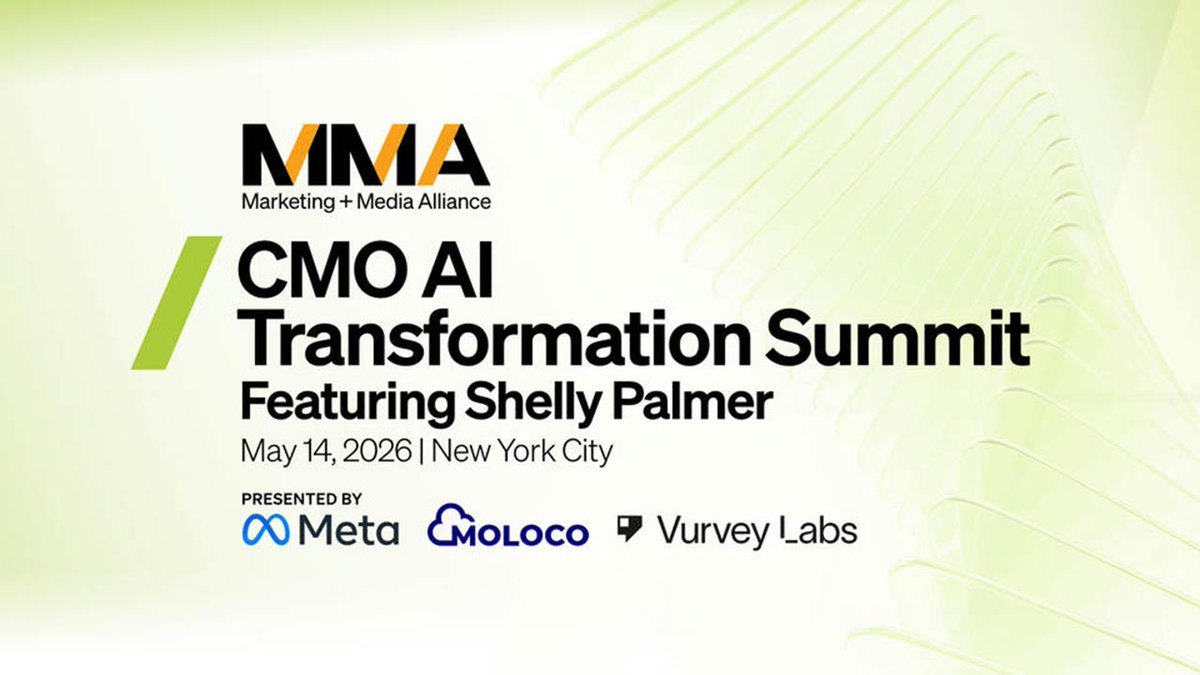
I want to tell you about the MMA CMO AI Transformation Summit that I’m hosting next week in New York City (May 14, from 9 a.m. to 1 p.m.). It’s a half-day, invitation-only gathering presented by Meta, Moloco, Vurvey Labs, and Bluefish.
Attendees will learn a little, teach a little, and spend the morning immersed in practical, actionable AI discussions. I can promise you an exceptional lineup of speakers and presenters. We’ll cover enterprise AI implementation, the rise of agentic consumers, and how to move from experimental AI projects to outcome-focused programs that drive measurable results.
By 1 p.m., you’ll have a clearer read on what to build, what to buy, and what to kill. The summit is peer-to-peer, senior-level, and deeply interactive by design. If you’re a CMO (or a senior marketing leader) looking to put AI to work, this will be a morning well spent.
Please request your invitation today. Seats are extremely limited.
mmaglobal.com/cmo-ai-transfo…
English
The deliverable is the atomic unit of business.
The memo, the deck, the analysis, the report, the brief, the model, the plan… these artifacts are so deeply embedded in how we work that we’ve stopped noticing them in the same way you stop noticing the foundation of a building until it cracks. Deliverables are how knowledge workers prove they worked, how managers justify headcount, how executives learn about the day-to-day without reading the raw data, and how entire careers are built and evaluated.
The deliverable is the load-bearing wall of corporate life, and AI is about to tear it down. My Sunday essay explores how.
shellypalmer.com/2026/05/from-d…

English