Shift Bioscience

126 posts

Shift Bioscience banner
Shift Bioscience

Shift Bioscience

@ShiftBioscience

Reversing aging by cell rejuvenation

Cambridge UK Katılım Aralık 2017
46 Takip Edilen1.5K Takipçiler
Shift Bioscience retweetledi
Daniel Ives
Daniel Ives@dives86·
I'm excited to be speaking at @RNID's Hearing Therapeutics Summit 2025, which is helping to speed the development of therapeutics for hearing loss and tinnitus. With a strengthening link between age related hearing loss and the underlying aging process, hearing loss has become a new test bed for cellular rejuvenation gene therapy. Find out more about the programme rnid.org.uk/hearing-resear…
Daniel Ives tweet media
English
0
1
3
449
Shift Bioscience retweetledi
Lucas Paulo de Lima Camillo
Lucas Paulo de Lima Camillo@lucascamillomd·
AI Virtual Cell vs Linear Model—who wins? 🤖 ⚔️ 📈 Our preprint, entitled "𝘋𝘦𝘦𝘱 𝘓𝘦𝘢𝘳𝘯𝘪𝘯𝘨-𝘉𝘢𝘴𝘦𝘥 𝘎𝘦𝘯𝘦𝘵𝘪𝘤 𝘗𝘦𝘳𝘵𝘶𝘳𝘣𝘢𝘵𝘪𝘰𝘯 𝘔𝘰𝘥𝘦𝘭𝘴 𝘋𝘰 𝘖𝘶𝘵𝘱𝘦𝘳𝘧𝘰𝘳𝘮 𝘜𝘯𝘪𝘯𝘧𝘰𝘳𝘮𝘢𝘵𝘪𝘷𝘦 𝘉𝘢𝘴𝘦𝘭𝘪𝘯𝘦𝘴 𝘰𝘯 𝘞𝘦𝘭𝘭-𝘊𝘢𝘭𝘪𝘣𝘳𝘢𝘵𝘦𝘥 𝘔𝘦𝘵𝘳𝘪𝘤𝘴", seeks to answer this question. Paper ▸ biorxiv.org/content/10.110… Code ▸ github.com/shiftbioscienc… 🎮 𝐋𝐚𝐜𝐤 𝐨𝐟 𝐜𝐨𝐧𝐭𝐫𝐨𝐥𝐬 Every wet-lab biologist knows that positive and negative controls are fundamental to assess whether an assay or experiment worked. However, the genetic-perturbation modeling field has been lacking these anchors to judge whether a model is actually learning the task. While the dataset mean is often used as a negative control, we propose an 𝐢𝐧𝐭𝐞𝐫𝐩𝐨𝐥𝐚𝐭𝐞𝐝-𝐝𝐮𝐩𝐥𝐢𝐜𝐚𝐭𝐞 baseline as a positive control, approximating the best achievable performance for a given dataset. 📐 𝐌𝐞𝐭𝐫𝐢𝐜 𝐦𝐢𝐬𝐜𝐚𝐥𝐢𝐛𝐫𝐚𝐭𝐢𝐨𝐧 With positive and negative controls, we analysed 14 perturbation datasets to see which metrics best separate the two. We call this difference the 𝐃𝐲𝐧𝐚𝐦𝐢𝐜 𝐑𝐚𝐧𝐠𝐞 𝐅𝐫𝐚𝐜𝐭𝐢𝐨𝐧 (𝐃𝐑𝐅). Strikingly, widely used metrics like MSE and Pearson Δ (relative to control) often show low DRF, indicating limited sensitivity to perturbation signals. Weighted MSE and normalized inverse ranking perform well. 🧠 𝐃𝐞𝐞𝐩 𝐥𝐞𝐚𝐫𝐧𝐢𝐧𝐠 𝐩𝐞𝐫𝐟𝐨𝐫𝐦𝐚𝐧𝐜𝐞 Using well-calibrated metrics, most deep-learning models outperform linear baselines—and even additive models on combinatorial tasks. This holds from GEARS and scGPT to MLPs built on foundation-model embeddings. Recently, a 𝐭𝐫𝐨𝐯𝐞 of papers has cast doubt on the utility of deep learning for building the so-called AI Virtual Cell. Here, we show these models learn useful biology when evaluated with well-calibrated metrics. Looking forward to the bright future of the field! Congrats to the first authors @Henrymiller2012, @g27182818, and @Fleblanc_3 for the absolutely fantastic work at @ShiftBioscience, alongside @BrendanMSwain and @BoWang87! 🔥
Lucas Paulo de Lima Camillo tweet mediaLucas Paulo de Lima Camillo tweet mediaLucas Paulo de Lima Camillo tweet mediaLucas Paulo de Lima Camillo tweet media
English
0
2
10
592
Shift Bioscience retweetledi
Henry E. Miller
Henry E. Miller@Henrymiller2012·
🚀 We’re hiring a Computational Biologist (Toronto) At Shift Bioscience, we’re uncovering the biology of cell rejuvenation to develop safe, effective therapies that reverse cellular aging 🧬 . Our platform integrates single-cell biology and machine learning to identify and validate rejuvenation factors that restore youthful function to aged cells. As a member of our Machine Learning team, you’ll coordinate closely with the wet-lab team, analyze large-scale genomics data, and help evolve our AI-based target discovery platform. What you’ll do 🛠️ ➡️ Build and maintain genomics pipelines (e.g., Nextflow) ➡️ Analyse scRNA-seq and DNA methylation datasets ➡️ Implement and apply aging clocks ➡️ Collaborate with wet-lab scientists to test hypotheses ➡️ Write clean, reproducible code and present results clearly The ideal candidate has a strong biology background, solid coding skills, and clear communication — experience with ML is a plus. Read the full job description here: bit.ly/shift-bio-cb-j… Send your CV and cover letter to cbhiring@shiftbioscience.com (Pictured): The rest of the ML Team (Myself, Lucas Camillo, Gabriel Mejia, and Francis Leblanc) and our advisor, Bo Wang #Rejuvenation #ComputationalBiology #Bioinformatics #MachineLearning #Longevity #Hiring #Toronto
Henry E. Miller tweet media
English
0
2
8
586
Shift Bioscience retweetledi
Bo Wang
Bo Wang@BoWang87·
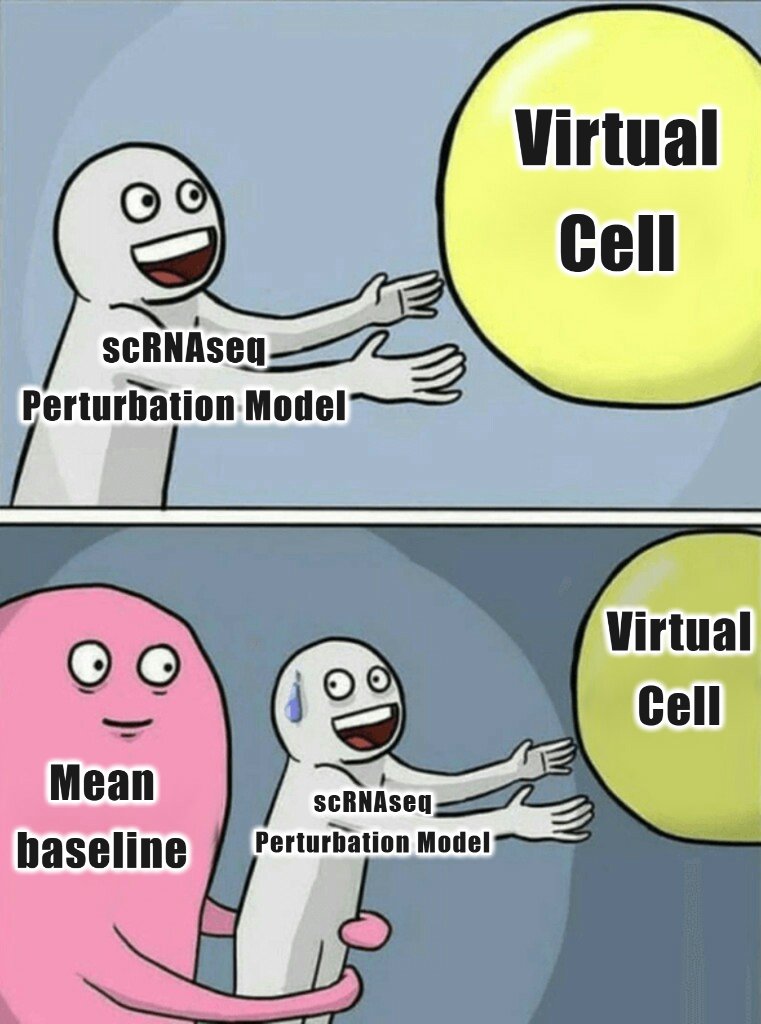
Do deep generative models in single-cell omics really work for perturbation prediction? Some benchmark studies say yes: 🔗 arxiv.org/pdf/2408.10609 🔗biorxiv.org/content/10.110… Others say no: 🔗 arxiv.org/abs/2410.13956 🔗 BMC Genomics: bmcgenomics.biomedcentral.com/articles/10.11… To move beyond this debate, we took a different approach—focusing on evaluation metrics. I’m excited to share a new preprint, just accepted at the ICML GenBio Workshop: “Diversity by Design: Addressing Mode Collapse Improves scRNA-seq Perturbation Modeling on Well-Calibrated Metrics” • 𝐏𝐚𝐩𝐞𝐫: arxiv.org/pdf/2506.22641 • 𝗖𝗼𝗱𝗲 & 𝗻𝗼𝘁𝗲𝗯𝗼𝗼𝗸𝘀: github.com/shiftbioscienc… 🧬 So, why do simple baselines sometimes outperform SOTA models? Because what we measure shapes what we discover. Our study shows that standard metrics can inflate the performance of naive models, hiding the true strengths and weaknesses of advanced approaches—and slowing progress toward robust “virtual cell” models. 🔎 What we found: • Commonly-used metrics often reward memorization or average prediction—allowing kNN or mean baselines to outperform deep generative models • Evaluations on random splits or with unweighted errors can miss a model’s ability to capture true biological effects • Many current benchmarks don’t truly test generalization to new perturbations—a core requirement for real-world virtual cell applications 🛠️ What we recommend: • Adopt rigorous, biology-aware evaluation—such as leave-one-perturbation-out splits—to test real generalization • Use metrics that reflect biologically meaningful differences, not just generic error rates 📈 Why it matters: Well-designed metrics and benchmarks are foundational for building the next generation of virtual cell models. Without them, we risk confusing artificial progress for real advances in biology and medicine. Huge thanks and congratulations to all the amazing co-authors: Gabriel Mejia, Henry E Miller, Francis Leblanc, Lucas Paulo de Lima Camillo and Brendan Swain!
Bo Wang tweet media
English
2
48
216
30.2K
Shift Bioscience retweetledi
Lucas Paulo de Lima Camillo
Lucas Paulo de Lima Camillo@lucascamillomd·
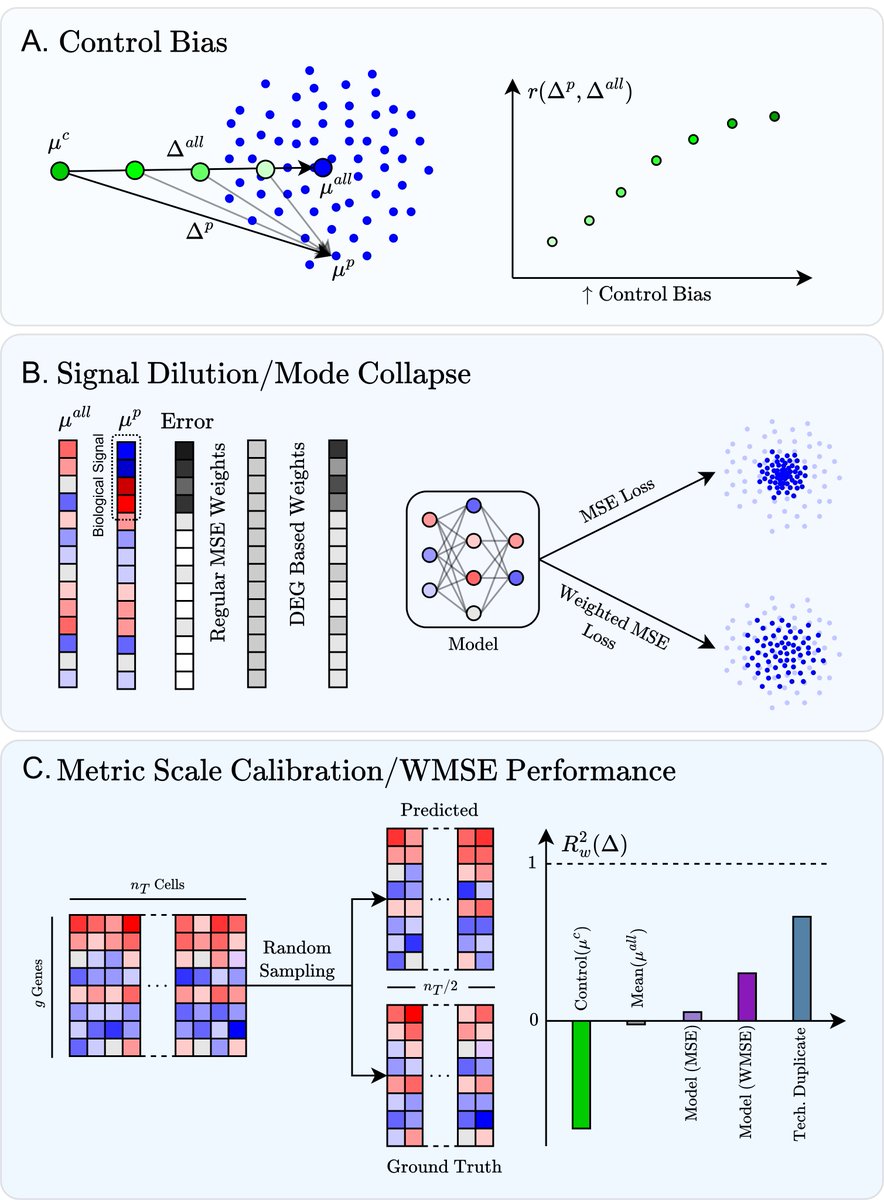
Are you trying to build a so-called AI virtual cell? 🔬 Yet ... the mean still outperforms your perturbation-response prediction model. 😮‍💨 Our paper— just accepted to the 𝗚𝗲𝗻𝗕𝗶𝗼 𝗪𝗼𝗿𝗸𝘀𝗵𝗼𝗽 @ 𝗜𝗖𝗠𝗟 —dives into 𝘸𝘩𝘺 the mean excels and what you can do about it. Paper ▸ arxiv.org/abs/2506.22641 Code ▸ github.com/shiftbioscienc… 🧪 𝗘𝘅𝗽𝗲𝗿𝗶𝗺𝗲𝗻𝘁𝗮𝗹 𝗳𝗮𝗰𝘁𝗼𝗿𝘀 We modelled perturbed single-cell RNA-seq data 𝘪𝘯 𝘴𝘪𝘭𝘪𝘤𝘰 to see which experimental variables inflate mean-baseline performance under common metrics (MSE and Pearson-Δ, computed for all genes and for the top-20 DEGs). Two stood out: 𝗰𝗼𝗻𝘁𝗿𝗼𝗹 𝗯𝗶𝗮𝘀 and 𝘄𝗲𝗮𝗸 𝗽𝗲𝗿𝘁𝘂𝗿𝗯𝗮𝘁𝗶𝗼𝗻 𝗲𝗳𝗳𝗲𝗰𝘁𝘀. Analyses of the datasets Replogle ’22 and Norman ’19 confirmed these trends: ↑ bias + ↓ perturbation effect = ↑ mean performance. 🏜️ 𝗠𝗲𝘁𝗿𝗶𝗰 𝗺𝗶𝗿𝗮𝗴𝗲𝘀 Pearson-Δ is usually referenced to control cells, introducing a systematic bias that lets the mean perturbed profile perform well. Our fixes: • 𝗪𝗲𝗶𝗴𝗵𝘁𝗲𝗱 𝗠𝗦𝗘 (𝗪𝗠𝗦𝗘), a DEG-weighted metric that can also be easily incorporate into model training. • 𝗪𝗲𝗶𝗴𝗵𝘁𝗲𝗱 𝗥² Δ, referenced to the 𝘮𝘦𝘢𝘯 𝘰𝘧 𝘱𝘦𝘳𝘵𝘶𝘳𝘣𝘢𝘵𝘪𝘰𝘯𝘴 instead of the control, capturing both the 𝘥𝘪𝘳𝘦𝘤𝘵𝘪𝘰𝘯 and 𝘮𝘢𝘨𝘯𝘪𝘵𝘶𝘥𝘦 of Δ without the control bias. 🔍 𝗖𝗮𝗹𝗶𝗯𝗿𝗮𝘁𝗲𝗱 𝗯𝗮𝘀𝗲𝗹𝗶𝗻𝗲𝘀 For fair evaluation, we suggest three anchors: 1. 𝗡𝗲𝗴𝗮𝘁𝗶𝘃𝗲 – control mean. 2. 𝗡𝘂𝗹𝗹 – mean of all perturbations; the bare-minimum a model should beat. 3. 𝗣𝗼𝘀𝗶𝘁𝗶𝘃𝗲 – 𝘵𝘦𝘤𝘩𝘯𝘪𝘤𝘢𝘭 𝘳𝘦𝘱𝘭𝘪𝘤𝘢𝘵𝘦: predict one half of a perturbation’s cells from the other half; an empirical upper bound set by the dataset noise. 🧠 𝗙𝗼𝗰𝘂𝘀𝗲𝗱 𝘁𝗿𝗮𝗶𝗻𝗶𝗻𝗴 = 𝗯𝗲𝘁𝘁𝗲𝗿 𝗯𝗶𝗼𝗹𝗼𝗴𝘆 Swapping MSE for WMSE lifted a perturbation model such as GEARS out of mode-collapse to capturing real biological variation—even in difficult zero-shot, unseen-gene settings. Centering Δ on the mean of all perturbations, using DEG-weighted losses, and benchmarking against these calibrated baselines offers a robust recipe for perturbation modelling. With 𝗔𝗿𝗰 𝗜𝗻𝘀𝘁𝗶𝘁𝘂𝘁𝗲’𝘀 𝗻𝗲𝘄 𝗩𝗶𝗿𝘁𝘂𝗮𝗹 𝗖𝗲𝗹𝗹 𝗖𝗵𝗮𝗹𝗹𝗲𝗻𝗴𝗲 kicking off, the community needs rigorous metrics and baselines more than ever—making this paper particularly timely. Shout-out to the co-first authors @Henrymiller2012 and @g27182818 for accelerating the discovery of cell rejuvenation genes @ShiftBioscience!
Lucas Paulo de Lima Camillo tweet mediaLucas Paulo de Lima Camillo tweet media
English
2
30
127
10.8K
Shift Bioscience retweetledi
Peter Ottsjö
Peter Ottsjö@peterottsjo·
🆕 New LEVITY episode is live! Why tune in? Because a 24-person Cambridge startup may have beaten the billion-dollar OSK race with a single gene found by AI-powered virtual cells - and the early data look game-changing. (Links as always below.) Just about the hottest thing in longevity science right now is partial reprogramming - using Yamanaka factors to rewind the biological clock in our cells. Billion-dollar giants like Altos, Retro, and New Limit are betting on it. But in this episode a far smaller player, Shift Bioscience, argues the field may be looking in the wrong place. In an exclusive interview CEO Daniel Ives explains how his team used AI-driven virtual cells to uncover one gene that seems to match OSK-level rejuvenation. Without the tumor risk that haunts classical reprogramming. Their just-released data could change aging research. 🔍 In this conversation: ✅ Daniel’s journey from mitochondrial PhD to founding Shift Bioscience. ✅ Why Yamanaka-factor partial reprogramming excites the field and why it’s risky. ✅ Epigenetic clocks 101 - Horvath, single-cell versions, what they really measure. ✅ Building AI “virtual cells” (transformers / GNNs) to run millions of in-silico experiments. ✅ Discovery of new rejuvenation factor sets - incl. SB000, a lone gene that rejuvenates without inducing pluripotency. ✅ Early wet-lab validation in fibroblasts & keratinocytes; mouse studies already under way. ✅ How inhibition targets (not just over-expression) could cut timelines from 15 yrs to ~5 yrs. ✅ Mapping a “risk landscape” of age-linked diseases and why fibrosis may be the fastest clinical entry point ✅ Funding Shift: from redundancy payout to a $16 M seed - and the next raise. ✅ Timelines, escape-velocity hopes, and where cryonics still fits. ✅ What Daniel would ask Jeff Bezos, and why pharma needs to “plug in” now.
Peter Ottsjö tweet media
English
7
20
83
4.4K
Shift Bioscience retweetledi
Prof Steve Horvath
Prof Steve Horvath@prof_horvath·
Genuine epigenetic rejuvenation in primary cells has long been the holy grail. A groundbreaking preprint reveals that over-expression of a single (secret) gene overcomes this barrier: greatly reduced age estimates across in fibroblasts and keratinocytes according to validated epigenetic clocks including the Skin&Blood clock (Horvath 2018) and the original pan-tissue clock (Horvath 2013). In keratinocytes, this gene decreased the pan-tissue clock by nearly ten years for each month of treatment! Longitudinal sampling confirmed age REVERSAL. This gene seems to outperform even the Yamanaka factors (OSKM) while crucially avoiding pluripotency induction and its associated cancer risks.  Lucas Paulo de Lima Camillo,  Daniel Ives,  Brendan M. Swain (2025) A single factor for safer cellular rejuvenation. biorxiv.org/content/10.110…
English
31
103
533
111.2K
Shift Bioscience
Shift Bioscience@ShiftBioscience·
@eythorarnalds @lucascamillomd 1. Confirm a broader range of cell types can be rejuvenated 2. Demonstrate rejuvenated cells exhibit the same behaviour as younger cells 3. Progress to proof-of-concept rejuvenation studies in mouse models
English
1
0
4
66
Shift Bioscience retweetledi
Lucas Paulo de Lima Camillo
Lucas Paulo de Lima Camillo@lucascamillomd·
Rare moments make you stop, stare, and imagine their future impact. I’m thrilled to share one of those moments from our work at @ShiftBioscience. Over the last few years, the data often felt unreal. Today we compare the single-gene SB000 (Shift Bioscience 000) with the gold-standard Yamanaka factors OSK(M). Key highlights -⏳ Efficacy – in fibroblasts, SB000 is comparable to OSK in transcriptomic rejuvenation, including decreased senescence markers, and it even outperforms the cocktail across dozens of epigenetic clocks. - ⛑️ Safety – SB000 preserves transcriptomic signatures of fibroblast identity and no pluripotent colonies are observed, in sharp contrast to OSK(M). - 🌐 Generalisability – Rejuvenation extends to cells from a different germ layer. In keratinocytes, PCHorvath2013 fell by over 10 years and DunedinPACE by more than 20% over six weeks. This is only a glimpse of what we’re cooking at Shift with @BrendanMSwain , @dives86, and the rest of the team. Super excited for the future of radical cellular rejuvenation! Paper: biorxiv.org/content/10.110…
Lucas Paulo de Lima Camillo tweet media
English
14
27
139
13.1K
Shift Bioscience
Shift Bioscience@ShiftBioscience·
RT @dives86: The dream of waking up in the near future and being substantially younger at a cellular level is something I have the rare pri…
English
0
4
0
18
Shift Bioscience retweetledi
Daniel Ives
Daniel Ives@dives86·
I’m excited to welcome Lord David Prior and Sir Tony Kouzarides to the team at @ShiftBioscience! Joining as Chair of the Board, David brings a wealth of Board experience, including as Chairman of NHS England, to support the Company’s long term mission to comprehensively reverse aging. Tony is a highly cited academic and entrepreneur, having co-founded both the Milner Therapeutics Institute and Abcam. As Scientific Advisor, Tony will help guide Shift’s scientific strategy and help raise awareness of Shift's cell rejuvenation approach to age-driven diseases. Full announcement here shiftbioscience.com/news/shift-bio…
Daniel Ives tweet media
English
0
2
18
1K
Shift Bioscience retweetledi
Daniel Ives
Daniel Ives@dives86·
I'll be speaking at Founders Longevity Forum in London on 10th June at OXO2! Let’s connect in London — whether you're building something new in Longevity biotech, investing in the future, or just curious about where the field is going next. Register your interest here: bit.ly/4lhvsYk
Daniel Ives tweet media
English
0
1
6
927
Shift Bioscience retweetledi
Daniel Ives
Daniel Ives@dives86·
I’m excited to be part of a #SynBioBeta2025 panel discussing breakthroughs in epigenetic reprogramming and how this could transform Longevity biotech. Let’s connect in San Jose — whether you're building the next big thing in Longevity biotech, investing in the future, or just curious about where biology is going next. Epigenetic reprogramming has rapidly become the hottest area in longevity biotech, attracting unprecedented attention and billions in investment in just the last two years. Building on Shinya Yamanaka's Nobel Prize winning iPSC reprogramming, a new wave of biotech startups are racing to extend the concept to therapeutically rejuvenate the cells in our bodies. This panel brings together the leading researchers and entrepreneurs of this field to explore the science and recent breakthroughs driving the excitement, the challenges of bringing these therapies to market, and the future of a field that could redefine what it means to age.
Daniel Ives tweet media
English
0
2
7
806
Shift Bioscience retweetledi
Vitalist Bay (May 14-17)
Vitalist Bay (May 14-17)@VitalistBay·
1/ We're thrilled to announce Shift Bioscience @ShiftBioscience as a sponsor of Vitalist Bay - our 8-week longevity zone dedicated to combating aging at the cellular level using groundbreaking AI technology. 🔬🧬💻
Vitalist Bay (May 14-17) tweet media
English
1
3
25
1.1K
Shift Bioscience retweetledi
Daniel Ives
Daniel Ives@dives86·
I’m excited to welcome Dr Jill Reckless and Dr Laurence Reid @laurence_reid to the Shift Bioscience team as Translation Advisor and Non-Executive Director respectively, to help advance our pipeline of rejuvenation therapeutics! Aging mechanisms are common to the majority of modern diseases and are being targeted by Shift to create a common therapeutic approach. With our AI-powered virtual cell delivering a critical mass of gene targets for cell rejuvenation, the major outstanding factors guiding therapeutic development are therapeutic modality and indication selection. Jill and Laurence will be invaluable in steering this latter selection process. Jill has more than 20 years' experience in translational biology. She is the co-founder and CEO at @RxCelerate , during which time she has successfully led drug discovery programs across a range of therapeutic indications and therapeutic modalities. In her role as Translation Advisor, Jill will work closely with our team to interpret our early research and guide the selection of new indications, strengthening our therapeutic pipeline. Laurence is an experienced biotech entrepreneur who has spent over 30 years in the pharma and biotech industries, specializing in strategic planning to develop discovery platforms for clinical translation and financing. Joining us as Non-Executive Director, Laurence will help to build out a robust business development framework, to harness proof-of-concept advances and support long-term Company growth. Read the full announcement here! shiftbioscience.com/news/key-appoi…
Daniel Ives tweet media
English
0
1
13
670