Will Connell

310 posts

Will Connell

Will Connell

@wilstc

predicting phenotypes 🖥🧬🔮 @transcriptabio

Katılım Mart 2016
952 Takip Edilen709 Takipçiler
Sabitlenmiş Tweet
Will Connell
Will Connell@wilstc·
🧬🔮 Single cell foundation models have been a recent hot topic in bio-ML! A few of the recent methods and some thoughts 🧬🔮 1) Geneformer 2) scGPT 3) scFoundation 4) Exceiver
English
4
59
253
51.9K
Will Connell
Will Connell@wilstc·
"We find that intra-complex interactions are largely conserved, whereas inter-complex relationships are extensively rewired, revealing new context-dependent genetic dependencies." 👏 💡rich resource for virtual cell benchmarking to disambig contextual-modeling vs coexpr-modeling
LukeGilbert@LukeGilbertSF

We mapped gene interactions across different environmental conditions (GxGxE) at scale for the first time in human cells. These maps lead to the realization that many genes function in a context dependent manner which provides insight into how humans have relatively few genes but many cell types. Congratulations Ben! Paper: cell.com/molecular-cell…
English
0
0
1
379
johnparkhill
johnparkhill@j0hnparkhill·
@jermdemo @wilstc I recently got my full seq done, but wouldn't be comfy with it floating around....
English
1
0
1
33
Will Connell
Will Connell@wilstc·
I built Scaling Biology 🧬 — a dashboard that live-tracks the volume and growth of key biological data sources across genomics, transcriptomics, and proteomics. The project is open to community contributions, check out the repo linked in footer wconnell.github.io/scaling-bio/
English
2
18
128
7.2K
Will Connell
Will Connell@wilstc·
@jermdemo any pointers toward resources that could help capture that stat?
English
1
0
1
169
Jeremy Leipzig
Jeremy Leipzig@jermdemo·
@wilstc i really wish we had more than 5000 truly public human genomes
English
2
0
6
319
Will Connell retweetledi
Xinming Tu
Xinming Tu@TuXinming·
1/13 Excited to share our (@anna_spiro @ChikinaLab @sara_mostafavi) latest preprint! 🧬💻 Personal Genome Prediction isn't just a downstream task—it’s the ultimate end-to-end benchmark for Variant Effect Prediction. We put the new SOTA AlphaGenome to the test and uncovered a striking "Modality Gap" between gene expression and chromatin accessibility. 📄 Link: biorxiv.org/content/10.648… 🧵👇
English
1
28
87
7.6K
Will Connell retweetledi
Ronghui (Ron) Zhu
Ronghui (Ron) Zhu@RonZhu2015·
Together with Emma Dann, we are thrilled to present a massive new Perturb-seq atlas of 22M primary CD4+ T cells, from 4 donors, across 3 timepoints – the result of a decade-long collaboration between the Marson (@MarsonLab) and Pritchard (@jkpritch) labs. 🧵👇
Ronghui (Ron) Zhu tweet media
English
4
52
240
38.3K
Will Connell retweetledi
Martin Borch Jensen
Martin Borch Jensen@MartinBJensen·
The recent breakthroughs from @nablabio & @chaidiscovery emphasize a split in early biotech strategy. For the specific range of problems that antibodies address, making the binder, is becoming trivial. This forces a choice between 'fast but competitive' and 'AI intractable'. 🧵
English
4
11
92
13.8K
Will Connell retweetledi
Sanju Sinha
Sanju Sinha@Sanjusinha7·
Most current drug discovery efforts is structure-based eg. create small molecules or antibodies that best binds X. However, a drug may not drive its efficacy from its strongest binder. Taking a step away from structure-paradigm, we reason that if a CRISPR knockout of a gene mimics a drug's effects across cancer cell lines, that gene is likely the drug's target. This was done in @EytanRuppin in collaboration with @anideshpandelab and @BenDavidLab Using this principle, we integrated drug and crispr profiles from 1000s of drugs to find their context specific targets (different cancers or when known target is not expressed but drug is yet killing cancer cells). We call this tool DeepTarget. We show that this approach outperforms current structure based methods (AF3, RF, Chai) to find drug's target in a genome-wide search, when we had no information on what the target might be. We benchmarked in eight gold-standard drug-target pairs. It took us months to get this benchmarks (we hope this benchmark helps the field) We present two experimentally validated cases and pls see the paper for this (link at the end). An intriguing observation is that we had many cases where we have many small molecules targeting the same gene (eg. EGFR) and we found that small molecules with higher predicted target specificity show greater clinical advancement. Very happy to hear your feedback. Here's the free access link: nature.com/articles/s4169…
Sanju Sinha tweet mediaSanju Sinha tweet mediaSanju Sinha tweet mediaSanju Sinha tweet media
English
9
52
204
46.8K
Will Connell
Will Connell@wilstc·
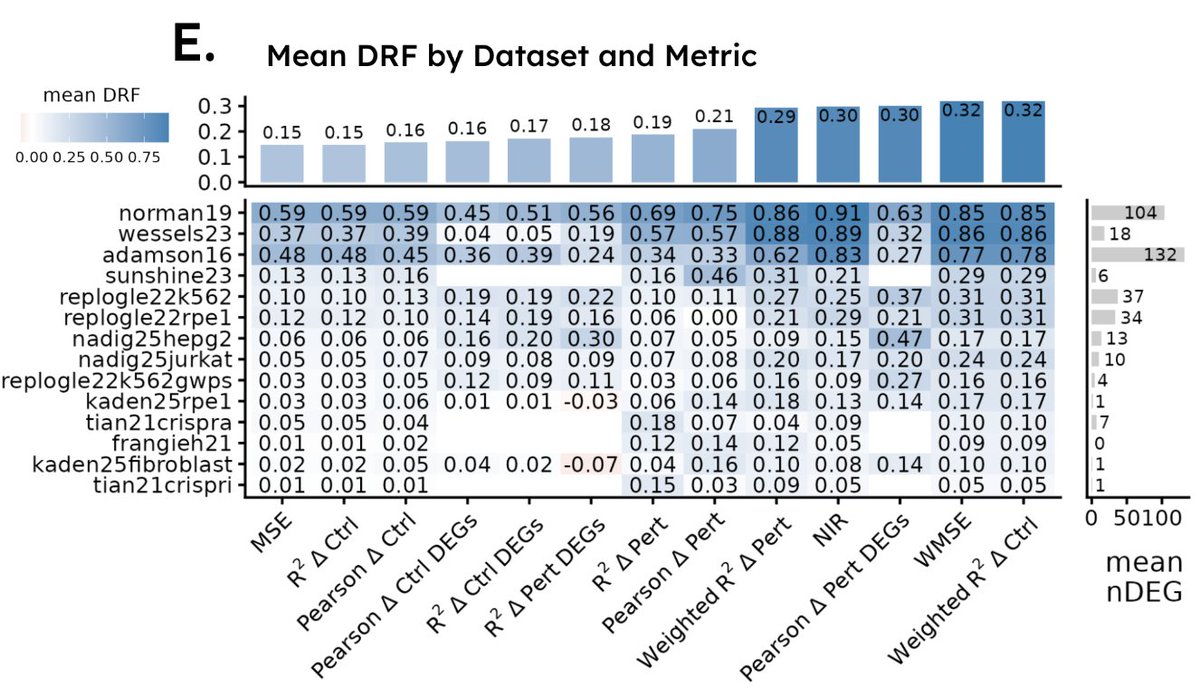
@anshulkundaje Metrics are one thing, but there are other major challenges with data. This paper designs improved metrics to highlight bio signal, but my takeaway is actually that most (perturb-seq) datasets have a very low prediction ceiling biorxiv.org/content/10.110…
Will Connell tweet media
English
2
2
11
3K
Anshul Kundaje
Anshul Kundaje@anshulkundaje·
@wilstc This is a very specific perturbation prediction task. It's not testing foundation models that r expected to solve many diverse tasks. It's very difficult to encapsulate even such focused biologically motivated objectives with a handful of metrics that cannot be gamed.
English
2
0
4
714
Will Connell
Will Connell@wilstc·
@anshulkundaje Yeah, this task is 1/n you expect such a model to perform well on. Creating community focus on evaluation strategies for this task is a very welcome outcome of the virtual cell challenge!
English
0
0
2
76
Will Connell retweetledi
Eli Weinstein
Eli Weinstein@EliWeinstein6·
We're excited to present LeaVS, a method to scale up learning for protein function models. It is based on the co-design of wet lab experiments and in silico training.
Eli Weinstein tweet media
English
4
11
53
10.5K
Will Connell retweetledi
Hani Goodarzi
Hani Goodarzi@genophoria·
Arc is hiring a unique role to lead the Virtual Cell Challenge. In its first year the Challenge has already attracted participation from thousands of top bio AI researchers and support from sponsors like NVIDIA. We need someone to help us make this annual competition historically impactful. The job is a mix of product, program, and community management, with collaboration across a wonderful and talented internal team at Arc. The Virtual Cell Challenge is modeled after CASP, which led to AlphaFold and a Nobel prize, and inspired by our board member Nat Friedman's Scroll Prize, which pushed the boundaries of applied machine learning. The person we hire for this role has an opportunity to make the Challenge something really special.
Hani Goodarzi tweet media
English
5
13
97
12.2K