Shephard Honzeri retweetledi

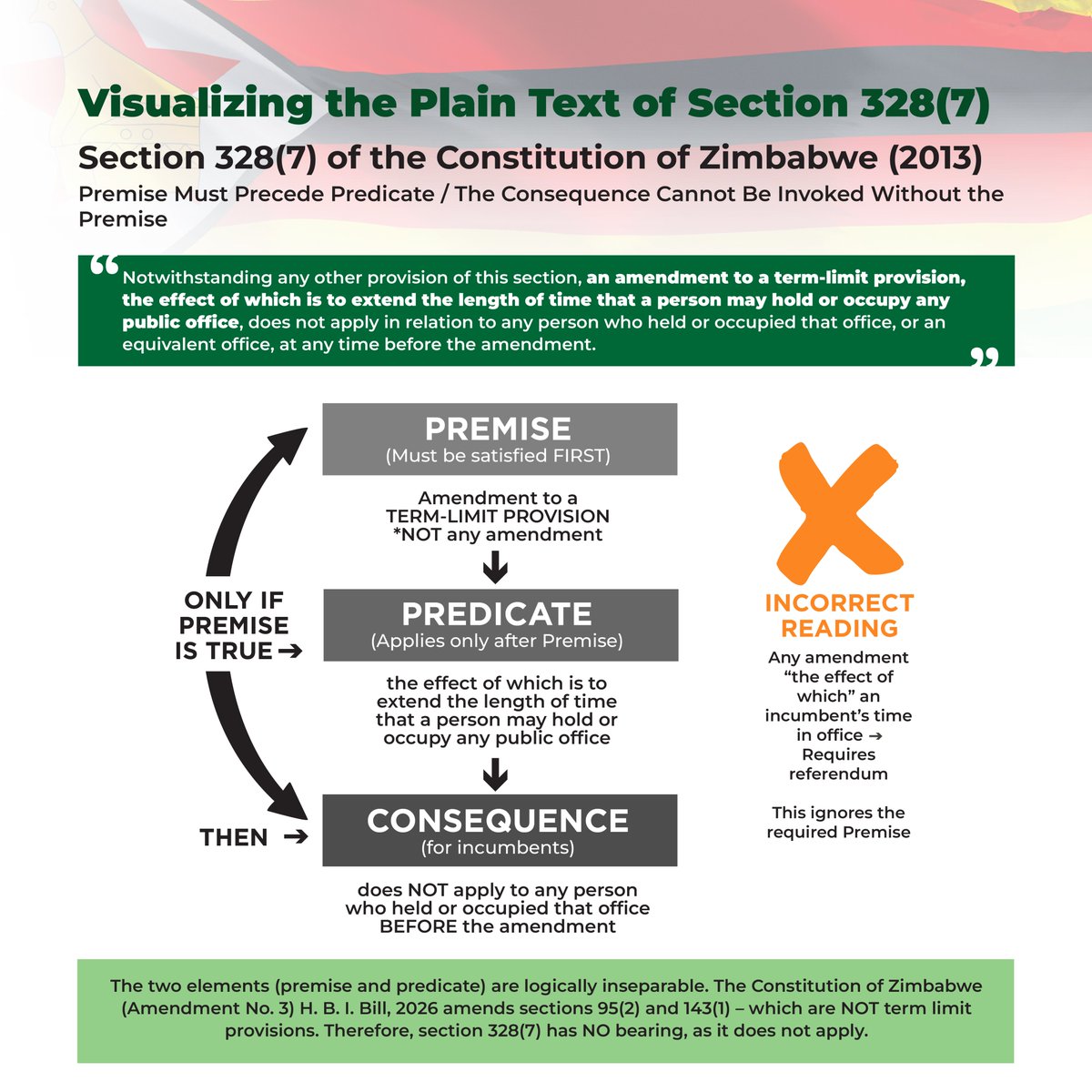
Why the Phrase in Section 328(7) of the Constitution — “An Amendment to a TERM LIMIT PROVISION the Effect of which is to extend the length of time that a person may hold or occupy any public office does not apply in relation to any person who held or occupied that office, or an office, at any time before the amendment” — Does NOT Apply to the Amendment of Section 95(2)(b) in the Constitution of Zimbabwe (Amendment No. 3) Bill, 2026.
With all respect for every thoughtful voice that has been expressed in this vital national conversation on the Bill, it has to be said that the Constitutional Court’s landmark reasoning in the precedent setting Marx Mupungu v Minister of Justice (CCZ 7/21) case, especially in paragraphs 43 to 51, speaks with undiminished, decisive and binding authority directly to the heart of the current debate on the Bill’s amendment to section 95(2)(b).
Distinguished colleagues and fellow citizens — including highly respected legal minds and public officials such as @DavidColtart (see, for example, his considered X-post here: [x.com/DavidColtart/s…]) — have rightly focused on the phrase in section 328(7): “the effect of which is to extend the length of time that a person may hold or occupy any public office.” Many view this phrase as an absolute barrier that can only be overcome by a national referendum.
However, the undeniable fact is that the Constitutional Court has already given the precise, authoritative interpretive framework in its binding Mupungu judgment. That framework powerfully exposes the fundamental distinction at the core of this issue — the very same distinction it drew so clearly when analysing the relationship between section 186(2) and section 328(7), which distinguished “term limit provisions” from “age limit provisions”, and showed that the latter are not affected by section 328(7).
When the same reasoning about sections 186(2) and 328(7) in paragraphs 43 to 51 of the Mupungu judgment is applied, mutatis mutandis, to the relationship between sections 95(2)(b) and 328(7), the path forward becomes unmistakably clear and inescapable.
Section 328(7) is written in plain, unambiguous language whose objective is crystal clear. It prevents an amendment to a term-limit provision — one whose effect would extend the time a person may hold public office — from applying to anyone who held that office (or an equivalent) before the amendment. As defined in section 328(1), a “term-limit provision” is one that “limits the length of time that a person may hold or occupy a public office.”
A careful, respectful reading of section 95(2)(b), guided by the Court’s wisdom in paragraphs 43 to 51 of Mupungu, reveals a decisive structural difference. Section 95(2)(b) does not impose a standalone, fixed, purely personal calendar-based cap. Instead, it expressly declares that the President’s term “is five years [now proposed in the Bill as seven years] and coterminous with the life of Parliament” — currently five years under section 143(1) and proposed to become seven years.
Section 95(b)(b) is inextricably linked to the outcome of a general election. This is a deliberate institutional and democratic mechanism that synchronises executive and legislative electoral cycles — not an independent, non-renewable personal term detached from the people’s democratic will.
In their plain and grammatical sense, sections 95(2)(b) and 143(1) draw a sharp, unmistakable line between tenure defined by a specific, fixed and determinate length of time (with a known beginning and a calculable end) and tenure shaped by variable electoral and parliamentary events. The true purpose of section 95(2)(b), as the Constitutional Court would clearly perceive it through the lens of paragraphs 43 to 51 in Mupungu, is to regulate the timing of national elections themselves — not to create or protect the kind of personal term limit on individual tenure that section 328 was designed to safeguard.
The decisive question is therefore this: What is the meaning of a “term-limit provision” in the context of section 328(7) that should be used to examine the Bill’s amendment to section 95(2)(b)? The definition in section 328(1) points unmistakably to the limitation of a specific “length of time” — not a duration determined by external democratic milestones such as electoral cycles and the timing of general elections.
It therefore follows — firmly and correctly — that a constitutional provision whose length is expressly made coterminous with the life of Parliament does not and cannot establish the rigid, person-specific term contemplated by section 328. The Bill’s amendment to section 95(2)(b) simply does not engage a “term-limit provision”, within the meaning and context of subsections (1) and (7) of section 328 at all.
Lengthening the electoral cycle from five to seven years consequently does not extend any protected term-limit provision. With the greatest respect, opponents of Clause 4 in the Bill have—like the court a quo in Mupungu which failed to distinguish “term limit provisions” and “age limit provisions”—not fully distinguished the electoral-cycle framework in section 95(2)(b) from genuine personal term limits under subsections (1) and (7) of section 328.
Some have, perhaps unintentionally, applied an overly broad interpretation by concentrating almost exclusively on the “effect” language in section 328(7), while bypassing the essential threshold question: whether section 95(2)(b) even qualifies as a term-limit provision in the first place. This risks misunderstanding the carefully drawn concept of “term-limit provisions” as they relate to presidential tenure.
The amendment in the new section 95(2)(b) proposed by the Bill does one thing only: it adjusts the length of the democratic electoral cycle that will apply equally and fairly to every future presidential office-holder. It does not amend or extend any non-renewable or fixed personal term limit for any individual. As the Constitutional Court powerfully reinforced in paragraphs 43 to 51 of Mupungu by reference to dictionary definitions, a “term” means “a fixed or limited period for which something, for example, office, lasts or is intended to last” — a period with a known beginning and a determinable end. A provision tied to the life of Parliament and the outcome of general elections simply cannot, and does not, denote any such fixed personal term.
To illustrate this with insurmountable clarity: within one and the same five-year electoral cycle, one President may serve three years while another serves only two—depending on when each assumes office—without resetting the clock to start a new fresh five-year term. This inherent variability decisively negates the very idea that section 95(2)(b) prescribes the specific, determinate term limit that section 328(7) protects. Any other interpretation would do violence to the ordinary and grammatical meaning of the phrase “term-limit provision.”
By powerful and irrefutable contrast, the Constitution contains an exhaustive list of 15 genuine term-limit provisions, as clearly set out by the Attorney General, Honourable Virginia Mabiza (see her authoritative post here: [x.com/AGZim_Official…]). These include fixed five-year terms (renewable once only) for heads of the Defence Forces, Police, Intelligence and Prisons Services; six-year terms (renewable once) for members of the Zimbabwe Electoral Commission and the Prosecutor-General; and the Auditor-General’s maximum twelve-year tenure. Amendments extending incumbents’ time in these roles would unquestionably fall within the protective shield of section 328(7).
The Bill’s amendment to section 95(2)(b), however, rests on an entirely different and far more fundamental constitutional footing. It is a reform of the democratic electoral cycle itself. The Constitutional Court’s meticulous and binding distinction in paragraphs 43 to 51 of the Mupungu judgment between what truly constitutes a term-limit provision and what does not; therefore, applies here with compelling, conclusive and binding force.
The narrow focus on the “effect of which” phrase in section 328(7), without first confirming that section 95(2)(b) is a term-limit provision at all, mirrors — with respect— the very conflation of term limits with other types of limits (such as age limits) that the Constitutional Court decisively rejected in 2021 in the Mupungu case.
In light of all the above, section 328(7) does not, and cannot, apply to the amendment of section 95(2)(b).
The Bill’s proposal to adjust the presidential electoral cycle stands constitutionally unencumbered by any incumbent-protection rule. The way forward for this Bill is not merely lawful — it is constitutionally clear, sound, and fully consistent with the Mupungu precedent.
This analysis is respectfully offered here in the sincere hope that it brings greater clarity, understanding, and unity in the interest of the shared commitment to constitutional fidelity and the recognition of and respect for the democratic will of the people of Zimbabwe as expressed in the Constitution of Zimbabwe (2013), taking into account the authority of binding case law!
English