Sidharth retweetledi
Sidharth
13.6K posts

Sidharth
@sidmoh575
I'm an Engineer & MBA having centre-right school of thought & economic policies, nationalist & avid watcher of National security matters related to India
Katılım Kasım 2017
697 Takip Edilen78 Takipçiler
Sidharth retweetledi

Russia for last 5 years begged India for common currency in BRICS.
But India stopped BRICS from the common currency (which would have had a say for Indians)
Now this humiliation of paying in enemy currency
The Spectator Index@spectatorindex
Indian oil refiners paid for Iranian oil using Chinese yuan, according to Reuters report.
English
Sidharth retweetledi

🚨🇮🇳🇷🇺 India and Russia agree to station up to 3K troops on each other’s territory
Up to 3,000 military personnel could be stationed on each other’s soil at any one time, in a significant boost to defence cooperation between the two long-standing strategic partners.
The arrangement, revealed in an agreement published on Russia’s official legal information portal, also permits the deployment of up to 10 military aircraft and 5 warships simultaneously.
The deal outlines the rules for the reciprocal deployment of military units, naval vessels and aircraft, while also covering logistical, technical and operational support for forces hosted by either country.
English
Sidharth retweetledi

@RShivshankar When U.S. focus is on the Middle East, Pakistan becomes strategically useful. When attention shifts to East Asia and China, Washington suddenly remembers India.
English

TRUMP PRAISES PAKISTAN. WHAT SHOULD INDIA MAKE OF IT?
Donald Trump calling Shehbaz Sharif and Asim Munir “fantastic” makes for a great headline. It does not mean Pakistan is ascending the geopolitical ladder. Nor does it imply any renewed hyphenation with India. Being useful is not the same as being influential. A doormat serves but a stepping stone leads somewhere.
1. CLIENT NOT STRATEGIC PARTNER
Pakistan might be getting praise, but its relationship with the United States remains fundamentally transactional and security dependent. Since 2001, Pakistan has received over $30–35 billion in U.S. aid, much of it tied to military cooperation and coalition support. Its leverage has typically come from geography, from Afghanistan to counter-terror access, rather than from economic or technological weight. India sits in a different category. It is not a client state. It brings a $3.5–4 trillion economy against Pakistan’s roughly $340 billion, a 1.4 billion market, and a growing role in technology, supply chains and defence. Even when India disagrees with Washington, it negotiates from relative strength. Pakistan simply can't.
The deeper constraint for Pakistan is structural. The military's dominance of Pakistan’s economy and state is embedded creating perpetual dysfunction. Which has meant that Pakistan has turned to the U.S. and U.S. dominated institutions International Monetary Fund more than 20 times since 1958. The Army not only corners a large share of national resources but also has little interest in scaling back. Reform, therefore, remains structurally blocked.
2. RELEVANCE IS NOT INFLUENCE
Pakistan does have a knack for staying relevant. It can facilitate, host and open channels. In the lead-up to the 1971 US–China Rapprochement, Pakistan helped connect Richard Nixon and Mao Zedong. During the 1980s Afghan war under Zia-ul-Haq, it became the frontline state for U.S. strategy. Today, it may offer itself as a facilitator in U.S.–Iran channels. In none of these cases did Pakistan set the terms or shape the outcome. It was useful, sometimes indispensable, but not decisive.
Facilitators sit outside the room where decisions are made. That is the difference between access and authority.
3. THE CHINA AXIS AND LIMITS OF PAK'S 'USEFULNESS'
In the long term, the United States is focused on countering China. This strategic concern underpins Indo-Pacific frameworks such as the QUAD and AUKUS.
Even if Trump seeks tactical accommodation with China, the broader U.S. strategic establishment continues to see India and not Pak as a balancing power.
Pakistan’s own position is constrained by its deep alignment with China. The China–Pakistan Economic Corridor is valued at over $60 billion. Pakistan depends heavily on Chinese financing, energy projects and defence supply. This dependence narrows its strategic flexibility with Washington.
India, by contrast, practices multi-alignment. That strategic autonomy is what gives India weight.
4. THE GULF AND PAK'S FOMO
Pakistan is responding to pressure in its own neighbourhood. India has deepened ties with the United Arab Emirates and Saudi Arabia, expanding beyond energy into investment and security. Trade with the UAE alone exceeds $80 billion. This has narrowed Pakistan’s traditional space. Gulf support is now more conditional, not automatic. In this context, Pakistan’s push to facilitate regional dialogue reflects a search for relevance it feels it is losing.
Facilitation may restore visibility. It does not restore leverage. In the end analysis, being useful is not the same as being influential. A doormat serves. A stepping stone leads somewhere.

English

@DerekJGrossman U.S. strategy often seems cyclical: Pakistan gains relevance when the Middle East dominates attention; India rises in importance when China becomes the central challenge.
English
Sidharth retweetledi

Appeal all MPs of #Odisha, irrespective of party affiliation, to raise your voice both inside and outside the Parliament against the 131st Constitutional Amendment Bill as it could undermine Odisha’s dignity, representation, and long-term interests. Let us stand united in protecting the interests of our state while continuing to support genuine and equitable reforms.
The Bill if implemented, will reduce Odisha's share in Lok Sabha from 3.9% to 3.4%, making us amongst the top 6 states losing their share. A 0.5% share loss is a huge loss given our minuscule 3.9% representation today. A relative reduction in Odisha's voice in the Lok Sabha would weaken our ability to advocate for state-specific needs, from disaster management to tribal welfare and regional development. This is not merely a political issue—it is about preserving the federal spirit enshrined in our Constitution.
@bjd_odisha wholeheartedly supports the principle of women's empowerment and greater representation of women in Legislative bodies. The idea of reserving seats for women in Parliament and the State Assemblies is both progressive and necessary. I have been a personal champion of it, as has been my father Late Biju Patnaik. He pioneered the reservation for women in Panchayat Raj Institutions and I took it forward further with your support. The Biju Janata Dal whole-heartedly supported the 106th Constitution Amendment Bill in 2023 with regard to Women's reservation (the Nari Shakti Vandan Adhiniyam). However, the current 131st Constitutional Amendment Bill, as proposed, raises serious concerns that go beyond its stated objective.
The proposed linkage between women's reservation and the delimitation process, which is expected to follow the next Census, has far-reaching implications. States like Odisha, which have made significant strides in population control and human development are being penalised. A disproportionate increase in Lok Sabha seats in more populous states could skew the allocation of central resources and policy attention. This may adversely impact Odisha's share in national development priorities, fiscal transfers, and infrastructure investments. Odisha has been a large contributor to the revenue of the Government and yet has always received discriminatory treatment including the denial of a special status. Our development needs are unique given the composition of our population.
For the people of #Odisha, representation in Parliament is not just about numbers—it is about identity, pride, and the assurance that our unique history, language, and aspirations are heard at the highest levels. Any move that diminishes our presence in the national discourse can create a sense of degradation among our people.
The Bill steals the political representation future of people of Odisha. We cannot let it happen under our watch when people of Odisha have voted you to protect their economic and political future through the Parliament. Biju Janata Dal is prepared to take it to the people of Odisha if our legitimate concerns and demands are trampled by the majority voice of other states.


English
Sidharth retweetledi

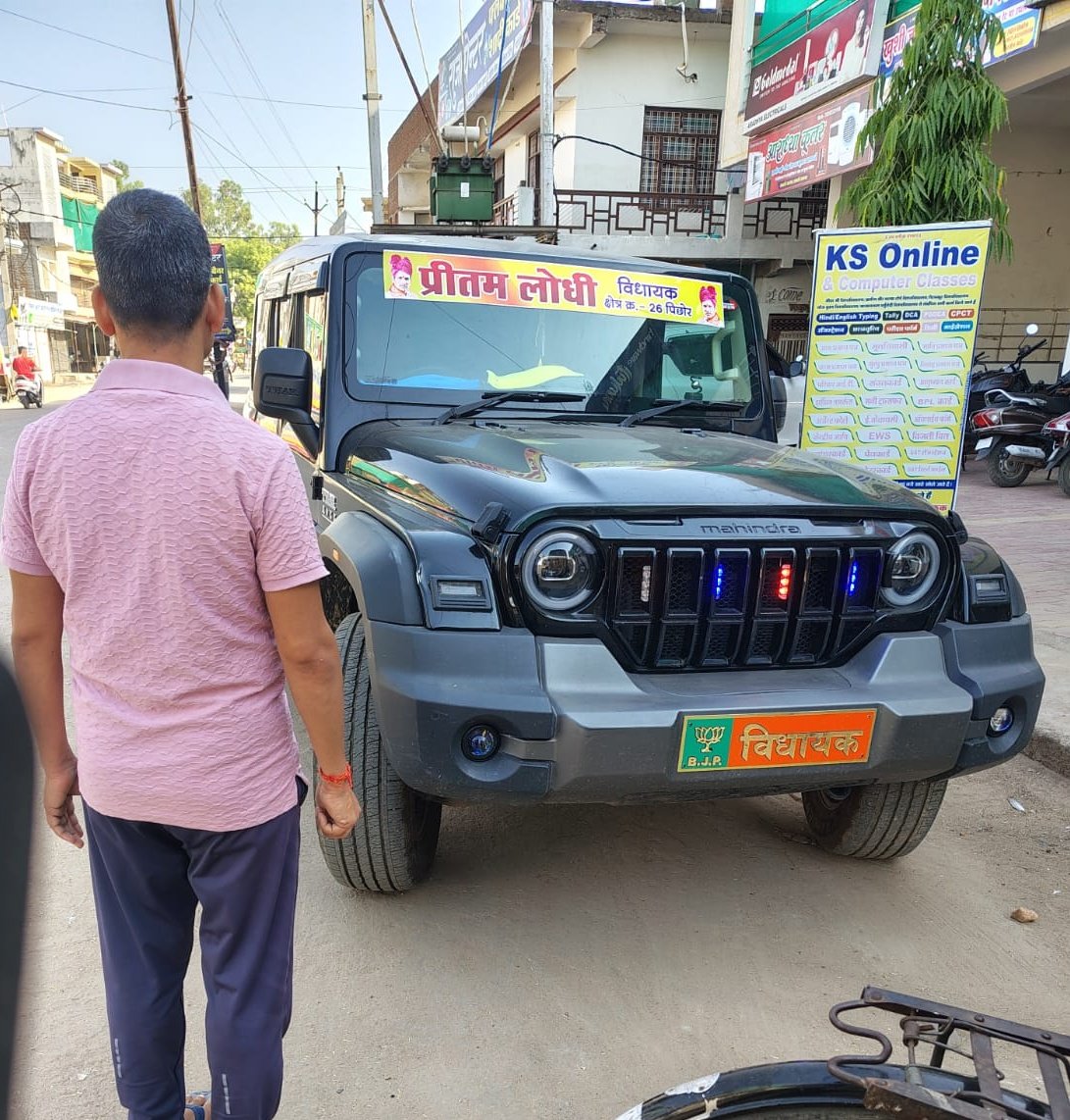
Son of a BJP MLA from Pichhore (Madhya Pradesh) ran over five people and arrogantly blamed the victims. He has a similar past case too. His father also has a glorious criminal record.
Look at his Thar: no number plate, sirens, modified lights, and his father’s photo and designation in bold. He must have been roaming like this, and no policeman would have dared act on these multiple RTO offences.
Given his confidence and our faith in the system, this time too he’ll face no action.

English
Sidharth retweetledi