Simform

8.4K posts

Simform banner
Simform

Simform

@simform

Premier digital engineering company and Microsoft partner specializing in Product Engineering, Cloud, Data, Agentic AI, and Enterprise Platform Innovation

Florida, USA Katılım Mart 2010
116 Takip Edilen1.7K Takipçiler
Simform
Simform@simform·
The pilot worked. That is usually where the real problem starts. Episode 1 of ECAF Voices, our Enterprise Cloud and AI Forum series, is now live. Rameshwar Balanagu, Co-Founder at Dallas CTO Club, is joined by Shuchi Agrawal, Head of AI Execution at SMBC Group, for a conversation about the execution gap: the distance between a demo that impresses a steering committee and a system a regulated business can actually run. Shuchi has spent 25 years building AI and data systems across aviation, global banking, and financial services. She maps the four specific points where enterprise AI programs break before they ship, and makes one point most teams learn the expensive way: token economics belongs in your architecture decisions, not in a budget review after the fact. The conversation stays on how those decisions actually get made rather than on tooling. The full episode is on the ECAF Voices page: simform.com/podcast/enterp… Where is the execution gap widest in your organization right now: the data foundation, the integration work, or adoption?
Simform tweet media
English
0
0
1
47
Simform
Simform@simform·
Cloud and AI strategies are everywhere. Production systems that live up to them are not. That distance is the execution gap. It shows up between a boardroom decision and the platforms, data, governance, and operating models needed to make that decision real. ECAF Voices, the podcast from @Simform’s Enterprise Cloud & AI Forum, brings that gap into the open through candid conversations with leaders responsible for closing it. Hosted by Rameshwar Balanagu, Co-Founder of Dallas CTO Club, the upcoming series features Shuchi Agrawal, Head of AI Execution at SMBC Group; Muralidhar Vemulapalli, Chief Enterprise Architect and Acting CTO at Arkansas Blue Cross and Blue Shield; and Brandon Micci, Head of AI Strategy & Business Transformation at J.P. Morgan, and many more guests. The teaser offers a first glimpse of conversations grounded in real decisions: what it takes to move AI beyond experimentation, modernize the platforms underneath it, and build governance into execution. ECAF Voices is coming soon. Where does the execution gap show up most clearly in your organization: platform, data, governance, or operating model?
English
0
0
3
123
Simform
Simform@simform·
Simform's TrueMorph, AI-native data modernization solution, has achieved Microsoft Azure IP Co-sell eligible status. This status lets Microsoft's own sellers identify TrueMorph for qualified co-sell opportunities, and gives enterprises a Marketplace-based procurement path for Fabric-led data modernization, with purchases applying toward existing Azure Consumption Commitments. Here is what this status is built on: - AI-powered data profiling, transformation, and quality checks, with built-in migration paths for legacy stacks like SSRS, SSIS, SSAS, OBIEE, OBIP, and Informatica Power Center - Governance embedded at every layer, backed by Azure Key Vault, Microsoft Entra ID, Purview, Unity Catalog, and Azure Monitor We recently used TrueMorph to help a multi-region retail and vending operator unify 400 to 500 GB of scattered operational data on Microsoft Fabric, cutting stockouts by 30% and speeding up deliveries by 20%. "With Azure IP Co-sell status, our TrueMorph solution is validated to work in the Fabric ecosystem, and it lets @Microsoft and @Simform field teams go to market together, which is what actually helps customers move faster," shared Juan Llovet de Casso, Cloud Solution Architect at Microsoft. Thank you to everyone at Simform who built and delivered this. #MSPartner #MicrosoftPartner
Simform tweet media
English
1
0
1
159
Simform
Simform@simform·
Microsoft’s $2.5B Frontier Company investment points to where enterprise AI is heading next. Not more pilots. Not more model shopping. Engineering. @Microsoft is embedding 6,000 industry and engineering experts with customers to co-design, deploy, and continuously improve AI systems around measurable outcomes. The important shift is the operating model behind it: Intelligence + Trust. Enterprise intelligence lives in proprietary data, workflows, expertise, and decision logic. And the trust comes from the architecture around it, comprising governed data access, context engineering, evals, observability, model routing, FinOps, human review, and IP protection. That is the same direction @Simform has been engineering toward. We have been building reusable foundations for this phase: 𝐓𝐫𝐮𝐞𝐌𝐨𝐫𝐩𝐡 to turn fragmented data into secure, AI-ready foundations; 𝐓𝐡𝐨𝐮𝐠𝐡𝐭𝐌𝐞𝐬𝐡 to design governed agentic systems; and 𝐏𝐞𝐱𝐀𝐈 and 𝐂𝐨𝐝𝐞𝐓𝐨𝐨𝐥𝐬 to bring AI-native discipline across delivery, review, and modernization. The next phase of enterprise AI will not be won by the team with the most agents. It will be won by the team that can make enterprise intelligence compound safely, measurably, and inside production systems. That has always been an engineering problem first. #mspartner #microsoftpartner
Simform tweet media
English
0
0
1
74
Simform
Simform@simform·
As @Microsoft reduces the infrastructure friction for deploying AI agents, the architecture decisions that determine whether these agents operate reliably in production matter more, not less. At Build 2026, Windows 365 for Agents reached general availability within Agent 365, giving enterprises managed Cloud PCs for agents working across modern apps, legacy systems, and UI-driven workflows. Microsoft Foundry also expanded its runtime, evaluation, and governance capabilities, while Microsoft Execution Containers remained in early preview. The platform can provide execution, containment, and controls. It cannot decide who owns a cross-system process. An agent that works in a pilot can still fail in production if no one defines the accountable process owner, approval thresholds, or recovery path when a workflow crosses a CRM, ERP, and claims system. For high-consequence workflows, the more defensible pattern is bounded autonomy. Authority should expand only when actions are observable, attributable, recoverable, and proven through evaluation. The boundary should follow the consequence and reversibility of the action, not the capability of the model. @Simform uses 𝐓𝐡𝐨𝐮𝐠𝐡𝐭𝐌𝐞𝐬𝐡 within agentic AI engagements to implement the orchestration, access, observability, and governance controls behind those decisions. Skip this work, and the risks surface later as audit gaps, unreliable approval paths, and substantial rework before workflows can scale. #microsoftpartner #mspartner
Simform tweet media
English
0
0
0
84
Simform
Simform@simform·
Most enterprises do not have a data platform problem. They have a fragmentation problem. Here’s exactly how #MicrosoftFabric is designed to solve it: - Fabric consolidates services that used to run separately, like Data Factory, data science workloads, and Power BI, into one SaaS platform with a single billing architecture and shared compute - OneLake sits at the centre as a unified storage layer built on the Delta open table format, enabling lakehouse, data warehouse, and ML use cases from the same foundation - Native governance through Microsoft Purview and real-time intelligence through Event Hub come built in, not bolted on One platform. One storage layer. One place to govern it all. Anamika Shaw, Sr. Data Architect at @Simform, Rachael Villalaz, Cloud & AI Specialist at @Microsoft, and Matthew Wendel, Principal Solutions Consultant at @Simform, break down how manufacturing and retail organisations can modernise their data estates using Microsoft Fabric. Watch the full session here: simform.com/lp/webinar-mod… #MSPartner #MIcrosoftPartner
English
0
0
1
91
Simform
Simform@simform·
Clean data does not automatically make enterprise AI reliable. @ISG_News reports that more than half of organizations still struggle with legacy data residing in old applications, compounding the overall data silo issue and creating further roadblocks to value from AI. But modernizing pipelines alone does not resolve every data problem. Consider "active customer." If three business units define it differently, an agent querying enterprise data has no authoritative meaning to reason against. It can retrieve more records and still return conflicting answers that require manual verification. That is why semantic governance must be part of data-platform modernization, alongside data quality and ETL improvements. On #MicrosoftFabric, Power BI semantic models can expose governed measures, relationships, and business terminology within a domain. Fabric IQ ontology can extend those definitions across domains, although it remains in preview and currently requires external change-management controls. The practical sequence is smaller than an enterprise-wide ontology program: - Start with one agent use case. - Identify the entities it must interpret. - Assign authoritative definitions and owners. - Then test the agent against verified business questions before expanding. Without a governed business meaning, better data access can widen an agent’s reach without improving its reliability. The hidden cost shows up in continued human verification.
Simform tweet media
English
0
0
1
69
Simform
Simform@simform·
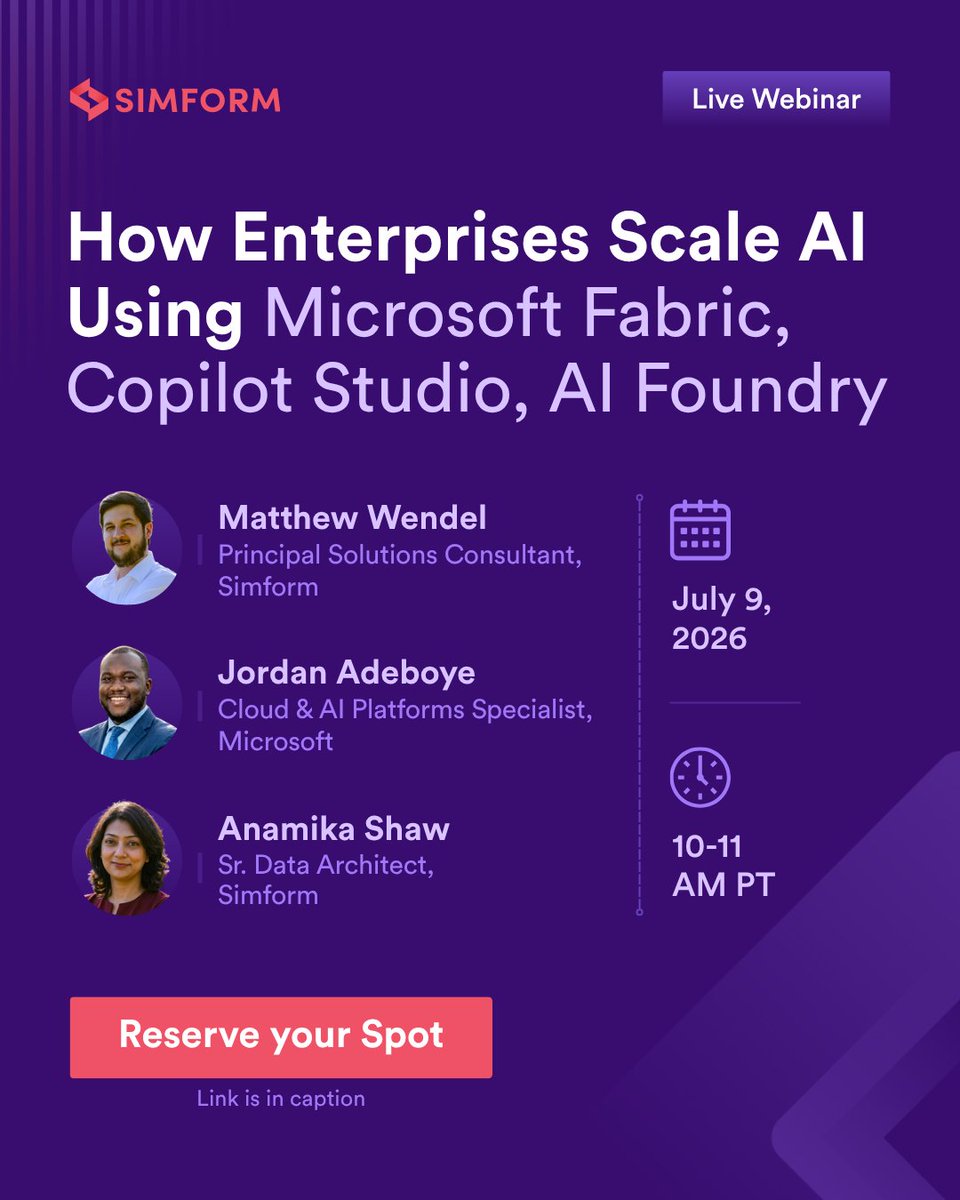
#EnterpriseAI adoption doesn't stall because teams lack ambition. It stalls because the three layers that matter most are never designed to work as one. The data layer. The agent layer. The governance layer. When they're built in isolation, you get pilots that impress and programs that don't ship. When they're built together, the picture looks different. Organizations that connect #MicrosoftFabric as their data foundation with #CopilotStudio and #AIFoundry for agent creation and orchestration report measurable outcomes once they move beyond the POC stage. - Time from data ingestion to actionable insight: reduced from days to hours in structured deployments - AI program deployment cycles: compressed by 30–40% when governance is designed in from the start, not retrofitted - Duplicate agent logic and redundant retrieval paths: cut significantly when a unified semantic layer is in place The session on July 9 is built around this exact architecture: how Fabric handles the data, how Copilot Studio and AI Foundry handle the agents, and how governance keeps the whole system production-ready. Not theory. A practical walkthrough with real-world architecture decisions. @Simform and @Microsoft experts will cover how to identify the right use cases, where readiness gaps typically appear, and how to build a roadmap that holds up. 📅 July 9, 2026 | 10–11 AM PT 🗣 Speakers: 1. Matthew Wendel, Principal Solutions Consultant, @Simform 2. Jordan Adeboye, Cloud and AI Platforms Specialist, @Microsoft 3. Anamika Shaw, Sr. Data Architect, @Simform #EnterpriseAI 👉 Register here for webinar: simform.com/lp/webinar-how…
Simform tweet media
English
0
0
0
80
Simform
Simform@simform·
Most enterprise AI programs don't fail because the ambition is wrong. They fail because the data layer, the agents, and the governance were never built to work together. The pilot works. The demo impresses. Then the handoff to production begins, and the gaps appear fast. The data isn't clean or contextualized enough for the agent to reason reliably. The agent logic that worked in a controlled environment breaks under real workload conditions. Governance frameworks are stitched together after the fact, not designed in from the start. And leadership starts asking the same question every quarter: "Why haven't we shipped anything?" The problem isn't the model. It isn't the talent. It's that the stack was never designed as a system. Microsoft Fabric, Copilot Studio, and AI Foundry are purpose-built to close that gap. But only when they are connected deliberately, with a data foundation that can support agents and governance that can survive an audit. On July 9, @Simform and @Microsoft experts will walk through exactly how enterprises make that connection, from scattered pilots to production-grade AI systems. 📅 July 9, 2026 | 10–11 AM PT 🗣 Speakers: 1. Matthew Wendel, Principal Solutions Consultant, Simform 2. Anamika Shaw, Sr. Data Architect, Simform 3. Jordan Adeboye, Cloud and AI Platforms Specialist, Microsoft #MicrosoftFabric #AgenticAI #MSPartner
Simform tweet media
English
1
0
2
99
Simform
Simform@simform·
Simform has been recognized as a Seasoned Vendor in AIM Research's PeMa Quadrant: Top Generative AI Service Providers 2026. AIM Research evaluates generative AI service providers on market penetration (Pe) and technology maturity (Ma). Seasoned Vendors are recognized for strong technical capabilities, consulting expertise, delivery maturity, and meaningful market impact. This recognition reflects Simform's ability to connect GenAI to the systems and workflows enterprises already run on. This recognition reflects Simform's engineering-led approach to closing that gap by connecting GenAI to the systems, data, and workflows enterprises already run on. Here is what this recognition is built on: - ThoughtMesh, our enterprise GenAI framework, is closing the gap between proof of concept and production deployment - Accelerators including TrueMorph, CodeTools, and NeuVantage spanning data modernization, developer productivity, and AI workflows Thank you to AIM Research for including @Simform through their independent assessment, and to every Simform member who built and delivered the work behind it. Read the full story here: finance.yahoo.com/sectors/techno…
Simform tweet media
English
0
0
2
66
Simform
Simform@simform·
Most organisations are ready to invest in AI. Their data is not. This is the pattern we see across retail and manufacturing engagements: - Over a third of retail organisations are not yet ready to begin their AI adoption journey, and the bottleneck is not budget or intent - Data spread across ERP, POS, IoT, and supply chain systems creates inconsistencies, duplicates, and gaps that make a trustworthy AI foundation impossible to build - The cost of running and maintaining these fragmented legacy systems keeps growing, while the decisions they support stay a day old or worse The real AI barrier is not the model. It is the data sitting underneath it. In this video, Anamika Shaw, Sr. Data Architect at @Simform, Rachael Villalaz, Cloud & AI Specialist at @Microsoft, and Matthew Wendel, Principal Solutions Consultant at @Simform, cover how manufacturing and retail organisations can build a governed, AI-ready data foundation using Microsoft Fabric. #MSPartner #MicrosoftPartner #MicrosoftFabric
English
1
0
1
98
Simform
Simform@simform·
The next test of AI readiness isn't whether your agent can act. It's whether your company can explain, govern, and stop that action when it matters. Speed is easy. Accountability is the hard part everyone's skipping.
English
0
0
0
28
Simform
Simform@simform·
And you can't bolt this on later. Retrofit it after deployment and the system already lacks the traces, ownership boundaries, and intervention points needed to explain its own behavior. You're debugging a black box you built yourself.
English
1
0
0
35
Simform
Simform@simform·
Most companies racing to deploy AI agents can't answer one basic question: When an agent makes a bad call in production, who's actually responsible? Nobody. And that's about to become the most expensive blind spot in enterprise AI.
English
1
0
1
85