Bakhtier Gaibulloev

630 posts

Bakhtier Gaibulloev banner
Bakhtier Gaibulloev

Bakhtier Gaibulloev

@slashmsu

I replace manual work with AI agents & pipelines | Helping orgs migrate to AI-first | 15+ yrs distributed systems | Claude Code / MCP / agent architecture


Aachen, Germany Katılım Mart 2016
127 Takip Edilen79 Takipçiler
Sabitlenmiş Tweet
Bakhtier Gaibulloev
Bakhtier Gaibulloev@slashmsu·
Such a good pleasure to win this trophy, in AI Era...
Bakhtier Gaibulloev tweet media
English
1
0
4
369
Bakhtier Gaibulloev
Bakhtier Gaibulloev@slashmsu·
@svpino raw conversation dumps inherit the same 70%-loss problem after /clear because the model still has to re-derive what mattered. structure the handoff like a schema: pinned files, decision log, current cursor, open todos. now /clear compounds across sessions.
English
0
0
8
732
Santiago
Santiago@svpino·
I'm spending so much time managing context, and I hate it. Here is a tip for you: don't use /compact any more in Claude Code. There's a much better option. /compact takes your entire conversation history in memory and compresses it into a summary. This frees up tokens, but you'll lose a ton of important details (sometimes up to 70% of what matters!). On top of that, the summarized context is still tied to the current session and won't persist beyond it. Here is what you should do instead: 1. Dump the entire conversation history to a markdown file 2. Call /clear to clear the context 3. Start your next prompt by pointing to the markdown file There are several advantages to doing this: 1. You don't lose any valuable information 2. You control what's in the file 3. The context persists beyond the current session In summary, when you hit a context limit, do a *handoff*, not a *cleanup*.
English
111
15
397
59.3K
Bakhtier Gaibulloev
Bakhtier Gaibulloev@slashmsu·
The 30-minute distribution cliff is the algorithmic curve. The other one is portability: a reply on a structural angle earned a mid-thread response 52 hours after publish. Concrete mechanisms compound past freshness. Optimise the draft for the reader two days later.
English
0
0
1
6
Bakhtier Gaibulloev
Bakhtier Gaibulloev@slashmsu·
@emollick deployment lane is the real product. microsoft optimises the model-plus-tenant boundary: rag, citations, audit trails. openai optimises the model-plus-chat boundary: turn quality, latency. same weights run different value functions over the output.
English
0
0
0
252
Ethan Mollick
Ethan Mollick@emollick·
It is really interesting that Microsoft and OpenAI have access to the exact same models at the exact same time, and they have done such different things with them. A rare pure experiment with a no-name startup and one of the biggest firms on earth with the same product offering.
English
46
17
593
48.3K
Bakhtier Gaibulloev
Bakhtier Gaibulloev@slashmsu·
@ArthurLillyblad @emollick the schema-compression claim is the load-bearing one. concrete: a 1500-line diff and a 50-line diff hit the same review queue under the same attention budget. compress submissions to a contracts-changed table plus call sites touched. reviewer throughput tracks producer again.
English
0
0
1
6
Ethan Mollick
Ethan Mollick@emollick·
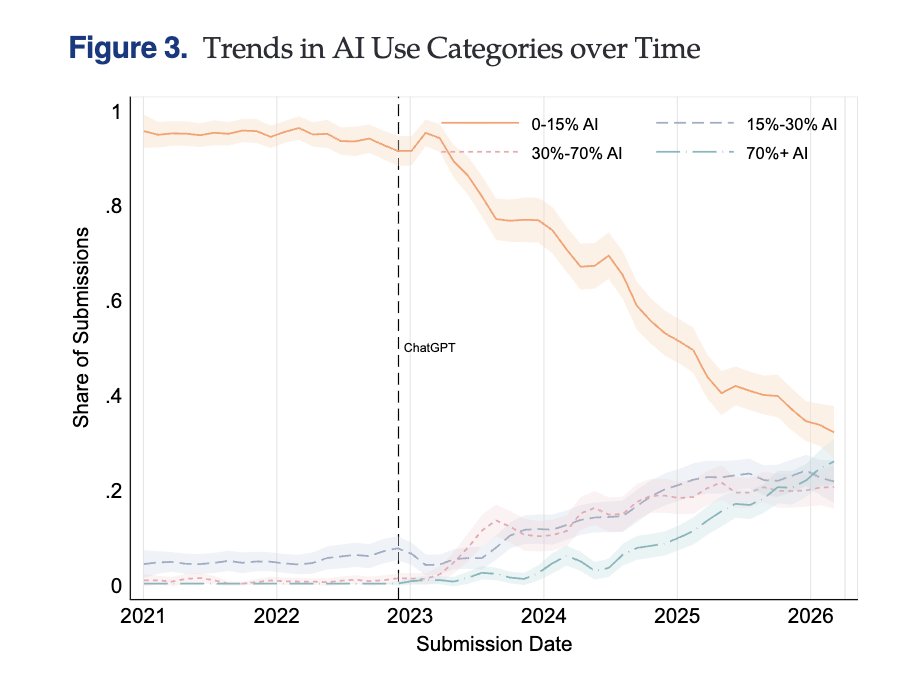
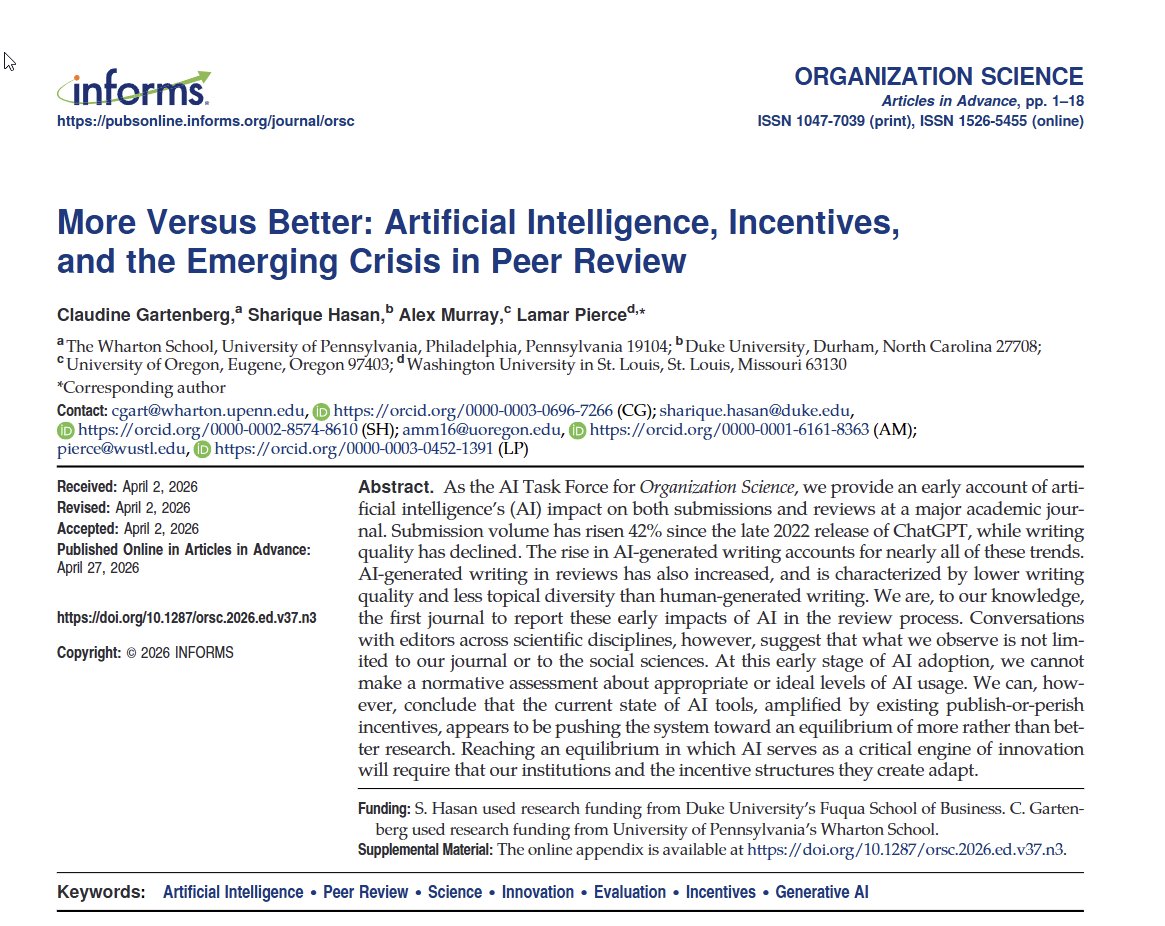
Very cool analysis of the submissions to a major management journal that shows how much the system of science, built for humans, is under strain as a result of AI. AI can be used to do better science or it can be used to just do more stuff. The danger is that "more" is winning
Ethan Mollick tweet mediaEthan Mollick tweet mediaEthan Mollick tweet media
English
28
61
429
60.4K
Bakhtier Gaibulloev
Bakhtier Gaibulloev@slashmsu·
@simonw reviewer attention is the rate limit. zig spends that budget on contributor onramp. ai pull requests consume the queue without producing future contributors, so the trade is a supply collapse. quality of the code never enters that equation.
English
0
0
0
180
Simon Willison
Simon Willison@simonw·
The Zig project's rationale for their blanket ban on AI-assisted contributions makes a lot of sense to me - for them, time spent reviewing PRs isn't about the code, it's about growing new contributors for the future of the project simonwillison.net/2026/Apr/30/zi…
English
47
55
501
39.5K
Bakhtier Gaibulloev
Bakhtier Gaibulloev@slashmsu·
@ID_AA_Carmack 32-bank cliff. at stride 512 every warp lane hits the same shared-memory bank, so a tiled solver serializes its column reads 32-wide. 511 falls on a non-multiple-of-32 stride and dodges it.
English
0
0
1
259
John Carmack
John Carmack@ID_AA_Carmack·
GPU library performance can be very notchy -- runtime of batched torch.linalg.solve_ex() went up by over 10x going from 511x511 matrices to 512x512.
English
40
16
583
76.2K
Bakhtier Gaibulloev
Bakhtier Gaibulloev@slashmsu·
@svpino The biggest payoff here is the stop condition. Models self-assess 'done' unreliably. A failing test gives the agent an external verdict it can't talk itself past. Tokens upfront, hours saved chasing phantom-completions.
English
0
0
0
312
Santiago
Santiago@svpino·
Agentic coding is the ideal mechanism for enforcing TDD and being strict with it. Here is a summary of the workflow I coded as part of my implementation skill in Claude Code: 1. Before writing any code, write a test that fails 2. Run the test and ensure it fails 3. If you get an error, fix the test until it runs but fails 4. Once the test fails, write the code 5. Run the test and ensure it succeeds 6. If the test fails, go back to step 4 7. Once the test succeeds, verify that the task is complete 8. If the task is not complete, go back to step 1 This loop forces the agent to write tests before writing any code, and tries to keep each test as simple as possible. This is token hungry upfront, but it has many advantages: 1. Simpler code 2. More modular code 3. Fewer bugs and regressions later 4. Easier to troubleshoot
English
48
14
187
17.4K
Bakhtier Gaibulloev
Bakhtier Gaibulloev@slashmsu·
A don't-list is a sentence the model parses once. Example pairs persist because the model matches against them on every token. The trillion tokens of training are the default reference. To compete with the corpus, give it a counter-corpus.
English
0
0
0
13
Bakhtier Gaibulloev
Bakhtier Gaibulloev@slashmsu·
@rubenhassid yes. each entry pairs a banned phrase with a same-meaning line i wrote that didn't read as ai. the model gets two anchors per entry. revisions hold for 3-4 sentences instead of one.
English
0
0
0
27
Ruben Hassid
Ruben Hassid@rubenhassid·
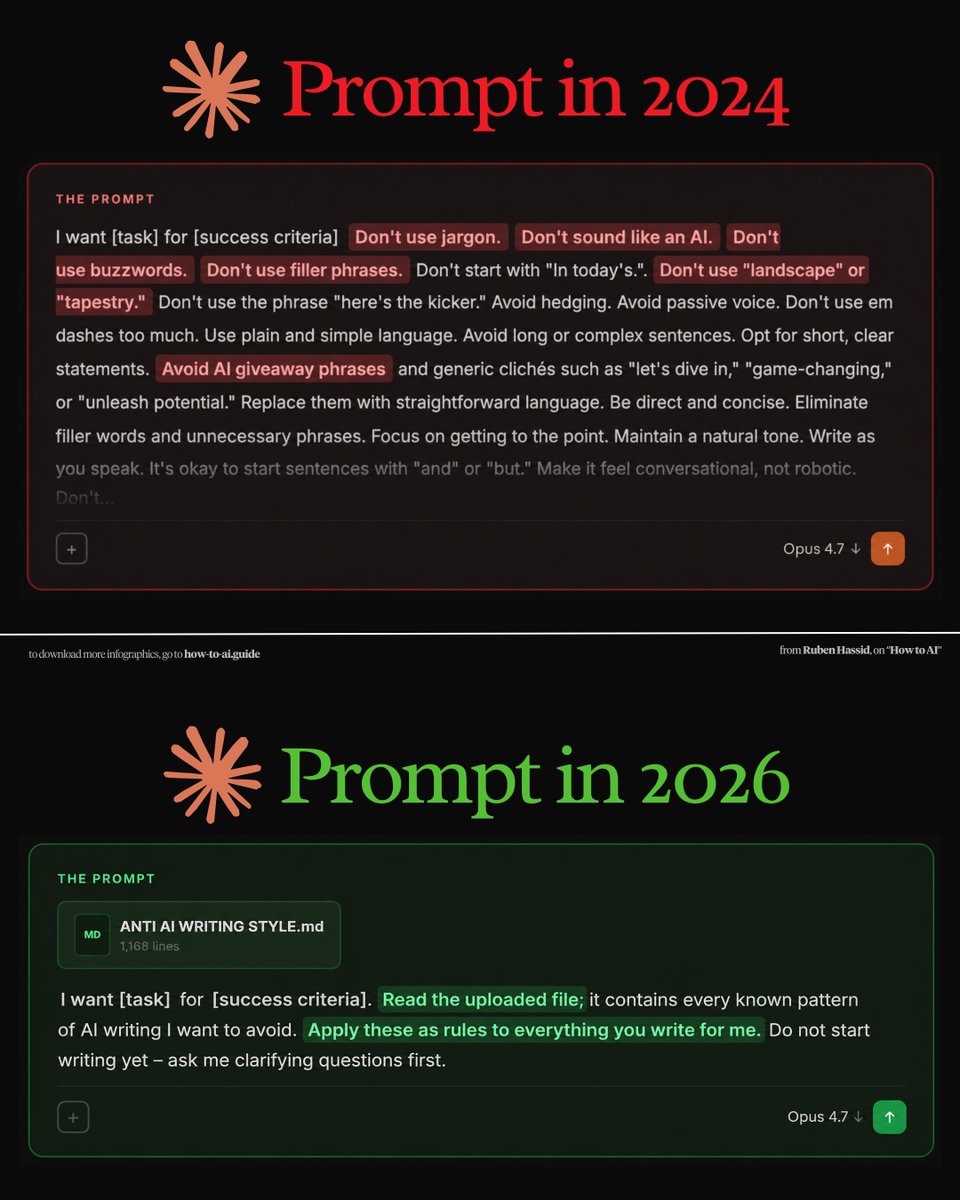
Stop writing 500-word prompts that don't work. This 35-word prompt writes better than all of them: "I want to [TASK] for [SUCCESS CRITERIA]. Read my anti-AI writing style file first. It contains every known pattern of AI writing I want to avoid. Apply these as rules to everything you write for me." That's it. But you need to set it up first. Here's how: Step 1. Go to how-to-ai.guide. Step 2. Subscribe for free. Don't pay anything. Step 3. Open my welcome email. Step 4. Hit the automatic reply button inside. Step 5. Click on the Notion link. Go to .md files. Step 6. Download ANTI AI WRITING STYLE .md file. Step 7. Upload it to Claude. Prompt: I want to [TASK] for [SUCCESS CRITERIA]. Ask me questions before starting so we define our plan first. After Claude's answer, follow up with this prompt: "Audit your text using the anti-ai-writing-style .md file from your folder." ✦ Here's why your prompts don't work (red flags): "Don't use jargon." "Don't sound like an AI." "Don't use buzzwords or filler." "Avoid passive voice." "Be conversational, not robotic." These are everywhere. LinkedIn posts. Emails. They sound thorough. The output is still garbage. Your prompt says "don't" 14 times. The model forgets half by sentence three. You're fighting the AI with a wall of "don'ts." It doesn't work at scale. The fix is counterintuitive. Stop telling the AI what to avoid. Give it a file that shows what to avoid. The model reads 1,168 lines of bad patterns, internalizes them, and writes clean. 500-word prompt → still robotic. Small prompt + 1 file → reads as a human wrote it. Get my entire setup (free): ruben.substack.com/p/its-not-x-it… ♻️ Repost to help one person stop sounding like AI.
Ruben Hassid tweet media
Ruben Hassid@rubenhassid

x.com/i/article/2049…

English
37
46
318
21.3K
Bakhtier Gaibulloev
Bakhtier Gaibulloev@slashmsu·
@GergelyOrosz leaving-github stories usually split on tooling. agents pull on the api 100x more than humans, so flakiness compounds before the ui notices. for an agent-heavy project the carrying cost of a broken host shows up before the migration cost does.
English
0
0
0
185
Gergely Orosz
Gergely Orosz@GergelyOrosz·
WOW. Mitchell Hashimoto voting with his feet: Ghostty is leaving GitHub. "I can't code with GitHub anymore. I'm sorry. After 18 years, I've got to go. I'd love to come back one day, but this will have to be predicated on real results and improvements, not words and promises."
Mitchell Hashimoto@mitchellh

Ghostty is leaving GitHub. I'm GitHub user 1299, joined Feb 2008. I've visited GitHub almost every single day for over 18 years. It's never been a question for me where I'd put my projects: always GitHub. I'm super sad to say this, but its time to go. mitchellh.com/writing/ghostt…
English
32
33
1.2K
152.1K
Bakhtier Gaibulloev
Bakhtier Gaibulloev@slashmsu·
@rubenhassid the .md-as-context-file pattern works here because tax categories are stable across years. the same file rolls forward unchanged, only the year-specific income and deduction sections take a delta. the file accumulates into a personal ledger more than a config.
English
0
0
0
12
Ruben Hassid
Ruben Hassid@rubenhassid·
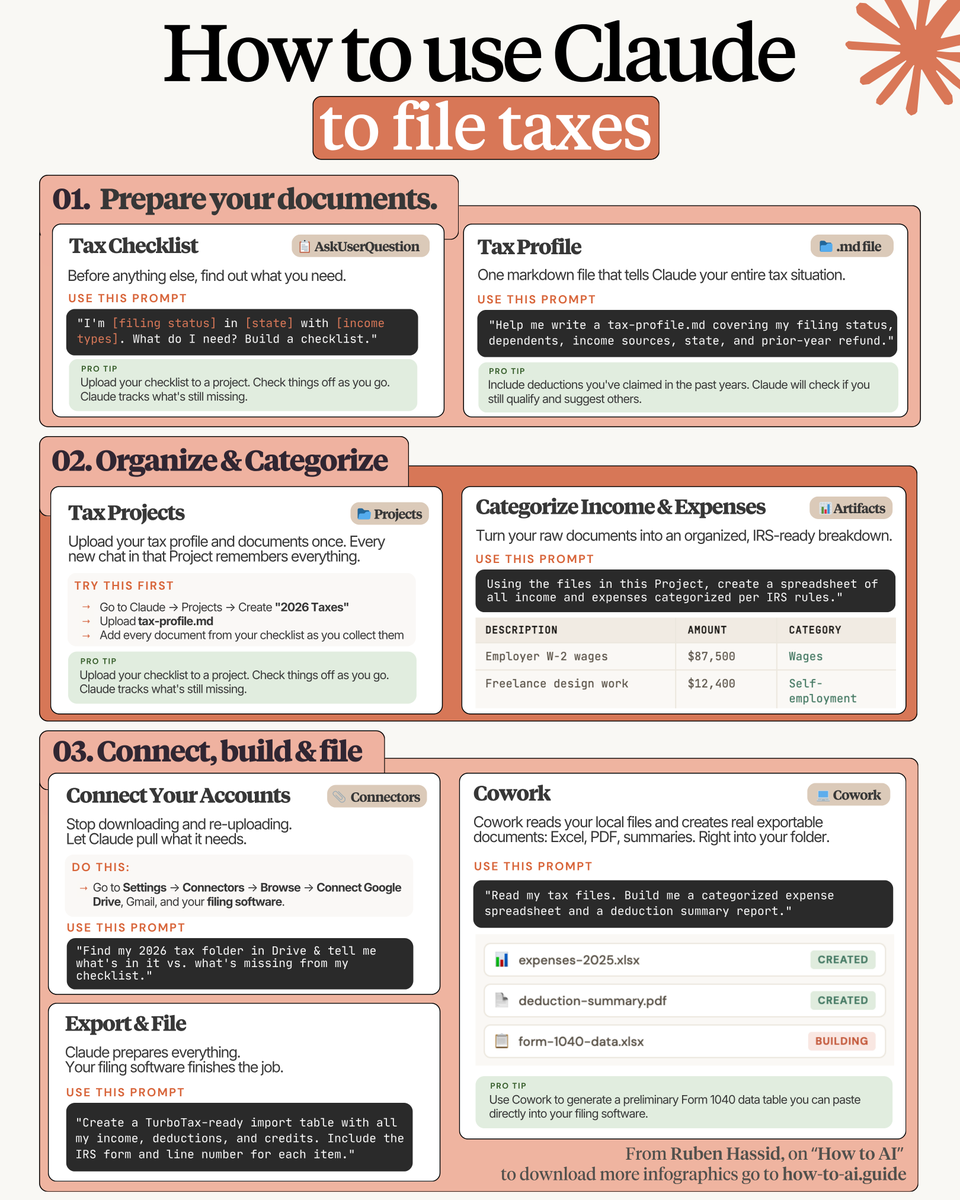
How to file your 2026 taxes with Claude: File 1: tax-profile .md (Your tax identity) 1. Create a Google doc called "TAX-PROFILE" 2. Add your filing status, state, and dependents. 3. List income sources (W-2, freelance, dividends) 4. List deductions you've claimed in past years. 5. Add last year's refund or amount owed. 6. Save it as a .md file format. File 2: The Tax Checklist 7. Go to Claude → Projects → Create "2026 Taxes" 8. Upload your tax-profile .md. 9. Prompt: "I'm [filing status] in [state] with [income types]. Build me a checklist." 10. Add every document from that checklist. 11. Every new chat in that Project remembers it all. File 3: Connectors (Claude inside your tools) 12. Settings → Connectors → Connect Drive + Gmail 13. Stop downloading and re-uploading. 14. Open Cowork. Point it at your tax folder. 14. Prompt: "Create a TurboTax-ready import table with all my income, deductions, and credits. Include the IRS form and line number for each item." 15. It exports a real .xlsx and .pdf into your folder. 16. Paste it into TurboTax. Done. I made over 100+ infographics like this. If you want to download all of them, just: 1. Go to how-to-ai.guide. 2. Then enter your work email. 3. It will ask you to pay or not. Don't pay. 4. Wait 2 min. Then open the welcoming email. 5. Click on my Notion library with everything in it. Disclaimer: you will be subscribed to my newsletter. It's free, and always will be. Some people pay only to join my community & get answers faster. 500,000+ readers enjoy it twice a week. To always stay ahead of the AI curve. To master AI, before it masters you. ♻️ Repost to help one person file smarter this year.
Ruben Hassid tweet media
Ruben Hassid@rubenhassid

x.com/i/article/2045…

English
27
17
158
13.8K
Bakhtier Gaibulloev
Bakhtier Gaibulloev@slashmsu·
@MengTo the split makes the corpus version-stable. design.md captures taste and rolls forward for years. html witnesses churn every model release, regenerated from the same skills. you can diff one layer without dragging the others through it.
English
0
0
0
140
Meng To
Meng To@MengTo·
Real quick, here's how you can turn a design element into a skill and reuse that. DESIGN.md, Skills and HTMLs are incredible prompt references. - DESIGN.md for the recipe - Skills for ingredients - HTMLs for the exact results
English
13
27
377
21.8K
Bakhtier Gaibulloev
Bakhtier Gaibulloev@slashmsu·
@svpino Self-routing is one of the few places where letting the model overestimate is correct. The cost of starting too weak is a redo from scratch. The cost of starting too strong is a few extra tokens. Asymmetric loss says round up.
English
0
0
0
29
Santiago
Santiago@svpino·
You can let Claude Code decide the level of thinking it needs to solve a problem. I like to use Sonnet as the default model, but I tell Claude to decide which model to use every time I spin off an agent to solve a problem: "Choose the weakest model that can complete the task." You can also give it specific guidelines. For example: """ • Use the smallest and cheapest model to create small functions, small test cases, or do anything mechanical. • Use the strongest model you have to make architectural decisions about the code base. """ This is great whenever you are giving the model a list of tasks and you don't have a chance to specify a different model for each task.
English
42
8
135
26.6K
Bakhtier Gaibulloev
Bakhtier Gaibulloev@slashmsu·
Every agent integration story is really a data-layer story. Sidecar agents see a synced shadow of host state and the seam shows. Agents that read and write the same files the user opens are native by construction. The interface is downstream of which buffer you share.
English
0
0
0
12
Bakhtier Gaibulloev
Bakhtier Gaibulloev@slashmsu·
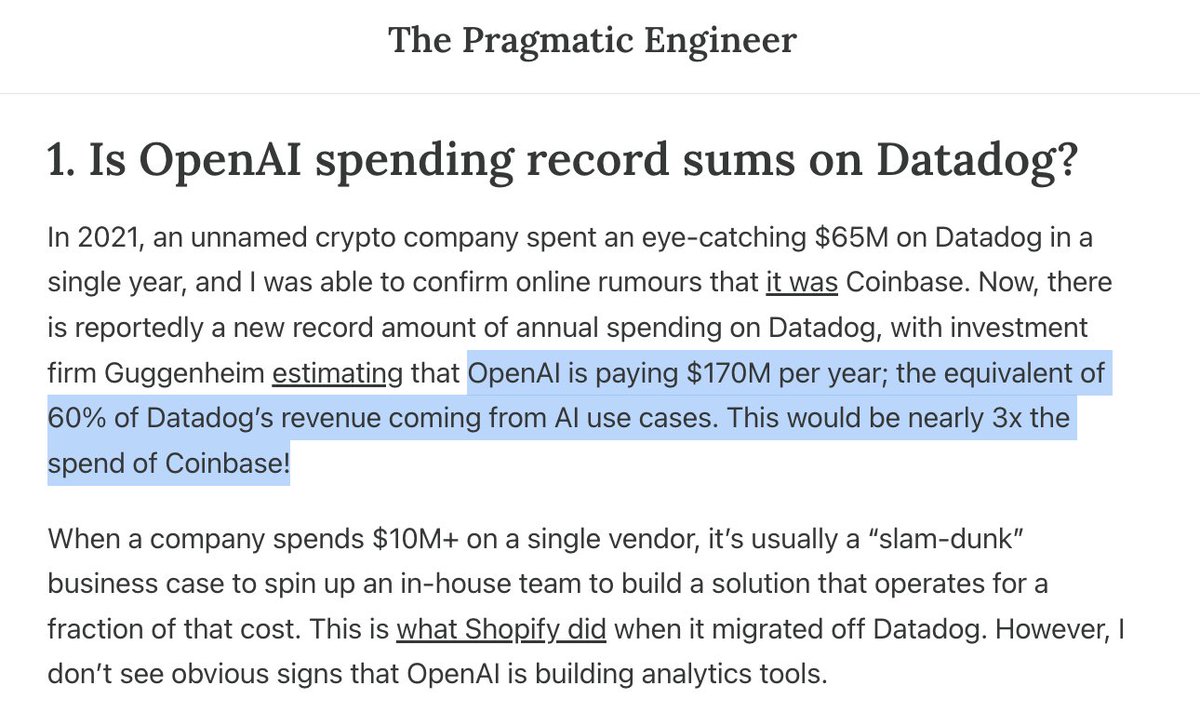
@GergelyOrosz @Pragmatic_Eng the $170M is a cardinality story. per-tag and per-user dimensions multiply fast at openai scale. dropping label cardinality on hot metrics and head sampling traces usually moves the bill more than any vendor migration.
English
0
0
0
186
Gergely Orosz
Gergely Orosz@GergelyOrosz·
Waiting when the CFO will notice the ~$170M Datadog bill after this... (yes, really! As shared in @Pragmatic_Eng back in October... though safe to assume OpenAI has reduced this since)
Gergely Orosz tweet media
Berber Jin@berber_jin1

NEW: openai missed key revenue and growth targets in recent months, prompting its cfo and board to reassess its data-center strategy ChatGPT was supposed to hit 1bn weekly active users last year but missed that target wsj.com/tech/ai/openai…
English
46
38
787
223.5K
Bakhtier Gaibulloev
Bakhtier Gaibulloev@slashmsu·
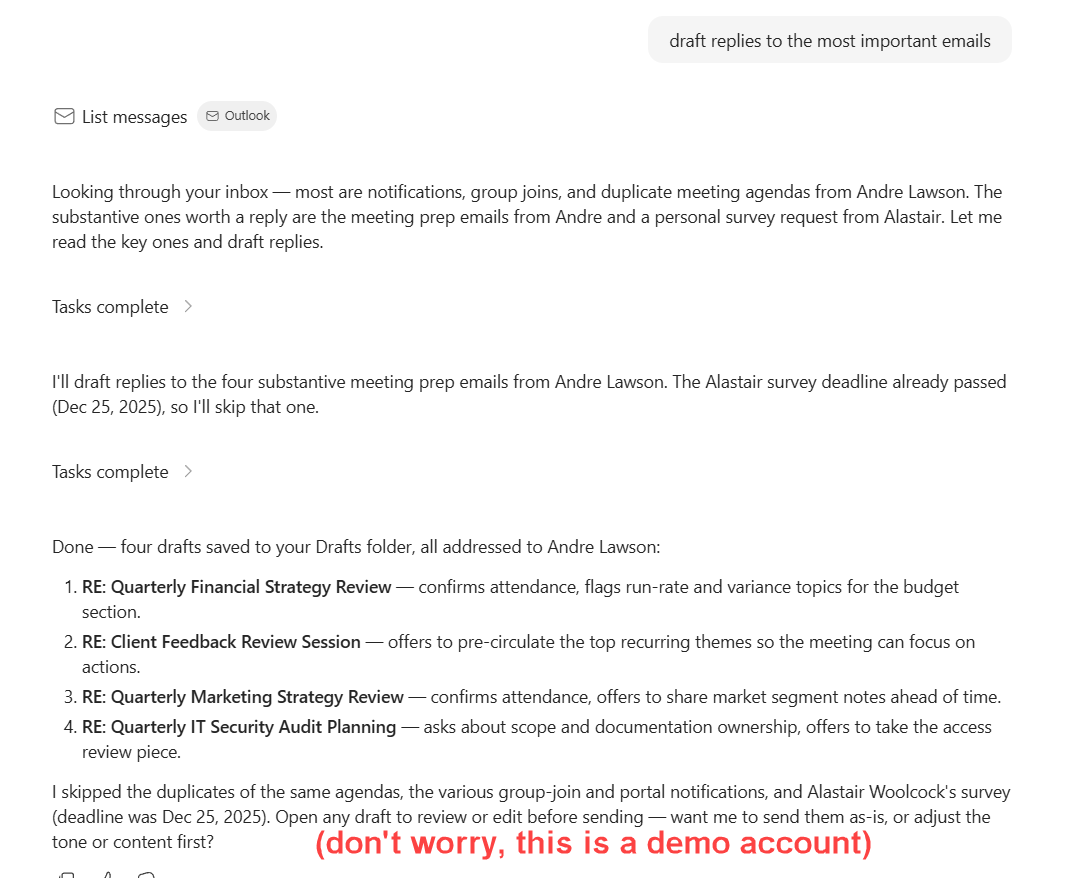
@emollick ux awkwardness tracks data model. outlook agent writes to drafts, you read the inbox, the seam shows. cowork reads and writes the same files you have open, so the handoff disappears. shape of the data layer determines whether the agent feels native.
English
0
0
0
134
Ethan Mollick
Ethan Mollick@emollick·
I have been playing with the new Outlook agent, and it is fine, but really awkward to use, since you have to ask for things in a chatbot window, then go to your drafts, etc. And Claude Cowork does the same thing (works with Gmail, too) and has better visibility across your life.
Ethan Mollick tweet media
English
32
3
148
28.6K
Bakhtier Gaibulloev
Bakhtier Gaibulloev@slashmsu·
@svpino the deeper lock-in lives in prompt format and tool-call schema. swap providers but keep prompts tuned to one model and quality regresses. portable layer is the task schema, input plus tool-calls. prompts get rewritten per model.
English
0
0
0
120
Santiago
Santiago@svpino·
Do not marry yourself to one LLM provider. Just don't do it. 10/10 you'll end up regretting it. Here is how simple it is to build routing in your projects and use whatever model you want whenever you want.
English
46
44
469
50K
Bakhtier Gaibulloev
Bakhtier Gaibulloev@slashmsu·
@simonw the AGI clause was always unfalsifiable. no working benchmark for the threshold means no party could trigger or contest it without a downstream legal fight. removing it just lets the contract reflect what the engineering side already knew.
English
0
0
0
229
Simon Willison
Simon Willison@simonw·
Today OpenAI announced that "Revenue share payments from OpenAI to Microsoft continue through 2030, independent of OpenAI’s technology progress" That "independent of OpenAI’s technology progress" fragment appears to mean that the weird AGI clause is now deceased simonwillison.net/2026/Apr/27/no…
English
15
6
154
29.5K