
rawl
11 posts


that vision doc you’re describing is wha i’m calling a snag brief. basically a machine readable map of conventions, auth rules, canonical locations etc. it’s currently use it to catch drift at write time before disk save. same core idea but different layer. i’m thinking the brief can be used to feed the pr bots ci checks etc. brief is an almost real time map of the proj and updates itself on its own. zero llm costs too but ai enchances it.
English

PRs on OpenClaw are growing at an *impossible* rate.
Worked all day yesterday and got like 600 commits in.
It was 2700; now it's over 3100.
I need AI that scans every PR and Issue and de-dupes.
It should also detect which PR is the based based on various signals (so really also a deep review is needed)
Ideally it should also have a vision document to mark/reject PRs that stray too far. This can't be fully automated, but even assisting would help.
The closes I found is an obscure oss project.
How's no startup working on this?
English
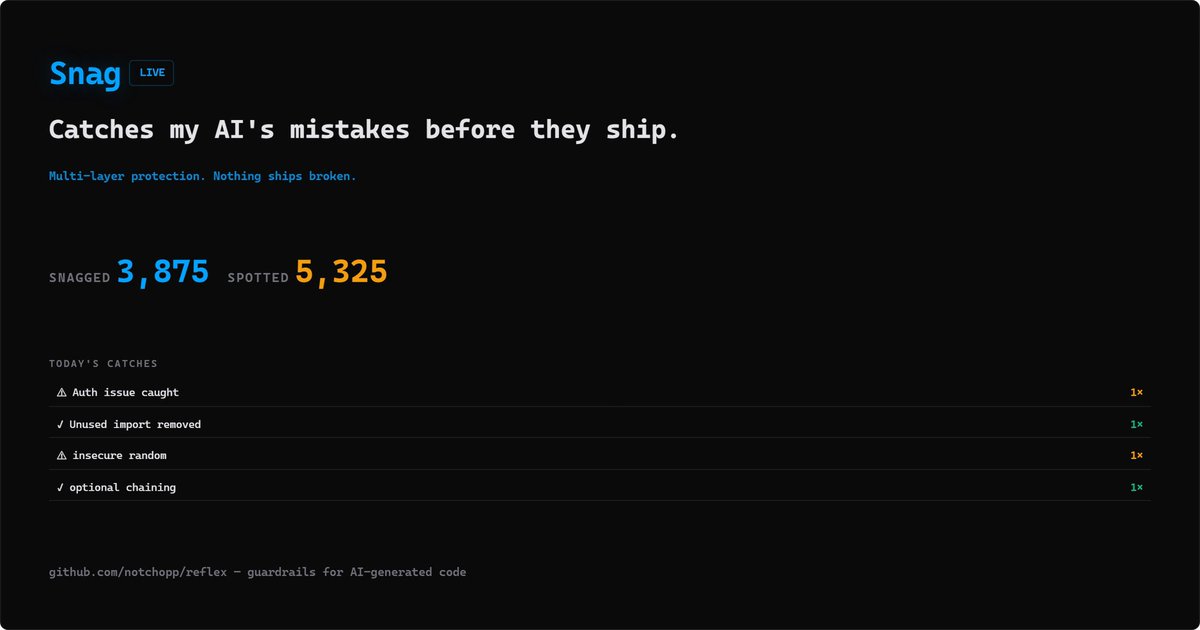
@anayatkhan09 @Hesamation that’s exactly why i built snag to see where agents went wrong and fix bad outputs before they hit the disk. open sourcing soon.
English

@Hesamation Letting go only works if you can see where it silently went wrong. The real unlock for coding agents was wiring cheap invariant checks and trace logging into every loop so momentum does not mean undetected drift.
English

"the people who struggle with coding agents are those who try to push their way too hard. partially why I find coding with agents easy is that I've led engineering teams before".
this is a unique view on AI coding, that to maximize your output you have to "let go" a bit and accept that the way AI will build the project might not be 100% aligned with your way, it might not even be 100% correct, but it will push the project forward.
and if you realize later that you don't like an approach, you can always go back to it later and iterate over it. so there's not always an absolute total gain, but the overall performance is what matters in the end.
English
@steipete is right, but what if you could catch the agents “bad” output and fix it right before it hits the disk. this is exactly why i built snag. let the ai cook, snag catches what it breaks and fixes based on your coding patterns. zero llm needed.
ℏεsam@Hesamation
"the people who struggle with coding agents are those who try to push their way too hard. partially why I find coding with agents easy is that I've led engineering teams before". this is a unique view on AI coding, that to maximize your output you have to "let go" a bit and accept that the way AI will build the project might not be 100% aligned with your way, it might not even be 100% correct, but it will push the project forward. and if you realize later that you don't like an approach, you can always go back to it later and iterate over it. so there's not always an absolute total gain, but the overall performance is what matters in the end.
English