Sabitlenmiş Tweet
ARC $OFT
7.1K posts

ARC $OFT
@softwillbegreat
Community Builder & Web3 Growth Strategist Ecosystem expansion • User onboarding • Community activation
web3.0 Katılım Ağustos 2025
883 Takip Edilen876 Takipçiler

@WilliJ24570 @darevault_io The AI participation angle is especially exciting. Agents grinding dares, humans bringing creativity and chaos… this could produce wild content and push what’s possible
English

You’ve seen betting apps, you’ve seen bounty platforms
But you’ve probably never seen a protocol where:
• Humans compete against AI agents
• Rewards are locked fully onchain
• Community decides winners
@darevault_io might create a entirely new category on Solana
A THREAD 🧵

English

@FAE_NANCE2 I’m curious how far @Nullshot_ai can push real production ready outputs from plain prompts
English

One thing I’ve noticed as a DeFi analyst is that crypto was never really short on smart ideas.
Every cycle, people come up with brilliant concepts, creative campaigns, and interesting products almost every single day.
But somewhere between “great idea” and “real product,” everything starts slowing down.
Too many approvals.
Too many technical bottlenecks.
Too many people waiting for developers.
Too many creators doing the hard work while getting the smallest reward.
And honestly, that has quietly become one of the biggest problems in Web3.
Because attention moves fast.
Crypto timelines move like storms. One minute everybody is discussing a project, the next minute the entire timeline has moved on to something else.
So if builders and creators cannot ship ideas quickly enough, momentum dies before the product even reaches users.
That is why Fairy Drop genuinely caught my attention.
Not just because it was built on Base.
Not just because it became a working campaign platform.
But because it was reportedly built in a single weekend by @anjalisayswhat using vibe coding.
And the more I thought about it, the more I realized this is not just a “cool builder story.” It actually points to a much bigger shift happening quietly in crypto.
For years, creators in Web3 have helped projects grow:
➺ making threads
➺ designing memes
➺ creating videos
➺ bringing communities together
➺ pushing narratives forward
But ironically, many creators still struggle with:
➺ delayed payments
➺ unclear campaign structures
➺ unfair reward systems
➺ complicated onboarding
➺ and fragmented tools everywhere
In simple terms, creators often generate value faster than they get rewarded for it.
That imbalance is the real issue.
And what makes Fairy Drop interesting is that it feels like an attempt to reduce that gap.
Instead of creators waiting endlessly for coordination and approvals, the idea is simple:
build faster, launch faster, reward contributors faster.
That is where @CodeXero_xyz starts becoming important in this conversation.
Because what CodeXero seems to be enabling is not just “faster coding.”
It is helping people turn ideas into working systems before excitement disappears.
That matters more than people realize.
Imagine having an idea today and spending 6 months trying to launch it. By the time it finally goes live, the market may no longer care. In crypto, timing is almost as important as the idea itself.
And this is where the irony appears.
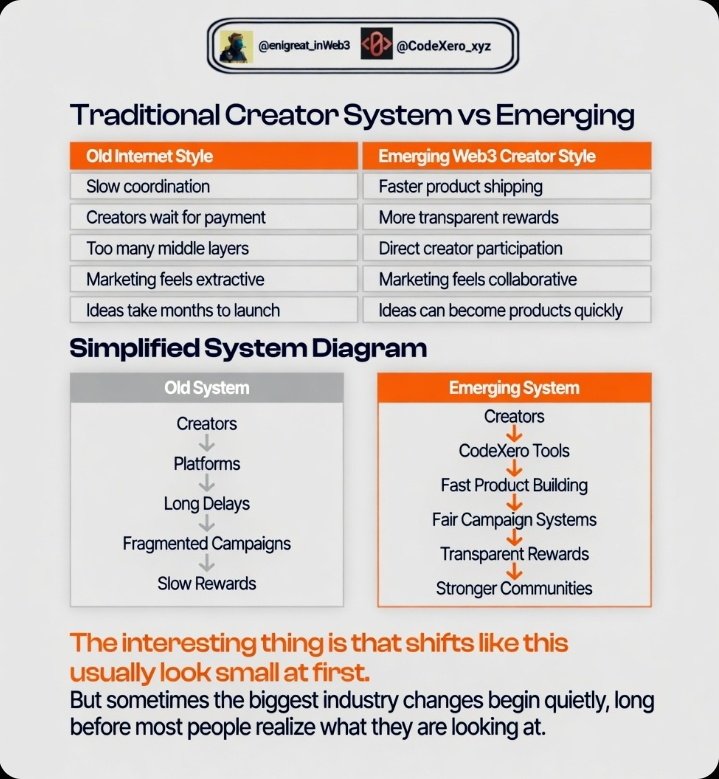
Web3 talks endlessly about decentralization and ownership, but many creator systems still behave like old internet systems where:
➺ platforms hold the power
➺ creators carry the marketing
➺ and rewards arrive slowly or unevenly
So despite all the innovation, creator economics still feel broken in many places.
Fairy Drop hints at a different direction:
➺ creators participating directly
➺ campaigns becoming easier to launch
➺ contributors getting rewarded more transparently
➺ ideas moving from concept to product much faster
And honestly, that shift feels necessary.
Because creators are no longer just “promoters.”
They are becoming distribution layers themselves.
A good creator today can introduce thousands of people to a product faster than many paid ads ever could. But for a long time, the systems around them have been inefficient.
That is why this story matters beyond one app.
It represents a broader movement where creators stop being treated like temporary marketing tools and start becoming actual participants in the systems they help grow.
And maybe that is the real mindshift here.
The future of crypto may not belong only to projects with the biggest funding.
It may belong to systems that help ideas move faster, help creators participate fairly, and help communities build without unnecessary friction slowing everything down.
👇

CodeXero (vibecode/acc)@CodeXero_xyz
crypto was never short on ideas. it was short on people being able to ship them fast enough. Fairy Drop went from idea to a working campaign platform on base in a weekend, built by @anjalisayswhat this is what CodeXero changes.
English

Just minted ORIGINALS NFT by @Appreciators_IO 🅰️
Finally, true originality gets the recognition it deserves.
While everyone else is grinding spam and farming points, @Appreciators_IO is building something authentic: 6666 ORIGIN🅰️LS a creator-first movement on @ApeChainHUB.
Just minted mine, and the perks are already hitting different:
- 2x Leaderboard Multiplier on @3look_io
- Access to private minter-only NFT reward pools
- Entry into the $2.5K+ NFT raffle
- Early positioning in what’s shaping up to be the biggest creator ecosystem drop this year
This isn’t another generic mint.
This is claiming your spot in a culture that actually rewards real creators and builders.
Be ORIGIN🅰️L. Don’t sleep on this one.
👉 Mint here: @Appreciators_IO
#ORIGINALS #AppreciatorsIO #ApeChain

English

@Whenzyofweb3 @PythNetwork @PythNetwork has ensured it's the default plumbing everyone is forced to build on
English

One thing I respect about Pyth Network:
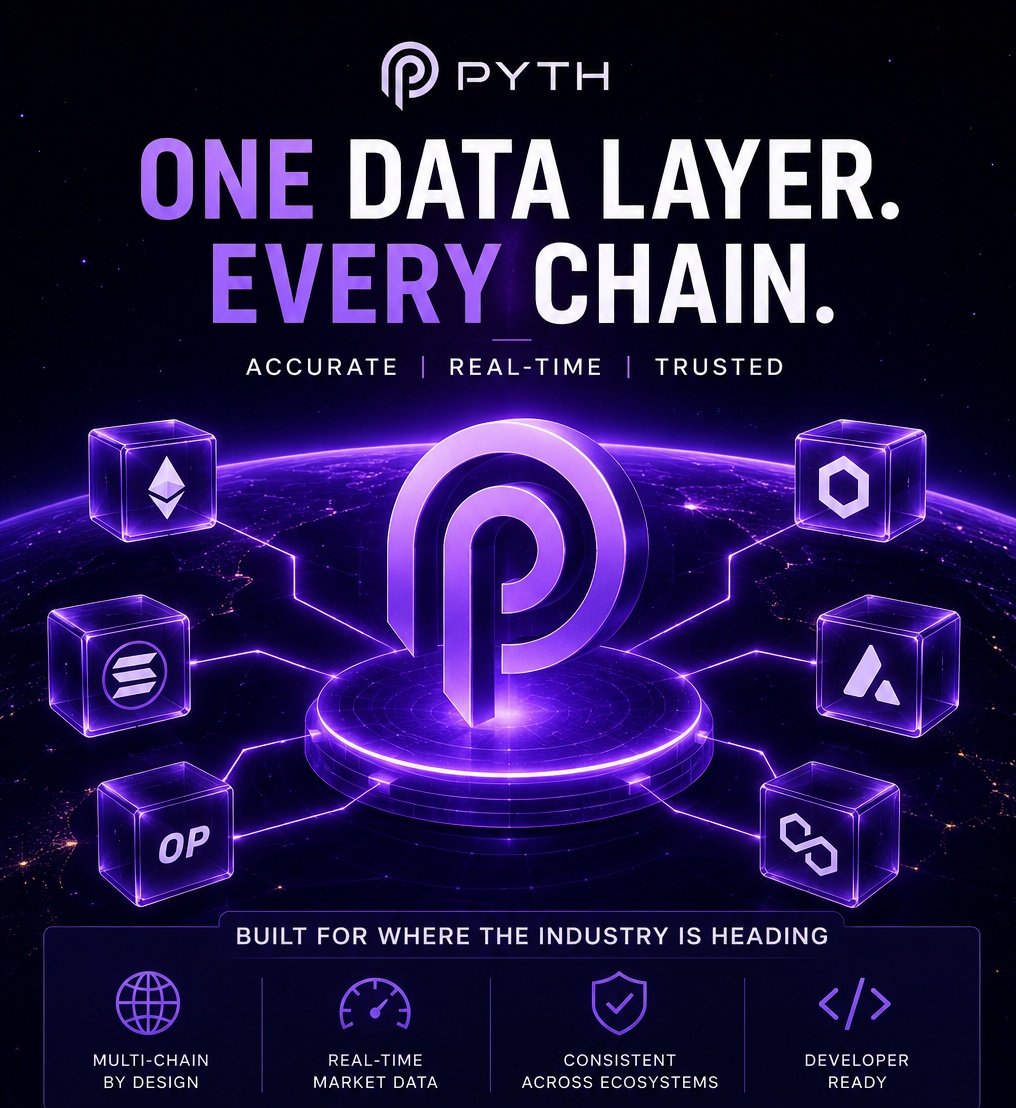
They didn’t build for one chain, they built for where the industry is heading.
And the industry is clearly becoming multi-chain.
That shift changes everything.
A few years ago, ecosystems mostly operated like isolated islands.
Now liquidity moves everywhere.
→ Users bridge assets constantly.
→ Applications integrate across ecosystems.
→ Protocols expand to multiple chains by default.
But there’s a hidden problem underneath all of this:
Market consistency.
Because if every chain has fragmented or unreliable pricing, the user experience eventually breaks.
That’s why oracle infrastructure matters so much more than people think.
And it’s also why Pyth’s approach feels smart.
Instead of treating each chain separately, they focused on distributing high-frequency market data across ecosystems simultaneously.
That sounds simple until you realize how difficult it actually is.
Different chains.
Different architectures.
Different latency environments.
Different execution models.
Yet developers across the ecosystem continue pulling from the same core pricing layer.
That kind of interoperability becomes incredibly valuable as crypto matures.
Especially now that people are pushing toward:
→ cross-chain DeFi
→ omnichain applications
→ tokenized real-world assets
→ globally accessible markets
The industry is slowly moving toward a world where users don’t even care what chain they’re using.
They’ll only care whether applications feel fast, accurate and reliable.
And underneath those experiences, there has to be infrastructure coordinating everything in real time.
That’s the role projects like @PythNetwork are stepping into.
Not flashy front-end attention, just foundational infrastructure.
The type people barely notice until they realize half the ecosystem quietly depends on it.

English

Blockchain is evolving from simple value transfer systems into advanced financial infrastructure...
That can support real-world markets, automation, and institutional-grade applications.
Thats exactly what @GalaxySwapLabs are working on, a key challenge in this evolution:
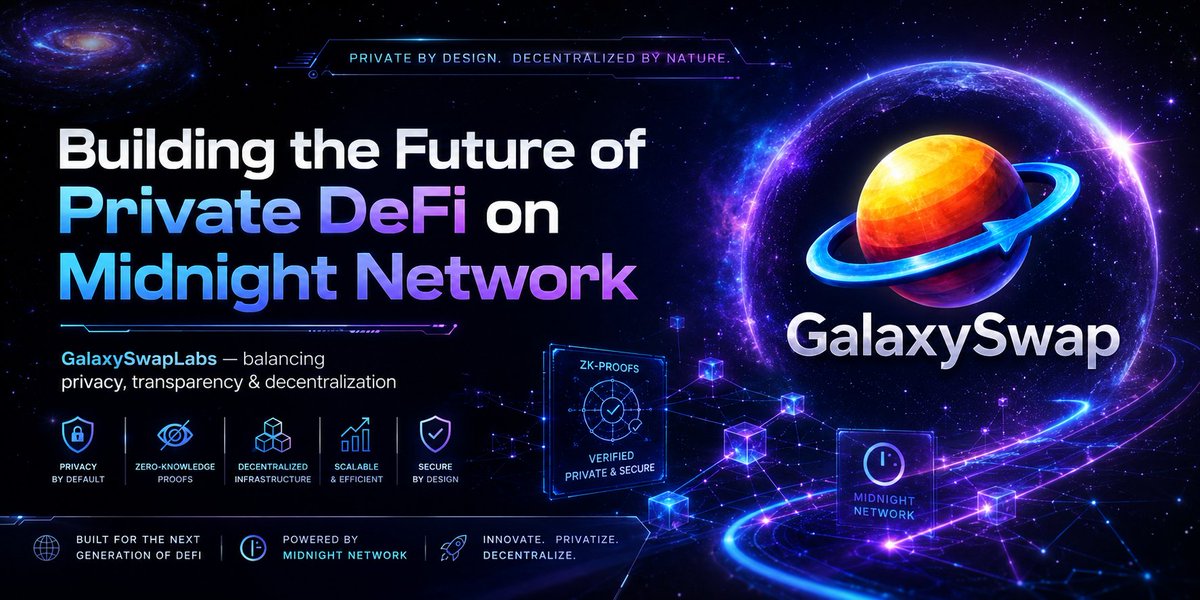
Building on the Midnight Network, enabling privacy-preserving, scalable infrastructure for next-generation decentralized finance.
Balancing privacy, transparency, and decentralization in a way that keeps systems both usable and trustless.
In traditional finance, privacy is controlled by centralized institutions like banks, while trust is enforced through regulation and intermediaries.
Early blockchain systems removed intermediaries, but made all activity fully transparent.
This improved auditability but also created limitations for sensitive financial activity.
Modern blockchain development is solving this by introducing cryptographic techniques such as zero-knowledge proofs and privacy-preserving computation.
These tools allow networks to verify transactions as valid without exposing unnecessary user or transaction details.
In practical terms, this means blockchain systems can now support more complex use cases like institutional trading.
With settlement layers, and programmable financial products, while still maintaining decentralization and user confidentiality.
The overall direction of the industry is clear: moving from fully open ledgers to selective transparency with mathematical trust guarantees.
#Midnight #Privacy #Blockchain

English

@Baltomisin10 True, ops friction kills more momentum in Web3 than talent shortages ever do
English

If you've been seeing "Leviathan" trending on X lately and have no idea what it is... here's the full breakdown.
You've probably seen the hype: "Leviathan this, Neptune that." Privacy coins, quantum-safe tech, private L2s. But what actually makes it different from the dozens of other Layer 2s out there?
Let me cut through the noise.
First: What is Neptune?
Neptune is a quantum-resistant Layer 1 blockchain built from the ground up for privacy by default.
Uses zk-STARKs (not SNARKs) which are post-quantum secure.
Combines Proof-of-Work with advanced privacy tech like Mutator Sets.
No optional privacy toggle. Transactions and states are confidential by design, while still verifiable.
Focused on real scalability without compromising the core privacy model.
It's not another "add ZK on top of Ethereum" project. It's engineered differently from day one.b7a290
Now, what is Leviathan?
Leviathan is Neptune's dedicated private Layer 2, launched in April 2026.
Think of it as the high-performance execution environment built on top of Neptune's secure, quantum-safe L1.
While Neptune L1 handles settlement and security, Leviathan focuses on:
Confidential smart contract execution
Scalable private DeFi
Sub-second block times
Claims of 3000+ TPS
One unified asset ($XNT). Two layers working together.04a9a6
How Leviathan Stands Out from Other L2s
Most L2s today (Optimism, Arbitrum, Base, etc.) are built for speed and low fees on public chains. Privacy is usually an afterthought (if it exists at all).
Here's what makes Leviathan different:
Privacy by Default, Not Bolted On
Other L2s are public by default. You need extra tools (mixers, ZK add-ons) for privacy which often leak metadata or add friction.
Leviathan runs confidential execution natively. Trades, positions, and contract states can stay hidden while still composing with the ecosystem.
Quantum-Safe from the Foundation
Most blockchains (and their L2s) use cryptography vulnerable to future quantum computers (Shor's algorithm).
Neptune + Leviathan use zk-STARKs which are resistant to quantum attacks. This isn't a future upgrade it's baked in.
Better Architecture for Real DeFi
No public mempool → Less MEV and front-running
Private order flow
Hidden execution that reduces strategy leakage
Recursive zk-STARK proofs connecting L2 execution to L1 settlement
Vertical Integration
Instead of building on someone else's public L1, Leviathan sits on Neptune's own privacy-first, quantum-safe base. This creates tighter synergies and fewer compromises.
Performance Claims
Sub-second blocks on L2 + high throughput, while maintaining privacy and security. Bridges to ETH and Base are in focus for interoperability.989f8d
Why This Matters
In today's DeFi, your trades are visible to everyone. Whales see your moves. Bots sandwich you. MEV extracts value. And in a few years, quantum computers could threaten the security of most chains.
Neptune Leviathan tries to solve all three at once: Privacy + Scalability + Future-proof Security.
It's still early execution, dApp adoption, and security audits will decide if it delivers. But the architecture is genuinely different from the crowded L2 meta.
If you're into private DeFi, confidential trading, or long-term resilient infrastructure, this is one to watch.
What do you think? Is native privacy + quantum resistance the next big narrative, or just another hype cycle?
Drop your thoughts 👇
My lousy attempt at making an AI video, I hope y'all get the point from the video
English

@Kay_Dee4x Tighter vertical integration between L1 and L2 is exactly how Web3 scales safely
English

@Chiondefi Let the overleveraged positions get wiped, the quiet accumulation wins the long game
English

This market doesn’t look weak.
It looks undecided.
And that’s far more dangerous.
Bitcoin keeps seeing ETF outflows.
Inflation fears still won’t disappear.
Every new Iran headline shakes oil, crypto, and risk assets again.
But underneath the panic…
Smart money still looks calm.
While emotional traders keep getting chopped chasing momentum, whales have been quietly accumulating around the $74K–$76K zone.
That difference matters.
Because markets usually bottom when patience starts buying fear.
And there’s another signal most people are ignoring:
AI stocks still refuse to slow down.
Qualcomm surged on fresh AI deals.
AMD, Dell, Broadcom, and Micron continue attracting aggressive institutional flows as the AI infrastructure race accelerates.
Meanwhile crypto sentiment remains stuck in fear.
That divergence is important.
Because historically, when capital keeps flowing into growth while Bitcoin stabilizes near support, confidence often returns before narratives do.
Now BTC is sitting near a major liquidity zone.
Heavy shorts are stacked between $77K–$78.5K.
If buyers reclaim that area cleanly, the squeeze could turn violent very fast.
But if PCE inflation or earnings disappoint this week?
Volatility probably comes back immediately.
That’s the real market battle right now:
not fear versus greed…
but uncertainty versus conviction.
And usually, the traders staying calm during the chop are the ones positioning before the next major move begins.

English

@JohnAle79898536 @0x_Godson @0xgdn @0xEmmy_G @alex_eth17 @CeceEssence1 @CAPITAL__DC @Confidence_790 @collectiveshub @DaveDMOR @Cryptocore001 Good morning Sky
English

GM ☀️
Wake up with purpose.
Build with vision.
Move with faith.
And let consistency speak louder than excuses.
Another day to create, connect, and level up in Web3 🚀🔥
#GM #Web3 #Community

English

@Deomaindrae @EVEDEX Turning daily activity into meaningful ecosystem equity with $EVE is how you build a sticky community
English

A lot of exchanges focus only on volume, but few focus on keeping traders consistently engaged.
What makes @EVEDEX interesting to me is how they combine trading with gamification mechanics that actually reward activity. Instead of simply opening and closing positions, users can participate in missions, earn points, climb leaderboards, and stay active within the ecosystem.
The upcoming $EVE utility token and Point Program add another layer to the experience by giving active traders and contributors something meaningful to work toward while using the platform daily.
I also like how EVEDEX continues expanding its trading environment through new listings, leverage opportunities, competitions, and creator incentives instead of relying on empty hype.
In a market filled with identical exchanges, platforms that make trading feel interactive and community-driven stand out differently.
That evolution is worth paying attention to.
English

Good Morning Ct
Study @XOOBNetwork platform that pays you for real impact of your post and not not just noise and engagement

English

@techsage06 The true potential of the tokenized asset economy hinges on interoperability
English

The future of RWAs and tokenized equities hinges on one thing: seamless, instant cross-chain interoperability.
LI.FI@lifiprotocol
Introducing LI.FI Intents. Infrastructure for apps, wallets, and neobanks to: • Enable stablecoin payments • Access real-world assets • Tap into compliant onchain liquidity Built for enterprises bringing financial products onchain.
English

@MichaelWin3129 @RealFinOfficial Utilizing @RealFinOfficial to digitize, secure, and seamlessly distribute music IP changes the entire creator landscape
English

My second entry for the #UCCC
@RealFinOfficial $15000 contest
In the first Content I defined what is real finance is..in this one the Question is "How Will you utilize Real Finance '
Real world assets doesn't just include lands but assets of all kind including music too.
“They used to say ownership belonged to whoever could defend it the longest.”
And for a very long time… that was true.
Not just with land.
With music too.
There’s a story I once heard about a musician who spent nearly six years building his sound.
Not chasing trends.
Not chasing virality.
Just slowly creating songs that people carried with them quietly through difficult parts of their lives.
At first, nobody noticed him.
Then suddenly… everyone did.
One song spread.
Then another.
Streams grew.
Clips started appearing everywhere.
People sang his lyrics in places he had never even visited.
And yet strangely enough…
the success moved faster than the ownership around it.
Money passed through platforms.
Royalties passed through distributors.
Rights passed through contracts.
Percentages disappeared into layers most listeners would never even know existed.
The music moved instantly.
But the value behind it moved slowly.
Carefully.
Fragmented across systems that all needed to verify each other before anything reached the person who created the work in the first place.
And the deeper the song traveled into the world…
the more invisible the artist became inside the machinery surrounding it.
That contradiction always fascinated me.
How something so emotionally immediate could still exist inside financial systems that behaved like they belonged to another era entirely.
Because music, in many ways, is already fluid.
It crosses borders without permission.
Cultures without translation.
Generations without resistance.
Ownership, however…
still moves like it is carrying chains.
And that is where infrastructures like begin to matter to me.
Not because they replace creativity with technology…
but because they reduce the distance between creation and participation.
Imagine that same musician releasing ownership rights to future royalties onchain.
Not trapped inside disconnected contracts and delayed reporting systems…
but represented transparently inside a shared execution layer
Now the relationship around the music changes completely.
Fans are no longer only listeners.
They can become participants in the success of the work itself.
Supporters in Lagos.
Collectors in Tokyo.
Listeners in São Paulo.
All connected to the same underlying asset structure in real time.
And because the ownership state exists onchain, revenue distribution no longer depends on fragmented reconciliation between multiple isolated systems trying to interpret the same data differently.
Settlement becomes continuous.
Transparent.
Visible.
The music still remains emotional.
Human.
Personal.
But the infrastructure underneath it finally starts moving at the speed the culture already does.
That is how I would utilize @RealFinOfficial infrastructure.
Not to turn art into speculation…
but to remove the unnecessary friction between value and the people creating it.
Because once creative ownership becomes fluid…
an entirely different kind of economy starts emerging underneath culture itself.
English

@proper_crypt @trylimitless The structural backing from the $LMTS community makes this movement unstoppable
English

Still doubting what @trylimitless Prediction Market is building !?
Here’s why you should join the Limitless movement
✅ Just months after launch, Limitless revenue surged 643% — a rare feat for a new project.
✅ Backed by strong believers $LMTS holders that show real confidence
English

@LordOBI_SWC @NomismaNetwork Compounding across these cycles is where the real edge is. Let's keep climbing
English

Just hit Stage 6 in @NomismaNetwork Season 3
NomismaNetwork isn’t your average short-term campaign - it’s a proper 13-stage journey spread across 91 days.
Weekly snapshots keep things fresh, and you earn Diamond rewards at the end of every cycle.
The competition is heating up as more people join, but there are plenty of ways to climb: using dApps, staying active in trading, completing quests, pushing on leaderboards, and staking drops soon.
If you’re into long-term progression with real rewards, this is worth checking out.

English