
Sabitlenmiş Tweet
sol🏴☠️
1.5K posts



At any point in the last 10 years I could of got pregnant and I would have been ecstatic, but I’ve been on birth control for all that time with the stubborn desire to get pregnant inside of a loving marriage, but like…. I think this year I stopped thinking that’s reasonably probable outcome.
English
sol🏴☠️ retweetledi

"Personalized" software should mean dynamically assembled by you, for you.
When your computer is truly yours, personalization stops being corporate extraction and becomes the sovereign production of your inner world.

English
sol🏴☠️ retweetledi

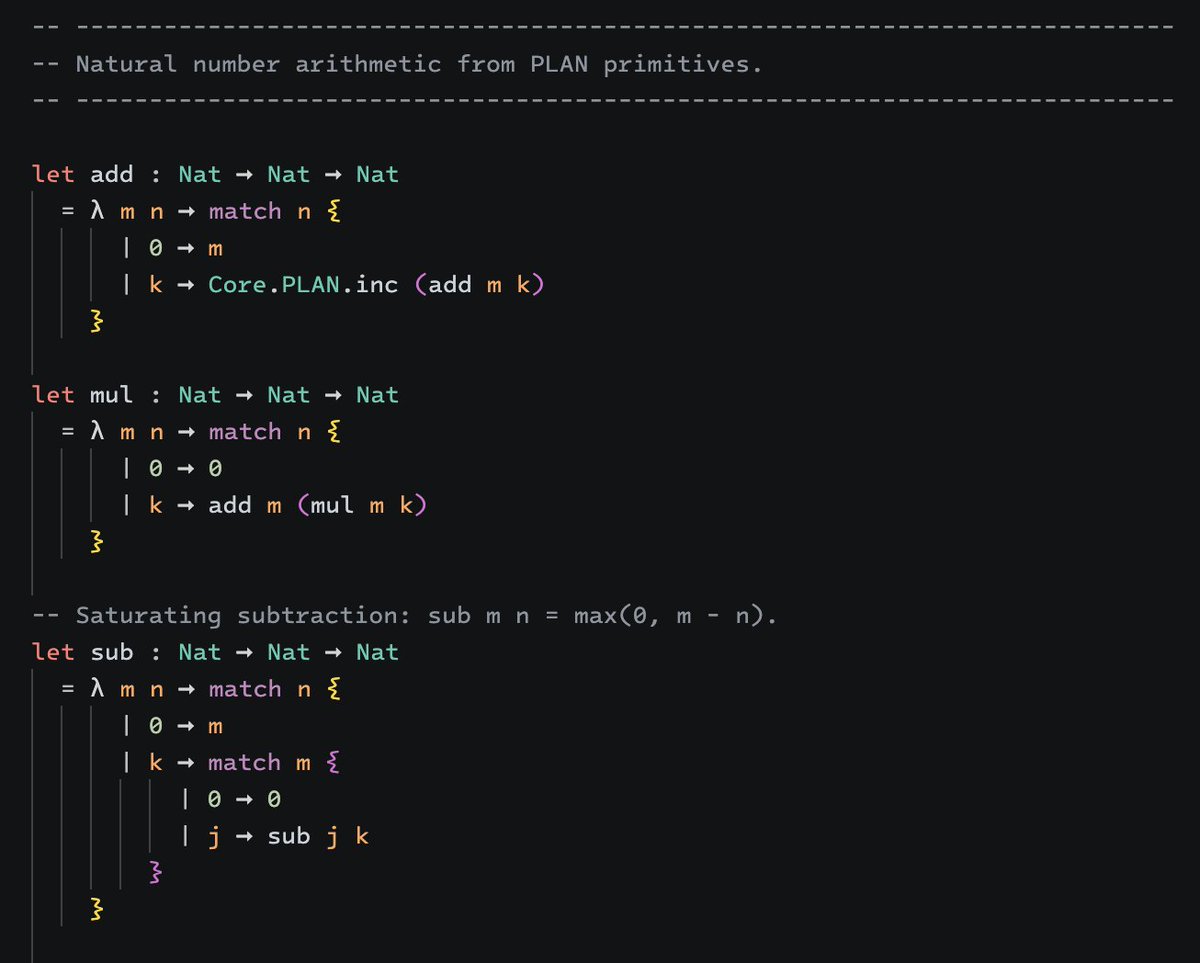
Gallowglass v1.0 releases today ⚔️.
A programming language targeting the PLAN ISA by @sol_plunder & Elliott, designed for LLMs to write and reason about. The compiler now compiles its own source under Reaver with bytewise correctness.
github.com/sigilante/gall…
English
@sigilante The tree of the knowledge of good and evil is civilization.
English
Catholic God: "It's not about the apple. It's about sending a message."

Bandito🚪🪨🗡️🦃@alma43_47
Former catholic here. I always wondered why Eve got in trouble for eating an apple. Years later, and I still don’t have a clue
English
sol🏴☠️ retweetledi

@SeungheonO @hastuc_dibtux My guess is that this is Foil, a language designed to feel like Hoon but using Rex notation and compiling to PLAN.
English

sol🏴☠️ retweetledi



what is the difference between a data structure and a database?
English
@IndividualistPE The goal is to take something like X and combine all of it's concerns together into one abstract universe: one coherent system of language/law
The thesis is that the integration costs compound with scale and that the reduction in construction costs can therefore be incredible.
English
@IndividualistPE And that is just the three biggest monoliths in something like X. If you look at the X software system as a whole, there are dozens of monoliths, each with their own ontologies.
Every interaction between these systems needs a custom system for translating between them.
English
The cog stuff from earlier architectures is no longer a part of PLAN. It has been replaced with direct support for side-effects, with virtualization to run code in a pure sandbox.
Shamanic Depressive Gymnosophist (book in bio)@sigilante
We have shipped some demos w/ Gallowglass; they run in CI but are difficult to run right now pending cog I/O. The PLAN runtime situation is under active flux today and we expect stable ways to run a PLAN OS soon. A byte-compatible Python PLAN interpreter ships w/ Gallowglass.
English
It's mostly an efficiency thing.
PLAN programs can make syscalls as side effects, and an outer layer decides what to do with them.
This is more efficient than the pure SSI model of returning a "please do this" object and a callback.
In the non-effectful version, you don't need any special sandboxing because there are no effects at all, only request values.
With the effectful version, you need to run the code "virtualized" with an effect handler.
This is a generalization of an Urbit idea (mock and scry).
English

@sigilante I'm interested in the idea of building a proper Scheme on top of PLAN using CPS and virtualization.
I suspect that almost all of Scheme can be implemented using PLAN, including varargs, multi return, continuations, mutation, dynamic scope, etc.
English
@sigilante Language design is pretty cool in general, I like the type system and syntactic approach.
Automatic CPS for effect handlers / IO, and then using that as an automatic snapshot point is a pretty compelling approach.
English
𝕎𝔼 ℍ𝔸𝕍𝔼 𝔸ℂℍ𝕀𝔼𝕍𝔼𝔻 ℂℝ𝕀𝕋𝕀ℂ𝔸𝕃 𝕄𝔸𝕊𝕊
The Gallowglass PLAN language is being released as a self-compiling alpha today.
github.com/sigilante/gall…

English
@sigilante If, Not, And, Or, etc are available as jets.
> Both Text and Bytes use the structural pair encoding: (byte_length, content_nat).
Strongly recommend using a high bit to encode the length for efficiency reasons.
English