
Sabitlenmiş Tweet
Solard
221 posts


Solard
@solardxyz
CA: 47M2U1eVot6VPWjcqEFWe2CesUTBGBXfSDovaqTmpump your gateway to trading with built-in intelligence and 0% fees, fully opensource
Katılım Temmuz 2026
17 Takip Edilen221 Takipçiler

One signal is an opinion.
Multiple independent signals are evidence.
In distributed systems,a single node doesn’t decide the truth.
Consensus does.
Why?
Because individual nodes can fail.
Become outdated.
Or report incorrect information.
Markets behave the same way.
A whale buy isn’t enough.
A volume spike isn’t enough.
A trending token isn’t enough.
Each signal can be manipulated in isolation.
But when independent signals begin to agree
Wallet accumulation
Holder growth
Liquidity expansion
Organic transaction activity
Sustained social momentum
you move from speculation to probability.
The strongest trading decisions don’t come from the loudest metric.
They come from signal consensus.
Most terminals ask you to interpret every signal yourself.
We think software should do the correlation first.
And thats how we approach the $Solard terminal
Not looking for one perfect indicator.
Building market consensus before surfacing an opportunity

English
Solard retweetledi

The market isn’t waiting for your fifth browser tab.
Every second spent searching is a second you’re not deciding.
$SOLARD is built to shorten the gap
Speed isn’t just execution
It’s reaching conviction before everyone else.
That’s where @solardxyz stands out

English
Speed isn’t about being faster.
It is about waiting less.
Modern processors spend a surprising amount of time waiting for data.
Engineers solved this with techniques like:
Prefetching
Caching
Parallel execution
The goal isn’t to make the CPU faster.
It is to eliminate unnecessary waiting.
Trading has the same problem.
You aren’t slow because you analyze markets poorly.
You are slow because your workflow is full of latency.
Open the chart.
Wait.
Check liquidity.
Wait.
Load holder distribution.
Wait.
Inspect wallet activity.
Wait.
Verify social momentum.
Wait.
By the time every request finishes…
The market has already produced new information.
Most trading terminals optimize rendering.
Very few optimize decision latency.
The fastest platform isn’t the one with the smoothest charts.
It is the one that already has the context ready before you ask for it.
That is the philosophy behind the $Solard terminal
Not just reducing clicks.
Reducing the time between question and conviction

English
Most traders analyze markets by looking at the output.
The chart.
The candle.
The percentage gain.
But in software architecture, when something goes wrong,engineers don’t debug the output.
They inspect the events that produced it.
This is the idea behind event sourcing.
Every state is simply the result of a sequence of events.
Markets work the same way.
Price doesn’t move randomly.
It is the consequence of:
>Wallet accumulation
>Liquidity changes
>Holder expansion
>Capital inflows
>Transaction velocity
>Social discovery
The chart is just the final state.
The edge comes from observing the events before they become price.
Most trading terminals are built around the destination.
We are more interested in the journey.
And that is how we think about with the $Solard terminal
Not as a charting platform.
But as an event engine that lets you see the market before the candle tells the story

English
Every question has an execution cost.
When you search a database, the answer isn’t instant.
The database builds an execution plan.
It decides:
>Which index to use.
>Which tables to scan.
>Which operations to avoid.
>The fastest path to the result.
Good databases optimize the query before executing it.
Trading terminals don’t.
Every token analysis starts from scratch.
Open the chart.
Check liquidity.
Inspect holders.
Track wallets.
Verify volume.
Read socials.
You are manually executing the same query…
Over and over again.
The problem isn’t that the data is difficult to access.
It is that the workflow is never optimized.
A trading terminal should already know the shortest path to conviction.
Not force you to discover it every single time.
That is one of the ideas behind the $Solard terminal
Every market question deserves an optimized execution plan.
Not another checklist.

English
Indexes exist because scanning everything doesn’t scale.
Databases don’t search every row every time you make a query.
They build indexes.
Why?
Because finding one record shouldn’t require reading a million others.
Crypto markets have the same problem.
Every minute produces:
Thousands of swaps
Hundreds of wallet movements
Liquidity updates
New holders
Social activity
Most trading terminals still expect you to scan everything.
Open another chart.
Check another wallet.
Refresh another dashboard.
You are effectively performing a full table scan on the market.
It is inefficient.
The edge isn’t seeing more data.
It is knowing where to look first.
That is what an index does.
It prioritizes.
It narrows the search space.
It gets you to the answer faster.
And that is how we think about the $Solard terminal
Not as a database of market data.
As the market index that points you toward what actually deserves your attention.

English
Markets don’t slow down.
Your brain does
Every second,the market generates:
>New transactions
>New wallets
>Liquidity updates
>Holder changes
>Social activity
The data stream never stops.
But human attention has a fixed throughput.
In distributed systems, when incoming data exceeds processing capacity, it’s called backpressure.
Queues grow.
Latency increases.
Eventually,the system becomes unstable.
Most traders experience the exact same thing.
Too many tabs.
Too many alerts.
Too many metrics.
Too many decisions.
By the time everything has been processed…
The market has already moved on.
The solution isn’t to consume more data.
It is to reduce the rate at which irrelevant data reaches you.
A well-designed trading terminal acts as a pressure valve.
It absorbs the firehose of market activity…
Processes it…
And only forwards what actually deserves your attention.
That is how we think with the $Solard terminal
Not as another source of information.
As a backpressure layer between the market and your decisions

English
use the $Solard terminal to find out
Don 🐂@DonWedge
Which blue chip altcoins will 100x from current levels?
English
Compression creates an edge.
In computer science,compression isn’t about deleting information.
It is about representing the same information more efficiently.
A ZIP file contains everything.
Just in a form that is faster to store and transfer.
Markets have the same problem.
A single token can generate:
>Thousands of transactions
>Hundreds of wallet movements
>Liquidity changes
>Holder updates
>Social activity
>Volume spikes
Raw events are expensive to process.
The information is there.
But the signal is buried inside millions of data points.
A good trading terminal should compress that complexity.
Not by hiding data…
But by extracting the information that actually changes your decision.
Instead of reading 10,000 events,
You read one conviction score.
Instead of watching dozens of metrics,
You understand the market state in seconds.
That is not less information.
That is higher information density.
That is how we think about the $Solard terminal
Not as a place to consume more data.
As a system that compresses complexity into conviction

English
use the $Solard terminal to find out
Your Crypto DJ@yourcryptodj
Which #crypto is going to make this chart? 🤔 Comment below👇
English
Trading is a pipeline problem.
Every decision follows the same sequence.
Input → Processing → Output
The problem is that most traders build this pipeline manually.
Input:
>Charts
>Wallets
>Volume
>Liquidity
>Holders
>Socials
Processing:
>Open five tabs.
>Compare metrics.
>Cross-check wallets.
>Verify liquidity.
>Filter noise.
Output:
“Maybe it is a good trade.”
The weakest part isn’t the data.
It is the processing layer.
Humans aren’t good at repeatedly correlating dozens of independent variables under time pressure.
Software is.
The future of trading terminals isn’t about exposing more inputs.
it is about building a better pipeline.
One that continuously ingests signals…
Processes them in real time…
And outputs ranked opportunities instead of raw information.
That is how we think about the $Solard terminal
Not as a collection of widgets.
But as a market intelligence pipeline that transforms data into decisions

English
Use the $Solard terminal to catch the next runner
POG 🧲@traderInosuke
I’m a simple guy. I see a good meme, I buy it. Shill me something.
English
Raw data lies.
Not because it is incorrect.
Because it is incomplete.
A token with $2M in volume sounds impressive.
Until you realize:
Liquidity is only $40K
>80% of holders own less than $10
>Three wallets generated half the volume
>Social activity is entirely bot-driven
The raw number didn’t change.
Your interpretation did
This is why engineers normalize data before analyzing it
A value without context is misleading
Trading should follow the same principle
Volume should be normalized against liquidity
Wallet activity against historical behavior
Holder growth against distribution quality
Social engagement against authenticity
Only then do metrics become comparable
Only then do patterns become reliable
Most trading terminals display raw metrics
The next generation will display normalized intelligence
Because better decisions don’t come from bigger numbers.
They come from better context.
That is the philosophy behind the $Solard terminal we are building
Not exposing raw market data.
Transforming it into signals you can actually trust

English
Your edge isn’t determined by how much data you consume.
It is determined by your signal-to-noise ratio.
Every market produces thousands of events every minute.
>New wallets.
>New swaps.
>Liquidity changes.
>Holder updates.
>Social mentions.
>Price movements.
Most of them don’t matter.
The challenge isn’t collecting more events.
It is actually identifying which events carry information.
In engineering,this is called signal extraction.
You remove noise until only meaningful patterns remain.
Trading should work the same way.
A 20% volume increase isn’t a signal.
A whale buy isn’t a signal.
A spike in social activity isn’t a signal.
But when all three occur alongside healthy liquidity and improving holder distribution…
The probability changes.
Not because one metric became stronger.
Because multiple independent signals started telling the same story.
That is the difference between monitoring markets…
And understanding them.
That is how we think about the $Solard terminal
Not as a dashboard
But as a signal extraction engine built for on-chain markets.

English
Solard retweetledi
Data is easy to find.
Context is hard to build.
That’s why @solardxyz isn’t just another dashboard.
It connects signals into decisions.
$SOLARD
The edge isn’t more metrics.
It’s knowing which metrics matter together.
That’s the philosophy behind @solardxyz
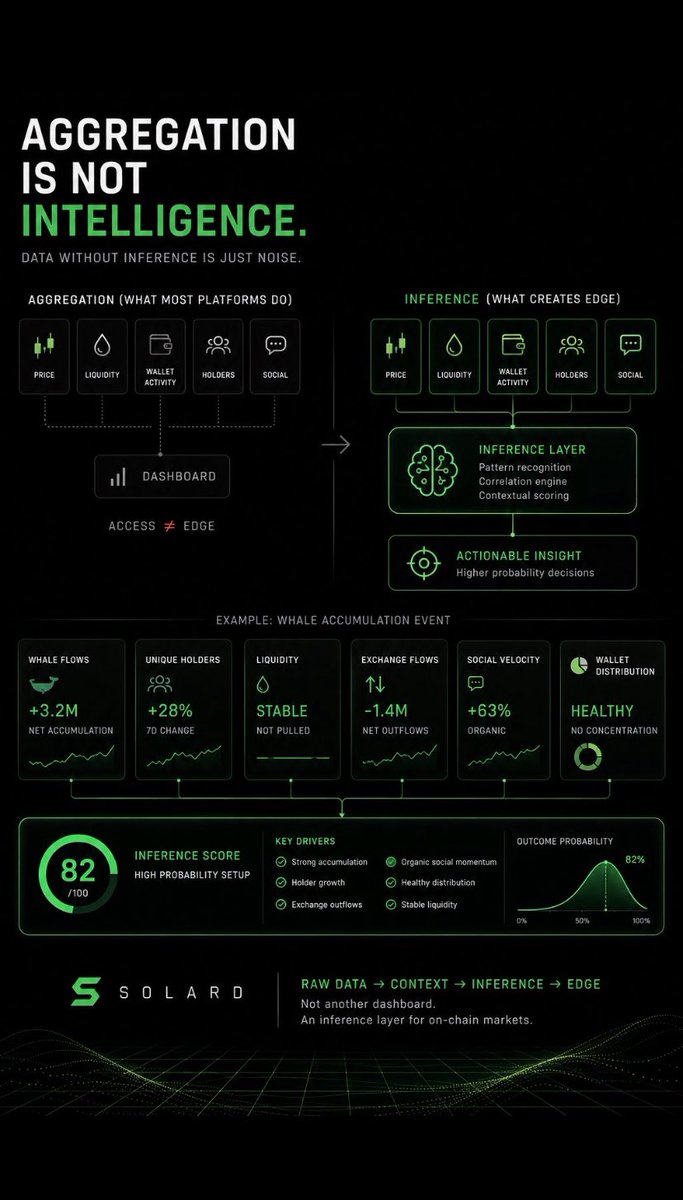
English
Aggregation is not intelligence.
Most trading platforms aggregate data.
They pull together:
>Price
>Liquidity
>Wallet activity
>Holder distribution
>Social metrics
Then they stop.
Aggregation solves an access problem.
It doesn’t solve a decision problem.
A useful trading system needs another layer.
Inference.
For example:
A whale accumulation event isn’t inherently bullish.
But combine it with:
>Increasing unique holders
>Stable liquidity
>Net exchange outflows
>Organic social velocity
>Healthy wallet distribution
Now the probability distribution changes.
The value isn’t in any individual metric.
It is in the relationships between them.
This is why simply adding more dashboards doesn’t create an edge.
You are still responsible for correlating everything manually.
The next generation of trading infrastructure won’t compete on data coverage.
It will compete on how well it transforms raw signals into actionable inference.
And that is the direction we are taking with $Solard
Not another dashboard
But an inference layer for on-chain markets

English
Solard retweetledi

under rated tech.
once the market picks back up i think this could preform well.
solana:47M2U1eVot6VPWjcqEFWe2CesUTBGBXfSDovaqTmpump
Solard@solardxyz
The fastest data is the data you don’t have to fetch. Modern CPUs are incredibly fast. Yet they spend most of their time waiting. Not because they are slow. Because data is in the wrong place. Engineers solved this with one idea: Keep the right information close to where decisions happen. Trading terminals have the opposite problem. The chart lives in one tab. Liquidity in another. Wallets somewhere else. Holder distribution somewhere else. Social activity on a different platform. Every decision becomes a cache miss. Your brain spends more time retrieving information than interpreting it. That is hidden latency. Not network latency. Cognitive latency. The next generation of trading software won’t win by collecting more data. It will win by reducing the distance between insight and action. And that is one of the principles behind solana:47M2U1eVot6VPWjcqEFWe2CesUTBGBXfSDovaqTmpump Not just bringing data together. But bringing context to where decisions are made
English
The fastest data is the data you don’t have to fetch.
Modern CPUs are incredibly fast.
Yet they spend most of their time waiting.
Not because they are slow.
Because data is in the wrong place.
Engineers solved this with one idea:
Keep the right information close to where decisions happen.
Trading terminals have the opposite problem.
The chart lives in one tab.
Liquidity in another.
Wallets somewhere else.
Holder distribution somewhere else.
Social activity on a different platform.
Every decision becomes a cache miss.
Your brain spends more time retrieving information than interpreting it.
That is hidden latency.
Not network latency.
Cognitive latency.
The next generation of trading software won’t win by collecting more data.
It will win by reducing the distance between insight and action.
And that is one of the principles behind solana:47M2U1eVot6VPWjcqEFWe2CesUTBGBXfSDovaqTmpump
Not just bringing data together.
But bringing context to where decisions are made

English
Solard retweetledi
Price can move.
Liquidity can disappear.
Token A
+15%
Liquidity: $118K
Token B
+15%
Liquidity: $81K → $54K
@solardxyz lets you spot the difference before it’s obvious.
$SOLARD

English