Javier Añorga

4.7K posts

Javier Añorga banner
Javier Añorga

Javier Añorga

@soyjanorga

Profesional del marketing e Internet. Motero, Perrero, y All black maorí frustrado

Katılım Nisan 2009
781 Takip Edilen381 Takipçiler
Javier Añorga
Javier Añorga@soyjanorga·
He llegado a creer que todo se resume en tres virtudes: coraje para vivir, generosidad para convivir y prudencia para sobrevivir. Fernando Savater
Español
0
0
0
15
Javier Añorga
Javier Añorga@soyjanorga·
Solo porque algo te ofenda no quiere decir que tengas razón
Español
0
0
0
14
Javier Añorga
Javier Añorga@soyjanorga·
Hoy no se discute para comprender y no se escucha para aprender, sino para detectar desviaciones y ponerlas en "falta". Somos muy leídos pero solo de lo que nos refuerza, de hecho si miráramos los dos lados sería muy complejo ser tan seguro y radical
Español
0
0
0
13
Javier Añorga retweetledi
Arturo Pérez-Reverte
Arturo Pérez-Reverte@perezreverte·
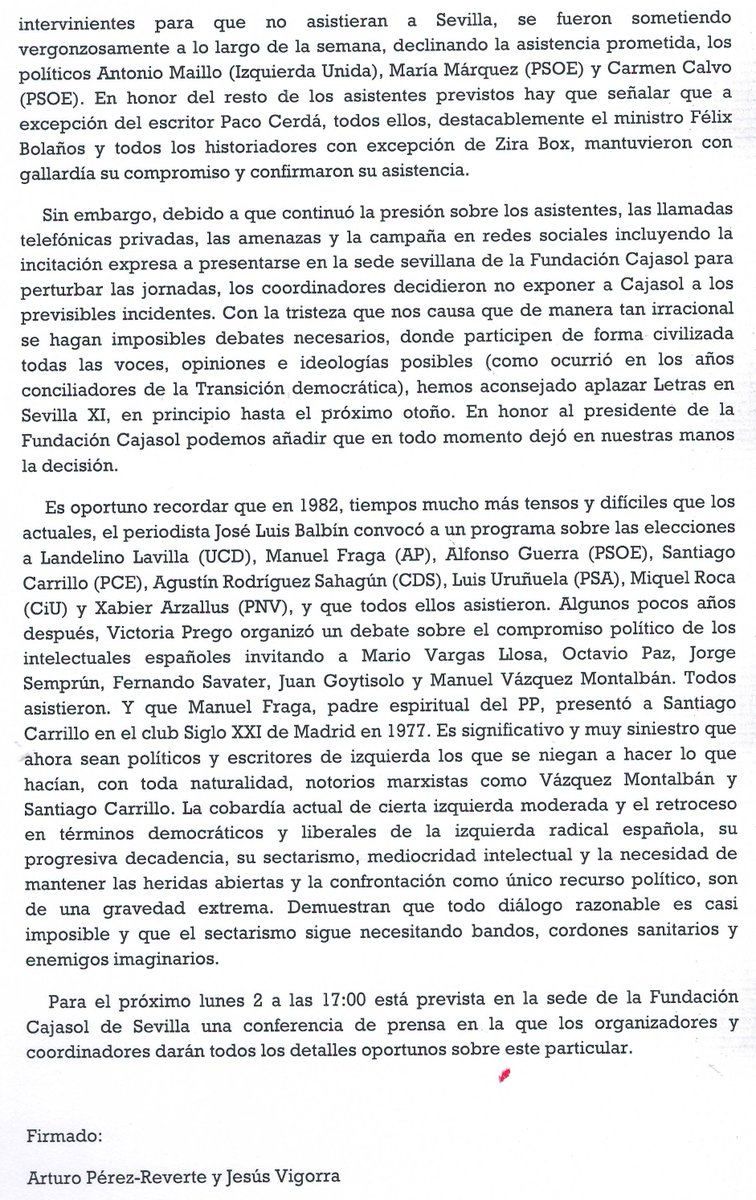
Por estas razones hemos aplazado lado la undécima edición de "Letras en Sevilla". Quizá les interese leer el comunicado completo.
Arturo Pérez-Reverte tweet mediaArturo Pérez-Reverte tweet media
Español
1.3K
3K
9.3K
548.4K
Javier Añorga
Javier Añorga@soyjanorga·
@MrtnzAlvrz Me parece que como todo debe ser una suma de factores, pero creo que el más importante es un margen superior en productos de marca blanca semi premium. Como ECI han desarrollado productos semi premium con su marca
Español
0
0
1
230
Javier Añorga retweetledi
Elon Musk
Elon Musk@elonmusk·
The reason government programs are so inefficient is that, unlike a commercial company, the feedback loop for improvement is broken, because they have a state-mandated monopoly and can’t go out of business if customers are unhappy. No matter how bad the service is at your DMV (sorry to pick on DMVs), you still have to use your DMV, because it’s a monopoly.
English
22.2K
40.3K
291.6K
33.1M
Javier Añorga
Javier Añorga@soyjanorga·
@pitiklinov Por supuesto que sí, pero creo que esta postura no está muy extendida actualmente
Español
0
0
0
3
Pablo Malo
Pablo Malo@pitiklinov·
Pregunta muy tonta pero la hago en serio: ¿creéis que hay personas decentes y honestas que piensan de forma diferente -muy diferente, incluso contraria- a vosotros?
Español
1.1K
127
1.4K
162.2K
Javier Añorga
Javier Añorga@soyjanorga·
The spreadsheet is not the customer ...or the power point
English
0
0
0
16
Javier Añorga
Javier Añorga@soyjanorga·
Smart people feel stupid doing simple things, so we invent complicated alternatives that accomplish less but feel more intellectually satisfying.
English
0
0
0
19
Javier Añorga retweetledi
Lucas Lopatin
Lucas Lopatin@llopatin·
“Me metí en 50 historias diferentes de fracasos de startups y busqué patrones.  Esto es lo que salió una y otra vez:
Español
11
102
1.1K
120.6K
Javier Añorga
Javier Añorga@soyjanorga·
Most complexity is unnecessary, but we manage it instead of removing it because deletion requires courage that addition doesn't
English
0
0
0
15
Javier Añorga
Javier Añorga@soyjanorga·
Fully agree, the problem is the formal barriers we all have created in the form of titles and so on, without that ...
Jesús Fernández-Villaverde@JesusFerna7026

⏳ Time to reorganize universities from scratch? I have been thinking a lot about what it means to be a university in 2025, once AI has arrived. My approach to learning new topics has undergone a significant change. Instead of relying only on textbooks or papers, I now integrate LLMs into my self-education. The result? My learning productivity has skyrocketed. Even more striking: I have reduced by 90% my dependence on colleagues and friends when exploring a new subject. Gone are the days of sending an email to a friend at University X asking, “What’s a good way to start learning about Y?” But this raises a deeper question: what is the added value of my lectures? Why should students take my course when LLMs already perform so well in 2025 and will likely perform even better in 2035? The problem is that most universities are not ready to face this challenge. Again and again, I see how vested interests slow down change, while layers of bureaucrats and administrators with limited vision remain in charge. Of course, there are exceptions—great leaders in some institutions—but I could fill a book with anecdotes of creeping bureaucratization that slows innovation, increases costs, and prioritizes meaningless “procedures” over real progress at a place like UPenn. History gives us a warning: think of Kodaks and Polaroids. When a fundamental change in a business model arrives, large organizations face almost insurmountable barriers to adapt. In higher education, these barriers are even greater: the absence of clear metrics for success (how do we measure the value of a new major?), the barriers to entry (accreditation, alumni networks), and the ideological biases of many stakeholders (not only political, but also a lack of responsiveness to change). If it were up to me, a top university should create its own Skunk Works to explore what higher education should look like in 2035. The original Skunk Works at Lockheed was an autonomous unit tasked with developing new technologies without the layers of managerial supervision that typically paralyze large organizations. For decades, Skunk Works produced some of the most innovative aircraft—the F-104, the U-2, the SR-71, the F-117—delivered on time and usually without cost overruns. The model was so successful that many other organizations have tried to replicate it, with varying degrees of success. Creating a Skunk Works inside a university is not without risks. See, for example, the insights of Rebecca M. Henderson and Kim B. Clark in “Architectural Innovation: The Reconfiguration of Existing Product Technologies and the Failure of Established Firms.” But right now, I cannot see another way for a large, inertial institution to move forward. By contrast, I am skeptical that creating entirely new institutions from scratch is the most promising path (for reasons I’ll explain another day). And if you want to know more about the original Skunk Works, I highly recommend “Skunk Works: A Personal Memoir of My Years at Lockheed” by Ben Rich and Leo Janos. A delightful book—especially if, like me, you love planes. ✈️


English
0
0
0
35
Javier Añorga retweetledi
Anna Escobar
Anna Escobar@annaescobaro·
Llamar #neurodivergente a todo el mundo es tan arriesgado como patologizar lo que es humano 👇
Español
1
9
17
3.6K
Javier Añorga retweetledi
Ma Wukong 马悟空
Ma Wukong 马悟空@Ma_WuKong·
Hay que introducir una reforma democrática que incluya representación directa en política de proximidad (pueblo, barrio) y meritocracia selectiva en política de Estado. Con la situación actual del mundo, las élites de las democracias liberales acaban siendo elegidas y cameladas por estructuras globalistas y no acaban trabajando para los intereses del pueblo que dicen gobernar.
Español
3
13
85
6.2K
Javier Añorga retweetledi
Samuel Gil
Samuel Gil@samuelgil·
hay que recordar periódicamente esta joya “If you have profits, you show profits. If you don’t, you show EBITDA. If you don’t have that, you show revenue. If there’s no revenue, you show users. If no users, you show app downloads. If nothing, you show awards.”
English
22
290
1.3K
63.7K
Javier Añorga
Javier Añorga@soyjanorga·
Por favor, deberían arreglarlo a la mayor brevedad, lleva así semanas y es un peligro para todos
Línea Madrid@Lineamadrid

@soyjanorga Gracias por la aclaración. Hola, solicitamos actuación con aviso 8880871. Un saludo

Español
0
0
0
60