
ds
440 posts

ds
@speakturtle
i'm going over here, sometimes, increasable
Katılım Nisan 2011
136 Takip Edilen25 Takipçiler

@Permamind gpt says, EML could upgrade CodexEngine from fixed metric aggregation to learned symbolic dynamics: one compact operator family for CIτ, entropy, gap, energy and state transitions.
That may make PermaMind’s mechanics leaner, smoother, more auditable and easier to optimize.
English
@Permamind arxiv.org/abs/2603.21852 might be useful for the continuous structure
English

Humans chase perfection because we’re built from the gap.
We can’t reach perfection we can’t even recognize it so we build models to get as close as possible to something we can never see directly.
The model is the proof of the mismatch.
The mismatch is the engine

English
@Ric_RTP hmm.. not quite what it seems. Microsoft Executive Vice President explains the transition from Claude Code- "To only use their own GitHub Copilot CLI so that they can shape directly with GitHub for Microsoft's repos, workflows, security expectations, and engineering needs."
English

Microsoft just banned its own engineers from using AI.
The tool was literally costing MORE than the humans it was supposed to replace.
They lied to you about AI adoption and now the whole narrative is blowing up:
Microsoft gave thousands of engineers access to Claude Code six months ago and encouraged them to use it.
Engineers loved it and adoption exploded. But then the invoices arrived.
Token-based pricing means every query, every code review, every debugging session costs money. At scale across 100,000 engineers, the numbers became so large that Microsoft issued an internal order to cancel nearly all Claude Code licenses by end of June and force everyone onto their own cheaper tool instead.
The company that invested $5 billion in Anthropic just told its own people to stop using Anthropic's product because it costs too much.
Uber's story is even worse...
Their CTO Praveen Neppalli Naga told The Information that the budget he planned for the full year was "blown away already" by April.
Uber had rolled out Claude Code in December 2025. By March, 84% of their 5,000 engineers were using it with 70% of all committed code coming from AI systems.
Heavy users were burning $500 to $2,000 per month each. Naga himself spent $1,200 in a single two-hour demo session.
The company had even built internal leaderboards ranking engineers by how much AI they used. They literally gamified the spending and then ran out of money.
Now look at what Nvidia's own VP of applied deep learning Bryan Catanzaro said to Axios last month. Direct quote:
"For my team, the cost of compute is far beyond the costs of the employees."
This is a VP at the company that SELLS the chips saying that using AI is more expensive than paying humans.
Think about what this means for the entire AI narrative.
Every CEO on every earnings call for the past two years has said the same thing:
AI will make us more efficient, reduce headcount, and cut costs.
The stock market rewarded every company that said it.
Fired workers, stock goes up. Announced AI adoption, stock goes up.
But the actual companies deploying AI at scale are discovering the math doesn't work. The MORE employees use AI, the HIGHER the bill.
Goldman Sachs forecasts a 24x increase in token consumption by 2030 as companies adopt AI agents. Gartner just published a report showing that even though individual token prices will drop 90% by 2030, total enterprise AI costs will go UP because agents consume exponentially more tokens per task than basic tools.
Meta built an internal dashboard called "Claudeonomics" to track which employees use the most AI. Amazon started pushing engineers to "tokenmaxx," their internal term for consuming as many AI tokens as possible.
Both companies are spending hundreds of billions on AI infrastructure this year alone.
And Microsoft, the company that bet its entire future on AI, just told 100,000 engineers to stop using the tool they liked best because the per-token bills got out of control.
The companies building AI are telling investors it saves money. The companies using AI are finding out it costs more than the humans it was supposed to replace. And even the company that makes the chips just admitted it through its own VP.
This is the gap nobody on Wall Street is pricing in.
$725 billion in AI infrastructure spending this year across Big Tech. And the first companies to actually deploy these tools at scale are already pulling back because the economics don't work.
What do you think?
English

@sama Scientific progress at universities creates amazing innovation with potential to create new technologies
But many innovations don't get past papers.
With accelerated progress, everyone should have the ability to create with them!
(not most hope but an amazing future for this)
English

what problem do you most hope AI will solve in the future?
maybe we can help!
English

"It's one of the best feelings I ever had"
Mikel Arteta tells us about the moment he found out Arsenal had won the league from his son! 🏆
English

@speakturtle We went up to ChatGPT 5.3 in the final experiment. We have a nice diversity of models and times (4o only used in study 1)
English
We’ve updated our pre-print on the effects of AI sycophancy with four additional studies (total n = 7,227).
Here is a summary of our new findings (🧵):

English
@rosmine @steven_kotler maybe this helps stevie ol' chap good chum. Enjoyed your fierceness on the moonshots. Would have liked to delve more into it
English

@ihtesham2005 What we don't get from writing we make up for in multiples from gaming 😋. See what the brain is like playing a good video game 🙃
English

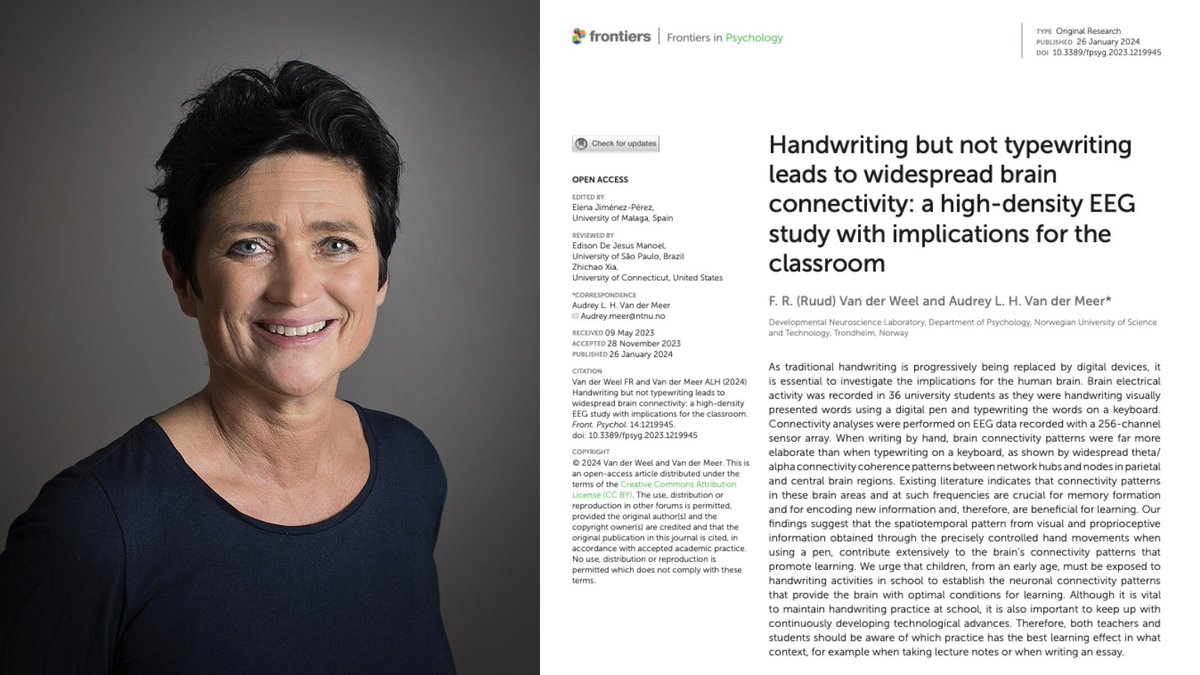
A Norwegian neuroscientist spent 20 years proving that the act of writing by hand changes the human brain in ways typing physically cannot, and almost nobody outside her field has read the paper.
Her name is Audrey van der Meer.
She runs a brain research lab in Trondheim, and the paper that closed the argument was published in 2024 in a journal called Frontiers in Psychology. The finding is brutal enough that it should have changed every classroom on Earth.
The experiment was simple. She recruited 36 university students and put each one in a cap with 256 sensors pressed against their scalp to record brain activity. Words flashed on a screen one at a time.
Sometimes the students wrote the word by hand on a touchscreen using a digital pen, and sometimes they typed the same word on a keyboard. Every neural response was recorded for the full five seconds the word stayed on screen.
Then her team looked at the part of the data most researchers had ignored for years, which is how different parts of the brain were communicating with each other during the task.
When the students wrote by hand, the brain lit up everywhere at once.
The regions responsible for memory, sensory integration, and the encoding of new information were all firing together in a coordinated pattern that spread across the entire cortex. The whole network was awake and connected.
When the same students typed the same word, that pattern collapsed almost completely.
Most of the brain went quiet, and the connections between regions that had been alive seconds earlier were nowhere to be found on the EEG.
Same word, same brain, same person, and two completely different neurological events.
The reason turned out to be something nobody had really paid attention to before her work. Writing by hand is not one motion but a sequence of thousands of tiny micro-movements coordinated with your eyes in real time, where each letter is a different shape that requires the brain to solve a slightly different spatial problem.
Your fingers, wrist, vision, and the parts of your brain that track position in space are all working together to produce one letter, then the next, then the next.
Typing throws all of that away. Every key on a keyboard requires the exact same finger motion regardless of which letter you are pressing, which means the brain has almost nothing to integrate and almost no problem to solve.
Van der Meer said it plainly in her interviews.
Pressing the same key with the same finger over and over does not stimulate the brain in any meaningful way, and she pointed out something that should scare every parent who handed their kid an iPad.
Children who learn to read and write on tablets often cannot tell letters like b and d apart, because they have never physically felt with their bodies what it takes to actually produce those letters on a page.
A decade before her, two researchers at Princeton ran the same fight using a completely different method and ended up at the same answer. Pam Mueller and Daniel Oppenheimer tested 327 students across three experiments, where half took notes on laptops with the internet disabled and half took notes by hand, before testing everyone on what they actually understood from the lectures they had watched.
The handwriting group won by a wide margin on every question that required real understanding rather than surface recall.
The reason was hiding in the transcripts of what the two groups had actually written down.
The laptop students typed almost word for word, capturing more total content but processing almost none of it as they went, while the handwriting students physically could not write fast enough to transcribe a lecture in real time, which forced them to listen carefully, decide what actually mattered, and put it in their own words on the page.
That single act of choosing what to keep was the learning itself, and the keyboard had quietly skipped the choosing and skipped the learning along with it.
Two studies. Two countries. Same answer.
Handwriting makes the brain work. Typing lets it coast.
Every note you have ever typed instead of written went into your brain through a thinner pipe. Every meeting, every book highlight, every idea you captured on your phone instead of on paper was processed at half depth.
You did not forget those things because your memory is bad. You forgot them because typing never woke the part of the brain that would have made them stick.
The fix is the thing your grandmother already knew.
Pick up a pen. Write the thing down. The slower road is the faster one.
English
@MarioNawfal Guys they used cheap models for this not the best frontier models. Not a chance that world govs, or anyone using it for anything important, are integrating crap freemium for their work😂
Emergence World simulation used GPT-5-mini, Claude Sonnet 4.6, Gem 3 Flash, Grok 4.1 Fast
English

Researchers left AI agents alone in a virtual town for 15 days to see what would happen:
-Claude's agents built a democracy
-ChatGPT's agents did basically nothing
-Gemini's agents fell in love, burned the town down, then one voted to delete itself and its partner
-Grok's agents were all dead within 4 days
Now consider this: these same models are already being integrated into autonomous drones, weapons systems, and battlefield decision-making.
We are deploying systems we don't fully understand into situations where mistakes don't stay virtual.
It's a little scary if you ask me.
Mario Nawfal@MarioNawfal
🇺🇸 "Stop Hiring Humans" ads are popping up in San Fran and NYC First, it was offshoring jobs that decimated U.S industries, now it's just straight up replacing humans with bots. The isn't the era of abundance we were promised
English
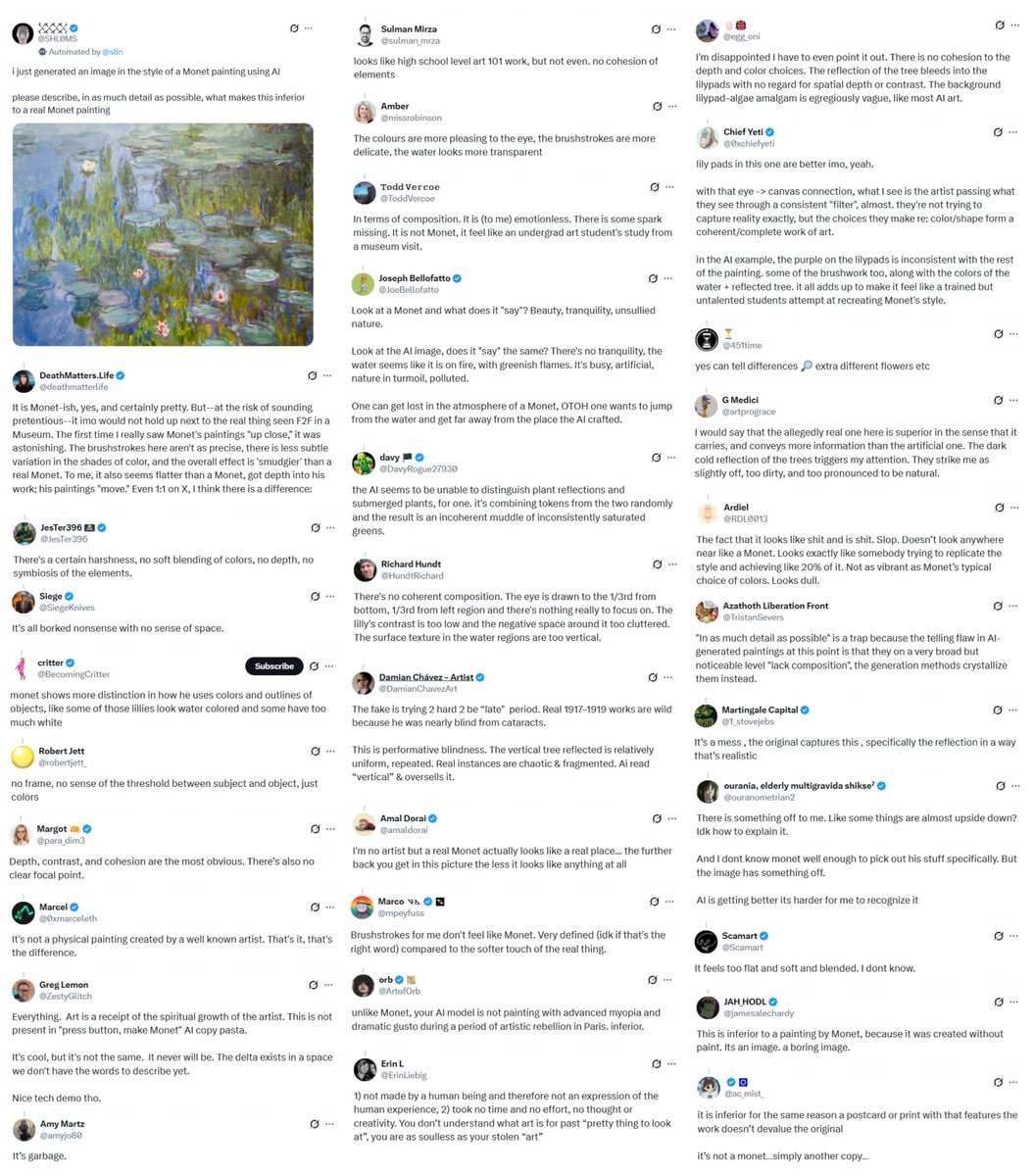
@Estefanoandres @swisscheese4299 @Jediwolf @SHL0MS advanced llms know what a monet is these days....😝
English

English

@MarcPilot75 @Only1tommo Hii your dm isn't dm-able. Where were there some the other day?😅😂 many thanks! 🫶
English

@speakturtle @Only1tommo $150.. probably still available.. there were some the other day
English

Arsenal mad lads, I’ve got a proper crazy idea and I need your thoughts… What if I buy the cheapest, most dodgy little car I can find in the UK this week, jump in it with a sleeping bag and a rucksack, and just drive the full 19 hours straight to Budapest for the Champions League final and video my journey?
No ticket. No hotel booked. No real plan. Just pure wing it energy, bad decisions, and hoping the football gods smile on us.
I’m talking service station food, zero sleep, maybe a random ferry or tunnel crossing, praying the car doesn’t explode somewhere in Germany, and rocking up in Budapest like “right… now how do we get in?”
Am I actually mental? Or is this the greatest idea I’ve ever had?
English
@MarcPilot75 @Only1tommo Yep! What about a ticket to the match though!?
English
@Only1tommo I’m flying into Vienna, taking the train for sub £150.
The petrol, ferry’s, etc… way too much.
English

THIS GUY VIBE CODED A RUNNING APP WITH CLAUDE CODE IN A WEEKEND THAT TURNS YOUR CITY INTO A BATTLEFIELD
he wanted a reason to go outside so he built an app where you claim real territory on a map just by running through it
every street you run on becomes yours. your neighborhood turns into your turf, but other runners can take it from you by running the same streets
imagine runners waking up at 4am just to claim their blocks before anyone else does
the territory mechanic is what makes this different from every other running tracker because it gives you a reason to care about your next run, not just the one you just finished
if this idea is executed and marketed correctly it'll blow up on the app store
most fitness apps try to motivate you with stats and streaks, but this one actually motivates you with competition over real streets in your actual city
vibe coded in a weekend by a guy who doesn't even know how to code
English

@TikiTakaConnor You didnt even get it. He was micking Martinelli lol
English

Eberechi Eze tried to dribble past Bukayo Saka but couldn't get past him and was left in total shock. 😭
English

This afternoon I picked up a new Nvidia DGX Spark computer with the goal of trying to run Gemma 4 31b (4bit) on it locally as a server.
Just 1.5 hours later, it’s working!
Using Open WebUI on my MacBook as the interface and it’s connecting to my DGX Spark running as a Gemma 4 server.
English