Sergey Pozdnyakov

139 posts

Sergey Pozdnyakov

Sergey Pozdnyakov

@spozdn

Postdoc @SchwallerGroup @EFFL | Geometric deep learning on 3D point clouds for atomistic modeling

Lausanne Katılım Mayıs 2023
513 Takip Edilen352 Takipçiler
Sergey Pozdnyakov retweetledi
Jean-Philip Piquemal
Jean-Philip Piquemal@jppiquem·
💫 As promised, we just released on GitHub the weights of the #FeNNixBio1 foundation machine learning model for drug design! 💫 Weights: github.com/FeNNol-tools/F… FeNNol GPU code: github.com/FeNNol-tools/F… The models are distributed under the open source ASL license (i. e. restricted to non-commercial academic research). You can also check the updated version of the preprint that includes a unified transformers architecture as well as the full computation of the Freesolv hydration free energies dataset etc... doi.org/10.26434/chemr… Happy holidays and merry Christmas everyone! 🎅 🎄 Sorbonne Université / CNRS @qubit_pharma #machinelearning #moleculardynamics #drugdesign #compchem #GPU #biophysics
English

2
18
60
5.1K
Alex Shtoff
Alex Shtoff@AlexShtf·
@spozdn @HannesStaerk I think some of the speedup can come from just using the right memory layout, I.e, which dimensions of the learned parameters come in which order. Same for the argument.
English
1
0
0
182
Sergey Pozdnyakov
Sergey Pozdnyakov@spozdn·
@AlexShtf @HannesStaerk I would say that the main speedup comes from using shared memory (L1 cache), and it is hardly achievable if using pure python. Nevertheless, there could be, indeed, some opportunities to speed up, if not so dramatically.
English
1
0
0
25
Alex Shtoff
Alex Shtoff@AlexShtf·
@spozdn @HannesStaerk @spozdn care to contribute to torchcurves? Id like to keep it pure python (no custom kernels) at this stage, but im pretty sure you have some learnings and expertise that transfers across implementation types.
English
1
0
0
142
Alex Shtoff
Alex Shtoff@AlexShtf·
@spozdn @HannesStaerk I see. Nice! I think it would be interesting to see a comparison of your custom kernels versus: - direct vectorized implementation of cox-deboor algorithm in pytorch (torch.searchsorted for lookup, then cox deboor for computation). - a torch.compile variant of the above.
English
1
0
0
58
Sergey Pozdnyakov
Sergey Pozdnyakov@spozdn·
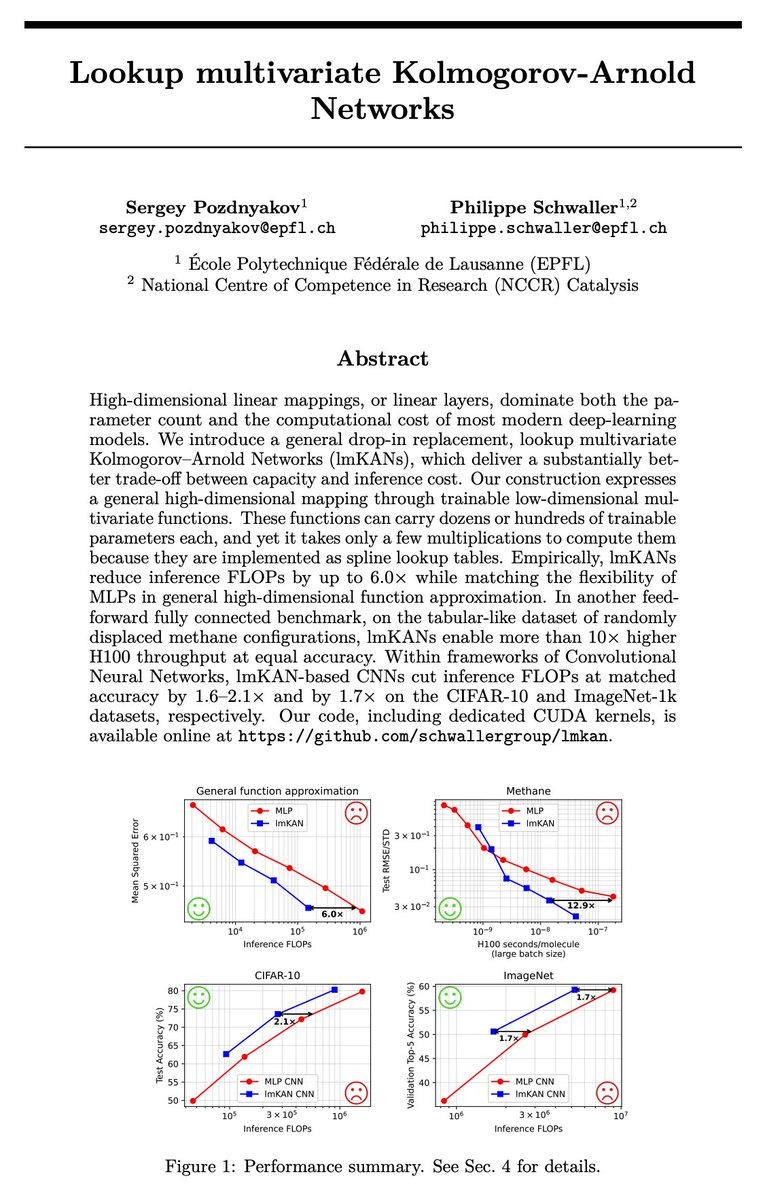
(*) CUDA kernels so that lmKANs > MLPs on modern GPUs and (**) multivariate extension. GPUs & current ecosystem are made for dense matrix multiplications, not for lookup tables, so a naive implementation is very slow. With custom CUDA kernels, we made lmKANs Pareto optimal compared to MLPs on modern GPUs. Also, the proposed multivariate extension of KANs relying on 2d functions performs way better than standard 1D KANs.
English
1
0
2
59
Alex Shtoff
Alex Shtoff@AlexShtf·
By the way, I do not understand the main contributions of the work. Tensor product splines were known for decades. Efficient algorithms for parsnetric spline surfaces were written since the 90s in games and CAD apps. So is it the pyrorch port of these efficient algorithms? Or is it the observation that tensor product splines actually work well in practice for KANs? Or is it something else I missed? The paper's text isn't very explicit about it.
English
2
0
0
66
Sergey Pozdnyakov retweetledi
Adil Kabylda
Adil Kabylda@kabylda_·
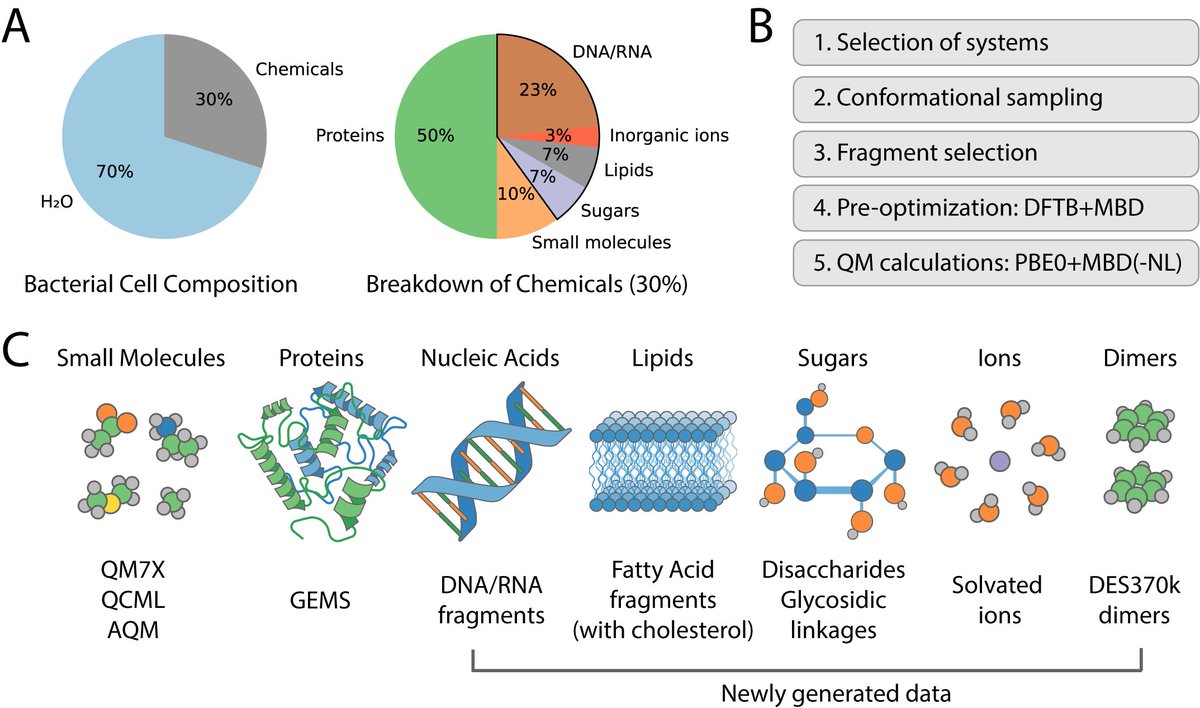
Our new work, “QCell: Comprehensive Quantum-Mechanical Dataset Spanning Diverse Biomolecular Fragments,” is now out on arXiv! 🌱 1/7
Adil Kabylda tweet media
English
1
1
6
513
Sergey Pozdnyakov retweetledi
Philippe Schwaller (he/him)
Exciting postdoc opportunity in the @SchwallerGroup at EPFL! We're hiring a postdoc to advance ML-driven synthesis planning after Zlatko Joncev’s successful exit to co-found B-12 (YC '25) 🚀 Work on: - LLMs for strategic synthesis planning - Chemical reasoning at scale - Building the next-gen framework for retrosynthesis Our recent preprint shows that LLMs can guide synthesis planning with natural-language strategies — combining AI reasoning with traditional chemical tools (arxiv.org/abs/2503.08537). Join us at the intersection of chemistry & AI. Up to 2 years. Based in Lausanne 🇨🇭 Apply: forms.fillout.com/t/nnxVE3RcPpus #ChemTwitter #MachineLearning #SynthesisPlanning #PostdocPosition
English
0
16
38
7.6K
Sergey Pozdnyakov
Sergey Pozdnyakov@spozdn·
@chaitjo Well, you need your NN to be able to express many body features of sufficiently large order to be expressive enough. Also, I don't think that restricting the body order really works as a preconditioning. Thus, I would say, the more the better, until it is computationally cheap.
English
0
0
2
41
Chaitanya K. Joshi
Chaitanya K. Joshi@chaitjo·
ML Force Fields people - what is current consensus on importance of many body features? All the top models only use 2 GNN layers. Some decouple features body order from layers but most don’t…
English
5
0
23
3.2K
Sergey Pozdnyakov
Sergey Pozdnyakov@spozdn·
Interesting question. Kolmogorov-Arnold Representation Theorem also requires one hidden layer, similarly to Cybenko's one. The difference is that the former states so for the finite (2n) number of neurons in the hidden layer. So, I would look into (and nearly certainly it is) that spline look-up-table KANs can fold the space similarly without the limit of an infinite number of neurons, as in the case of MLP.
English
0
0
0
35
Andrei Mircea
Andrei Mircea@mirandrom·
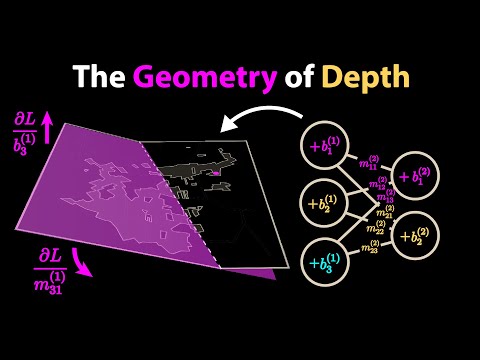
@spozdn Cool idea! Makes me think of this visualization on how stacked ReLU linear layers fold a 2D space from youtube.com/watch?v=qx7hir…). Is there a way in which spline lookup tables are doing something similar with a single layer?
YouTube video
YouTube
Andrei Mircea tweet media
English
1
0
1
73
Sergey Pozdnyakov
Sergey Pozdnyakov@spozdn·
High-dimensional linear mappings, or linear layers, dominate both the parameter count and inference cost in most deep learning models. We propose a general-purpose drop-in replacement with a substantially better capacity - inference cost ratio. Check it out!🧵
GIF
English
1
10
35
3.6K
Sergey Pozdnyakov retweetledi
Xuan-Vu Nguyen
Xuan-Vu Nguyen@XuanVuNguyen18·
You don’t like molecular dynamics? We get it. That’s why at this year’s LLM hackathon for Chemistry and Materials Science, we built not one, but ✨two✨ AI agents for molecular dynamics 👇
English
1
7
18
12.3K
Sergey Pozdnyakov
Sergey Pozdnyakov@spozdn·
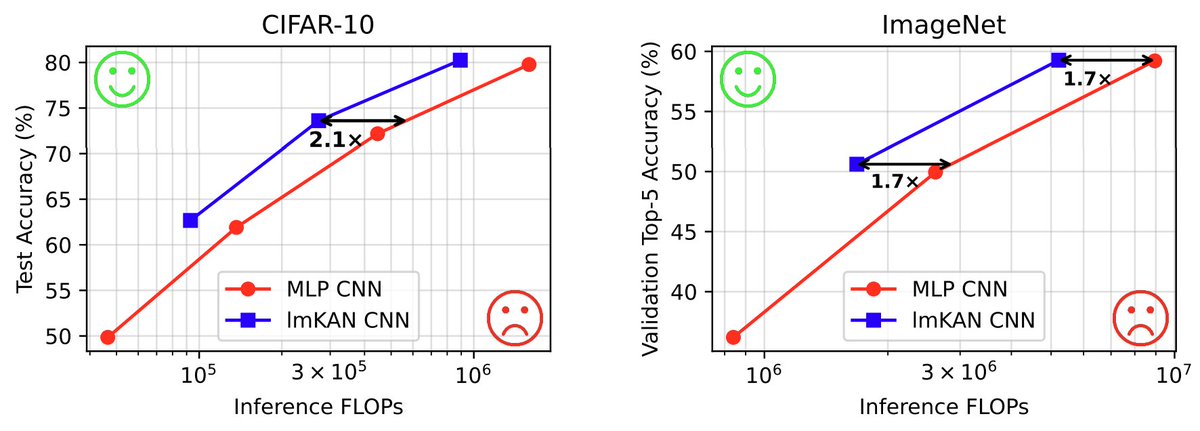
We did it for Convolutional Neural Networks, and it works too. lmKAN-based CNNs are Pareto optimal on both the CIFAR-10 and ImageNet-1k datasets, achieving 1.6-2.1× reduction in inference FLOPs at matched accuracy.
Sergey Pozdnyakov tweet media
English
1
0
5
275