Mr. Pi

6 posts

Mr. Pi

Mr. Pi

@squared2pi

Katılım Şubat 2022
45 Takip Edilen2 Takipçiler
Mr. Pi
Mr. Pi@squared2pi·
@StevenOh_ Figure 5 provides some indication through the reported L2 norm of tau_ext; however, since tau_ext depends on the robot configuration through the Jacobian, it is difficult to relate these values to the actual magnitude of the applied external wrench.
English
0
0
0
163
Mr. Pi
Mr. Pi@squared2pi·
@StevenOh_ I see. What I'm trying to understand is how the accuracy of NEXT changes as the magnitude of the external wrench increases. I know from the paper that NEXT was evaluated under contact conditions, but it does not explicitly report the range of external wrenches during testing.
English
1
0
0
172
Steven Oh
Steven Oh@StevenOh_·
Force sensing for low-cost robot arms — without adding force sensors. 🚀 Excited to share FACTR 2! 🚀 FACTR 2 enables external torque sensing on low cost arms and uses it to improve policy learning. w/ @JasonJZLiu  @_tonytao_ 🧵(1/6)
English
7
23
141
28.3K
Mr. Pi
Mr. Pi@squared2pi·
@JasonJZLiu @StevenOh_ @_tonytao_ Oh cool. It would be great to investigate how accurately NEXT estimates the external joint torques caused by payloads of known masses (up to 3 kg). I think this experiment could serve as an excellent testbed for validating its accuracy and OOD generalization.
English
1
0
1
220
Jason Liu
Jason Liu@JasonJZLiu·
@squared2pi @StevenOh_ @_tonytao_ We ran ablations on the input signals and found that NEXT still works pretty well even without feeding in delta q, though performance is slightly better when it is included.
Jason Liu tweet media
English
1
0
1
193
Mr. Pi
Mr. Pi@squared2pi·
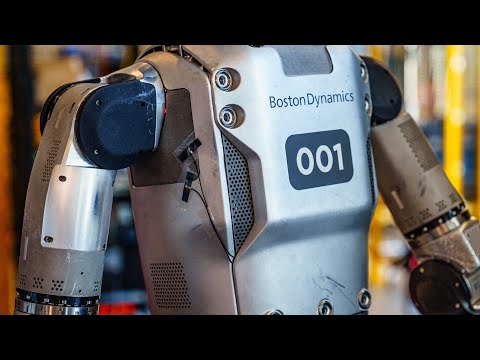
@Mrpossidez As technology progresses, I believe we’ll see deviations from the human form factor in favor of more efficient designs. A case in point is the new Boston Dynamics Atlas robot (youtu.be/29ECwExc-_M?si…).
YouTube video
YouTube
English
0
0
0
114
Mr. Pi
Mr. Pi@squared2pi·
@Mrpossidez Great points made. I’d like to add that one of the major reasons for the interest in legged robots, such as humanoids, is that the world around us has been built for humans. For a robot to perform useful tasks in human-centric environments, legs are necessary (at least for now).
English
1
0
0
133
Mr. Possible
Mr. Possible@Mrpossidez·
Why give a robot 2 arms when you can give them 4? Why limit them to what the average human has, making them have to multitask in order to be more efficient? Apparently, there’s this subconscious insistence that whatever surpasses us must, at minimum, resemble us. It’s as if we’re saying: “sure, build something smarter. But don’t you dare give it more arms.” What’s funny is that we know better. We build spiders with drones, build wheels with legs, but the moment we say robot assistant, we default to some shiny humanoid wearing clothes like us. Maybe we anthropomorphize robots specifically because they would represent the highest form of intelligence and we can’t imagine it looking other than humans. But the question is: what would intelligence look like if we had no need to impress ourselves? It probably wouldn’t walk. It probably wouldn’t blink. It probably wouldn’t need to be friendly. It might look very weird and unnervingly inelegant but could do ten things at once with a hive of coordinated limbs. It would be efficient to the point of eeriness. Maybe I just prefer efficiency over forms as the default framework for making machines. And maybe my preference is a roundabout manifestation of pride. I suppose I don’t want them to look like us, so that I could say “yes, they’re very smart but they’re nothing like humans”.
English
24
45
232
18.2K