South Sudan Eagles Media

2.4K posts

South Sudan Eagles Media banner
South Sudan Eagles Media

South Sudan Eagles Media

@ssemtv

To be South Sudan’s most trusted voice — a home for truth, inspiration, and stories that build peace and connect our people everywhere.

United States, South Sudan Katılım Mayıs 2022
450 Takip Edilen3.5K Takipçiler
South Sudan Eagles Media
From Kakuma to America: SPLM Leadership Failed the Lost Boys and the Nation By Abraham Madit Majak South Sudan Eagle Media In 2001, a video was recorded in Kakuma. At first glance, it may appear to capture an ordinary moment—an elderly man speaking to a group of young refugees preparing for departure. But that video is far more than a memory. It is a political testimony. It is evidence of a generation that was failed, displaced, and forced to survive against all odds. I know this because I was there. I was one of the Lost Boys of Sudan—a generation shaped not by choice, but by war, neglect, and political failure. We did not leave our homes in search of opportunity. We fled because our country collapsed around us. We walked across borders, buried friends along the way, and grew up without families—not because of fate, but because of decisions made by those in power. Kakuma was not just a refugee camp. It was a holding ground for the consequences of war. It was where the abandoned waited. In that video, an elder—Uncle Machiek—speaks. His voice carries the weight of a generation. He represents the leadership that remained when formal systems failed. When governments collapsed, when institutions disappeared, and when political leaders chose power over people, it was elders like him who held broken communities together. But let us be clear: we should never have been there. The story of the Lost Boys is often told as a story of resilience—and it is. But that narrative alone is incomplete. It is also a story of political failure. A failure of leadership in South Sudan. A failure of protection. A failure of accountability. While ordinary people suffered in displacement, political elites remained consumed by power struggles rather than the responsibility to protect their citizens. In 2001, many of us were resettled in the United States. The world described it as a humanitarian success—and in many ways, it was. It saved lives and opened doors to opportunity. But it also revealed a painful truth: we were not resettled because the crisis was resolved; we were resettled because the system had failed to protect us at home. We carried trauma into a new world. We arrived without parents, without wealth, and without preparation for the cultural shock ahead. We rebuilt our lives from nothing—again. We learned new languages, adapted to unfamiliar systems, and struggled to belong in a society that often saw us as refugees rather than survivors. Yet we endured. But survival must never silence the truth. That video from Kakuma is not just a personal memory—it is a political record. It exposes the reality that behind every story of successful resettlement lies a deeper story of displacement caused by failed leadership. It forces us to confront uncomfortable questions: Why were children left to walk across countries alone? Why did a generation grow up in refugee camps instead of classrooms at home? Why do the same political failures continue to repeat themselves today? Uncle Machiek’s voice in that video is not confined to 2001. It speaks directly to the present. It speaks to South Sudanese in the diaspora. It speaks to those still displaced. And it speaks to a nation that gained independence with hope, yet continues to struggle under the weight of its own leadership failures. It is a reminder of what happens when leaders abandon their people. It is a warning that history will repeat itself if nothing changes. After more than two decades of war against Sudan, the very movement that promised liberation has, in many ways, failed to deliver lasting peace and stability to its own citizens. The suffering did not end with independence—it evolved. And the people are still paying the price. As survivors of Kakuma, as members of the Lost Boys, and as citizens of a nation still searching for peace, we carry a responsibility—not only to remember, but to speak. Because our story is not just about where we came from.
English
0
0
1
161
South Sudan Eagles Media
Listening, Reflecting, and Reaffirming Our Mission: South Sudan Eagle Media Responds In a recent effort to better understand our audience and strengthen our work, South Sudan Eagle Media conducted a public survey asking a simple but essential question: How do you feel about the work we are doing? The response was both honest and sobering. A significant number of participants expressed dissatisfaction, with some describing our platform as “tribalist” or biased in its coverage. We take this feedback seriously. At South Sudan Eagle Media, we believe that public trust is not given—it is earned, protected, and constantly tested. When our audience raises concerns, especially ones as serious as accusations of tribal bias, it is our responsibility not to dismiss them, but to listen, reflect, and respond with clarity, humility, and accountability. Let us be clear: South Sudan Eagle Media is not a tribal platform. We are an independent, nonpartisan media voice committed to inclusive public discourse and in-depth analysis of the political, social, and economic issues that matter most to the people of South Sudan. That said, we also recognize an important truth: perception matters. If a portion of our audience believes our reporting leans toward tribalism, then we must critically examine not only what we say, but how we say it. Media credibility is built not only on intention, but on impact. Our editorial position has always been rooted in principle—not identity. When we criticize opposition leaders, it is never because of their ethnic background or region of origin. Our criticism is directed at political conduct—especially when leaders engage in or promote tribal politics that divide communities, inflame tensions, or contribute to cycles of violence. In a country as fragile and diverse as South Sudan, such politics are not only irresponsible—they are dangerous. At the same time, our scrutiny does not stop with the opposition. We hold the government to the same standard. We have consistently raised concerns when there is a lack of genuine commitment to peace agreements, when cooperation with opposition groups appears insincere, and when political decisions continue to deepen the suffering of ordinary citizens. The failure to fully implement peace, the erosion of trust between political actors, and the ongoing instability across the country are realities we will not ignore. Criticism, in our view, is not an act of division—it is an act of accountability. South Sudan Eagle Media exists to challenge harmful narratives, expose political failures, and promote a more informed, inclusive, and united national conversation. We do not claim perfection, nor do we expect universal agreement. But we remain firm in our commitment to fairness, independence, and the belief that South Sudan deserves better from all its leaders—regardless of tribe or political affiliation. Moving forward, we will deepen our engagement with our audience, improve the balance and clarity of our reporting, and ensure that our platform reflects the diversity, dignity, and aspirations of all South Sudanese voices. To those who shared their concerns: we hear you. To those who continue to support us: we thank you. And to all South Sudanese: this platform belongs to you. By Abraham Madit Majak South Sudan Eagle Media March 26, 2026
English
0
0
0
153
South Sudan Eagles Media
Juba Teaching Hospital: South Sudan’s Referral Hospital at a Crossroads of Sanitation and Safety Hazard Juba Teaching Hospital, the Republic of South Sudan’s only referral hospital, is meant to be the pinnacle of the nation’s healthcare system—a place where patients seek expert care and doctors save lives. Yet today, it stands as a troubling testament to neglect, where basic hygiene has become a serious public health threat. Reports from both patients and medical staff indicate that the hospital’s sanitation is so compromised that the stench from its washrooms is overwhelmingly pungent, sometimes forcing visitors and even healthcare professionals to vomit. This is not merely unpleasant—it is dangerous. Poor sanitation in healthcare facilities is a recognized breeding ground for nosocomial infections, those preventable yet often deadly diseases acquired within hospitals. Hospitals, by design, are supposed to be safe spaces that heal, not amplify disease. When a hospital’s toilets, sinks, and waste management systems become vectors for infection, the very institution intended to preserve life turns into a potential reservoir for illness. Patients already weakened by disease face new threats from bacteria, viruses, and fungi thriving in unsanitary conditions. Healthcare workers, too, risk exposure, endangering not only their own health but also the continuity of care for patients. The implications are clear: inaction is unacceptable. Maintaining hospital hygiene is not an optional luxury—it is a core pillar of patient safety. Every day of continued neglect at Juba Teaching Hospital risks turning preventable infections into fatalities, undermining the public trust in South Sudan’s entire healthcare system. Urgent interventions are needed. These include immediate deep cleaning of all facilities, upgrading sewage and waste systems, training and deploying sufficient cleaning staff, and instituting strict hygiene protocols. Equally important is accountability: hospital administrators, alongside health authorities, must prioritize sanitation as a matter of national health security. South Sudan faces enormous health challenges, from endemic diseases to the ongoing strain of limited medical infrastructure. But the crisis at Juba Teaching Hospital is self-inflicted and preventable. The government, international partners, and civil society must act decisively to restore the hospital’s basic hygiene and safety. Lives literally hang in the balance. A referral hospital should be a sanctuary for healing. Right now, Juba Teaching Hospital is a warning: if the nation cannot secure the health of its referral hospital, it cannot claim to safeguard the health of its people. The time for action is yesterday, not tomorrow.
South Sudan Eagles Media tweet media
English
7
2
11
1.3K
South Sudan Eagles Media
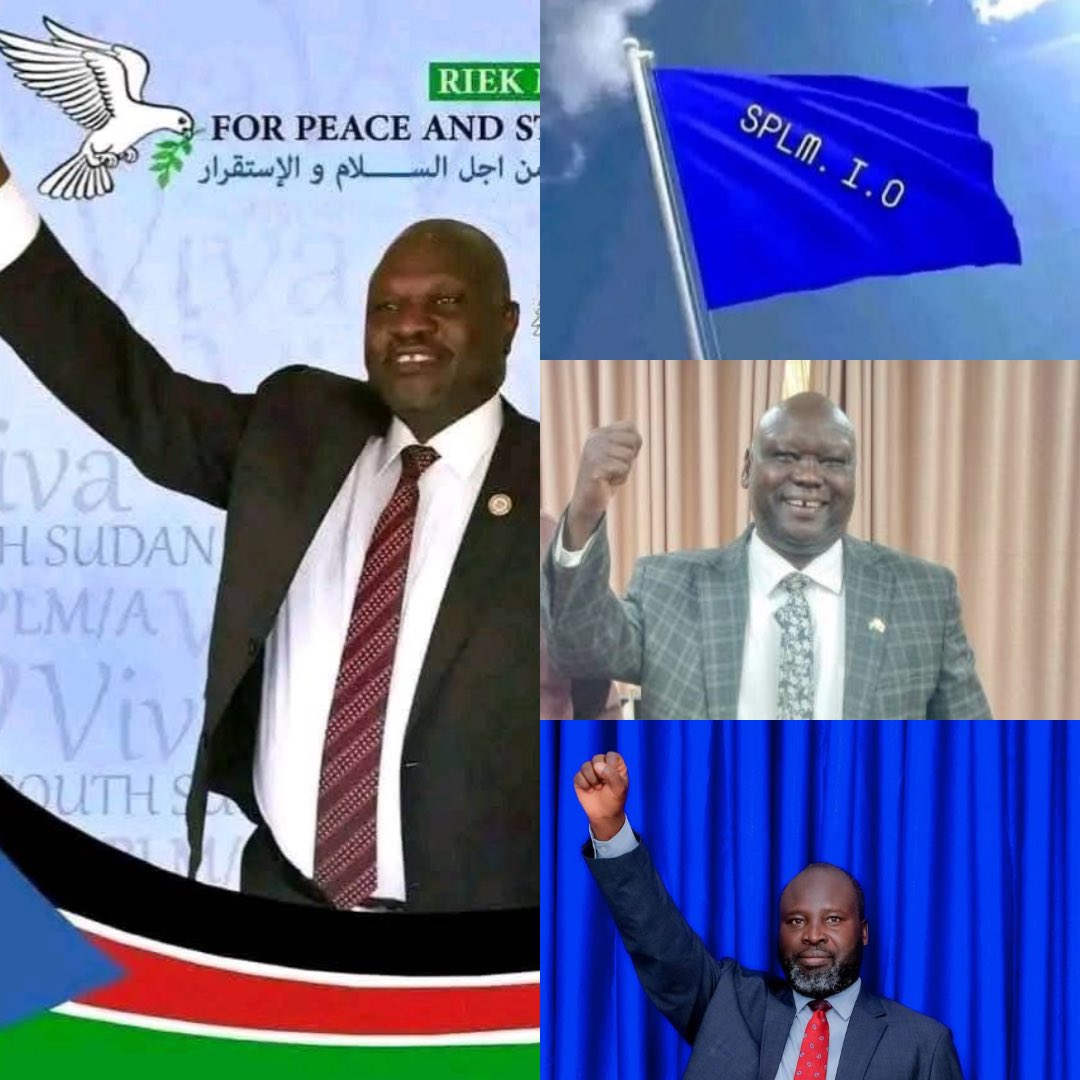
Oyet Refuses to Go to Juba & Phar Refuses to Step Down: A Double Test for SPLM-IO Unity By Madit Majak | Independent Political Analyst, South Sudan Eagle Media The Sudan People’s Liberation Movement–In Opposition (SPLM-IO) may be approaching one of the most defining and fragile moments in its history. Two parallel scenarios—each involving senior figures within the movement—pose a serious test of unity, leadership, and political direction. If Oyet Nathaniel refuses to return to Juba after the release of Dr. Riek Machar, and if Stephen Phar Koul refuses to step down from his interim leadership role, the SPLM-IO could face a dual crisis with far-reaching consequences. The first scenario—Oyet’s refusal to return to Juba and his decision to remain in the bush alongside Gen. Thomas Cirillo of the National Salvation Front (NAS)—would signal a direct challenge to centralized leadership. It would raise fundamental questions about discipline, trust, and cohesion within the movement. For years, SPLM-IO has relied on unity under Dr. Machar as a cornerstone of its political legitimacy. A fracture at this level would weaken not only internal coordination but also the movement’s credibility on the national stage. Supporters would likely split along familiar lines. Loyalists to Dr. Machar would view Oyet’s move as defiance—an act that risks undermining collective struggle and political progress. Others, however, may interpret it as a reflection of deeper frustrations: insecurity, unmet commitments, or dissatisfaction with the implementation of peace agreements. In a political environment shaped by broken trust, such divergence is not unexpected—but it is dangerous. At the same time, a second and equally consequential challenge could emerge from within the leadership structure itself. If Stephen Phar Koul refuses to step down after Machar’s return and instead consolidates his control over a faction of SPLM-IO—potentially aligning with the government of President Salva Kiir—the movement would face a deeper institutional crisis. Such a move would likely be interpreted by many as a direct challenge to Dr. Machar’s authority, if not an outright political betrayal. As the founding leader of SPLM-IO, Machar’s influence rests heavily on unity and loyalty. Any refusal by Phar to relinquish power would force Machar into a decisive response: either to confront the breakaway faction or attempt reconciliation under increasingly strained conditions. Among supporters, reactions would again be divided. Many would rally behind Machar, condemning Phar’s actions as opportunistic and inconsistent with the movement’s founding principles. Others—particularly those fatigued by years of instability—might see alignment with the government as a pragmatic step toward peace, even if it comes at the cost of ideological consistency. The convergence of these two scenarios would place SPLM-IO at a political crossroads. It would no longer be a question of a single disagreement, but rather a broader crisis of identity. Is SPLM-IO still a unified movement with a shared vision, or has it evolved into a collection of factions driven by competing interests and survival strategies? For the government, any fragmentation within SPLM-IO may appear as a strategic advantage. A divided opposition weakens resistance and strengthens the ruling establishment’s position. Yet such short-term gains could come with long-term risks, as fragmentation often fuels further instability and complicates national reconciliation efforts. Ultimately, the responsibility lies with the leadership of SPLM-IO to navigate this delicate moment with wisdom and restraint. Unity cannot be sustained through force alone; it requires trust, dialogue, and a shared commitment to purpose. For supporters, the question becomes even more critical: should loyalty be anchored in individuals, or in the broader ideals of peace, reform, and national stability?
South Sudan Eagles Media tweet media
English
0
0
3
295
South Sudan Eagles Media
Mr. Edmund Yakani Welcomes Appointment of H.E. Jakaya Kikwete as AU High-Level Representative to South Sudan Mr. Edmund Yakani, Executive Director of the Community Empowerment for Progress Organization (CEPO), warmly welcomes and congratulates former President of Tanzania, H.E. Jakaya Mrisho Kikwete, on his appointment as the African Union (AU) High-Level Representative to South Sudan. Mr. Yakani expressed deep appreciation to the Chairperson of the African Union Commission for positively responding to CEPO’s sustained advocacy and lobbying efforts for the appointment of H.E. Kikwete to this critical role. He described the decision as both timely and commendable, noting that it reflects a strong commitment by the AU to support South Sudan’s transition from violence to lasting peace. “We have full confidence in H.E. Jakaya Kikwete’s leadership, experience, and diplomatic capacity to effectively support South Sudanese leaders in navigating the complex transitional process toward stability and peace,” Mr. Yakani stated. He further emphasized that CEPO will actively utilize its Civil Society–African Union Dialogue Platform for the Transitional Process to engage in meaningful and consultative discussions with H.E. Kikwete. These engagements will aim to ensure that the voices of civil society are heard and integrated into the ongoing peace and transition efforts. CEPO remains committed to working collaboratively with regional and international partners to advance sustainable peace, democratic governance, and national unity in South Sudan.
English
0
0
4
317
South Sudan Eagles Media
Mr. Edmund Yakani, Executive Director of the Community Empowerment for Progress Organization (CEPO)
English
0
0
3
209
South Sudan Eagles Media
A Government That Cannot Talk to Itself Cannot Lead a Nation In any functioning government, access to the head of state is not a privilege—it is a necessity. When a sitting vice president publicly claims he has been unable to meet the president for nearly a year, it is not just an internal administrative issue. It is a warning sign of a deeper institutional breakdown. Recent claims by Taban Deng Gai that officials within the Office of the President have blocked his access to Salva Kiir since May 2025 raise troubling questions about the state of governance in South Sudan. According to reports, the vice president alleges he has been prevented from holding any direct meeting with the president for almost a year. A Symptom of a Bigger Crisis This is not an isolated political complaint—it reflects a broader pattern of dysfunction within South Sudan’s fragile power-sharing system. The country’s leadership structure, already strained by years of civil conflict and uneasy political compromises, depends heavily on communication between its top officials. If a vice president cannot access the president, then who is truly running the government? Such a situation suggests that unelected actors—bureaucrats, gatekeepers, or political loyalists—may be exerting undue influence over state affairs. This undermines not only transparency but also accountability. Power becomes concentrated in informal networks rather than constitutional offices. Undermining the Peace Framework South Sudan’s political system is built on delicate agreements meant to prevent a return to war. The 2018 peace deal, though imperfect, relies on cooperation among rival leaders sharing power at the highest level. But recent developments already point to growing instability. Political dismissals, arrests, and tensions within the leadership have raised fears about the future of the peace process. In that context, the reported isolation of a vice president is more than symbolic—it risks weakening the entire structure of governance. When communication collapses at the top, mistrust spreads across institutions. Leadership or Isolation? There are two possibilities in this situation, and both are concerning. Either: •The president is aware and allows this blockade—raising questions about inclusivity and leadership style, or •The president himself is being shielded from key officials—raising questions about who controls access to power. Neither scenario inspires confidence. A functioning presidency must be open to its own cabinet, especially to senior figures tasked with implementing national policy. Blocking access creates a parallel system where decisions are made without consultation, coordination, or consensus. The Cost to Ordinary Citizens While political elites navigate internal power struggles, it is ordinary South Sudanese who pay the price. A disconnected leadership cannot effectively respond to: •insecurity and violence •economic hardship •humanitarian crises When top officials cannot meet, policies stall. When policies stall, services fail. And when services fail, citizens lose faith in the state. Time for Transparency If these claims are true, they demand an urgent and transparent response. The presidency must clarify: •Whether such restrictions exist •Who is responsible •And why a vice president would be denied access for nearly a year Silence will only deepen speculation and mistrust. Conclusion A government that cannot communicate internally cannot govern effectively. The reported exclusion of Taban Deng Gai from direct access to Salva Kiir is not just a political dispute—it is a test of whether South Sudan’s leadership is still functioning as a unified system or drifting into fragmented power centers. At a time when the country needs cohesion, clarity, and direction, internal barriers at the highest level may prove to be its greatest obstacle.
English
0
1
5
529
South Sudan Eagles Media
Mr. Edmund Yakani, Executive Director of the Community Empowerment for Progress Organization (CEPO)
English
0
0
0
80
South Sudan Eagles Media
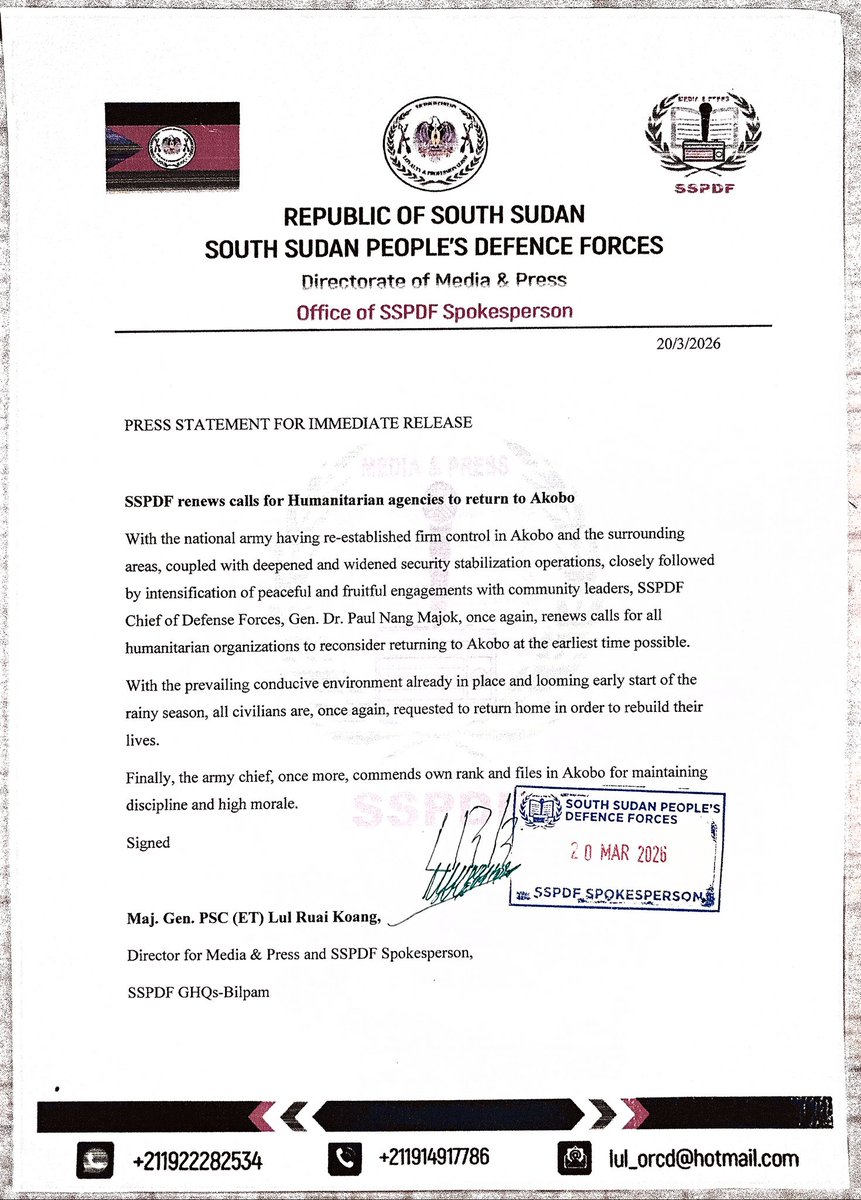
SSPDF Urges Humanitarian Organizations to Return to Akobo County, Jonglei State Jonglei, South Sudan — The South Sudan People’s Defence Forces (SSPDF) have renewed calls for humanitarian organizations to return to Akobo County following earlier military operations in the area. Earlier this month, the SSPDF issued an order requiring UNMISS (United Nations Mission in South Sudan) personnel, other humanitarian agencies, and civilians to evacuate Akobo ahead of planned military operations. The directive sparked international concern, with foreign governments and aid coordinators warning of a potential humanitarian disaster, given the heavy dependence of displaced populations on aid services. In a statement released this week, the SSPDF said it now has full control of Akobo and is urging humanitarian organizations and civilians who fled the area to return. The military also encouraged agencies to resume assistance activities to support local communities, many of whom have been cut off from essential services during the recent operations. Humanitarian groups have yet to confirm plans to redeploy staff to the county, citing security considerations and the need to assess the situation on the ground. Akobo has been a flashpoint in Jonglei State, with years of conflict contributing to displacement, food insecurity, and limited access to health and social services. The SSPDF’s latest call comes as the international community continues to monitor the situation closely, emphasizing the importance of safe and sustained humanitarian access.
South Sudan Eagles Media tweet media
English
0
0
1
164
South Sudan Eagles Media
Response to Edward Ashiek To Edward Ashiek, I have carefully read your response, and while I appreciate your attempt to broaden the discussion, your argument unfortunately downplays a very serious and well-documented threat. Let me be clear: acknowledging the failure of the state does not absolve armed groups of responsibility. The fact that the White Army operates in an environment of weak governance does not make it less dangerous. On the contrary, it makes its actions even more devastating for vulnerable civilians. You argue that the issue is “national, not tribal,” and I agree that South Sudan suffers from widespread militia activity. However, this generalization must not be used to dilute accountability for specific crimes. The events of 2022 in Chollo Kingdom were not abstract failures—they were targeted, large-scale attacks that resulted in thousands of deaths, destruction of homes, and the displacement of the Chollo (Shilluk) people. This is not a “selective narrative.” These are facts documented by survivors, humanitarian reports, and even acknowledged in public discussions at the time—including forums where members of the Chollo community, yourself among them, spoke out and condemned the attacks on the Shilluk Kingdom. Your attempt to shift responsibility toward the government raises valid questions—but it remains incomplete. Yes, the government, including the South Sudan People's Defense Forces, has a duty to protect civilians, and its failure to do so must be condemned. But failure to protect is not the same as committing atrocities. Two truths can exist at the same time: • The government failed to protect civilians. • Armed groups, including the White Army, carried out the violence. One does not cancel the other. You also question how information about threats reached Salva Kiir. That line of argument risks distracting from the core issue. Whether intelligence was known or not does not change what happened on the ground: civilians were attacked, killed, abducted, and displaced. Furthermore, listing dozens of militias across the country does not weaken the argument—it actually reinforces it. The existence of many armed groups is exactly why each one must be held accountable for its actions. We cannot normalize violence by suggesting that “everyone is doing it.” The specific claim that the White Army is “not a threat” is what I strongly reject. Any group responsible for mass killings, abductions, and threats against traditional leadership—including reported threats against the Shilluk King—is, by definition, a threat. This is not about tribalism. It is about justice and truth. If we are serious about peace in South Sudan, then we must: • Call out violence wherever it occurs • Hold all perpetrators accountable • Demand that the government fulfills its responsibility to protect all citizens We must never minimize the suffering of victims by reframing clear acts of violence as merely a “structural issue.” This is not propaganda. This is about the lives of real people. By Abraham Madit Majak South Sudan Eagle Media March 18, 2026
South Sudan Eagles Media tweet media
English
0
0
1
195
South Sudan Eagles Media
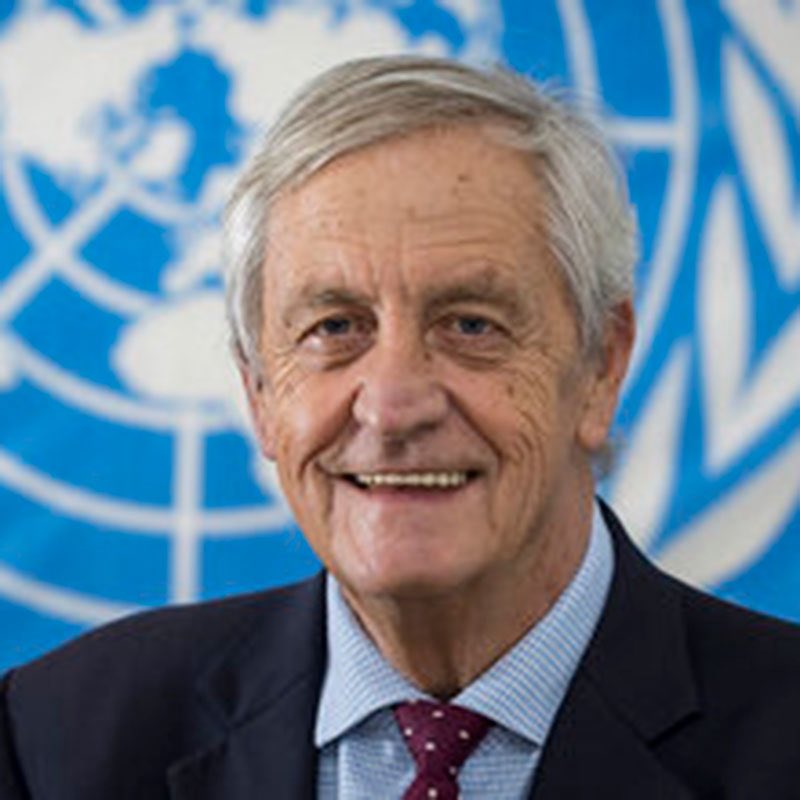
Condolence Message Edmund Yakani, Executive Director of Community Empowerment for Progress Organization (CEPO), extends his heartfelt condolences to the family, friends, and colleagues of the late Nicholas Fink, as well as to the entire United Nations Mission in South Sudan (UNMISS) and the broader United Nations family. Late Mr. Nicholas Fink made significant contributions to South Sudan throughout his life. He played an important role as one of the drafters of the Comprehensive Peace Agreement and remained a strong and consistent voice in advocating for the protection of South Sudan’s political rights and the well-being of its people. Mr. Yakani is urging His Excellency the President to order the national flag to be flown at half-mast as a sign of solidarity and respect following the passing of Mr. Fink, who died while serving as a senior official with UNMISS. May his soul rest in eternal peace.
South Sudan Eagles Media tweet media
English
0
0
4
234
South Sudan Eagles Media
Mr. Edmund Yakani, Executive Director of the Community Empowerment for Progress Organization (CEPO), strongly appeals to the government of South Sudan at the national, state, and local levels to urgently develop concrete plans and allocate funding for flood response across the country, as the rainy season has already begun. Today, rainfall in Juba has already started posing serious threats, raising the risk of flooding and its devastating impact on communities. It is essential that the country’s leadership demonstrates primary responsibility by allocating sufficient resources for flood response before relying on support from the donor community. Flooding is an annual and predictable shock that requires real political commitment and proactive funding from the government first, followed by support from international partners. The same urgency and speed often applied to funding conflict-related responses should also be directed toward flood preparedness and response, as floods pose severe threats to lives, livelihoods, and property across the country.
English
0
0
3
200
South Sudan Eagles Media
Edward Ashiek claims that the White Army “is not a threat to the people of South Sudan,” yet the events of 2022 tell a very different story. That year, the White Army carried out attacks on his tribe, the Chollo (Shilluk) community, resulting in an estimated 3,000 casualties, including the abduction of children and women, and causing mass displacement. They also threatened to behead the King of the Shilluk, escalating the threat to both the community and its traditional leadership. These documented actions clearly show that the White Army has directly threatened and harmed communities, making any claim that they are harmless factually inconsistent. While political rhetoric may downplay such violence for strategic purposes, the reality of mass attacks against the Chollo/Shilluk in 2022 demonstrates that the White Army is indeed a serious threat to South Sudan’s stability and to vulnerable communities.
South Sudan Eagles Media tweet media
English
0
0
2
157
South Sudan Eagles Media
Statement by Mr. Edmund Yakani, Executive Director of CEPO Edmund Yakani, Executive Director of Community Empowerment for Progress Organization, has urged the national parliamentary committees on Public Accounts and Finance to summon key government officials. These include the Minister of Trade and Industry, the Minister of Finance and Planning, and the Commissioner General of the South Sudan Revenue Authority. This call comes in response to recent friction observed between the Vice President and Chair of the Economic Cluster and the Minister of Trade and Industry, as well as the Revenue Authority, regarding transparency in the collection of national revenue from various sources. CEPO is calling on lawmakers to take a firm stance in support of the suffering civil servants, soldiers, and citizens of South Sudan, emphasizing the need for accountability and transparency in public financial management.
English
0
0
1
125
South Sudan Eagles Media
Mr. Edmund Yakani, Executive Director of CEPO, urged the Governor of Unity State and Chief Administrator of Ruweng Administrative Areas to prevent any revenge attacks following the massacre of over 200 civilians in Abiemnom county of Ruweng Administrative Area.
English
0
0
0
158
South Sudan Eagles Media
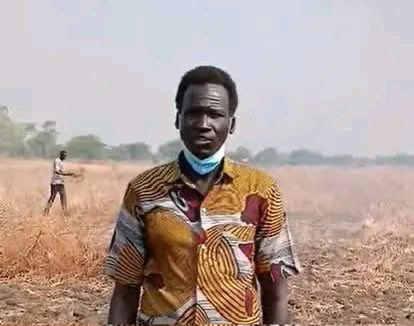
"I am here in Tiergol, Akobo District [Ethiopia], at the old airstrip. We are collaborating with the local community to receive refugees from South Sudan. Right now, we are clearing the 1949 colonial airstrip so humanitarian planes can land with supplies. The refugees are in distress—suffering from hunger and a lack of medicine. Among the 80,000 refugees we have recorded, we have registered 90 wounded people and many pregnant women, primarily coming from Uror, Nyirol, and Akobo in South Sudan. This is my appeal as the Akobo District Administrator: I call upon the Federal Government of Ethiopia and the international community to intervene and help." Ato Simon Hoth Chuol, Akobo District Administrator in Ethiopia’s Gambella region.
South Sudan Eagles Media tweet media
English
1
1
11
594
South Sudan Eagles Media
CEPO Welcomes Kiir’s Pledge to Fund 2026 Elections but Warns Against Undermining by Officials Mr. Edmund Yakani, Executive Director of the Community Empowerment for Progress Organization, has welcomed the pledge by President Salva Kiir Mayardit to provide funding for the scheduled December 2026 elections. Yakani said the pledge could represent an important step toward credible elections if it is honored and respected by government officials responsible for implementing the president’s directives. However, he warned that some close subordinates of the president have a history of undermining similar commitments. According to Yakani, several past pledges made by the president were violated, ignored, or dishonored because some officials pursued different priorities when allocating government funds. “We have seen ministers allocate themselves large allowances for external travel, workshops, and other activities,” Yakani said. “At the same time, significant resources continue to be spent on costly wars and political activities instead of prioritizing preparations for elections.” He stressed that the time remaining to create the necessary conditions for credible elections is running out quickly. Yakani noted that the June 22, 2026 deadline for critical electoral preparations is approaching fast. “The moment some of the president’s subordinates begin to honor and enforce his directives to prepare the country for elections will be the real signal that South Sudan is serious about holding elections,” Yakani said. He warned that if current practices continue—such as funding wars, fueling political divisions, creating multiple committees, and prioritizing ministerial allowances—there is a high risk that the country will fail to hold elections in December 2026.
English
0
0
1
169