Stackdrop

121 posts

Stackdrop

Stackdrop

@stackdropHQ

Frictionless Operations Software on top of your databases, APIs, spreadsheets, and business apps from conception to delivery.
Athens, Greece Katılım Eylül 2022
3 Takip Edilen26 Takipçiler
Stackdrop
Stackdrop@stackdropHQ·
The gap between "this process is slow" and "we need to build a tool" is usually filled by workarounds that feel manageable until they don't. What that looks like operationally, and when teams finally decide to fix it: eu1.hubs.ly/H0v3H2w0
English
0
0
0
0
Stackdrop
Stackdrop@stackdropHQ·
Signed S3 URL loads fine in the browser. Open it in a Retool PDF component and a blank screen appears, no error. The fix: one CORS config change on your S3 bucket. Our engineer Arsany documented the full breakdown 👇 Link here: eu1.hubs.ly/H0tZHTD0
Stackdrop tweet media
English
0
0
0
16
Stackdrop
Stackdrop@stackdropHQ·
Last week, John joined Retool's Build Together session to walk through a custom component we built for a real client project The component is built to drop into any Retool component library with minimal coupling. Full technical breakdown here: eu1.hubs.ly/H0tSS-r0
English
0
0
0
11
Stackdrop
Stackdrop@stackdropHQ·
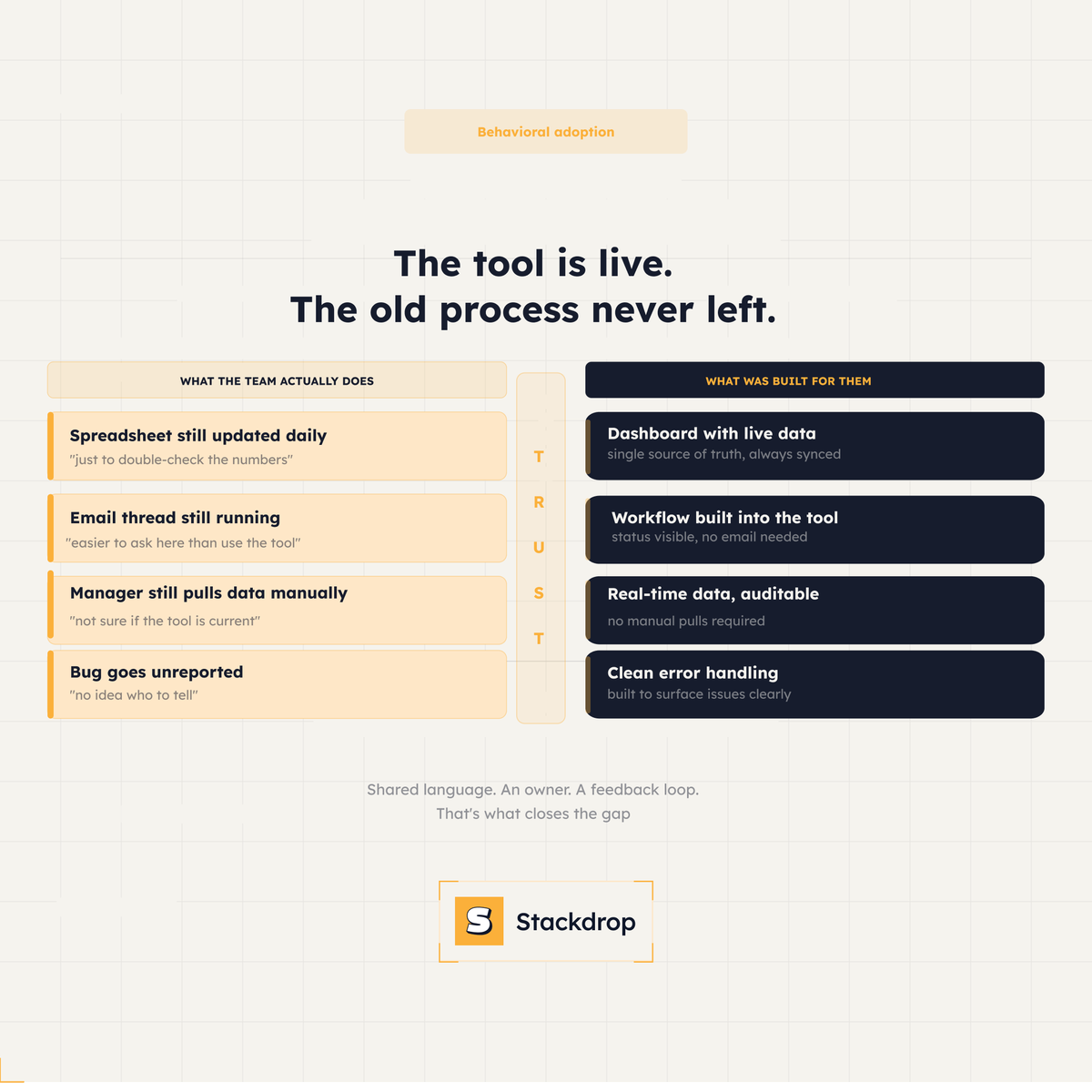
Why do well-built internal tools still get abandoned? Most teams assume it's a UX problem. Or a training problem. Or that people just resist change. It's usually simpler than that: the old process stays because the new one hasn't earned enough trust yet. There is no clear owner, no documentation and no place to raise issues. The build is done, but the adoption work hasn't started. 🛠️ Full article on Internal tool adoption here: eu1.hubs.ly/H0tzTHq0 #InternalTools #OperationalExcellence #EnterpriseOps
Stackdrop tweet media
English
0
0
0
18
Stackdrop
Stackdrop@stackdropHQ·
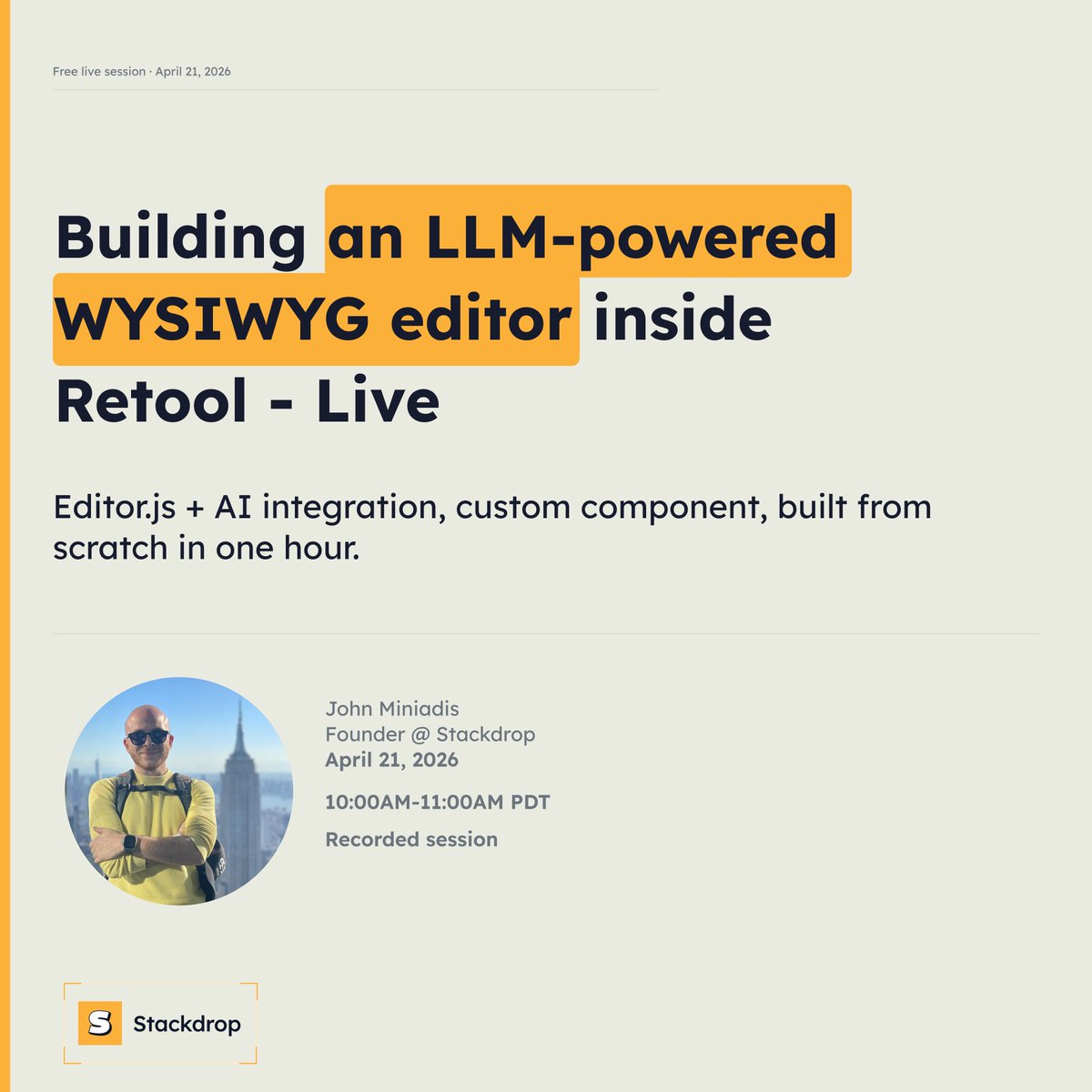
@retool invited Stackdrop's founder, John, to build live on April 21. Here's what he's building: an LLM-powered WYSIWYG editor inside Retool, using Editor.js as the foundation: a custom component that doesn't exist out of the box, built from scratch in one hour. 🏗️ If your team runs Retool in production and has ever needed a richer text input layer inside your tools, this session is worth watching. The full build happens live and the recorded session will be available afterward. 🗓 April 21 · 7:00–8:00 PM CEST 🔗 Register: eu1.hubs.ly/H0twQQ10 #Retool #InternalTools #LowCode #CustomComponents
Stackdrop tweet media
English
0
0
1
28
Stackdrop
Stackdrop@stackdropHQ·
Retool's default slider lets you filter data. It doesn't show you what you're filtering into. Vaggelis Kapetanakis, an engineer at Stackdrop, built a custom range slider with a histogram above it so you can see how your data is distributed before you set a range. Not after. The difference matters when you're reviewing transactions, managing inventory, or tracking any metric where context changes the decision: You stop filtering blind. This component is now part of @retool's official custom component library. 📚 On April 21, we're building a WYSIWYG editor live at Retool's Build Together event. Register here: eu1.hubs.ly/H0thS9v0 #Retool #InternalTools #CustomComponents
English
0
0
0
25
Stackdrop
Stackdrop@stackdropHQ·
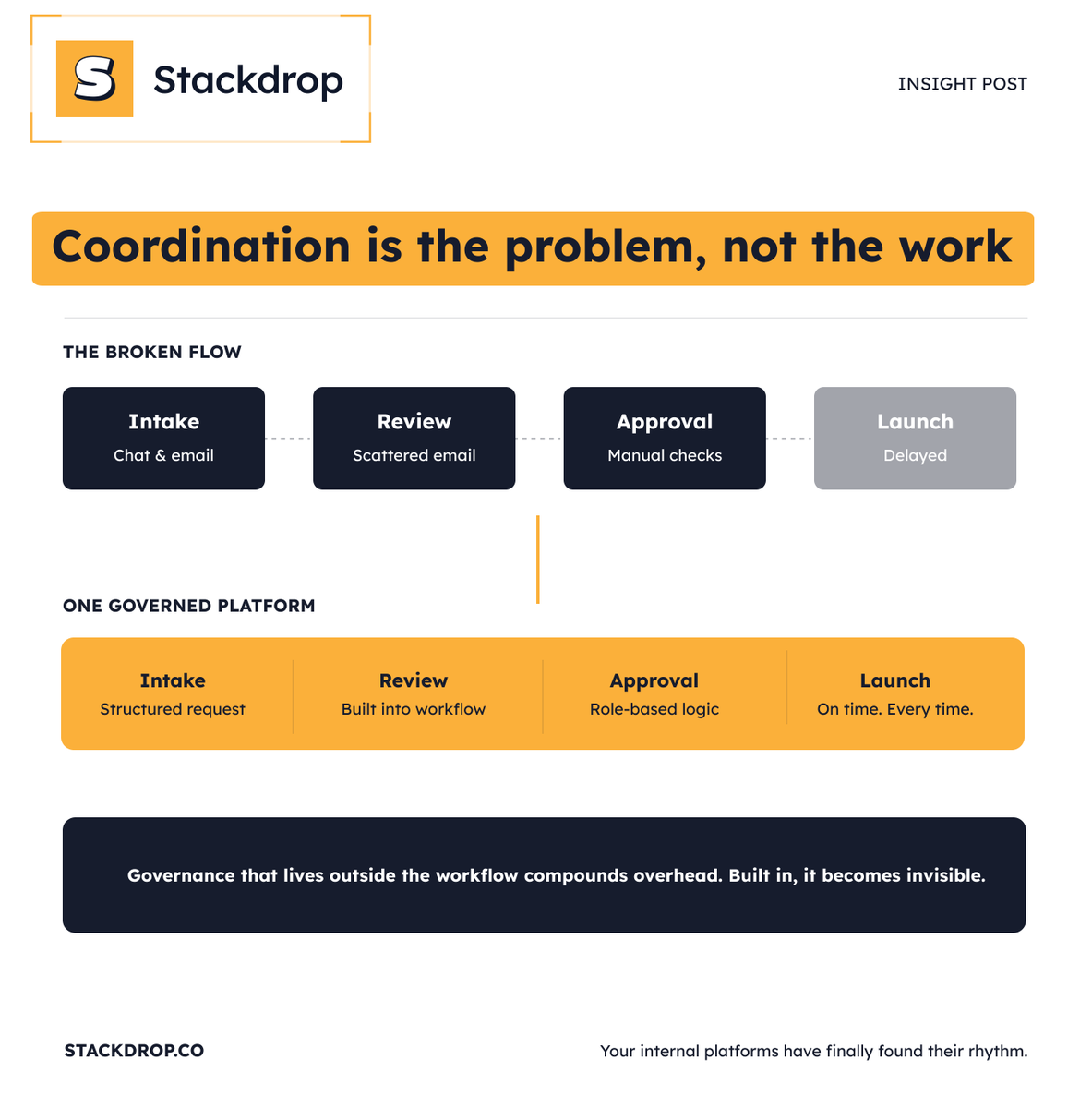
At a certain scale, enterprise creative teams run into the same wall. Output is high, tools are in place, and the work keeps moving, but campaigns slip, brand inconsistencies creep in, and nobody can quite explain where the delays are coming from. You'd think the problem is in the creative work itself, but it actually lives in the coordination around it: requests moving through chat threads, approvals scattered across email, assets distributed across tools that weren't built to connect. We wrote about what that looks like structurally, why tool consolidation alone doesn't solve it, and what a governed platform layer actually requires: eu1.hubs.ly/H0tddpQ0 #InternalTools #MarketingOperations #EnterpriseOperations #Stackdrop
Stackdrop tweet media
English
0
0
0
17
Stackdrop
Stackdrop@stackdropHQ·
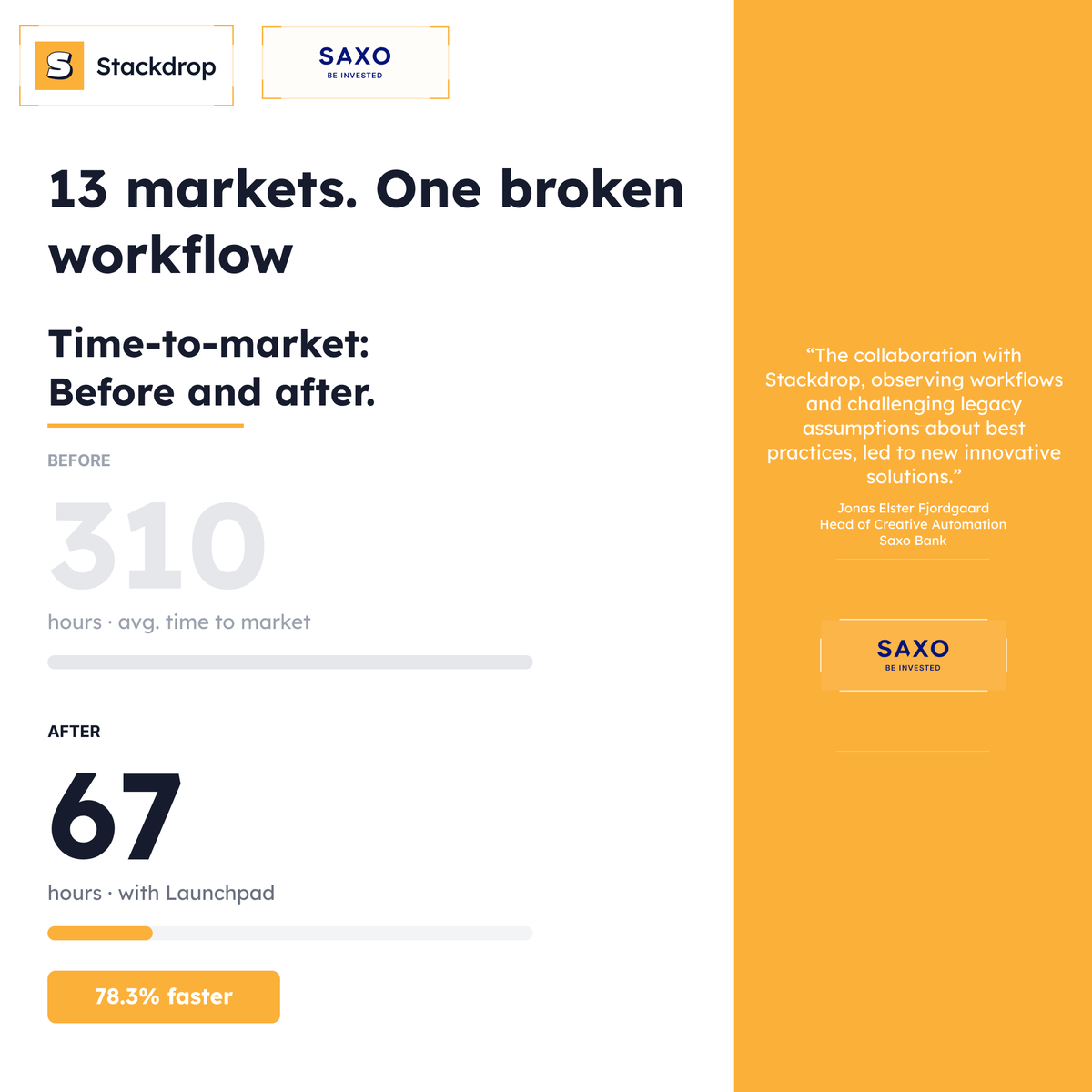
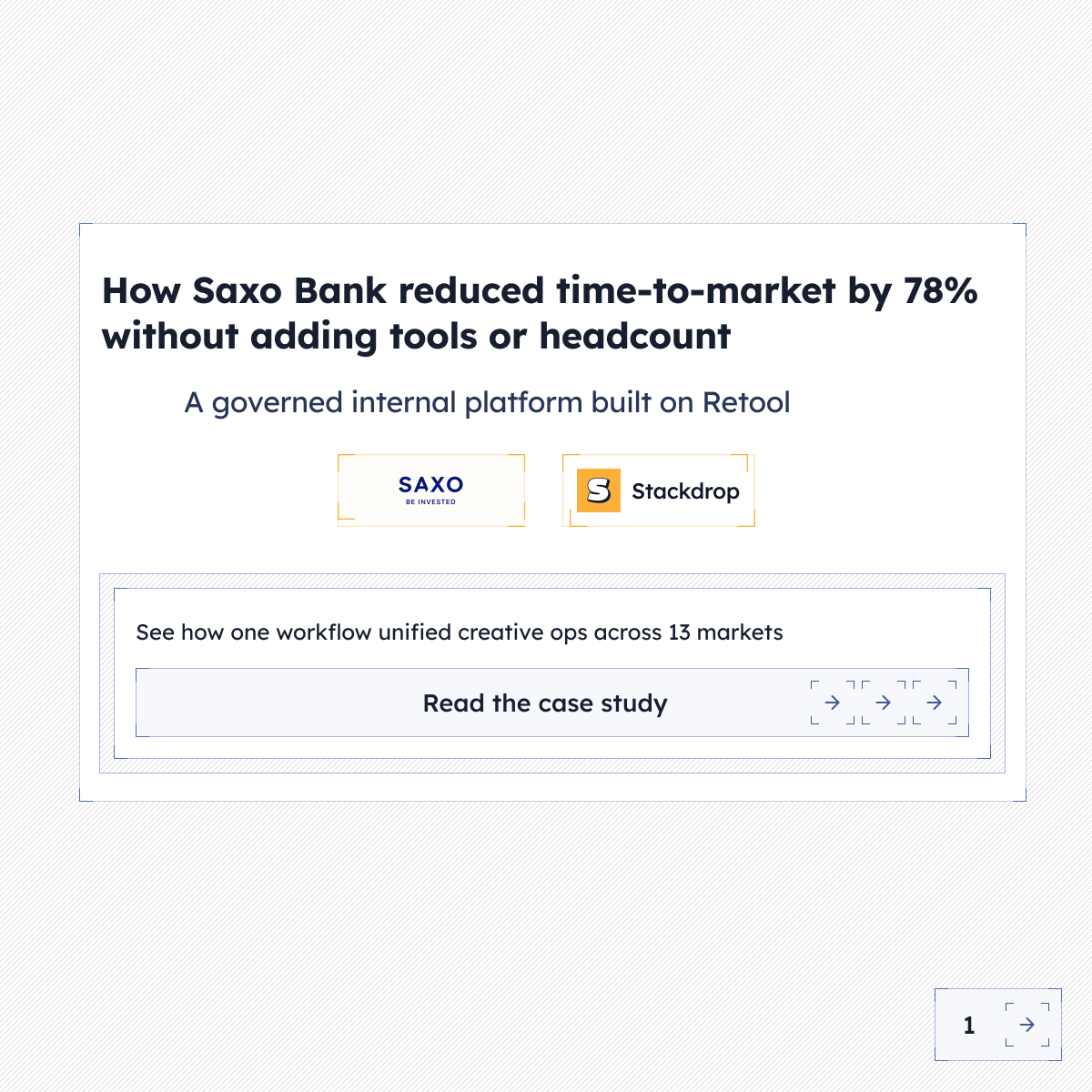
@saxobank 's creative team was producing thousands of formats each year across 13 markets. The work itself wasn't the problem, it was the coordination layer underneath it. Requests, approvals, assets, and brand reviews spread across disconnected tools, with governance enforced manually outside the workflow. We built Launchpad on @retool to bring all of that into one place. Intake to delivery, brand controls embedded directly into the process. Full case study here: eu1.hubs.ly/H0t92mb0 #InternalTools #CreativeOps #MarketingOperations #Retool #WorkflowAutomation
Stackdrop tweet media
English
0
0
0
11
Stackdrop
Stackdrop@stackdropHQ·
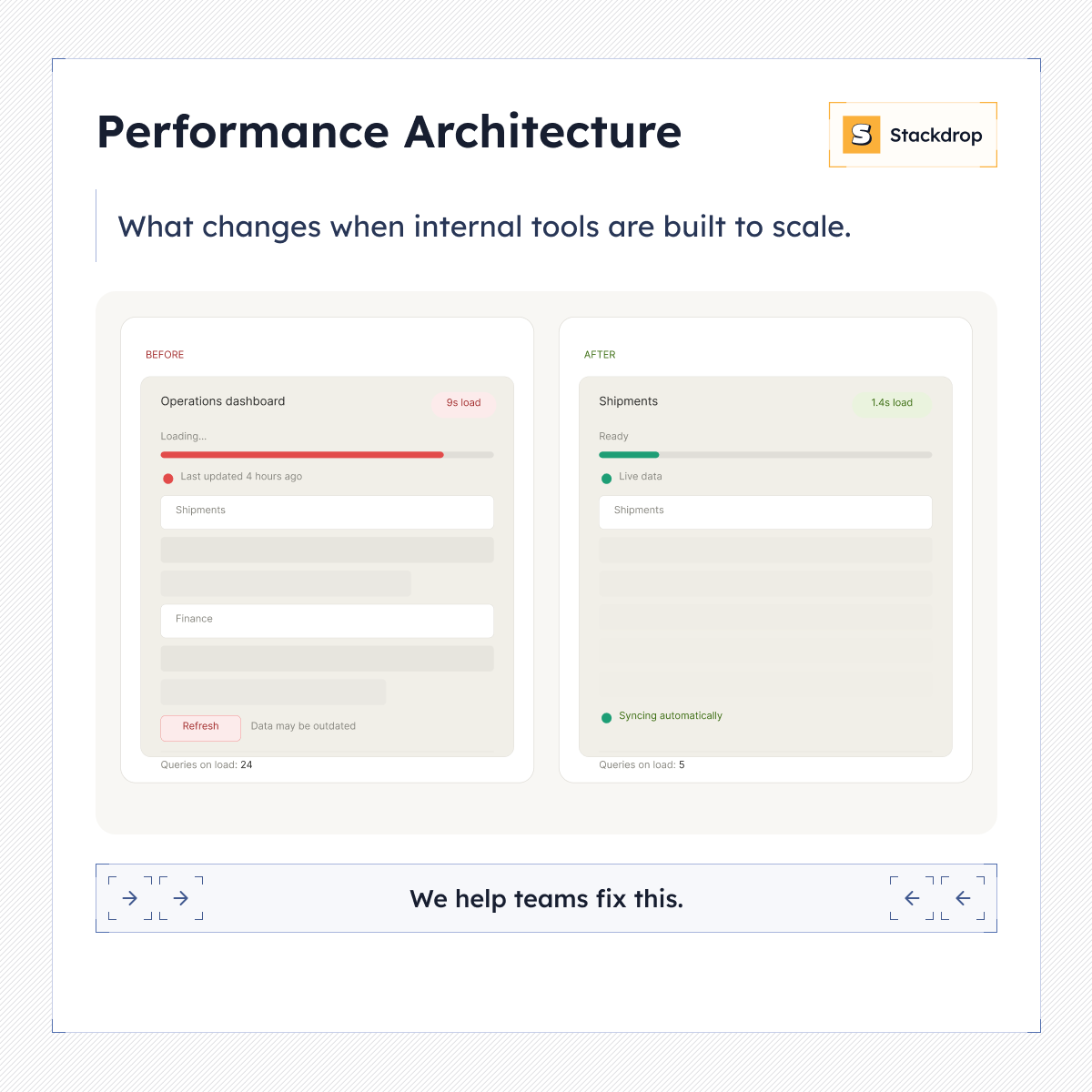
Internal tools tend to slow down gradually: A page that loaded in a second starts taking five, then nine. People refresh constantly until they stop trusting the data, so they build workarounds. ⚙️ By the time it feels broken, the structural issues have usually been there for a while, just not visible enough to prioritize. We wrote about what causes this and how to fix it without rebuilding from scratch. Pillar 3 of our internal tool literacy series is live: eu1.hubs.ly/H0t4q0r0 #InternalTools #RetoolDevelopment #EngineeringLeadership
Stackdrop tweet media
English
0
0
0
16
Stackdrop
Stackdrop@stackdropHQ·
We're joining @retool's Build Together series on April 21. John Miniadis, our founder, will be building a custom component live — an AI-powered WYSIWYG editor using Editor.js with live LLM calls directly inside a Retool app. If you've ever hit the limits of out-of-the-box Retool components, this is what building past them actually looks like in practice. One hour. Real build. All the code shared after. → Register here: eu1.hubs.ly/H0t1r8W0
English
1
0
1
43
Stackdrop
Stackdrop@stackdropHQ·
Nine hours a week. That's how much time employees spend on average just moving data between systems, not making decisions, not solving problems, copying information from one tool into another. 🔄 Most teams we work with don't realise how much of this they've absorbed into their normal workflow. It gets done reliably every week, so it never registers as something that could be fixed. That's what our second pillar on internal tool literacy is about: Integration Awareness. Link in comments, take a look! 👇🏼 #InternalTools #OperationsLeadership #SystemsDesign #Integration
English
0
0
0
16
Stackdrop
Stackdrop@stackdropHQ·
💡 From what we see working with ops teams, the tools usually exist, but the visibility doesn't. Intake tracked here, approvals somewhere else, handoffs in a thread nobody can find. Each piece works but the picture never comes together. And somehow, "where are we on this?" still gets answered manually. If that sounds familiar, it's worth a conversation. → eu1.hubs.ly/H0sH5l90 #InternalTools #OperationsLeadership #ProcessDesign #Stackdrop
English
0
0
0
13
Stackdrop
Stackdrop@stackdropHQ·
Every approval flow made sense when someone built it. Then the team scaled, the timelines compressed, and the workflow started absorbing time in ways nobody could fully explain — and the questions that followed all got directed at the tools rather than the system underneath them. That gap between how tools are designed to behave and how operations actually run is what systems logic is about. We wrote a full breakdown of it, including what it looks like when it's missing and where to start if you want to map this in your own workflows. 👇 Link in the comments. If this gap is costing your team time, we'd love to talk. → eu1.hubs.ly/H0sBp-20 #InternalTools #OperationsLeadership #SystemsLogic
English
0
0
0
9
Stackdrop
Stackdrop@stackdropHQ·
When we talk about internal tools, we mean the internal apps, dashboards, automations, and workflows your teams use to run operations: refund tools, finance views, onboarding flows, support consoles, logistics dashboards, and more. These are usually built on platforms like Retool, low‑code builders, or custom admin UIs that sit on top of your core systems. For scaling teams, the question is not "do we have enough tools?" but "do our internal tools and operational systems behave in a way we can understand, improve, and trust when volume and complexity grow?" This guide maps the basics any modern team needs to understand if they want internal tools and internal platforms to become real operational leverage 👉🏻 eu1.hubs.ly/H0stmcL0
English
0
0
0
9
Stackdrop
Stackdrop@stackdropHQ·
Internal tools rarely fail on tech alone. They fail when teams can’t see how they really work or what they could unlock. That gap is visibility debt: 👀 - Shadow spreadsheets next to internal apps - Slack full of “Why isn’t this updating?” - The same architecture debates every quarter We’ve published a new guide to help fix that: 📕 Internal Tool Literacy: A Practical Guide for Modern Teams Inside: Why internal tool literacy is a structural advantage in the AI era The 4 pillars that keep internal tools from becoming “fragile side projects” 7 patterns behind failing internal tools (even with strong engineering teams) ​ 👉 Read the guide on our blog: eu1.hubs.ly/H0sfzMS0 #InternalTools#InternalPlatforms #EngineeringLeadership #SystemsThinking
English
0
0
0
14
Stackdrop
Stackdrop@stackdropHQ·
As internal tools grow in scope, the real challenge is keeping coordination, governance, and quality consistent across teams and markets. Together with @saxobank, we built a governed internal platform in @retool to support creative operations at scale across multiple markets and workflows. Over the course of a year, this resulted in: • 78% faster time-to-market • 86% faster time-to-review The interesting part wasn’t a single tool, but how the system was designed to hold up as complexity increased. Full case study here → eu1.hubs.ly/H0s3nh80
Stackdrop tweet media
English
0
0
0
28
Stackdrop
Stackdrop@stackdropHQ·
Why do Excel workflows break as teams scale? Excel works early because it removes barriers and friction. You don't need a developer, a project timeline, or a vendor evaluation to start solving a problem. You open a file, structure data the way you see it, and get immediate feedback. For smaller teams with straightforward processes, this is exactly the right tool.​ We've seen that first-hand in our work with different clients, read this blog post to understand the hidden costs of Excel 👉🏻 eu1.hubs.ly/H0r_-y-0 #Excel #Spreadsheets #Operations #ProcessImprovement
Stackdrop tweet media
English
0
0
0
22
Stackdrop
Stackdrop@stackdropHQ·
Pattern 3: Designing internal tools like future SaaS products Some internal tools are shaped more by imagined futures than by the problems they exist to solve today. Decisions get locked in early, long before real usage creates pressure or clarity. Progress feels steady, but usefulness keeps getting deferred. This pattern rarely ends in a visible failure. It usually shows up as time lost and momentum that never quite returns. Follow along if this feels familiar. Or share the pattern that slowed your team down the most. #InternalTools #EngineeringLeadership #PlatformTeams #ProductOps #SaaS
English
0
0
0
10
Stackdrop
Stackdrop@stackdropHQ·
Sometimes, the smartest move is to leave the broken system entirely. Walk away, and build one that actually holds under pressure. #penguin #internaltools
Stackdrop tweet media
English
0
0
0
17
Stackdrop
Stackdrop@stackdropHQ·
Many internal tools start with the right intention where a team needs to move fast, solve a local problem, and ship something useful. ✅ Over time, that tool spreads. Other teams rely on it, processes grow around it, and it quietly becomes part of how the business operates. But ownership, onboarding, and long-term evolution were never designed for that stage. Nothing is broken but changes somehow feel riskier than they should and progress slows in subtle ways. We keep seeing this pattern in technically strong teams who are already past the build phase and now dealing with what comes after. If this sounds familiar, get in touch or share how you have seen this play out: bit.ly/49Ttusy #Internaltools #Platformengineering #Enterprisesoftware
Stackdrop tweet media
English
0
0
0
13