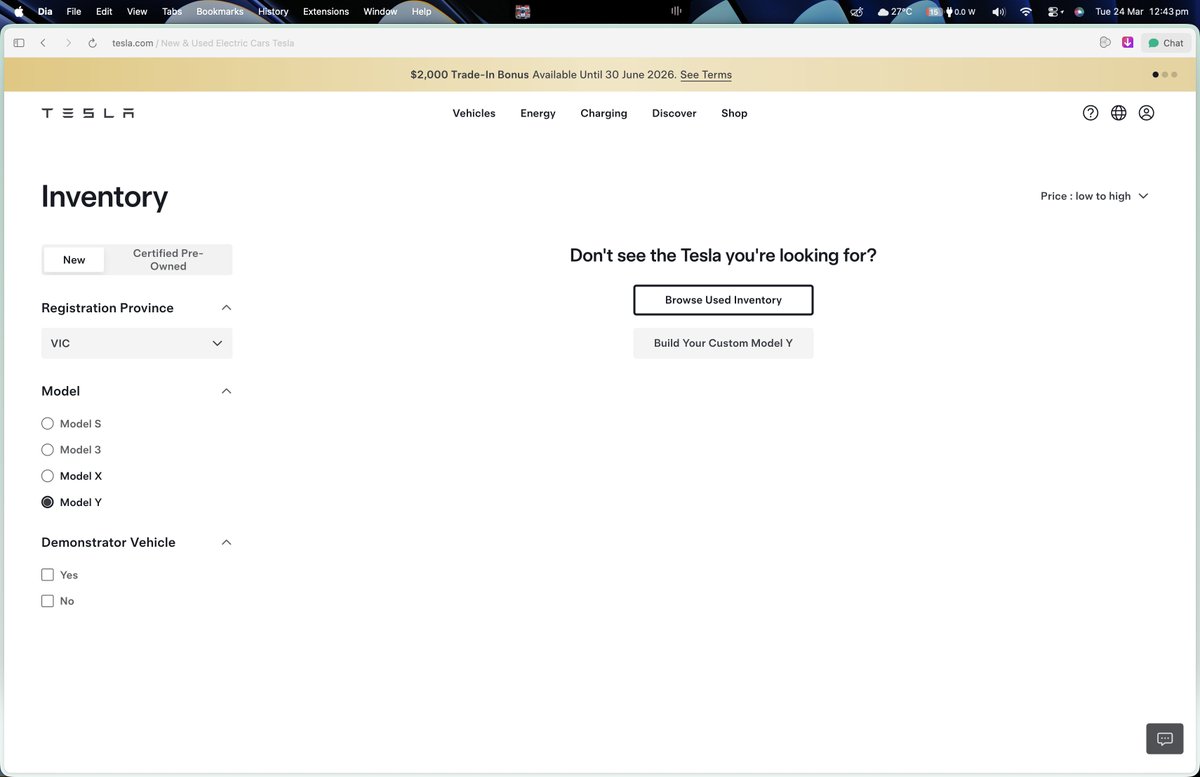
@Jackalblog @NZNationalParty @nzlabour @NicolaWillisMP It's not govt funded, so that's a big improvement
English
Stefan Olson
14K posts
@stefanolson
Windows (WPF) Developer in New Zealand










First, the numbers. Diesel passenger vehicles are 6% of overall diesel consumption. Even if they were able to outbid other uses, they're starting from a really low base relative to diesel demand.





BREAKING: South Korea just announced mandatory fuel rationing. Government vehicles at public institutions barred from operating one day each week on a five-day licence plate rotation. The world’s 10th largest economy, a G20 member, a semiconductor superpower, home to Samsung and SK Hynix, the country that fabricates a quarter of the world’s memory chips, is rationing fuel like Sri Lanka. South Korea imports 73 to 87 percent of its oil from the Middle East. Every barrel transits the Strait of Hormuz. The strait is closed and mined. There is no alternative route for Korean crude imports at scale. The Kospi crashed 4.9 percent on Monday before Trump’s “productive conversations” post briefly eased the panic. The won is weakening. Inflation is accelerating. And now the Energy Minister is telling government workers which days they cannot drive. Count the dominoes. Sri Lanka rationed first: Wednesdays off, QR codes at pumps, LPG vanished from southern shelves. Bangladesh followed with public holidays to conserve fuel. Pakistan imposed restrictions. India tightened allocations. Slovenia became the first EU country with QR codes and odd-even plates. Now South Korea. The rationing is no longer a developing-world phenomenon. It is migrating up the GDP ladder. The 10th largest economy. The 12th largest military budget. A US treaty ally hosting 28,500 American troops. Rationing. Those 28,500 troops run on fuel. USFK operates bases across the peninsula that require continuous diesel, aviation fuel, and generator capacity. Joint exercises with the ROK military consume thousands of tonnes of fuel annually. Every barrel of that fuel traces back to the same Middle Eastern supply chain that South Korea’s Energy Minister just acknowledged cannot sustain civilian demand. If civilian vehicles are being restricted, military logistics are under pressure. If military logistics are under pressure, deterrence against North Korea erodes. If deterrence erodes, Pyongyang and Beijing calculate. The Strait of Hormuz is 7,500 kilometres from the Korean DMZ. The fuel that deters Kim Jong Un transits a chokepoint held closed by Iran’s 140 remaining missile launchers. Kim Jong Un is watching. Every day that South Korea rations fuel is a day that North Korea’s calculus shifts. Not toward war, not yet, but toward the conclusion that the American alliance system has a fuel dependency that a single regional conflict can exploit. The US cannot simultaneously secure the Strait of Hormuz with carrier groups, deploy 82nd Airborne paratroopers to the Iran theater, accelerate the 11th MEU from San Diego, AND maintain full deterrence posture on the Korean Peninsula. Something gives. The fuel rationing in Seoul is the first visible signal of what is giving. Taiwan is watching too. TSMC’s fabrication plants in Hsinchu are counting LNG reserves in single-digit days. Taiwan imports virtually all of its energy. If South Korea, with its larger strategic reserves and diversified economy, is already rationing, Taiwan’s timeline is shorter. The chips that power every Nvidia GPU, every Apple processor, every AI training run on Earth depend on a gas supply that depends on a strait that depends on a 5-day pause that depends on a Truth Social post that Iran says corresponds to nothing. Sri Lanka. Bangladesh. Pakistan. India. Slovenia. South Korea. Six countries rationing. Three continents. One strait. The molecules do not check GDP rankings. The molecules check whether the chokepoint is open. It is not. open.substack.com/pub/xerion/p/a…

BREAKING: Slovenia just became the first European Union country to introduce fuel rationing. QR codes at the pump. Odd-even licence plate systems. Purchase limits per vehicle. The same system Sri Lanka implemented three weeks ago. The same system Bangladesh and Pakistan adopted in early March. The same system that Europeans once watched on their screens as a distant developing-world problem they would never face. Twenty-four days of war erased the distance between Ljubljana and Colombo. Europe’s LNG prices have surged 35 to 50 percent since the Strait of Hormuz closed. Qatar’s Ras Laffan, which supplied 17 percent of global LNG capacity, declared Force Majeure after Iranian strikes on Day 3. Repairs will take 3 to 5 years. Russia’s pipeline gas was already severed after Ukraine. Norway is running at maximum output and cannot increase. The EU’s only remaining large-scale supplier is the United States, whose president just told 450 million Europeans to ratify a $750 billion trade deal by Thursday or lose access to American LNG. Slovenia is small. Two million people. A GDP smaller than some American counties. But Slovenia is the signal. When the first EU member state reaches for QR codes and odd-even plates, the system is telling you that the buffers have failed. Strategic reserves delay rationing. They do not prevent it. Slovenia burned through the delay in 24 days. The question is not whether other EU countries follow. The question is when. Sri Lanka closed government offices every Wednesday to conserve diesel. LPG vanished from shops on the southern coast. Queues stretched for kilometres. In 2022, Sri Lanka experienced this during a sovereign debt default. In 2026, Sri Lanka is experiencing it during a global war. The cause changed. The queues did not. The island that defaulted four years ago and the continent that lectures it about fiscal discipline are now standing in the same line. The next line is food. The Strait of Hormuz does not only block oil. It blocks fertiliser. Gulf nations supply 49 percent of the world’s exported urea. Ammonia production requires natural gas that is no longer flowing. Without fertiliser, yields fall 5 to 10 percent on the next planting cycle. The USDA Prospective Plantings report arrives March 31. The FAO Food Price Index publishes April 3. If the strait is still closed when those numbers land, the rationing conversation moves from fuel to food. The architecture of globalisation was built on a single assumption: the chokepoints will always be open. Hormuz carries 20 percent of the world’s oil. Bab al-Mandab carries the traffic that avoids Hormuz. Suez connects both to Europe. One war closed Hormuz. The Houthis disrupted Bab al-Mandab. Freight analysts say Suez rerouting around the Cape of Good Hope will continue “for another year.” Three chokepoints. All compromised. The system that delivered cheap energy and cheap food to Europe for decades was never resilient. It was lucky. The luck ran out on February 28. Slovenia is rationing fuel with QR codes. Sri Lanka is rationing fuel with QR codes. The same codes. The same war. The same strait. The only difference is that one country expected this and the other did not. Full analysis: open.substack.com/pub/shanakaans…