Stefano Mariani
2.5K posts

Stefano Mariani
@stemarO_O
Ricercatore RTD-B / Fixed-term research assistant (post-doc) @ Università di Modena e Reggio Emilia
Forlì Katılım Ekim 2011
427 Takip Edilen100 Takipçiler
Sabitlenmiş Tweet

**Researchers in AI, agent-based systems, and causal reasoning**, the 1st CLaRAMAS workshop will take place in May at AAMAS in Paphos, Cyprus :)
Co-organisers Mehdi Dastani, André Meyer-Vitali, and @JulienSiebert
Check out the welcome post ;) claramas-workshop.github.io/claramas2026/b…
English

@yudapearl Your work inspired generations, and as little as it is, myself I’m trying to bring causal learning and reasoning in the Autonomous Agents community with the 1st workshop of its kind at the AAMAS conference: claramas-workshop.github.io/claramas2026/d…
Hope it turns out to be a seminal event!
English

Dear readers,
I was honored with the following Award:
The 2026 National Academy of Artificial Intelligence Exploration Award
" For establishing the foundations of causal artificial intelligence."
See:
thenaai.org/index/index/ne…
I hope it brings a small sprinkle of glamour to the entire causal inference enterprise. Congratulations also go to our colleagues @tdietterich and Leslie Valiant, who are sharing this award for their pioneering works.
English

🥷🏻 "Pssst, @Conf_CLeaR authors, come closer"..."Got your paper rejected?" 😢 "DON'T WORRY! We got you covered 😘" claramas-workshop.github.io/claramas2026/b…
#causality #agents #ai @AAMASconf @JulienSiebert
English

📢📢 ATENTION PLEASE 📢📢
Exceptional deadline extension for #CLaRAMAS at @AAMASconf 2026 submission to welcome authors of papers rejected by #clear2026: new deadline is **March, 11th 2026**!
📢📢 SPREAD THE WORD 📢📢
@JulienSiebert @IJCAIconf @IJCAI @NeurIPSConf @RL_Conference
English

Dear fellow researchers,
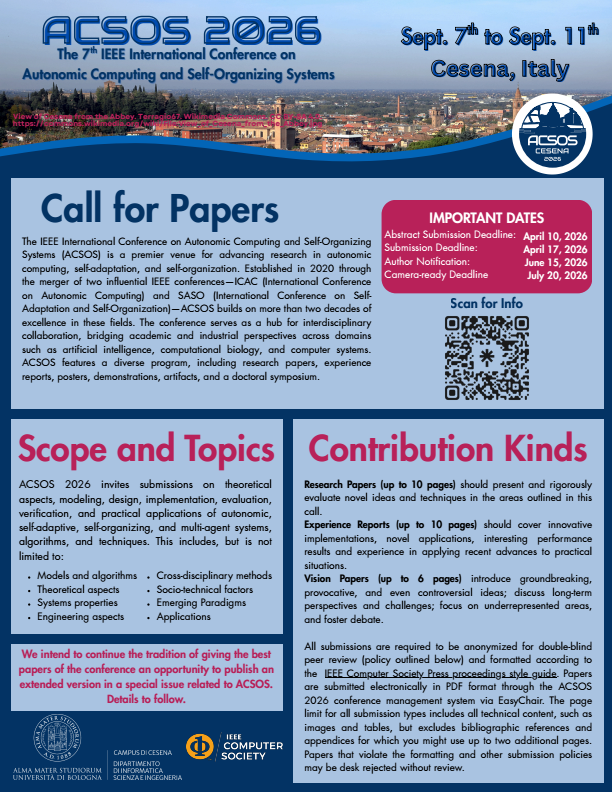
my friends in Cesena are hosting the @ACSOSconf 2026!
That's the premiere venue for #Autonomic and #Self-organising systems research 💪🏻
Don't miss it, and visit the Romagna region, where wonderful landscapes top food & wine await 🍷

English

**LAST CALL FOR PAPERS**
#CLaRAMAS workshop at @AAMASconf '26 accepts submission until **March 1st** strict.
Come publish in @SpringerNature #CCIS series!
claramas-workshop.github.io/claramas2026/s…
#Causality #Agency #aamas26
@JulienSiebert @iclr_conf @RL_Conference @ecai2025 @IJCAI @IJCAIconf
English

Got your paper about #causality and #agency rejected at @aistats_conf ?
Submit to the CLaRAMAS workshop hosted by
@AAMASconf :)
claramas-workshop.github.io/claramas2026/
English

Got your paper about #causality and #agency rejected at @iclr_conf ?
Submit to the CLaRAMAS workshop hosted by @AAMASconf :)
claramas-workshop.github.io/claramas2026/
English

@SchmidhuberAI I would be extremely grateful for having your (perhaps, concise, on this platform) viewpoint on this matter Prof. @SchmidhuberAI, perhaps to be better developed “off-X” :)
English

@SchmidhuberAI Do world models always entail causal reasoning?
If so, do they explicitly model cause-effect relationships?
Or, is all of this not necessary for AGI?
English

World Model Boom
The concept of a mental model of the world - a world model - dates back millennia. Aristotle wrote that phantasia or mental images allow humans to imagine the future and to plan action sequences by mentally manipulating images in the absence of the actual objects. Only 2370 years later - a mere blink of an eye by cosmical standards — we are witnessing a boom in world models based on artificial neural networks (NNs) for AI in the physical world. New startups on this are emerging.
To explain what's going on, I'll take you on a little journey through the history of general purpose neural world models [WM26] discussed in yesterday's talk for the World Modeling Workshop (Quebec AI Institute, 4 Feb 2026) which is on YouTube [WM26b].
★ 1990: recurrent NNs as general purpose world models. In 1990, I studied adaptive agents living in partially observable environments where non-trivial kinds of memory are required to act successfully. I used the term world model for a recurrent NN (RNN) that learns to predict the agent's sensory inputs (including pain and reward signals) reflecting the consequences of the actions of a separate controller RNN steering the agent. The controller C used the world model M to plan its action sequences through "rollouts" or mental experiments. Compute was 10 million times more expensive than today.
Since RNNs are general purpose computers, this approach went beyond previous, less powerful, feedforward NN-based systems (since 1987) for fully observable environments (Werbos 1987, Munro 1987, Nguyen & Widrow 1989).
★ 1990: artificial curiosity for NNs. In the beginning, my 1990 world model M knew nothing. That's why my 1990 controller C (a generative model with stochastic neurons) was intrinsically motivated through adversarial artificial curiosity to invent action sequences or experiments that yield data from which M can learn something: C simply tried to maximize the prediction error minimized by M. Today, they call this a generative adversarial network (GAN).
The 1990 system didn't learn like today's foundation models and large language models (LLMs) by downloading and imitating the web. No, it generated its own self-invented experiments to collect limited but relevant data from the environment, like a physicist, or a baby. It was a simple kind of artificial scientist.
★ March-June 1991: linear Transformers and deep residual learning. The above-mentioned gradient-based RNN world models of 1990 did not work well for long time lags between relevant input events - they were not very deep. To overcome this, my little AI lab at TU Munich came up with various innovations, in the process laying the foundations of today's foundation models and LLMs. We published the first Transformer variants (see the T in ChatGPT) including the now-so-called unnormalized linear Transformer [ULTRA], Pre-training for deep NNs (see the P in ChatGPT), NN distillation (central to the famous 2025 DeepSeek and other LLMs), as well as deep residual learning [VAN1][WHO11] for very deep NNs such as Long Short-Term Memory, the most cited AI of the 20th century, basis of the first LLMs. In fact, as of 2026, the two most frequently cited papers of all time (with the most citations within 3 years - manuals excluded) are directly based on this work of 1991 [MOST26].
Back then, however, it was already totally obvious that LLM-type NNs alone are not enough to achieve Artificial General Intelligence (AGI). No AGI without mastery of the real world! True AGI in the physical world must somehow learn a model of its changing environment, and use the model to plan action sequences that solve its goals. Sure, one can train a foundation model to become a world model M, but additional elements are needed for decision making and planning. In particular, some sort of controller C must learn to use M to achieve its goals.
★ 1991-: reward C for M's improvements, not M's errors. Many things are fundamentally unpredictable by M, e.g., white noise on a screen (the noisy TV problem). To deal with this problem, in 1991, I used M's improvements rather than M's errors as C's intrinsic curiosity reward. In 1995, we used the information gain (optimally since 2011).
★ 1991-: predicting latent space. My NNs also started to predict latent space and hidden units rather than raw pixels. For example, I had a hierarchical architecture for predictive models that learn representations at multiple levels of abstraction and multiple time scales. Here an automatizer NN learns to predict the informative hidden units of a chunker NN, thus collapsing or distilling the chunker's knowledge into the automatizer. This can greatly facilitate downstream deep learning.
In 1992, my other combination of two NNs also learned to create informative yet predictable internal representations in latent space. Both NNs saw different but related inputs which they tried to represent internally. For example, the first NN tried to predict the hidden units of an autoencoder NN, which in turn tried to make its hidden units more predictable, while leaving them as informative as possible. This was called Predictability Maximization, complementing my earlier 1991 work on Predictability Minimization: adversarial NNs learning to create informative yet unpredictable internal representations.
★ 1997-: predicting in latent space for reinforcement learning (RL) and control. I applied the above concepts of hidden state prediction to RL, building controllers that follow a self-supervised learning paradigm that produces informative yet predictable internal abstractions of complex spatio-temporal events. Instead of predicting all details of future inputs (e.g., raw pixels), the 1997 system could ask arbitrary abstract questions with computable answers encoded in representation space. It could even focus its attention on small relevant parts of its latent space, and ignore the rest. Two learning, reward-maximizing adversaries called left brain and right brain played a zero-sum game, trying to surprise each other, occasionally betting on different yes/no outcomes of computational experiments, until the outcomes became predictable and boring. Remarkably, this type of self-guided learning and exploration can accelerate external reward intake.
★ Early 2000s: theoretically optimal controllers and universal world models. My postdoc Marcus Hutter, working under my SNF grant at IDSIA, even had a mathematically optimal (yet computationally infeasible) way of learning a world model and exploiting it to plan optimal actions sequences: the famous AIXI model.
★ 2006: Formal theory of fun & creativity. C's intrinsic reward or curiosity reward was redefined as M's compression progress (rather than M's traditional information gain). This led to the "formal theory of fun & creativity." The basic insight was: interestingness is the first derivative of subjective beauty or compressibility (in space and time) of the lifelong sensory input stream, and curiosity & creativity is the drive to maximize it. I think this is the essence of what scientists and artists do.
★ 2014: we founded an AGI company for Physical AI in the real world, based on neural world models [NAI]. It achieved lots of remarkable milestones in collaboration with world-famous companies. Alas, like some of our projects, the company may have been a bit ahead of time, because real world robots and hardware are so challenging. Nevertheless, it's great that in the 2020s, new world model startups have been created!
★ 2015: Planning with spatio-temporal abstractions in world models / RL prompt engineer / chain of thought. The 2015 paper went beyond the inefficient millisecond by millisecond planning of 1990, addressing planning and reasoning in abstract concept spaces and learning to think (including ways of learning to act largely by observation), going beyond our hierarchical neural subgoal generators and planners of 1990-92. The controller C became an RL prompt engineer that learns to create a chain of thought: to speed up RL, C learns to query its world model M for abstract reasoning and decision making. This has become popular.
★ 2018: A 2018 paper finally collapsed C and M into a single One Big Net for everything, using my NN distillation procedure of 1991. Apparently, this is what DeepSeek used to shock the stock market in 2025.
And the other 2018 paper with David Ha was the one that finally made world models popular :-)
★ What's next? As compute keeps getting 10 times cheaper every 5 years, the Machine Learning community will combine the puzzle pieces above into one simple, coherent whole, and scale it up.
REFERENCES
100+ references in [WM26] based on [WM26b]. Links in the reply!
[WM26b] J. Schmidhuber. Simple but powerful ways of using world models and their latent space. Talk at the World Modeling Workshop, Agora, Mila - Quebec AI Institute, 4 Feb 2026. It's on YouTube!
[WM26] J. Schmidhuber. The Neural World Model Boom. Technical Note IDSIA-2-26, 4 Feb 2026.
English

** CLaRAMAS workshop deadline extension :) **
#causality #agents #mas @AAMASconf #aamas26 @JulienSiebert
claramas-workshop.github.io/claramas2026/b…
English

The #CLaRAMAS workshop on #causality and #agency hosted at @AAMASconf '26 will **publish accepted papers** on @SpringerNature CCIS series (link.springer.com/series/7899) :)
#AI #agents #research
claramas-workshop.github.io/claramas2026/b…
@JulienSiebert
English

📢 The **#CLaRAMAS workshop hosted at @AAMASconf '26** is honoured to announce our 1st keynote speaker: **Prof. Emiliano Lorini** 🍾
[Reminder: submission deadline on February, 4th] claramas-workshop.github.io/claramas2026/b…
@JulienSiebert
#ai #causality #agents
English

Congrats @BrigliaGiovanni for your first best paper award 🍾
May it be the start of a looong streak 🚀
Thx to AREA'25 Organisers (@Peppia42 and Rafael C. Cardoso) 🙇♂️
Read blog post for paper info 📖
#AREA25 #ECAI25 #CAUSALRL #MARL smarianimore.github.io/2025/10/25/are…
English

@parallelecinico ripeto: non giocate coi miei sentimenti!
Stefano Mariani@stemarO_O
#europeitipo da -19 a -7: non giocate coi miei sentimenti
Italiano

#europeitipo fanculo Momo: mi sono alzato sulla schiacciata e mi è caduta la bambina che mi dormiva in grembo
Italiano