stefan

1.4K posts

stefan banner
stefan

stefan

@steve_quantum

PhD in Quantum Computing | Ex IBM PhD Fellow | working on something new

Katılım Temmuz 2020
573 Takip Edilen2.3K Takipçiler
stefan
stefan@steve_quantum·
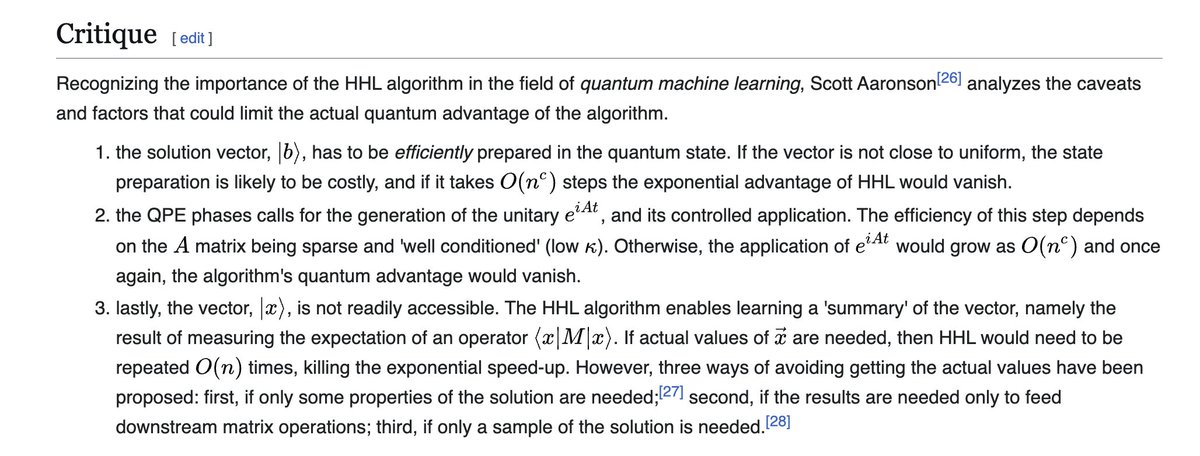
Well kind of, you get the answer as a quantum state, to get it out into classical information you need to measure that state. The measurement collapses the state. So you need to repeat the computation and measure again. That slows things down and negates the speedup. So you unfortunately cannot just use a QPU to simply speed up linear algebra. The quantum speedups are very subtle especially when classical information is involved.
English

0
0
1
16
David
David@burgundonfero·
@steve_quantum @JKeynesIonQ @_Freeder_ So you mean that the actual bottleneck is in the physical action of measure the qubits, and not on the physical way of transferring the data? That is interesting. Regarding the second part, someone asked a question about it, but it went way too technical.
English
1
0
0
30
stefan
stefan@steve_quantum·
What I am talking about is: you have a quantum algorithm that does the matrix-matrix multiplication. You now need to measure that to get it back to the classical world, the number of measurements that are required is such that it negates any speedup. This is not about how fast you transfer between QPU and CPU or GPU, this is about basic physics of measuring a quantum state. The same is with getting the classical matrix onto the QPU, that operation also requires more operations than just doing it on a GPU. This is also not about any faster hardware or whatever.
English
2
0
2
118
stefan
stefan@steve_quantum·
It is unrelated, they are talking about decoding for error correction, yes you need fast data transfer there. We are talking about using QPUs to accelerate LLMs. Data loading and readout of a QPU for linear algebra is not related to this at all, like zero connection. It's not even about speed, it's about the computational complexity of the algorithms that exist for putting classical data into a quantum state and reading that out after the quantum linear algebra algorithm was applied.
English
1
0
0
43
David
David@burgundonfero·
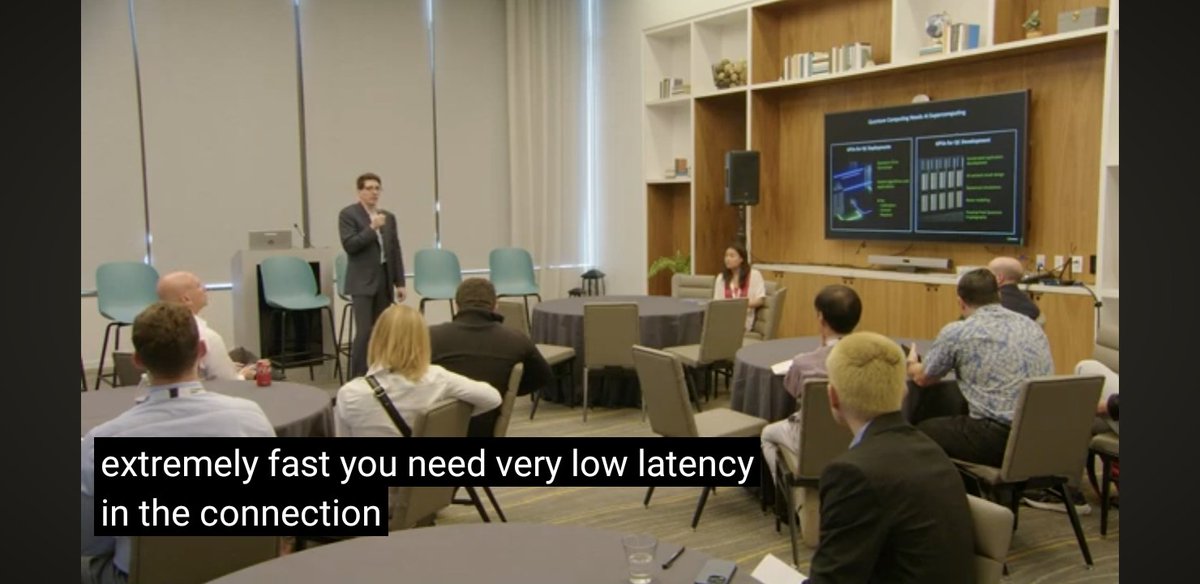
@steve_quantum @JKeynesIonQ @_Freeder_ Not unrelated. Forget the AI part. I'm focusing on the hardware they are developing to reduce latency in the connection GPU/QPU. Reducing latency orders of magnitude and allowing huge data transfer is key to handle the information.
David tweet media
English
1
0
0
54
stefan
stefan@steve_quantum·
what you linked is about error correction. speeding up LLMs requires speeding up the attention mechanism. so you need to do matrix matrix multiplication fast on a QPU. Any algo that does that already assumes working error correction (the research you linked). But the data input and readout problem still remains.
English
1
0
0
82
stefan
stefan@steve_quantum·
@JKeynesIonQ @_Freeder_ if the data was already fully quantum or we had QRAM and you would only need the final output in quantum form, I agree QPUs could help but that is not the case
English
1
0
0
97
stefan
stefan@steve_quantum·
yeah I think he is pumping the stock, which is great since I may or may not have shares 😂 but on a more serious note, the bottleneck of LLMs is the attention mechanism, so a matrix-matrix multiplication. QPUs cannot help with that since data loading and readout negates any algo speedup
English
1
0
0
154
Haimeng Zhao
Haimeng Zhao@haimengzhao·
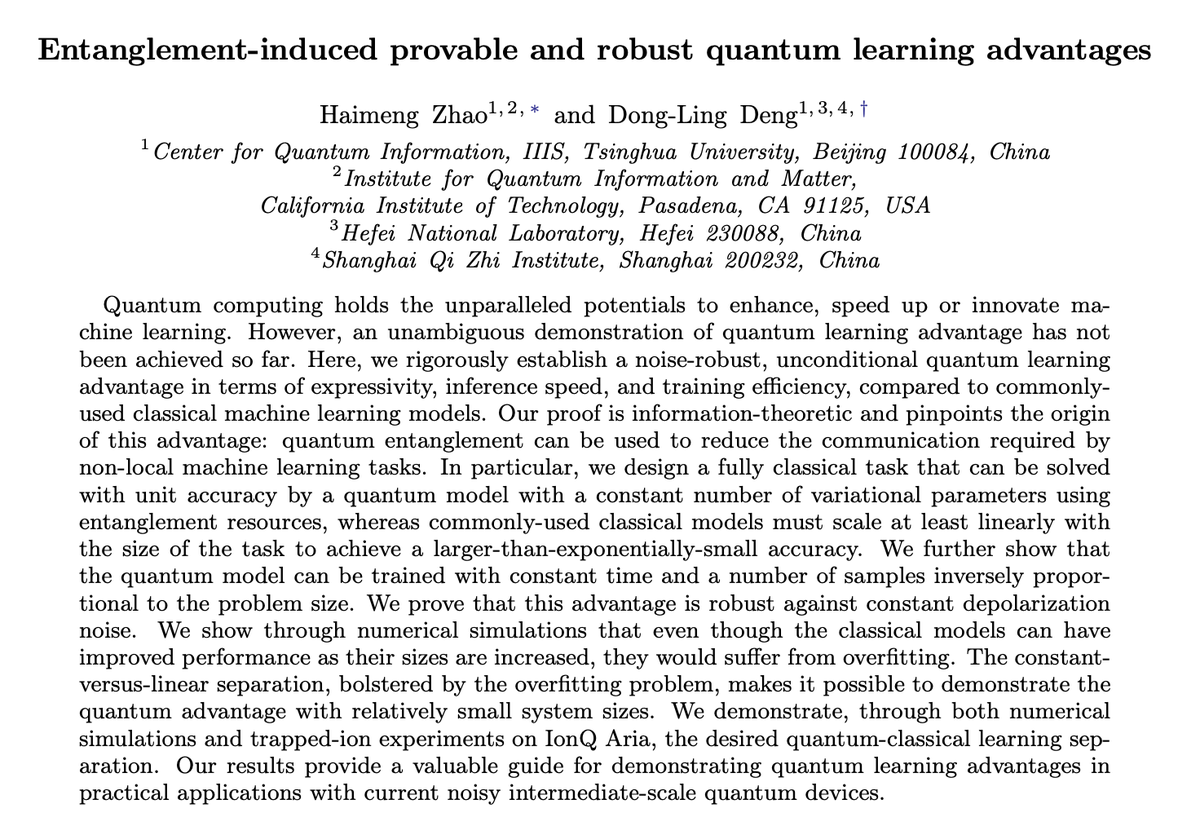
@steve_quantum Yes! The quantum circuit can be simulated in O(n^3) time classically. This is compatible with the quantum O(1) versus classical \Omega(n) advantage we prove. The exp separation here is in terms of accuracy when the classical model has param size below o(n) or face overfitting.
English
1
0
2
111
Haimeng Zhao
Haimeng Zhao@haimengzhao·
Ever questioned yourself whether quantum advantage in classical machine learning tasks is even possible? In this new paper, we give affirmative evidence to this question! We provide both theoretical proofs and empirical demonstrations on trapped ions! scirate.com/arxiv/2410.030…
Haimeng Zhao tweet media
English
7
18
88
18.8K
stefan
stefan@steve_quantum·
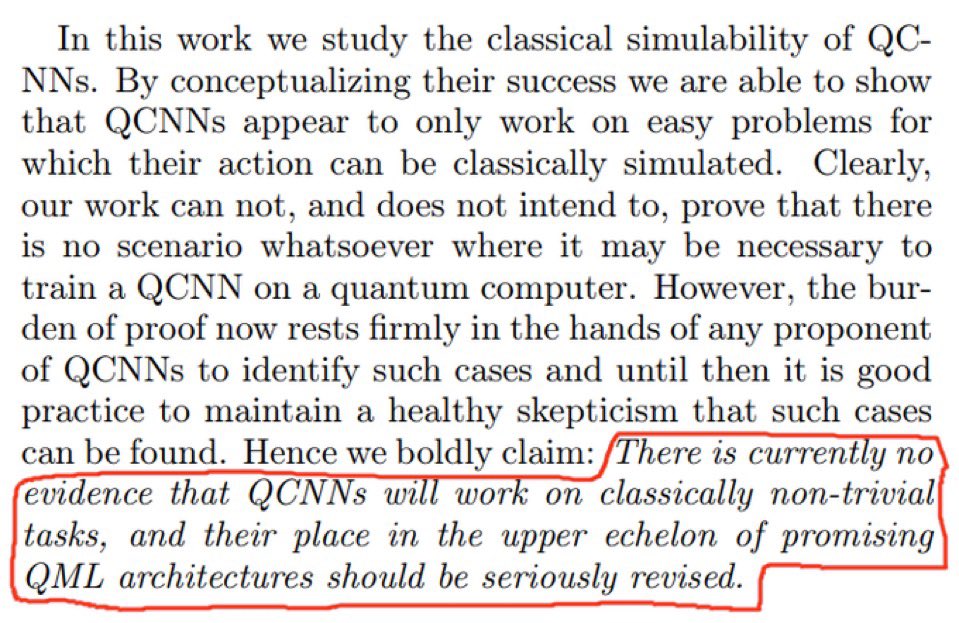
@Hamptonism that's not new - QCNNs are basically MERA tensor networks. MERAs cannot represent volume law entanglement entropy scaling, so they are classically simulatable by construction.
English
1
0
3
241
ₕₐₘₚₜₒₙ
ₕₐₘₚₜₒₙ@hamptonism·
Quantum Convolutional Neural Networks are (Effectively) Classically Simulable
ₕₐₘₚₜₒₙ tweet media
English
5
2
18
10.7K
stefan
stefan@steve_quantum·
Free market vs. degrowth, bureaucracy, and regulation Europe is still well off due to centuries of free market and competition, however, the current economic trajectory will undo that. When will Europe wake up and start addressing the obvious elephant in the room?
Holger Zschaepitz@Schuldensuehner

#Nvidia is now worth more than the entire stock market in #France or the #UK.

English
0
0
5
699
stefan
stefan@steve_quantum·
@JKeynesIonQ @RealTimShady42 Idk, AQ is their own metric so I have no feeling for it. What’s the expected log(quantum volume)? Two qubit fidelity? Do you perhaps have source?
English
0
0
0
115