Steven-Shine Chen

84 posts

Steven-Shine Chen

Steven-Shine Chen

@stevenshinechen

CS Master's Student at @MIT, previously @imperialcollege Researching multimodal reasoning at the MIT @medialab

Katılım Aralık 2012
351 Takip Edilen399 Takipçiler
Sabitlenmiş Tweet
Steven-Shine Chen
Steven-Shine Chen@stevenshinechen·
Current AI tutors are text-based, but humans rely on diagrams to reason through visual problems such as geometry 🚨Introducing Interactive Sketchpad, an AI tutor that combines hints with visualizations to help students solve problems Paper & Code: stevenshinechen.github.io/interactiveske… 🧵1/6
Steven-Shine Chen tweet media
English
1
19
46
5.6K
Steven-Shine Chen retweetledi
Chanakya Ekbote
Chanakya Ekbote@thecekbote·
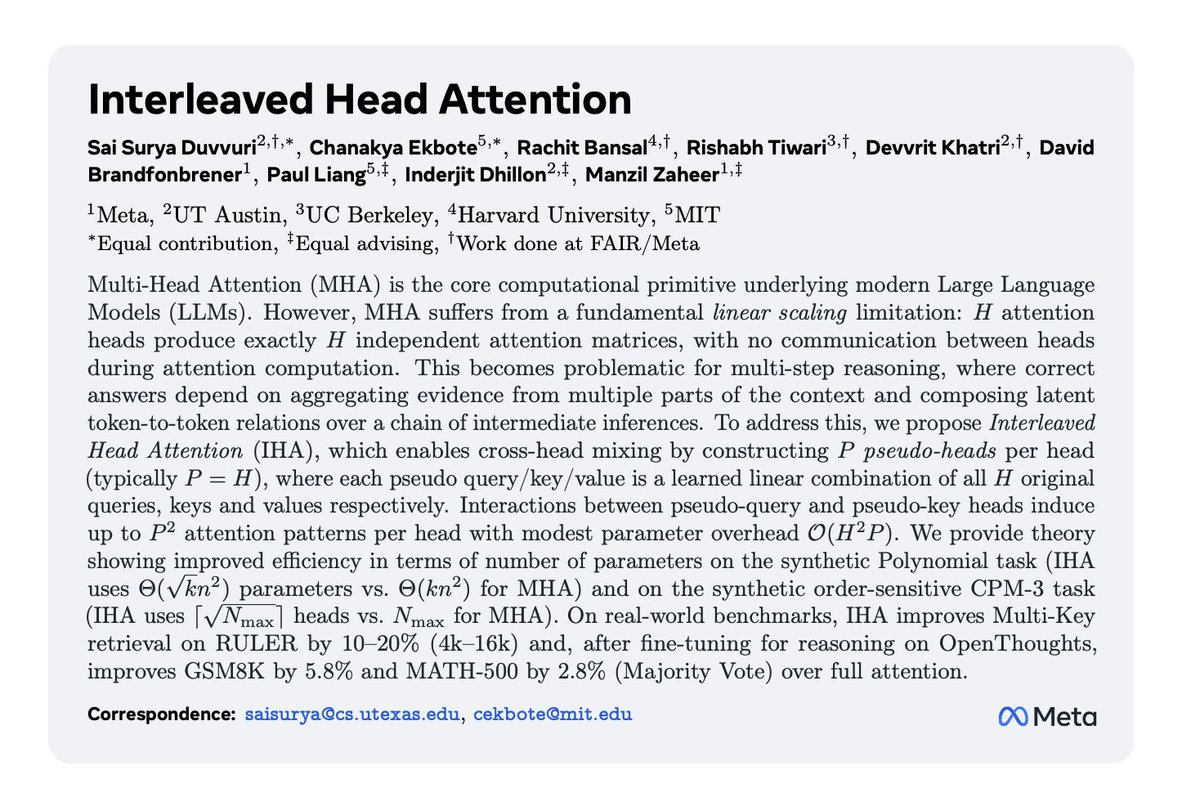
🧵 [1/14]: Talking-Heads Attention by @NoamShazeer et al. showed something interesting: maybe attention heads shouldn’t be fully isolated. 🧠 That got us thinking: If communication across heads matters, what is the right way for heads to communicate, especially from a one-layer reasoning perspective? 🔗⚙️ That question led us to Interleaved Head Attention (IHA) ✨ 📄 Paper link: arxiv.org/pdf/2602.21371
Chanakya Ekbote tweet media
English
15
96
691
202.3K
Steven-Shine Chen
Steven-Shine Chen@stevenshinechen·
@GregKamradt Partial observability, imperfect information and multi-agent systems. e.g. if you take other agents as part of the env dynamics and their policy updates in a way that you can only partially observe then it is a non stationary problem + also issues of multi-agent credit assignment
English
0
1
2
21
Greg Kamradt
Greg Kamradt@GregKamradt·
@stevenshinechen What axis of non-stationary influence are you referring to. I know you mean more than proc gen and randomness
English
1
0
0
110
Steven-Shine Chen retweetledi
Kimi.ai
Kimi.ai@Kimi_Moonshot·
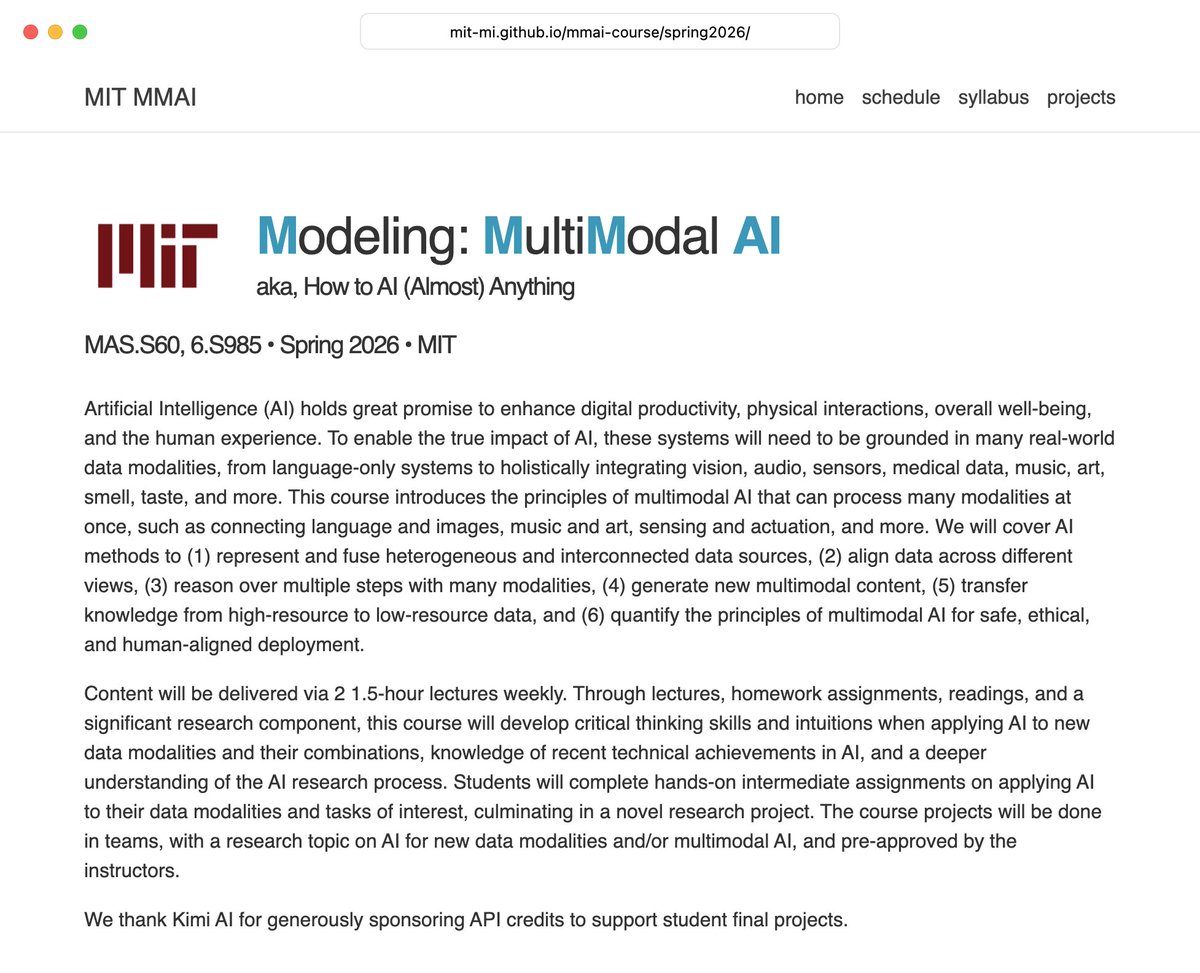
Supporting @MITEECS and @nlp_mit’s Multimodal Machine Learning course (Spring 2026). 🎓 Students are leveraging the multimodal capabilities of Kimi K2.5 to power their final research projects. We look forward to seeing the innovative applications that will emerge this semester. 🔗 mit-mi.github.io/mmai-course/sp… Happy coding! ✨
Kimi.ai tweet media
English
21
65
720
51.9K
Steven-Shine Chen
Steven-Shine Chen@stevenshinechen·
@GregKamradt @arcprize @LiaoIsaac91893 @_albertgu Don’t know of other competitions that do this, but one way could be disallowing weights to be uploaded for the competition so that you provide training script in your submission and the weights are randomly initialised. Then manually inspect winners to check
English
1
0
1
26
Steven-Shine Chen
Steven-Shine Chen@stevenshinechen·
@GregKamradt @arcprize e.g. would like to see methods like CompressARC from @LiaoIsaac91893 and @_albertgu compete separately. And for ARC 3 we could see approaches that generate many synthetic games and train on these offline - would like to see differences between this and pure online learning
English
1
0
0
61
Steven-Shine Chen
Steven-Shine Chen@stevenshinechen·
@GregKamradt @arcprize Perhaps a track without pre-training? A lot of advances are from using a lot of compute pre-evaluation and baking this into weights/data. So even though at eval time you have limited compute/data, there is no limit before eval starts, so this is used to reduce inference costs.
English
1
0
1
46
Steven-Shine Chen
Steven-Shine Chen@stevenshinechen·
@yacinelearning I agree, one thing I've been thinking about - what happened to the AlphaZero, MuZero style research? DeepMind seems to have pivoted to LLMs/VLAs even though I feel there's still a lot of untapped potential in exploring non language based game agents
English
0
0
0
11
Yacine Mahdid
Yacine Mahdid@yacinelearning·
one thing I've come to realize is that hype around a specific research area can literally kill multiple others indirectly all the funding talents discussion just goes into that one hyped-up research areas and everything else withers not sure how I feel about it
English
7
2
40
2.9K
Steven-Shine Chen
Steven-Shine Chen@stevenshinechen·
Pre-training is dead. We can't keep scaling pre-training data or even RL envs - they are all curated by humans AI needs to take actions which maximise their own learning. Like humans, they need to be curious, take actions not to maximise reward, but improve their own world model.
Dwarkesh Patel@dwarkesh_sp

The @ilyasut episode 0:00:00 – Explaining model jaggedness 0:09:39 - Emotions and value functions 0:18:49 – What are we scaling? 0:25:13 – Why humans generalize better than models 0:35:45 – Straight-shotting superintelligence 0:46:47 – SSI’s model will learn from deployment 0:55:07 – Alignment 1:18:13 – “We are squarely an age of research company” 1:29:23 – Self-play and multi-agent 1:32:42 – Research taste Look up Dwarkesh Podcast on YouTube, Apple Podcasts, or Spotify. Enjoy!

English
0
0
0
85
Steven-Shine Chen retweetledi
Chanakya Ekbote
Chanakya Ekbote@thecekbote·
How do we teach LLMs not just to reason, but to reflect, debug, and improve themselves? We at AWS AI Labs introduce MURPHY 🤖, a multi-turn RL framework that brings self-correction into #RLVR (#GRPO). 🧵👇 Link: arxiv.org/abs/2511.07833
English
2
21
33
5.7K
Antoine Cully
Antoine Cully@CULLYAntoine·
Almost exactly 10 years after joining @imperialcollege as a Postdoc, I am honoured to announce that I am now Professor in Machine Learning and Robotics! 👨‍🎓 🤖 My fantastic team found the best gift to celebrate this special occasion!
Antoine Cully tweet media
English
32
6
239
11.5K
Steven-Shine Chen retweetledi
Megan Tjandrasuwita
Megan Tjandrasuwita@mmtjandrasuwita·
Most problems have clear-cut instructions: solve for x, find the next number, choose the right answer. Puzzlehunts don’t. They demand creativity and lateral thinking. We introduce PuzzleWorld: a new benchmark of puzzlehunt problems challenging models to think creatively.
English
3
9
32
23.3K
dvd@dvd.chat
[email protected]@ddvd233·
Claude Research 一下找了 313 个 source...现在是不是比较流行比谁的 source 比较多(
dvd@dvd.chat tweet media
中文
14
0
31
17.4K
Steven-Shine Chen retweetledi
Paul Liang
Paul Liang@pliang279·
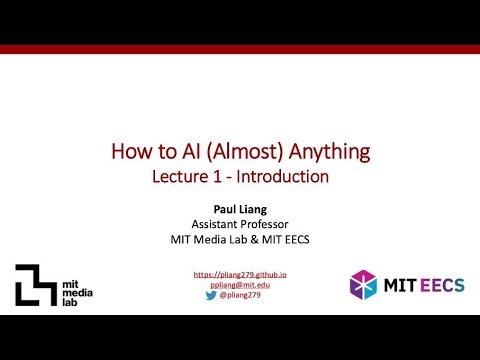
A bit late, but finally got around to posting the recorded and edited lecture videos for the **How to AI (Almost) Anything** course I taught at MIT in spring 2025. Youtube playlist: youtube.com/watch?v=0MYt0u… Course website and materials: mit-mi.github.io/how2ai-course/… Today's AI can be applied to almost anything - from language to vision, audio, sensors, medical data, music, art, smell, and taste. This course covers the principles of AI (focusing on deep learning and foundation models), how we can apply AI to novel real-world data modalities, and multimodal AI that can process many modalities at once, such as connecting language and multimedia, music and art, sensing and actuation, and more.
YouTube video
YouTube
Paul Liang tweet media
English
15
235
1.3K
105.5K