
Steven Zuber
20.7K posts


Steven Zuber
@stevenxzuber
Content is go-to-market. Turn thinking into distribution. Marketing @BioProtocol
Katılım Kasım 2012
1.2K Takip Edilen15.7K Takipçiler
Solo creators are outperforming entire corporate content teams right now and most companies are pretending it isn't happening.
A founder with a phone and a perspective is generating more pipeline from one post than a brand generates from a full campaign.
And this isn't a phase.
It's what happens when platforms stop rewarding who you know and start rewarding how interesting you are.
The algorithm does not care about your media plan. It does not care about your brand guidelines. It cares whether people stop scrolling when they see your content.
That's it.
And individuals are winning that game because they can actually say something real without routing it through three rounds of committee feedback that kills everything sharp about it.
I've watched this play out for 12 years. The companies that produce the safest, most internally approved content are the ones getting the worst results. Because content that's designed to not offend anyone internally doesn't move anyone externally. You can't have it both ways.
The other part nobody wants to say out loud: people trust people more than they trust logos. They always have. It just didn't matter before because brands could buy their way in front of you through paid media.
Now reach is earned and audiences choose humans over brands every single time.
This is why the smartest companies are turning their founders into the content engine instead of trying to make a brand page work. The brand page is a logo talking to strangers. The founder is a person talking to people.
One of those compounds. The other burns budget.
If you're running marketing at a company and your founder isn't posting, that's probably the most expensive mistake you're making right now.
English
The brands that will dominate their categories in 2026 are the ones that finally accepted a brutal truth about content.
The truth most marketing teams are still actively avoiding because facing it would mean admitting that the entire way they've structured their content operations is wrong.
Here's the truth.
Reach used to be something you bought. Now it's something you earn. And the entire infrastructure of modern marketing was designed for the world where reach was for sale, which is why so much brand content is collapsing in performance even though the budgets keep growing.
Think about how marketing departments are still organized. There's a media buying team. There's a creative team. There's a content team that mostly produces assets to support paid distribution.
The entire org chart assumes that the way you reach people is by paying platforms to put you in front of them. Content exists to fill the slots that media has bought. Brand exists to make sure the content looks consistent. The whole structure is downstream of one assumption that no longer holds.
That assumption is dead.
Platforms are aggressively shifting toward interest-based distribution which means reach is now determined by content quality rather than budget size. A bootstrapped founder writing one good post can outperform a Fortune 500 brand spending six figures on a campaign in the same week.
And yes, this is happening every single day on every major platform and most marketing teams are pretending it isn't.
The reason they're pretending is because the alternative is terrifying. If reach is earned through quality and emotional response rather than bought through media spend, then the entire skill set that built modern marketing departments is suddenly less valuable. Media buyers, agency relationships, ad ops infrastructure, optimization specialists, all of it was built for a different game.
The new game requires a completely different set of skills. Specificity. Editorial judgment. The ability to write to one human at a time. The discipline to publish daily and consistently. The taste to know what's worth saying in the first place.
These are not skills most marketing departments hire for. They're not skills that get measured in QBRs. They're the kind of skills that look soft and unmeasurable until you watch a single piece of content generate more pipeline than a quarter of paid campaigns. Which is happening, every day, at the brands that have figured this out.
Here's what the new game actually looks like in practice.
The brand picks one specific human in their category. Not an audience. One real person with a real problem in a real moment. They write to that person directly, with all the specifics intact, no committee softening, no corporate caveats. They publish that post and then they show up in the comments of other relevant posts in the space, adding real perspective, building reputation through engagement rather than through interruption.
They do this every single day. The content compounds. The audience compounds. The pipeline compounds.
What they don't do is produce another quarterly content calendar full of vague thought leadership aimed at "decision makers in our target verticals." That document is the artifact of a dying playbook and every hour spent producing it is an hour that could have been spent writing something a real person would actually want to read.
The shift required here is not a tactic. It's a worldview. You either treat content as the primary mechanism through which your brand acquires trust and grows, or you treat it as a supporting line item that decorates your real marketing strategy. Those two beliefs lead to completely different organizations, different team structures, different metrics, and different outcomes.
The brands that get this right in 2026 will spend the rest of the decade in a category of their own. The ones that don't will keep increasing their ad budgets, keep wondering why their CAC keeps climbing, and keep blaming the algorithm for problems that have nothing to do with the algorithm.
The old game is reach as something you buy. The new game is reach as something you earn. Both still exist. Only one has a future.
If you're running content or marketing at a brand right now, the only question worth answering this quarter is which game your team is actually playing. Open your last 30 days of output and look at it honestly. If most of it was built to support paid campaigns, written for "an audience," approved by committee, and aimed at maximizing impressions, you're playing the old game.
And the cost of staying in that game is going to compound just as fast as the rewards of leaving it.
English
@anvisha You are doing exactly that would every good startup should do. Talk to the users 1:1. No AI can ever do that for you
English

imo if you aren’t a techy and just want shit to work, there is no reason to download openclaw and just wait for anthropic to build the things on a daily basis. From a purely consumer but also “semi-tech” perspective, it is the best what is out there and they are doing literally everything right right now.
English

The genius thing that Anthropic does is infiltrate the work as you already do it.
They remove friction and add velocity to the tools you already use daily.
People don't want to learn how to use ai.
They want ai to do the things they already do faster.
This is how mass adoption occurs.
Most people don't want to learn a new thing.
But that's also good news for those of us running agents like Hermes and openclaw on local models.
Claude@claudeai
Claude for Word is now in beta. Draft, edit, and revise documents directly from the sidebar. Claude preserves your formatting, and edits appear as tracked changes. Available on Team and Enterprise plans.
English
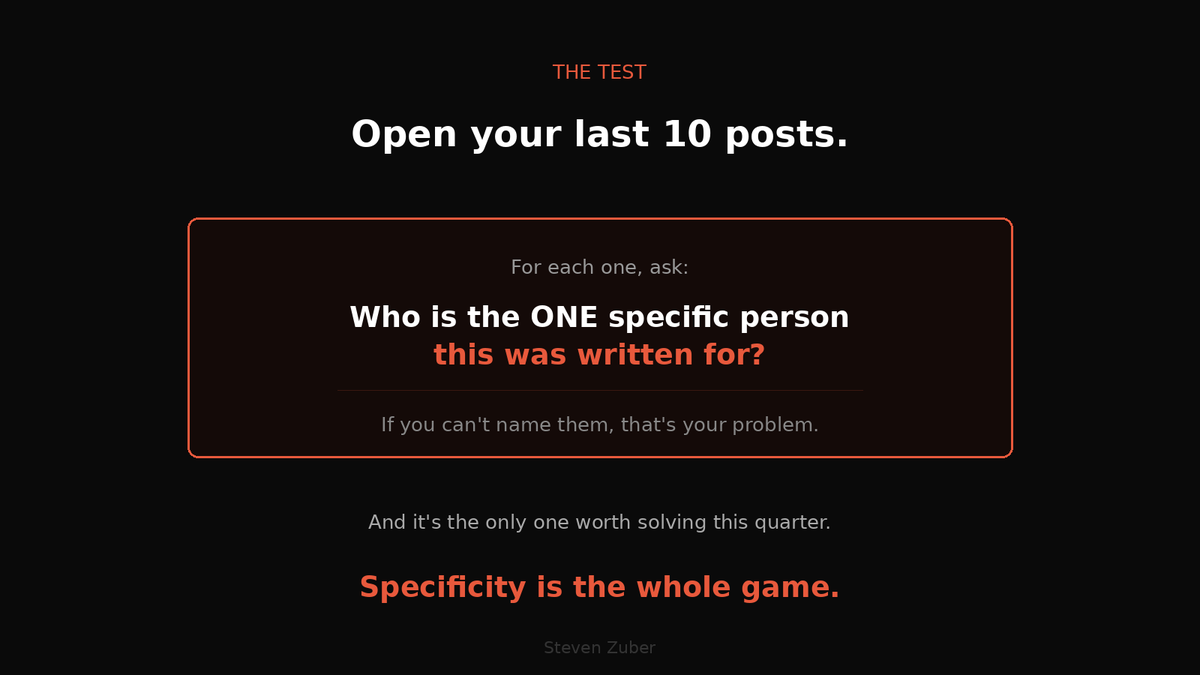
14/ If you're running content at a brand right now, the test is simple.
Open your last ten posts. For each one, ask: who is the one specific person this was written for?
If you can't name them, that's your problem. And it's the only problem worth solving this quarter.
English
13/ The brands that figure this out in 2026 are going to look back in two years and realize this single shift was the most valuable thing they did all year.
The ones that don't will still be paying agencies to produce content nobody reads, wondering why their "brand awareness" numbers never translate into pipeline.
English
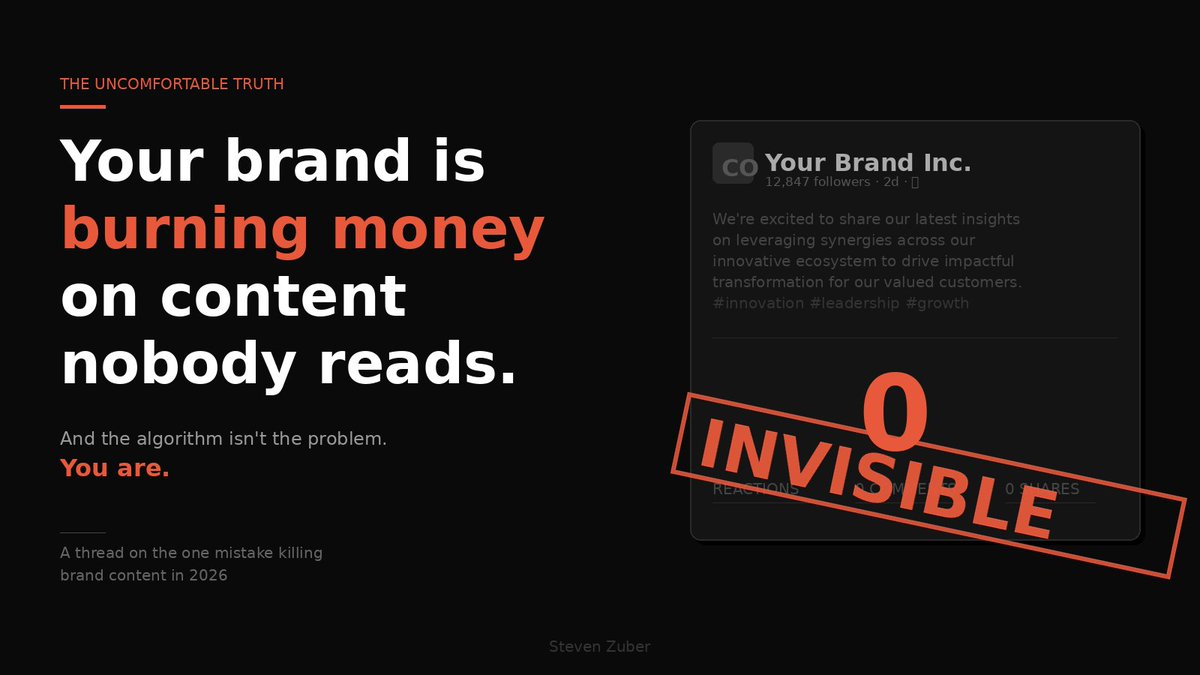
1/ Most brand content in 2026 is invisible and the marketing teams running it don't even know why.
I've spent 12 years watching this happen and the mistake is almost always the same one.
Let me show you how the brands winning right now are doing the opposite.
English
The ones hiring content creators at scale, AI and not AI, are gonna be the real winners in the next decade.
Building is not an edge anymore.
Distribution is.
English