

steve rogers
1.8K posts

PM Carney responds to Canadians facing nearly $2 per litre at the gas pumps bnnbloomberg.ca/business/econo…
English
@ArmstrongEcon So mellows out soon before picking up again in july?
English

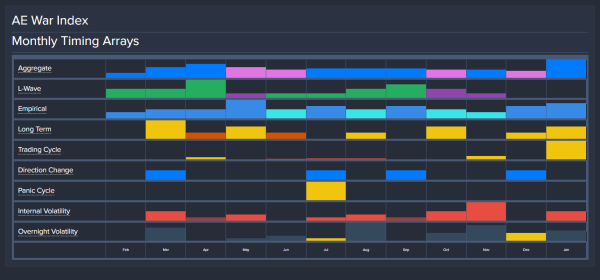
Our War Model projected this would start in February with a Directional Change in March escalating into April with a Panic Cycle in July.
English
steve rogers retweetledi

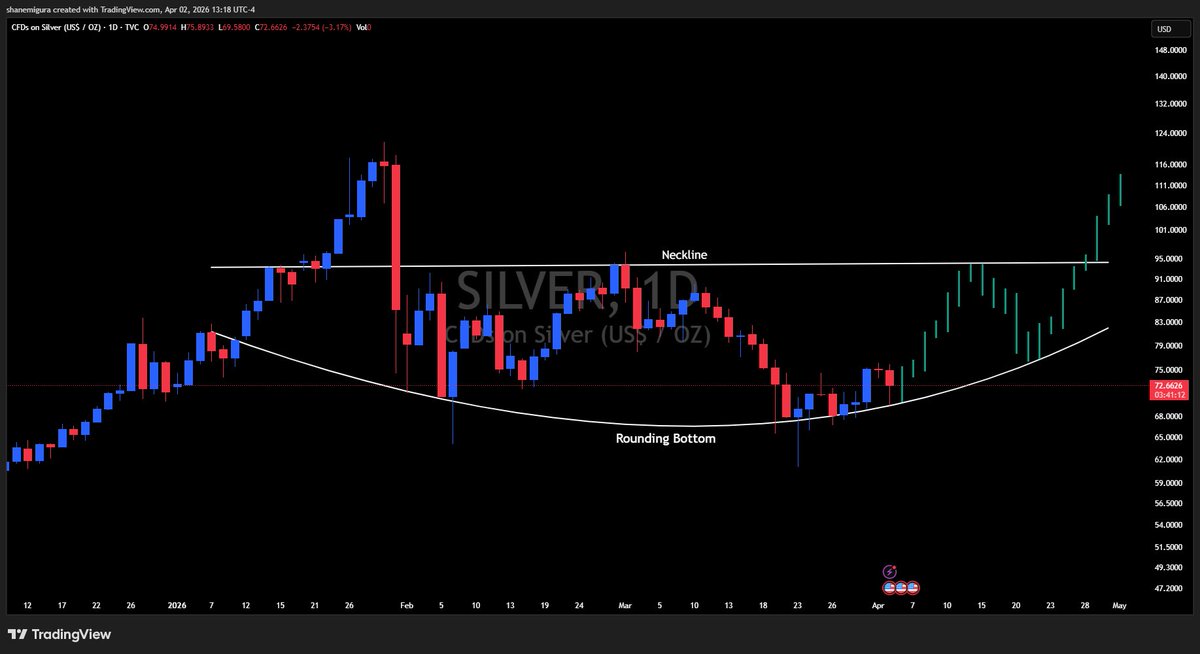
Silver’s drop today confirmed my thoughts on a rounding bottom even more. Would rather see the neckline break on this next touch, if not I see April playing out similar to this.
English
@raagaarddenmark @graddhytrading As we rotate from the season of tech into the season of commodities, mag7 is not the ideal hiding spot
English

@graddhytrading I know its not your thing G, but could you perhaps show analysis of Mag7 in respect of and if SPX moves to around 55-5200? Where they most likely would go to.
English
@KingKong9888 @maneco1964 Grok says not true. Please try to verify info before posting.
English

How 'buy Canadian' boosting cottage boom bnnbloomberg.ca/video/shows/mo…
English
@unusual_whales No, your job is policy. So make rules that allow everyone else to be like musk, do not punish him for doing a good job
English

Bernie Sanders: “60% of our people living paycheck-to-paycheck, and one guy, Elon Musk, owns more wealth than the bottom 53% of American households... Think maybe that might be an issue that we should be talking about?"
English

Rare sighting! A Lesser Canada Goose has appeared in the Tiaozini Wetland of Dongtai, Yancheng — marking the first recorded observation of this species in Jiangsu Province!
English

BREAKING: Iraq declared force majeure on all oilfields developed by foreign companies as the region's military operations disrupted navigation through the Strait of Hormuz, preventing most of its crude exports from moving, oil ministry sources said reut.rs/47fPs8x
GIF
English
@anasalhajji Yeah maybe if Iran stopped lobbing bombs the straights could be owned
English
🔴President Trump talking about Hormuz Strait:
“We don’t even need to be there, in that the U.S. has just become the largest producer of energy anywhere in the world.”
He also questioned the role of the U.S. in the region: The U.S., he said, is “protecting the shipping lanes for other countries” for “zero compensation.”
Anas Alhajji@anasalhajji
🔥🔥🔥🔥 A must read: President Trump reverts to old thinking and statements from his first presidency in 2019, downplaying the significance of oil in the Middle East and talks about shipping in Hormuz Strait. You can evaluate what I wrote in this column in World Oil Magazine in July 2019 in light of current events and Trump's statement below: Link: worldoil.com/magazine/2019/… Trump is wrong on the declining significance of the Strait of Hormuz. Speaking about the Strait of Hormuz and the Persian Gulf, President Trump asserted recently that “We don’t even need to be there, in that the U.S. has just become the largest producer of energy anywhere in the world.” He also questioned the role of the U.S. in the region: The U.S., he said, is “protecting the shipping lanes for other countries” for “zero compensation.” Here is why he is wrong: 🔴Throughout history, superpowers have always tried to control trade routes and secure them. Protecting waterways is well-entrenched in U.S. foreign and defense policies. 🔴U.S. control of the flow of Middle Eastern oil means its control of Europe, Japan and China. Russia will be more than happy to take over such a position. 🔴Being the largest oil producer in the world does not shield the U.S. from a price shock resulting from instability in the Middle East in general, and from the vacuum caused by the absence of the U.S. from the region. 🔴The U.S. needs Middle Eastern oil because of crude quality issues: All the increase in U.S. shale production is light crude, super-light, and condensates, while several U.S. refineries need the heavier, more sour crudes. From a policymaking point of view, crude quality matters, probably more than quantity at this stage, especially after the loss of the Venezuelan heavy crude because of U.S. sanctions on that country. 🔴The cost of protecting the Strait of Hormuz should be compared to the potential losses, if the U.S. were to withdraw from the region, not to the current benefits. That is how U.S. military leaders viewed the role of the U.S. in the Middle East, in recent decades. 🔴Those countries in the Gulf region can crash the oil market for a long period and reduce U.S. oil production by more than 3 MMbpd, making the U.S. more dependent on the Middle East again. I will conclude with this statement: Who will be happy to see the U.S. either withdrawing from the Gulf region or reducing its presence? Here is a list: Iran, ISIS, AL Qaeda, Russia and China. I rest my case!
English

TRUMP DID THIS.
I heard 2 Canadians next to me complaining about how Trump is making Canada unaffordable.
Trump is screwing the world.

English

Probably nothing.
Altcoin Daily@AltcoinDaily
🇺🇸 BREAKING - SEC Chair announces new crypto rules:
English
@zerohedge They do enforcement?
English


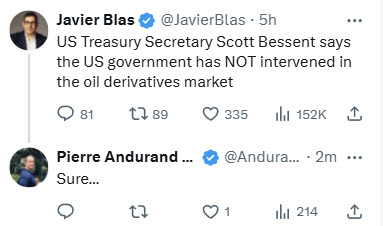
@investingLive_ Bessent didnt lie, TREASURY WAS NOT IN THE MARKET. of course not, they got a bank to do it for them LOL
English

One of the greatest oil traders of all time thinks the Treasury was in the market
English

VON DER LEYEN: WE NEED TO BE PREPARED TO PROJECT OUR ATTACHED PLASTICS POWER MORE ASSERTIVELY
English
@JimboStanford @TorontoStar Will you give it back to them in the years they run at a loss? Only fair, no? Also did u risk ur own capital to start their business?
English
As you fill up with gas that's now up 20c/litre in a week, remember who profits. Cdn oil companies made $150b after-tax profit after the last oil spike (2022). An excess profit tax redistributed to consumers would ease the pain. My take in @TorontoStar: thestar.com/business/opini…
English

BREAKING: The U.S. has begun deploying paratroopers and army to the Middle East.
The deployment will take 3 weeks, with initial airdrop around 100,000 troops into the heart of Iran.
Financelot@FinanceLancelot
Are we about to see the largest coalition airdrop in world history into the heart of Iran? You don't need to cross the Zagros mountains, you airdrop into the Kavir Desert & move on Tehran. If I'm right the speed of deployment will shock the🌎 All that's needed is a false flag.
English

@4TaxFairness Yes, that how it works.....you are allowed to deduct business expenses on your tax return.......did you not know this? Kinda the base of all business in the world.
English

All those AI and sports gambling ads at the Super Bowl?
You helped pay for them.
Yep. Our tax code lets corporations write the full cost of their ads off on their taxes.
Yet another loophole created to steal from public revenue and benefit billionaires and rich shareholders.
English