Alan Li

23 posts

Alan Li

Alan Li

@succinct_li

Web3, AI & Science

Katılım Temmuz 2015
171 Takip Edilen82 Takipçiler
Alan Li
Alan Li@succinct_li·
AI can already write code. But fast code isn't one-shot. AutoEng automates the refinement loop: an agent that improves code step by step, keeping only what measurement proves faster. ~11% on our SOTA zkVM, by itself. Step-by-step, not one-shot — that's what's next. 👇
Brevis@brevis_zk

Today we're introducing AutoEng: an AI agent that runs the entire performance-engineering loop on its own. Find the bottleneck, write the fix, prove it's correct, prove it's faster, keep only what wins. We pointed it at Pico, our zkVM, and with no human in the loop it found a ~11% speedup. 🧵

English
0
1
6
1.2K
Barna
Barna@realbarnakiss·
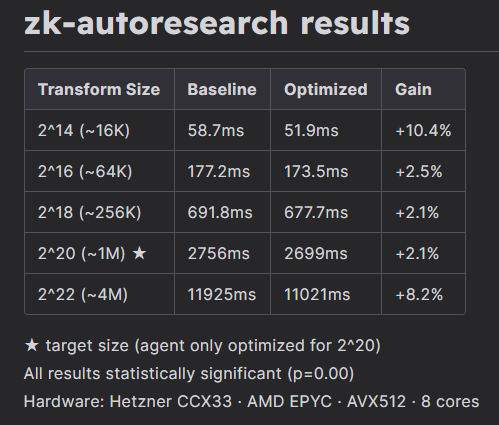
I implemented zk-autoresearch, based on Karpathy's autoresearch loop, on a production ZK prover, Plonky3. Soundness review by a Plonky3 engineer is pending before I treat these as final. The methodology finding is already clear, preliminary results below. Target: Plonky3's NTT implementation — the inner loop of proof generation, already heavily optimized by expert ZK engineers. If the approach doesn't work here, it doesn't work anywhere. Hardware: Hetzner CCX33, AMD EPYC, AVX512, 8 cores. Model: I used Claude Sonnet 4.6 deliberately, Opus would have marginal gains at significantly higher cost per iteration. For a loop running potentially 100s of times in future experiments, that tradeoff matters. 74 iterations. Fully autonomous by design, but in this first experiment 2 adjustments were made to the setup (at iterations 5 & 10) to nudge the agents to be more decisive. - Raised MAX_TOKENS from 8192 to 20000, and added "you must always make a change" as the agent kept hitting the token limit. This unlocked improvements at iterations 6 and 9. - Added near-miss display in the history prompt, showing reverted experiments within 1.5% as combination candidates. This set up iteration 21, where the agent revisited a failed idea that now worked because the surrounding code changed. Iteration constraints: - Each iteration ran correctness tests to prevent faulty proofs. Note: during the run these were compile-level checks; post-run correctness was confirmed via full end-to-end ZK proof generation and verification with Radix2DitParallel on BabyBear (10 tests, all passing). - Agents were structurally prevented from touching FRI or other soundness-critical components — only dft/src/ and baby-bear/src/ were writable. 3% faster at the target size (2^20) during the experiment. Post-experiment benchmarks across 2^14 to 2^22 showed the optimizations generalized better than expected, particularly at the extremes (see image). The agent only optimized for 2^20. The known issues (short history window causing agent amnesia, wasted tokens on repo exploration, correctness test targeting wrong package) meant the last improvement was found at iteration 21. Round 2 with these fixed should yield a more consistent staircase pattern over 100 iterations. All gains came from the agent finding redundant work in the hot butterfly loop: precomputing products, hoisting broadcasts, skipping multiplications by 1. Pure implementation-level work, no algorithmic changes. 6 improvements in 74 iterations. 57 regressions. The full experiment log with every diff, benchmark result, and agent reasoning is auditable. The agent that found these improvements is not a ZK expert. It reasoned about Rust and Montgomery arithmetic from first principles and found real optimizations in code already written by expert engineers. ZK has been underexplored for agentic optimization because people worry about agents breaking proof soundness. The concern is real but misapplied here, all 6 changes are mathematically equivalent transformations, verified by end-to-end proof generation and verification. (Soundness review by a Plonky3 engineer is pending) Round 2 is being prepared with the known issues from Round 1 fixed. Full findings and code will be open sourced after it completes. If you are ZK team and want to run this, feel free to DM me. Inspired by @karpathy autoresearch pattern. First known application to a production ZK prover.
Barna tweet media
English
10
19
190
17.9K
Alan Li
Alan Li@succinct_li·
Separating what is executed, how it is proven, and what security is assumed will enable fair benchmarking and comparability over time. Very excited to spend 2026 shipping real, production-grade zkVM capabilities from Pico that fit squarely into this emerging L1 zkEVM stack.
English
1
0
0
149
Alan Li
Alan Li@succinct_li·
Encouraging to see the coming standardization of: (1) reproducible guest programs, (2) a unified zkVM–guest API, and (3) well-defined security bounds for the proving system. ethereum-magicians.org/t/l1-zkevm-roa…
English
4
0
2
164
Alan Li
Alan Li@succinct_li·
7825 turns ETH block proving into a throughput problem — not a single-tx latency problem. And Pico is built for this: parallel, scalable, and cluster-native. Fusaka raises gas. Pico keeps proofs real-time.
michael@no89thkey

EIP-7825 is one of the most underrated upgrades for the future of ZK proving and 100X Ethereum scaling. By capping each Ethereum transaction at ~16.78M gas, it removes the risk of a single “mega-transaction” consuming an entire block. That sounds small, but the implications for ZK systems are huge. ZKVMs generate proofs by replaying execution. Bigger single tx → bigger un-parallelizable unit of work → longer latency. Before 7825, one "ZK unfriendly" transaction could blow up the proof time because you cannot run parallel proving across multiple transactions. This easily breaks real-time proving which is needed for 100X Ethereum scaling. For any team working on fast ZKVMs, this was the nightmare scenario. 7825 fixes that. Now, every block is made of predictable, bounded work units, which makes proving schedulable and highly parallelizable. As long as we can prove a worst-case 16M gas tx fast enough (like <5s), we know we can prove basically any big blocks through parallel computing. In short: EIP-7825 made sure that Ethereum real-time proving becomes a pure money problem. As long as we can throw enough parallel computing power to the problem, we can get real-time Ethereum proving for even 100M, 200M gas blocks, TODAY. This upgrade may not look like the main event tonight, but it is actually a massive unlock for the ZK roadmap and the future of Ethereum scaling in 2026. Believe in somETHing.

English
2
0
6
618
Alan Li retweetledi
michael
michael@no89thkey·
EIP-7825 is one of the most underrated upgrades for the future of ZK proving and 100X Ethereum scaling. By capping each Ethereum transaction at ~16.78M gas, it removes the risk of a single “mega-transaction” consuming an entire block. That sounds small, but the implications for ZK systems are huge. ZKVMs generate proofs by replaying execution. Bigger single tx → bigger un-parallelizable unit of work → longer latency. Before 7825, one "ZK unfriendly" transaction could blow up the proof time because you cannot run parallel proving across multiple transactions. This easily breaks real-time proving which is needed for 100X Ethereum scaling. For any team working on fast ZKVMs, this was the nightmare scenario. 7825 fixes that. Now, every block is made of predictable, bounded work units, which makes proving schedulable and highly parallelizable. As long as we can prove a worst-case 16M gas tx fast enough (like <5s), we know we can prove basically any big blocks through parallel computing. In short: EIP-7825 made sure that Ethereum real-time proving becomes a pure money problem. As long as we can throw enough parallel computing power to the problem, we can get real-time Ethereum proving for even 100M, 200M gas blocks, TODAY. This upgrade may not look like the main event tonight, but it is actually a massive unlock for the ZK roadmap and the future of Ethereum scaling in 2026. Believe in somETHing.
Ethereum@ethereum

3/⛽ Scale L1: 60M gas limit #pumpthegas 🎉 The gas limit increased to 60M (up from 45M), increasing transaction throughput by ~33%: x.com/nero_eth/statu… ‼️ More gas = more transactions, higher transaction complexity or lower fees 🛡️ 60M is safe, thanks to benchmarking, ModExp repricing & optimizations: nethermind.io/blog/measuring… ⚙️ Clients set their default to 60M. Update validator config manually: pumpthegas.org 🆙 Block proposers can increase by 0.0976% each block (per EIP-1559): gaslimit.pics Fusaka features: * Set default gas limit to 60M (EIP-7935) * Set upper bounds for ModExp (EIP-7823) * ModExp gas cost increase (EIP-7883) * RLP execution block size limit (EIP-7934) * eth/69 - history expiry and simpler receipts (EIP-7642) * Transaction gas limit cap of ~16.8M gas (EIP-7825) Note: devs/users of VERY large transactions should check they fit within Fusaka ~16.8M gas cap: blog.ethereum.org/2025/10/21/fus…

English
78
82
593
374.8K
Alan Li retweetledi
Brevis
Brevis@brevis_zk·
🌕Missed THE DEMO from @drakefjustin at @eth_proofs Day? Here is a 40-second recap: Justin showed his zklighthouse client verifying the three fastest proofs, from Brevis Pico ZKVM and @ziskvm, then finalizing the block WITHOUT re-execute the block transactions. The era of Gigagas ETH has begun.
English
174
133
746
228.8K
Alan Li retweetledi
Brevis
Brevis@brevis_zk·
Today we're releasing the Brevis ProverNet whitepaper. The first decentralized marketplace for ZK proof generation, built from our experience after 250M+ production proofs across PancakeSwap, Uniswap, Euler, Linea, MetaMask, and so much more. Read the whitepaper here: brevis.network/whitepaper/pro… 🧵
English
1.6K
2.8K
17K
643K
Alan Li retweetledi
Ethereum
Ethereum@ethereum·
One big step towards Ethereum's future. ZK technology like Pico Prism will enable Ethereum to scale to meet global demand, while still remaining trustworthy and decentralized.
Brevis@brevis_zk

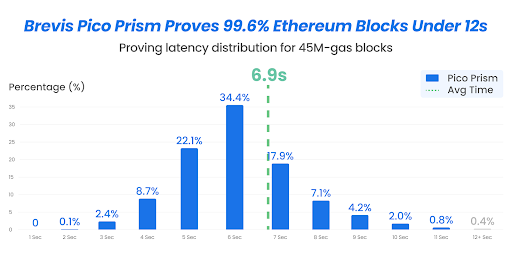
Announcing Pico Prism, the state-of-the-art zkVM for Ethereum real-time proving. 99.6% of blocks proven under 12 seconds, 6.9s average with 64 RTX 5090 GPUs. This marks a major step toward scaling Ethereum by 100x and a future where you can validate the chain from a phone.

English
270
402
2.3K
571.6K
Alan Li retweetledi
Alan Li retweetledi
Brevis
Brevis@brevis_zk·
Announcing Pico Prism, the state-of-the-art zkVM for Ethereum real-time proving. 99.6% of blocks proven under 12 seconds, 6.9s average with 64 RTX 5090 GPUs. This marks a major step toward scaling Ethereum by 100x and a future where you can validate the chain from a phone.
Brevis tweet media
English
15.9K
23K
123.3K
3.4M
Alan Li retweetledi
michael
michael@no89thkey·
🚀 Beyond proud of our team for delivering Pico GPU today. Not only did it achieve the fastest Reth proving time on a single GPU, it was also built in record time — all thanks to our modular architecture. Next stop: real-time ETH proving.
Brevis@brevis_zk

🖥️+🚀 Pico-GPU 1.0 is live! 🚄20× faster proofs than Pico CPU, 25 % faster than the closest contender on a single 4090 and already crunching full Ethereum blocks on @eth_proofs. Real-time ETH block proving coming soon! Dive into the details below 👇 blog.brevis.network/2025/06/27/ann…

English
1
1
13
885
Alan Li retweetledi
Brevis
Brevis@brevis_zk·
🖥️+🚀 Pico-GPU 1.0 is live! 🚄20× faster proofs than Pico CPU, 25 % faster than the closest contender on a single 4090 and already crunching full Ethereum blocks on @eth_proofs. Real-time ETH block proving coming soon! Dive into the details below 👇 blog.brevis.network/2025/06/27/ann…
English
2.8K
1.8K
1.9K
42.5K
Alan Li retweetledi
Brevis
Brevis@brevis_zk·
💰💡@usualmoney just flipped the Revenue Switch powered by Brevis! Stakers of $USUAL (aka $USUALx holders) can now claim their share of protocol revenue—fully on-chain, fully verifiable, powered by the Brevis zkCoprocessor 🧠⚡ blog.brevis.network/2025/04/07/usu…
English
6
11
90
46.4K
Alan Li retweetledi
Brevis
Brevis@brevis_zk·
🚀 Meet Pico! Write ZK proofs in pure Rust, no ZK knowledge needed. • Up to 32x performance boost for DeFi proofs • Modular architecture • Swappable proving backends • Custom proving workflows Watch our Co-Founder @no89thkey explain why Pico is a game-changer ⬇️
English
9
13
12
8.1K
Alan Li retweetledi
BRIAN SΞONG
BRIAN SΞONG@BrianSeong·
Pessimistic Proof of @Agglayer running in @brevis_zk Pico zkVM👀 (Their devx its soo good among the zkVMs I’ve used, love it) In case if you wonder, I ran it on a 32core cpu and 92g ram instance.
BRIAN SΞONG tweet media
English
7
10
59
11.1K
Alan Li retweetledi
Brevis
Brevis@brevis_zk·
‼️Stop scrolling and meet Brevis Pico, a modular zkVM with 🧩LEGO-style customizability and ⚡️turbo-charged efficiency. blog.brevis.network/2025/02/11/int…
English
71
157
499
173.1K