
Sudheer retweetledi
Sudheer
260 posts



Sudheer retweetledi

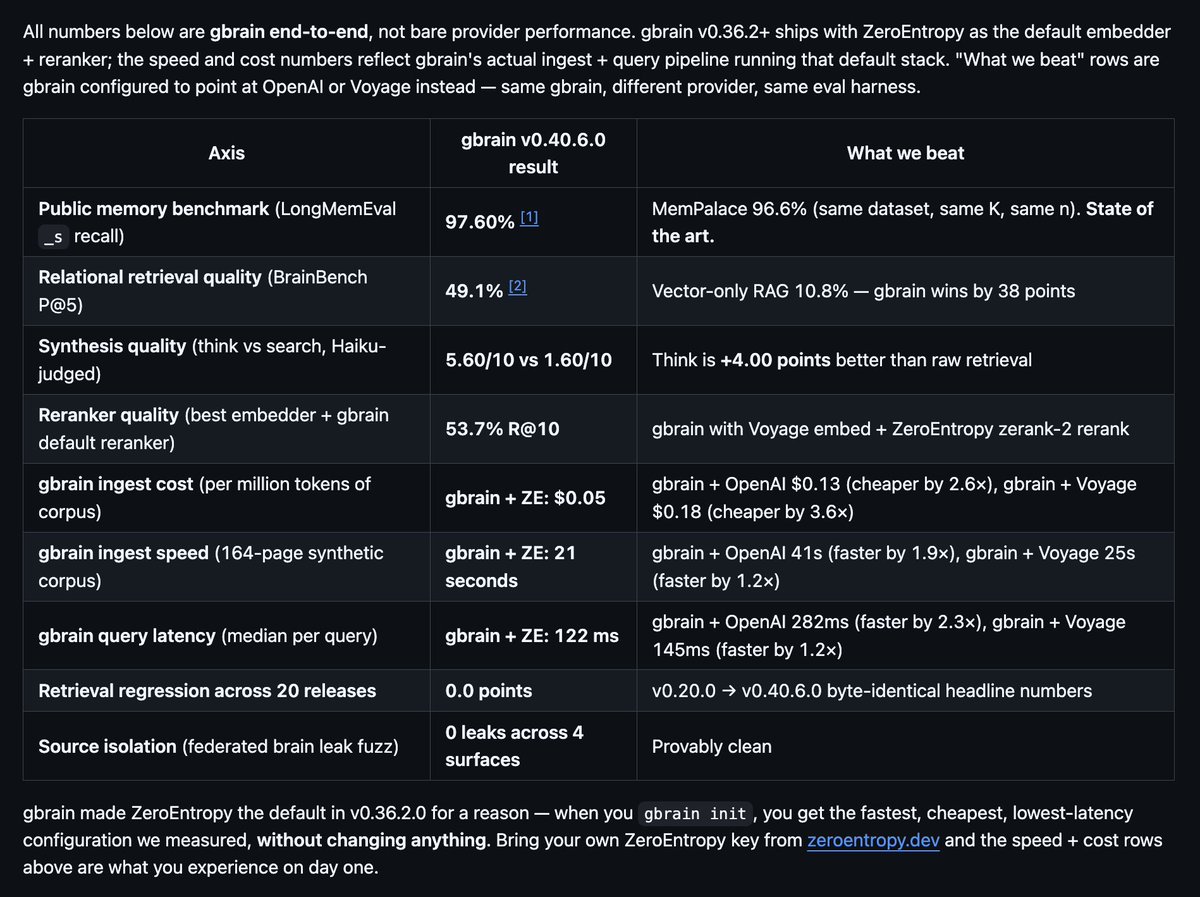
My newest gbrain-evals just dropped - this is how gbrain does vs other options. ZeroEntropy.dev is SOTA for reranking and embedding cost, speed, and retrieval success.
GBrain beats MemPalace by 1% on LongMemEval and beats Vector RAG by 38%
github.com/garrytan/gbrai…
English
Sudheer retweetledi
Thinking Machines is impressive. In a couple hours I just fine tuned my own Qwen3.5-397B model this afternoon.
Fast usable multimodal is also going to enable very mind-blowing personal AI.
Thinking Machines@thinkymachines
People talk, listen, watch, think, and collaborate at the same time, in real time. We've designed an AI that works with people the same way. We share our approach, early results, and a quick look at our model in action. thinkingmachines.ai/blog/interacti…
English
Sudheer retweetledi

Anthropic engineer showed how one person can run 5 AI agents, that code, test, review, and deploy at the same time.
In 30 minutes they built the whole thing live in one session.
Here's what they cover:
> when to use one agent vs a full team
> how to split work so agents don't step on each other > the exact framework for deciding what each agent handles
that's exactly why, I put together a guide on building agent teams that actually work.
full guide in the article below 👇
rody@0x_rody
English
Sudheer retweetledi
Everyone building AI agents is focusing on building the prefrontal cortex. Planning. Reasoning. Multi-step chains. There's value here. CEO-stuff.
But also, a reframe: there is value in building the cerebellum. It's offloading boring tasks into reflex so the complex thought can focus.
Your mortgage gets paid by a standing order, not a committee. The things that are not fun, not interesting, but have to be done? Done. Most agent frameworks will fail because they treat all cognition as high cognition.
The winners will nail the boring stuff first.
English
Sudheer retweetledi

Introducing USVC - a single basket of high-growth venture capital, for everyone.
No accreditation required, SEC-registered, and a very low $500 minimum.
Includes OpenAI, Anthropic, xAI, Sierra, Crusoe, Legora, and Vercel. As USVC adds more companies, investors will own a piece of that too.
Liquidity typically comes when companies exit, but we’re aiming to let investors redeem up to 5% of the fund every quarter. This isn’t guaranteed, but if we can make it work, you won’t be locked up like in a traditional venture fund.
It runs on AngelList, which already supports $125 billion of investor capital.
And I’ve joined USVC as the Chairman of its Investment Committee.
—
Go back to the 1500s, you set sail for the new world to find tons of gold - that was adventure capital.
Early-stage technology is the modern version. It says we are going to create something new, and it’s risky. It’s daring.
But ordinary people can’t invest until it’s old, until it’s no longer interesting, until everybody has access to it. By the time a stock IPOs, most of the alpha is gone. The adventure is gone. Public market investors are literally last in line.
This problem has become farcical in the last decade. Startups are reaching trillion dollar valuations in the private markets while ordinary investors have their noses up to the glass, wondering when they’ll be let in.
Investing in private markets isn’t easy. You need feet on the ground. You need judgment built over years. Most people don’t have the patience to wait ten or twenty years for an investment to come to fruition.
But there is no more productive, harder-working way to deploy a dollar than in true venture capital.
USVC enables you to invest in venture capital in a broad, accessible, professionally-managed way, through a single basket of innovation, focused on high-growth startups, at all stages.
It is how you bet on the future of tech: the smartest young people in the world, working insane hours, leveraged to the max, with code, hardware, capital, media, and community. Your dollar doesn’t work harder anywhere.
There is an old line - in the future, either you are telling a computer what to do, or a computer is telling you what to do. You don’t want to be on the wrong side of that transaction.
USVC lets you buy the future, but you buy it now. Then you wait, and if you are right, you get paid.
Get access here:
usvc.com
English
Sudheer retweetledi

Sudheer retweetledi

𝚗𝚙𝚡 𝚍𝚎𝚎𝚙𝚜𝚎𝚌
We're introducing an open-source agent orchestrator for deep security reviews.
We built it for internal use, and after running it against some major OSS projects, we gained conviction to share it with the world.
Coding agents can now find critical vulnerabilities in minutes that would take teams of people months (if they can spot them at all). Since 𝚍𝚎𝚎𝚙𝚜𝚎𝚌 is optimized to work with Vercel Sandbox, you can effectively harness the power of thousands of agents scrutinizing your codebase in parallel.
I encourage you to try this on your repositories. BTW: If you run an OSS project and want us to sponsor a run, my DMs are open.
Vercel Developers@vercel_dev
Introducing deepsec, an open source coding security harness. • CLI-first • Sandbox-based scaling • Pluggable coding agents • Designed for large-scale repos • Use AI Gateway or your own subscription After months of successful internal use, we put it to the test on some of the largest open source codebases. vercel.com/blog/introduci…
English
Sudheer retweetledi

Want to see what happens behind each prompt?
🔍 Agent Debug Logs lets you inspect chat interactions, tool calls, model requests, prompt discovery, agent flows, and more.
code.visualstudio.com/docs/copilot/c…
English
Sudheer retweetledi

Sudheer retweetledi

The clearest explanation of Claude Managed Agents you'll find.
Everyone's talking about it. Nobody's explaining it well.
In 12 minutes we cover:
- What it actually is (platform as a service for AI agents)
- Who it's for and who should avoid it (4 personas)
- Live console walkthrough (sessions, analytics, costs)
- Real cost breakdown ($2.58 to fulfill a $1,000 service)
We also built a free Google Doc that deploys your first managed agent when you hand it to Claude Code.
You can grab it in the podcast show notes (Build With AI podcast) or YouTube description (video link below).
Corey Ganim@coreyganim
English
Sudheer retweetledi

Introducing Claude Managed Agents: everything you need to build and deploy agents at scale.
It pairs an agent harness tuned for performance with production infrastructure, so you can go from prototype to launch in days.
Now in public beta on the Claude Platform.
English
Sudheer retweetledi
I'm telling most everyone I know that they should build a personal OpenClaw
Ryan Sarver@rsarver
English
Sudheer retweetledi

I made Claude Code and Codex talk to each other.
No APIs. No special protocol.
Just a terminal.
smux lets agents create, read, and act on terminals.
the terminal becomes a shared interface.
this enables agent-to-agent communication.
Now Claude Code and Codex can hold hands 🤝
Try it now ↓
English
Sudheer retweetledi
Sudheer retweetledi

Our team is growing.
If you're a talented, high-conviction individual who supports our mission to build the web for its second user, we'd love to hear from you.
- Research
- AI/ML
- DevRel
- Deployed Engineer
- Frontend
- Backend
- Infrastructure
jobs.ashbyhq.com/parallel

English
Sudheer retweetledi

Sudheer retweetledi

Introducing the Google Workspace CLI: github.com/googleworkspac… - built for humans and agents.
Google Drive, Gmail, Calendar, and every Workspace API. 40+ agent skills included.
English
Sudheer retweetledi