Swarup Das

251 posts

Swarup Das

Swarup Das

@swarupdcs

Full Stack Web Developer | Reactjs | Nodejs | MongoDB | Postgresql | AWS | Azure

Katılım Haziran 2018
403 Takip Edilen172 Takipçiler
Sabitlenmiş Tweet
Swarup Das
Swarup Das@swarupdcs·
I’ve been working on something for the past few weeks - a real-time AI voice assistant called Aurix 🎙️ 🔗 Live: aurix.swarupdas.dev 💡 What is Aurix? Aurix is a browser-based AI voice assistant where you can talk naturally with AI in real time - no text input. Your voice streams → AI processes → responds instantly with audio + transcript. ⚙️ Tech Stack Next.js, React, Zustand, Web Audio API (AudioWorklet), Gemini Live API (WebSocket), PostgreSQL + Prisma, NextAuth, Three.js 🧠 What I learned 1. Real-time audio streaming in the browser 2. Raw PCM (16-bit) handling 3. WebSocket lifecycle & latency issues 4. Interrupt (barge-in) logic 5. Structuring complex systems with managers + global state 🛠️ What I built Started simple - just sending mic audio to AI. But step by step, it turned into: 🎤 real-time audio streaming engine 🔁 full-duplex conversation (talk + listen together) ⛔ interrupt AI mid-response 📜 live transcript system 🔐 secure token-based connection Then I added context + UX: 1. customizable language, topic, tone 2. dual transcription (preview + final) 3. auto-restart listening for seamless flow 4. audio visualizations + conversation history 🧨 What I broke (and fixed) A lot 😅 -> SSR crashes, hydration errors -> audio glitches & buffering issues -> WebSocket reconnect loops -> mic permission edge cases 🙏 Final thoughts Not perfect yet, but this is the first project where I truly learned how audio works in the browser - how frequency and sound behave, how the Web Audio API works, how to handle mic permissions, and especially how to fix Next.js SSR hydration issues. Would love your feedback if you try it 🙌 @codersGyan #buildinpublic #webdev #ai #nextjs #learning #realtime #javascript #llm #gemini #langgraph #langchain
Swarup Das tweet media
English
0
1
3
175
Swarup Das
Swarup Das@swarupdcs·
@NovaXCode I am also the windows user, but still love macbook because its battery backup and for the performance
English
1
0
1
8
Nova
Nova@NovaXCode·
@swarupdcs I was also thinking about it, I am a windows user, btw what are the good sides of choosing a mac over windows?
English

1
0
0
7
Nova
Nova@NovaXCode·
Hey guys, I have $1500, Should I buy a Windows or a MacBook? Suggest me the best laptop for a developer.
Nova tweet mediaNova tweet media
English
4
1
4
130
Swarup Das
Swarup Das@swarupdcs·
@NovaXCode next plan is test the auth routes, then move to build other routes with test cases.
English
0
0
1
6
Nova
Nova@NovaXCode·
@swarupdcs Great work on Day 3, Swarup! Smart move blending stateless JWTs with stateful refresh tokens in Postgres. The revocation + JTI part is pro-level.Loving this series. What’s next after auth?
English
1
0
0
12
Swarup Das
Swarup Das@swarupdcs·
📚 Day 3 of Building a Microservices-Based Project Over the past few days, I've been working on the Authentication Service and learning more about how authentication and session management are handled in backend systems. Today's focus was on stateless vs stateful authentication, JWTs, Access Tokens, Refresh Tokens, and token persistence. Some of the things I explored: 🔹 Understanding the difference between stateless and stateful authentication 🔹 Learning how JWT-based authentication enables stateless authorization 🔹 Understanding the difference between Access Tokens and Refresh Tokens 🔹 Generating JWTs and storing them securely in cookies 🔹 Creating a dedicated Refresh Token entity in PostgreSQL using TypeORM 🔹 Persisting refresh tokens in the database instead of relying solely on stateless JWTs 🔹 Learning how JWT IDs can be be used to link tokens with database records 🔹 Updating integration tests to verify refresh token persistence during user registration One thing I found particularly interesting was the distinction between stateless and stateful authentication. With stateless authentication, all the information needed to validate a user is contained within the token itself, allowing services to verify requests without querying a database. This can improve scalability and simplify distributed systems. With stateful authentication, session information is stored on the server side, making it easier to manage active sessions, revoke access, and enforce security policies. By storing refresh tokens in the database, we introduce a stateful component that enables features such as session management, token revocation, and token rotation. Another valuable lesson was seeing how quickly controllers can become overloaded with responsibilities and how moving logic into dedicated services makes the codebase easier to maintain and test. Still learning a lot about authentication, security, and microservice architecture, but each step is helping me better understand how production-ready systems are designed. @codersGyan #Microservices #BackendDevelopment #NodeJS #TypeScript #JWT #Authentication #PostgreSQL #TypeORM #SoftwareEngineering #LearningInPublic #WebDevelopment
Swarup Das tweet mediaSwarup Das tweet media
English
1
0
2
49
Swarup Das
Swarup Das@swarupdcs·
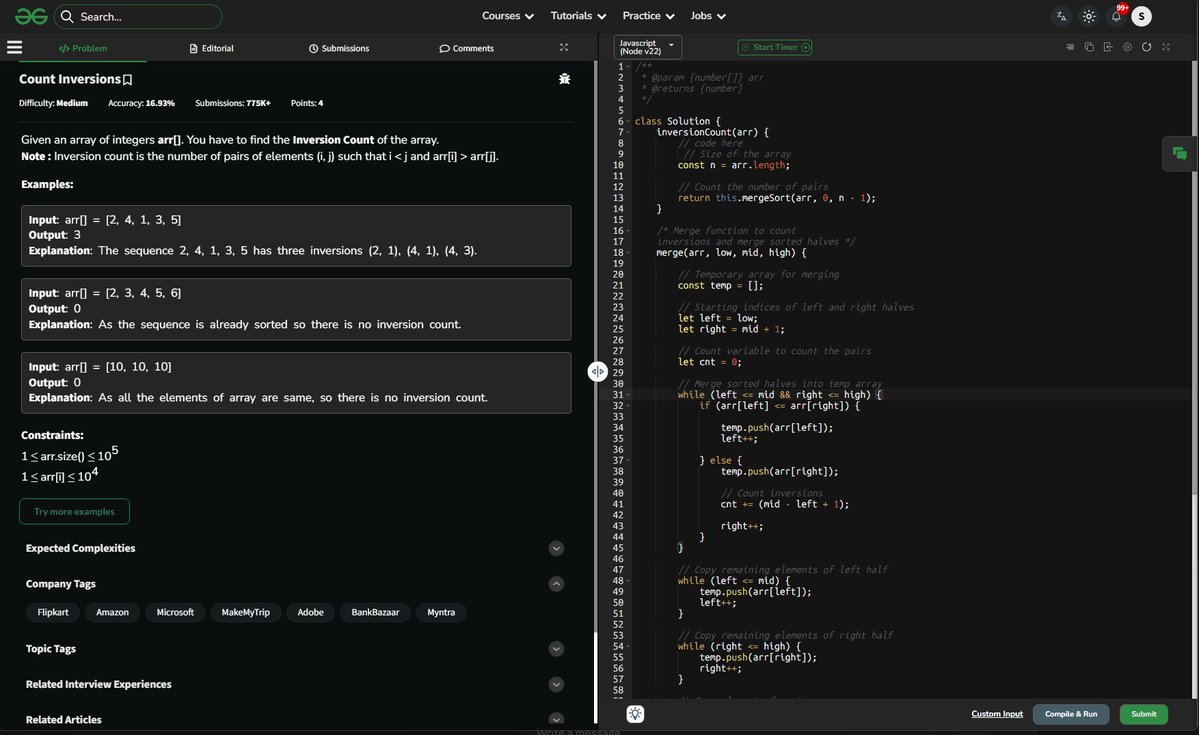
🚀 Day 4 of #SDESheetChallenge Today's session was all about applying mathematical intuition, cycle detection, and divide-and-conquer techniques to solve some challenging array problems: ✅ Find the Duplicate Number ✅ Missing and Repeating Number ✅ Count Inversions in an Array Key Learnings 🔹 Find the Duplicate Number - Used Floyd’s Tortoise and Hare (Cycle Detection) algorithm to identify the duplicate element in O(n) time and O(1) extra space. 🔹 Missing and Repeating Number - Applied mathematical formulas involving the sum and sum of squares of the first n natural numbers to efficiently determine both the missing and repeating elements. 🔹 Count Inversions - Learned how a modified Merge Sort can count inversions while sorting the array, reducing the complexity from O(n²) to O(n log n). Every problem today reinforced an important lesson: understanding the underlying pattern is often more valuable than memorizing the solution. #SDESheetChallenge #DSA #LeetCode #Programming #SoftwareEngineering #ProblemSolving #CodingJourney #DataStructures #Algorithms #JavaScript @takeUforward_ @striver_79
Swarup Das tweet mediaSwarup Das tweet mediaSwarup Das tweet media
English
0
0
3
27
Harshit
Harshit@rrrautela·
I think I studied the wrong dsa 🫪
Harshit tweet media
English
23
0
98
18.3K
Swarup Das retweetledi
Rakesh K
Rakesh K@codersGyan·
I post about backend engineering almost every day. Mostly databases, Go, system design, and mistakes that I keep seeing in real codebases. If you’re new here, this is the best way to use my work. 1/ CodersGyan Discord Around 2,000 backend engineers. Code reviews, system design discussions, job posts, doubts, and people building things in public. Free to join.. Link in comments. 2/ YouTube 140k+ subscribers now. I’ve covered networks, HTTP, system design, Go, databases, and backend fundamentals there. We sit properly with one topic in long video formats, apart from shorts. 3/ The LinkedIn feed I post one backend lesson here every day. Usually from code reviews, cohort discussions, or mistakes that I’ve seen/made in actual products. 4/ Substack Newsletter This is where I write the longer breakdowns. Architecture decisions, database mistakes, backend tradeoffs, and practical examples The paid thing is the Backend Foundation Course. 13 weeks. 1,350+ engineers have gone through it so far. Currently open. If you’re new, spend some time with the free content first. Read posts, join discord, watch the videos, go through newsletters.. If the way I explain backend makes sense to you, the course is there. Discord, newsletter, and course links are in comments. ♻️ Repost to help other developers in your network. 👉 If you want to build scalable, high-performance backend systems without the guesswork, check out lnkd.in/ePKQ76nr for deep, practical architecture training.
Rakesh K tweet media
English
1
5
43
1.1K
Swarup Das
Swarup Das@swarupdcs·
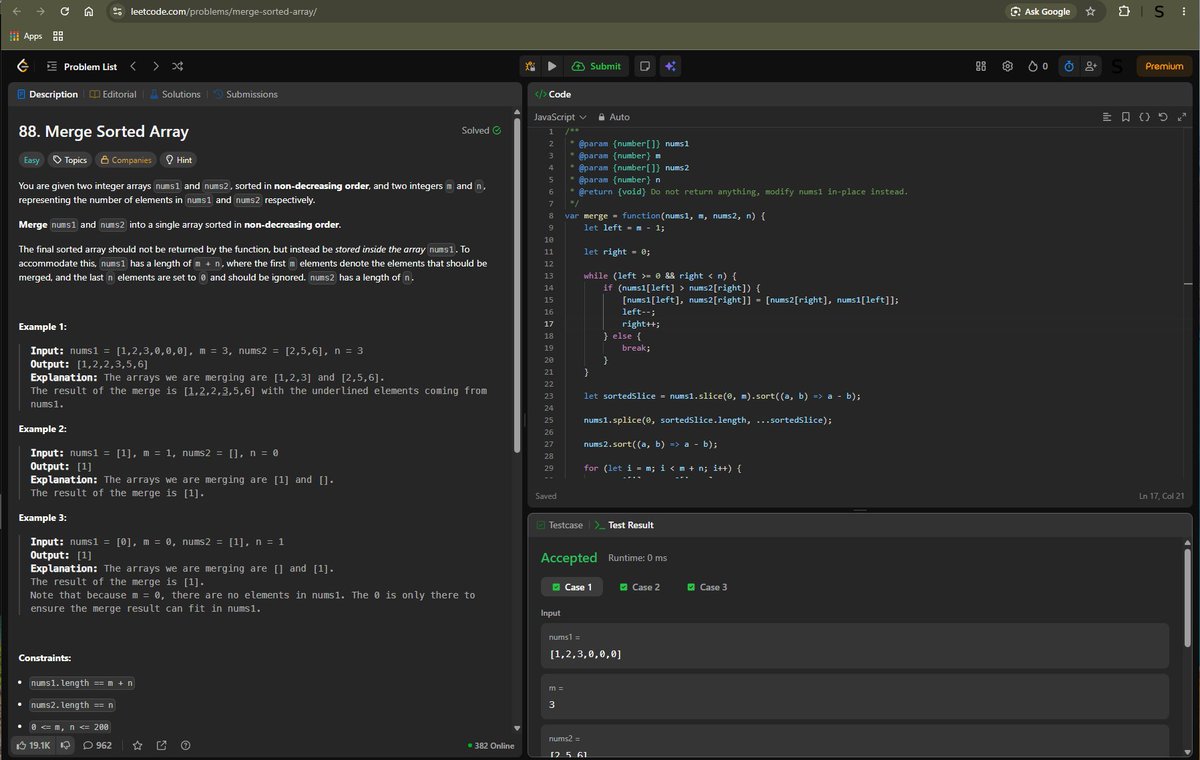
🚀 Day 3 of #SDESheetChallenge Today's focus was on mastering some classic array and matrix problems : ✅ Rotate Matrix by 90 Degrees ✅ Merge Overlapping Intervals ✅ Merge Two Sorted Arrays Without Extra Space A few key takeaways from today's practice: 🔹 Rotate Matrix - Learned how matrix transformations work and how elements map to their new positions after rotation. 🔹 Merge Overlapping Intervals - Strengthened my understanding of sorting-based approaches and interval merging techniques. 🔹 Merge Two Sorted Arrays Without Extra Space - Explored pointer-based optimization techniques to efficiently rearrange and merge elements while minimizing extra memory usage. Every problem reinforces an important lesson: it's not just about getting the correct answer, but understanding the intuition behind the optimized solution. #SDESheetChallenge #DSA #LeetCode #Programming #SoftwareEngineering #ProblemSolving #CodingJourney #DataStructures #Algorithms #JavaScript @takeUforward_ @striver_79
Swarup Das tweet mediaSwarup Das tweet mediaSwarup Das tweet media
English
0
0
6
42
TriceRozay ✊🏽🔌🔥
TriceRozay ✊🏽🔌🔥@TheTriceRozay·
Bro to Bro: build your x account now Just say “Hello” and gain 840 mutuals here.
TriceRozay ✊🏽🔌🔥 tweet media
English
1K
66
456
44.6K
Isha singh
Isha singh@isha_singh06·
Best programming language for complete beginners?👇 1. Python 2. JavaScript 3. Java 4. C++ 5. C Only one choice 🚀
English
53
1
58
2.2K
Swarup Das
Swarup Das@swarupdcs·
📚 Another small milestone in my microservice-based project development journey. Over the past few days, I've been working on the User Registration flow for the Authentication Service in the microservices-based project I'm building. This phase was much more than simply creating a registration endpoint. It gave me the opportunity to learn about validation, testing, database persistence, error handling, and security practices that go into building a reliable authentication system. Some of the things I explored: 🔹 Designing and persisting a User entity in PostgreSQL 🔹 Connecting the application to the database using TypeORM 🔹 Implementing request validation and sanitization with express-validator 🔹 Adding email uniqueness checks to prevent duplicate registrations 🔹 Assigning default user roles during registration 🔹 Improving error handling and application logging 🔹 Learning the basics of password hashing 🔹 Following a Test-Driven Development (TDD) approach to verify functionality before implementation 🔹 Writing tests for successful registrations, validation failures, duplicate emails, and other edge cases One thing that stood out to me during this process is how much effort goes into handling edge cases and ensuring data integrity. Building the happy path is often the easy part - making the system robust requires much more attention to detail. I'm still learning a lot about authentication systems, testing strategies, and microservice architecture, but every step of the process is helping me better understand how production-ready backend services are built. Next up: continuing to strengthen the authentication service and exploring more advanced microservice patterns. @codersGyan #Microservices #BackendDevelopment #NodeJS #TypeScript #PostgreSQL #TypeORM #TDD #SoftwareEngineering #LearningInPublic #WebDevelopment
Swarup Das tweet mediaSwarup Das tweet media
English
0
0
6
39
Abhi
Abhi@0xAbhiii·
what's your fav programming languages , i'll go first :
Abhi tweet mediaAbhi tweet media
English
59
1
47
1.8K
Swarup Das
Swarup Das@swarupdcs·
📚 Small progress update from my microservices learning journey. Over the last few days, I've been learning about microservices while building an Authentication Service as part of a larger microservices-based project. Instead of jumping straight into authentication features, I spent some time understanding what goes into creating a backend service that is maintainable and production-ready. Here's what I've explored so far: 🔹 Setting up a Git workflow and repository structure 🔹 Managing Node.js versions with NVM 🔹 Configuring TypeScript, ESLint, and Prettier for better code quality 🔹 Learning how Git hooks can automate checks before commits 🔹 Structuring an Express.js application with configuration management 🔹 Implementing centralized logging and error handling 🔹 Setting up automated testing 🔹 Containerizing the application with Docker One thing I've realized is that building software isn't only about implementing features. A lot of engineering effort goes into creating a solid foundation that makes development, testing, deployment, and maintenance easier in the long run. @codersGyan #Microservices #BackendDevelopment #NodeJS #ExpressJS #TypeScript #Docker #SoftwareEngineering #LearningInPublic #WebDevelopment
English
0
0
0
36
Swarup Das
Swarup Das@swarupdcs·
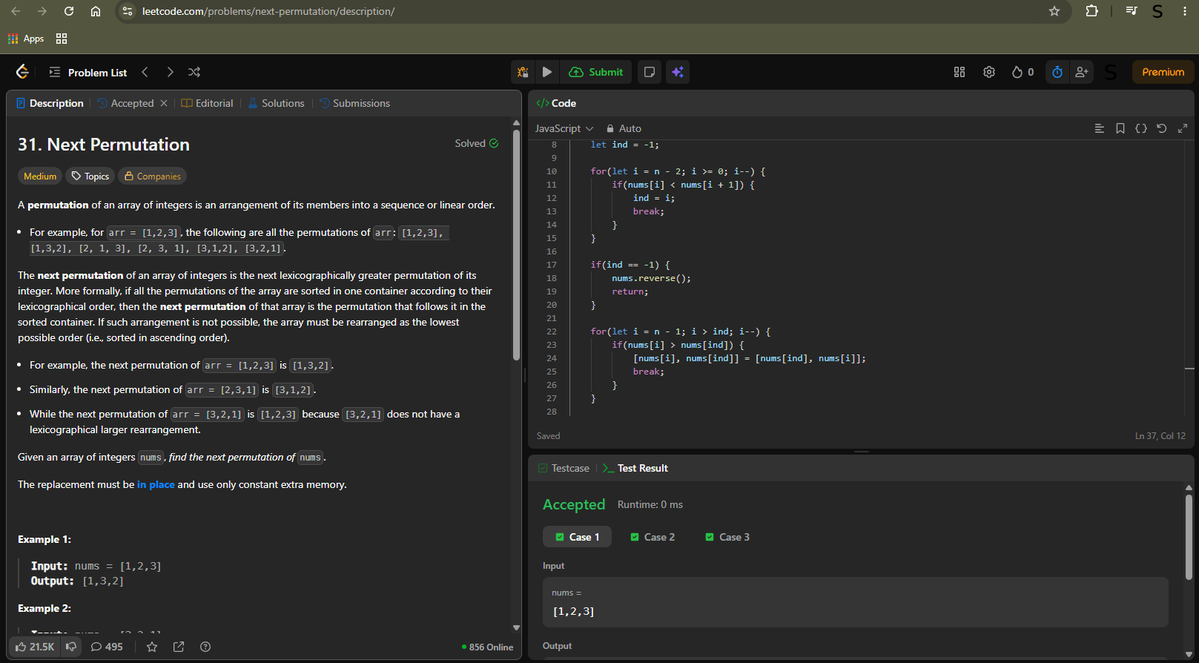
🚀 Day 1 of #SDESheetChallenge Started my journey through Striver's SDE Sheet Challenge today, and it was a great mix of learning and problem-solving. ✅ Set Matrix Zeroes ✅ Pascal's Triangle ✅ Next Permutation Among these, Next Permutation was definitely the toughest. Understanding the intuition behind finding the breakpoint, swapping with the next greater element, and reversing the suffix took some time, but it was worth it. #SDESheetChallenge #DSA #LeetCode #Programming #SoftwareEngineering #ProblemSolving #Java #CodingJourney @takeUforward_ @striver_79
Swarup Das tweet mediaSwarup Das tweet mediaSwarup Das tweet media
English
2
0
7
92
Sneha
Sneha@sneha___03·
Be honest, which one is actually worth learning in 2026?
Sneha tweet media
English
50
1
58
2.1K
Isha singh
Isha singh@isha_singh06·
Best backend language in your opinion? 1. Node.js 2. Java 3. Python 4. go
Français
49
3
56
3.3K