TangibleUX

4 posts

TangibleUX

TangibleUX

@tangibleux

Designing early-stage products that ship smart, scale right, and feel just right.

Bengaluru, India Katılım Temmuz 2025
3 Takip Edilen3 Takipçiler
TangibleUX retweetledi
Vishal Gupta
Vishal Gupta@visualbit·
Untamed: A slow-burn masterclass in sense-making Just finished Untamed. Six episodes, Yosemite as the stage, Eric Bana as an ISB agent threading a murder through terrain, weather, and egos. Dropped July 17 and already climbing the Top 10 for good reason. Netflix+1 What I watched as a designer Environment as a system. The park isn’t a backdrop; it’s the rules engine. Constraints (terrain, weather, jurisdiction) shape outcomes more than any character. Good products behave the same way—systems make behavior predictable. Cadence > speed. The show’s pacing—clues, silence, reveals—mirrors healthy discovery cycles. You feel progress without cheap dopamine. Teams need this rhythm when exploring messy problems. Evidence beats vibes. Every “obvious” answer gets tested against ground truth—logs, tracks, timelines. That’s incident review energy. Replace “I think” with “Here’s what the traces say.” Stakeholders with teeth. Rangers, locals, Feds—same case, different incentives. Great design maps power and motivation early, or you ship into a crosswind. Misdirection as a risk. The story plants convincing false leads. In product, these are vanity metrics and loud edge cases. Name the bias. Park it. Move on. Use of negative space. Silence, wide frames, and sparse dialog do heavy lifting. In interfaces, the equivalent is ruthless visual hierarchy and fewer toggles. Let intent breathe. Clean exits. Endings resolve enough to move forward, not everything. Ship decisions with explicit debt: what we learned, what we’re leaving, what we’ll revisit. If you lead design, try this with your team → Which constraint in your product behaves like the park (unavoidable, shaping every choice)? → Where is your investigation theater—beautiful dashboards, thin evidence? → What are today’s plausible red herrings (metrics, anecdotes, power users)? → How would you redesign your cadence to create momentum without noise? → What’s your “clean exit” doc for the next decision? Verdict: Not “prestige TV that changes your life.” It’s a field guide for product teams who solve ambiguous problems under pressure—and want the work to hold up outside the conference room. #UXDesign #ProductDesign #DesignLeadership #SystemsThinking #Sensemaking #DecisionQuality #Netflix
Vishal Gupta tweet media
English
0
1
0
113
TangibleUX retweetledi
Vishal Gupta
Vishal Gupta@visualbit·
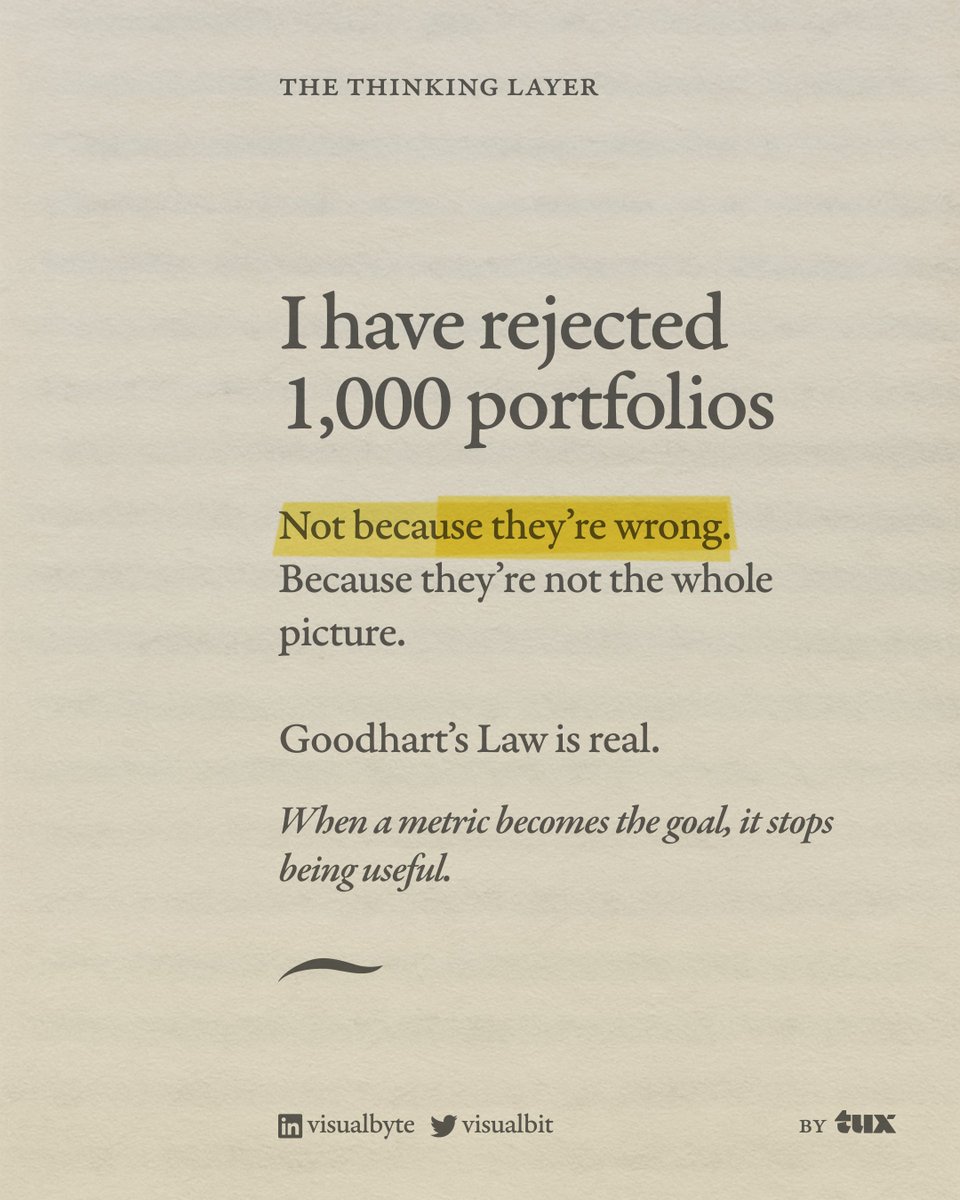
🙅No, seriously, I have not rejected 10,000 portfolios. Lately, I’ve seen too many performative posts — “I rejected 1000 portfolios,” “Here’s what every junior designer is doing wrong” — that boil design down to a checklist of measurable outputs. (some even rejecting 10,000 portfolios) But real product design? It doesn’t always fit inside a dashboard. Here’s what that kind of metric fixation misses: 🔹 Trust isn’t a KPI. 🔹 Delight doesn’t show up in GA. 🔹 Brand perception, ethical design, and workflow sanity? Good luck cramming those into a single OKR. Sure, metrics matter. But over-optimizing for what’s measurable leads to: – Correlation mistaken for causation – Short-term wins over long-term vision – Confusing UX that keeps users stuck, just to boost “time on site” – Designs that hit the metric but miss the mark And worst of all? It teaches teams to play it safe — to tweak buttons instead of challenging assumptions. Design is not A/B testing your way into greatness. It’s not always clean. And it’s rarely viral. Sometimes, the best work doesn’t look like performance — until it becomes the product people can’t live without. Let’s stop celebrating rejection and start talking about what’s actually worth building. #ProductDesign #UXStrategy #DesignThinking #BeyondMetrics #GoodhartsLaw #RealWorldUX #BuildBetterProducts #DesignLeadership #UserExperience #EthicalDesign #DesignTwitter #PortfolioGate
Vishal Gupta tweet media
English
1
1
0
33
TangibleUX retweetledi
Vishal Gupta
Vishal Gupta@visualbit·
Prompting Is the New Prototyping Before AI, UX was the bridge between idea and implementation. We studied users, mapped flows, designed clarity — and handed over a well-structured blueprint to engineers. Today, when working with AI models, the blueprint is the prompt. And the same principles apply: → Define intent clearly → Structure with logic → Handle edge cases → Test and iterate → Speak the system’s language A thoughtful prompt is interaction design — just with a different interface. The clearer your input, the better your outcome — whether you’re designing for humans or machines. 💡 UX isn’t going away in the age of AI. It’s evolving into new forms — and prompting is one of them. #UXDesign #PromptEngineering #AIUX #DesignForAI #TheArtOfUX #SignalOverNoise #ProductDesign #HumanCenteredAI #UXPrinciples
Vishal Gupta tweet media
English
2
1
0
44
TangibleUX retweetledi
Vishal Gupta
Vishal Gupta@visualbit·
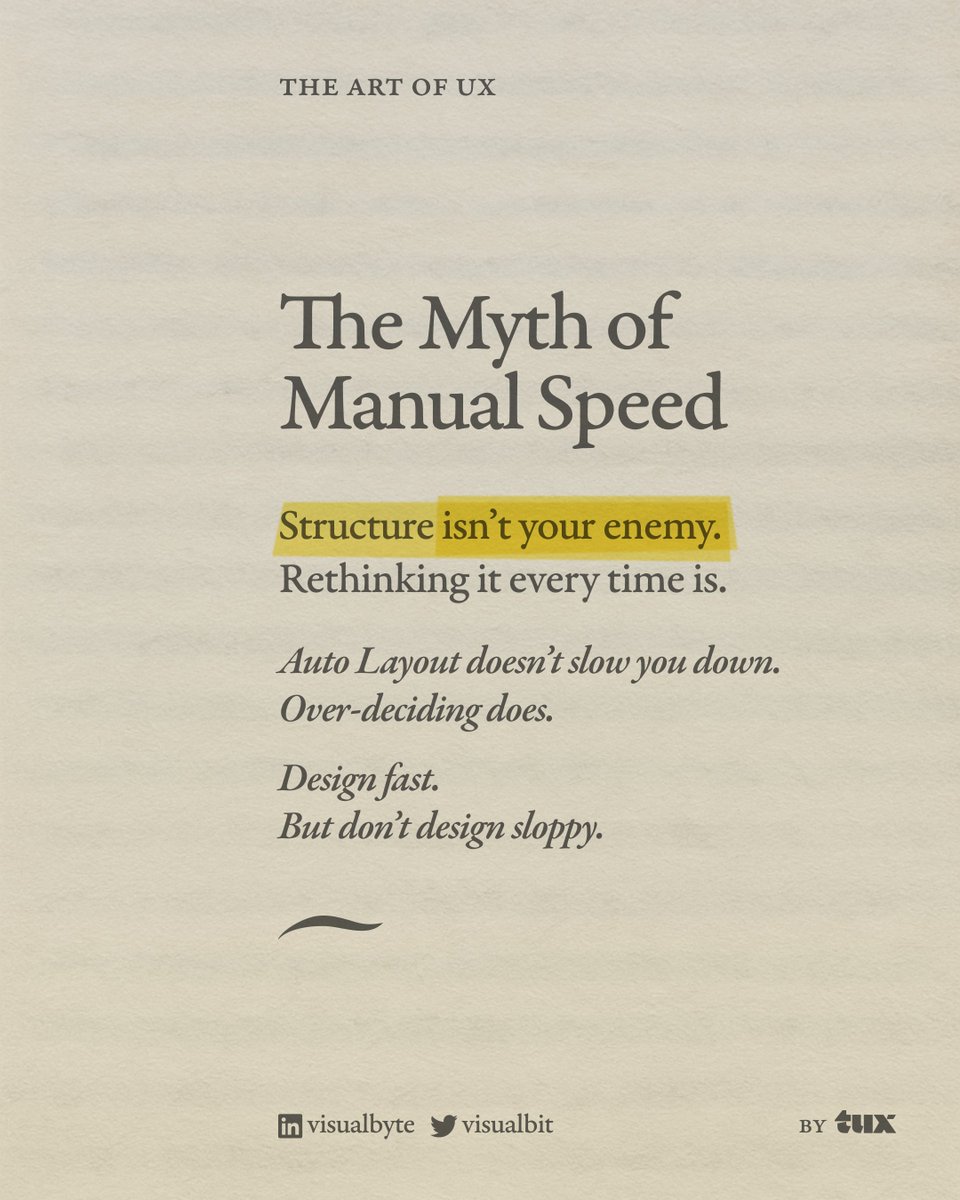
Auto Layout Isn’t the Problem. Sloppy Thinking Is. We hear it often: “Auto Layout slows down our speed.” But here’s the truth behind The Myth of Manual Speed. Structure isn’t your enemy. Over-deciding is. I work in the same start-up chaos — shifting roadmaps, sprint pivots, experimental ideas. But blaming Auto Layout for lack of speed is like blaming scaffolding for slow construction. Auto Layout doesn’t slow you down. Over-structuring without purpose does. Here’s what I’ve found instead: ✅ Auto Layout frees your attention from nudging pixels — so you can focus on actual design problems. ✅ It enables fast, modular thinking — frame once, reuse forever. Drag, drop, remix. Much faster than starting from scratch every time. ✅ When the team plays the same system, design-to-dev handoff becomes frictionless — even mid-sprint. The real question is: Are you using Auto Layout to explore, or to decorate your exploration? 💡 Good design systems support creativity. They don’t replace it. Use Auto Layout the way jazz musicians use rhythm: As a base to improvise. Not a cage. ---- Want the speed of sketching and the power of systems? Learn to think with Auto Layout — not around it. What’s your take — structure first or structure later?
Vishal Gupta tweet media
English
0
1
1
214