

Jeffrey Alexander
2K posts
Jeffrey Alexander
@techiewonk
Director, Innovation Policy @RTI_Intl. Unrepentant wonk at the intersection of tech, policy, #innovation & strategy. #scipol #scientometrics #eval #bigdata
Washington, DC Katılım Ocak 2010
1.5K Takip Edilen795 Takipçiler
@JMateosGarcia I have to say, it was fantastic in the movie theatre!
English


I had to order Mars Express from NZ but it was worth it. Immersive cyberpunk noire with some of the coolest near-future tech I’ve seen in any media. Strong recommend.

English
@KumarAGarg I still remember as a young science policy graduate student watching the vote to defund the OTA on C-SPAN. Boy, that was depressing (especially since I wanted to work there after graduating).
English

I remember starting work for President Obama’s Science Advisor in 2009 and at the first staff meeting he asked for ideas-worth-working on. Someone raised their hand and said “bring back OTA.”
Still a good idea.
And kudos to all those who continue to make the case.
Santi Ruiz@rSanti97
Congress once had a dedicated office to provide technical analysis of new technologies. The idea was to make Congress better at legislating under uncertainty. New Statecraft, on the Office of Technology Assessment and why it died: statecraft.pub/p/how-to-asses…
English
@csugimoto @IsmaelRafols @sppgatech We were fortunate to have him visit the DC office of @RTI_Intl last week to discuss research evaluation!
English
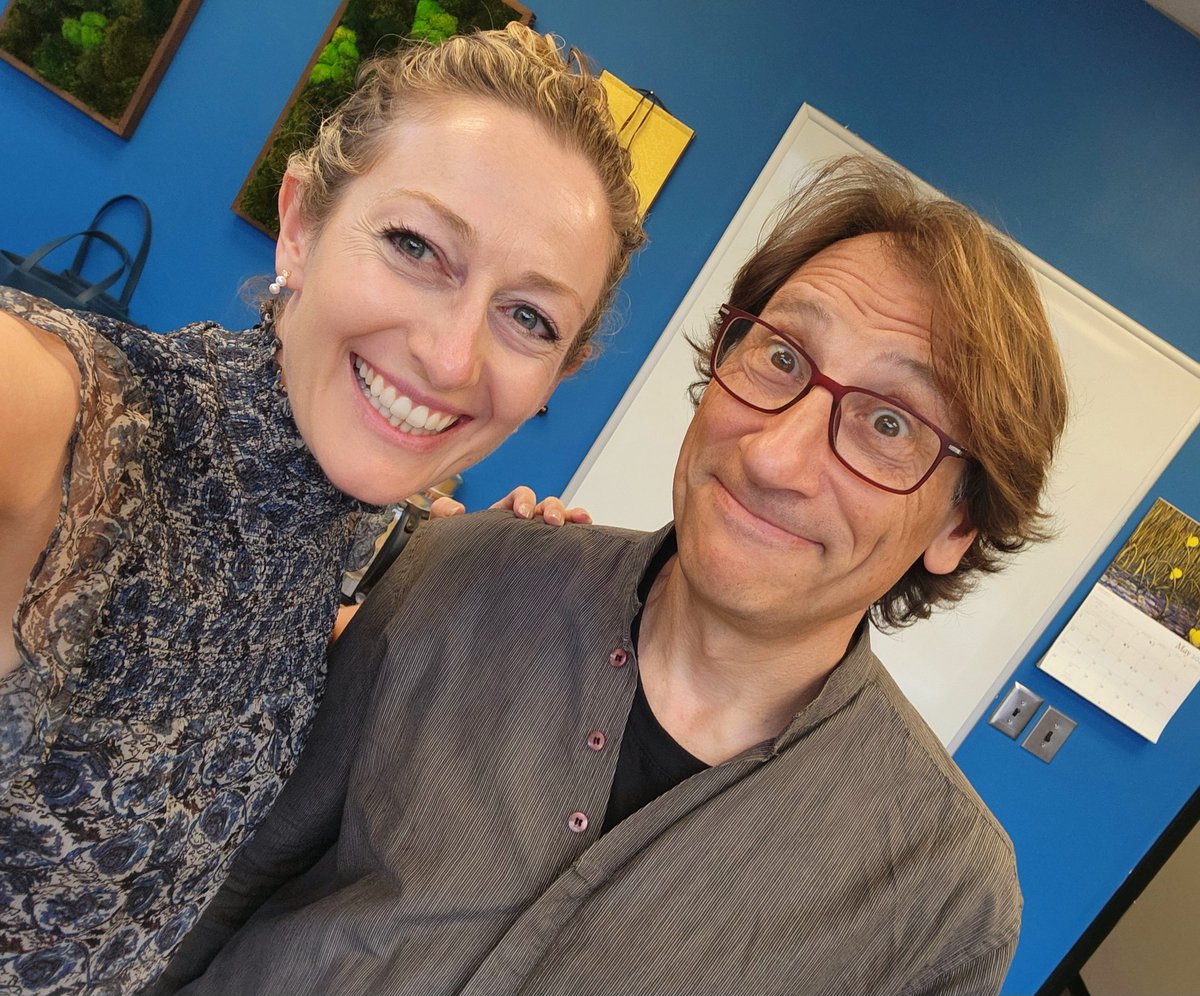
Such a pleasure to have my friend and colleague @IsmaelRafols at @sppgatech today to discuss open science monitoring and equity!
English
@mattsclancy I'll try to dig up a few citations but to illustrate, innovation is defined as something put into use. Only a fraction of patents are "worked" (deployed in practice) so relying on patent counts overstates the incidence of innovation.
English

@techiewonk That’s an interesting critique. Do you have some examples in mind?
English
Are patents a good measure of innovation?
One way to answer: do papers that investigate similar phenomena, some with patent and some with non-patent data, converge on similar results?
If yes, suggests patent data is as good a measure as alternatives, when used appropriately.
English
@mattsclancy This reflects a fundamental issue in innovations studies--that patents measure invention, but invention is not the same as innovation and treating the two as equivalent leads to perverse conclusions.
English
@mattsclancy For example, I would expect studies using papers to disagree with studies using patents, as the motives and incentives to publish are very different from those for patenting. In fact, agreement between such studies makes me trust both studies less.
English
@stuartbuck1 Is this part of your solution? forensiccoe.org
English

The shoddy quality of forensic "science" has been known for a long time. See, e.g., obamawhitehouse.archives.gov/sites/default/…
An idea that would be high-impact for a philanthropist interested in both high-quality science and criminal justice--
A new org focused on improving forensic science by:
1) Relentlessly looking for academic fraud and irreproducibility;
2) Naming and shaming individual prosecutors and judges who rely on bad evidence, and trying to get them removed from office;
3) Filing lawsuits and amicus briefs challenging the use of bad evidence;
4) Advocating for policy reforms at the state and federal level (and supporting baby steps in the right direction, e.g., nij.ojp.gov/general-messag…).
Kelsey Piper@KelseyTuoc
I was haunted by this ProPublica story about how nonsensical analysis of 911 calls is used to convict people of killing their kids. I mentioned it to a friend with more knowledge of criminal justice. "Oh," she said casually, "all of forensics is like that" propublica.org/article/911-ca…
English
@MishaTeplitskiy The whole concept of a "disruptive" discovery is that it would receive low scores in traditional measures of "scientific impact" even though it has very high potential future impact. So the lack of correlation is consistent with that framing.
English

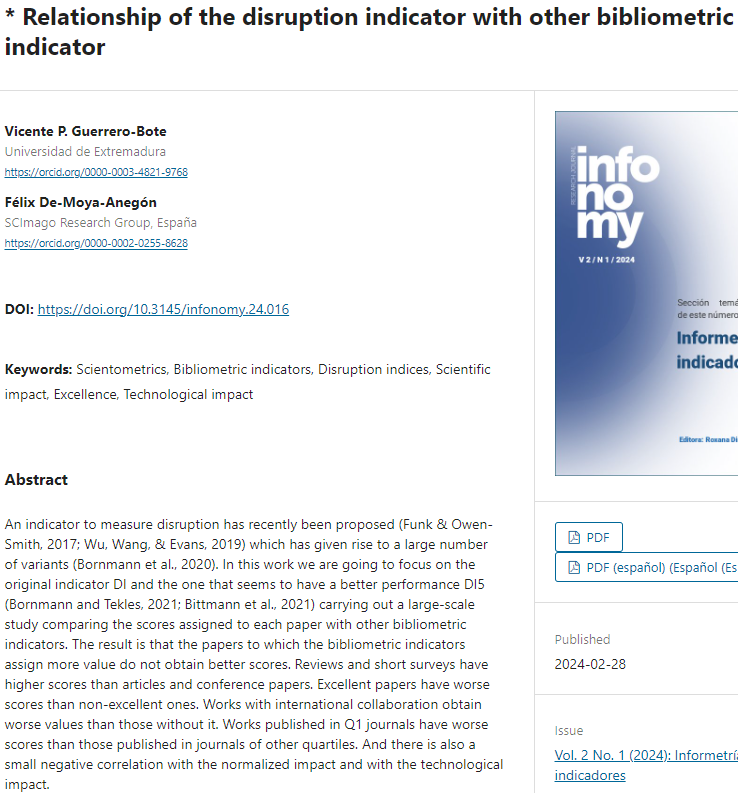
The disruption index doesn't correlate with some other quantities one might expect it to correlate with
infonomy.scimagoepi.com/index.php/info…
English
@KumarAGarg @stuartbuck1 @eric_is_weird @jordanschneider @tkalil2050 @calebwatney @Parthion Or, to be more accurate, ask the people advising the key policymakers, since they are usually the ones who screened the options and evidence to present to the policymakers.
English
@stuartbuck1 @eric_is_weird @jordanschneider @tkalil2050 @calebwatney @Parthion Why you often need to be play detective and ask the key policymakers who was helpful and why.
English

When I worked for Steve Levitt, he used to say, "Nobody wants to work on ideas that aren't theirs." And that often is the case!
It makes me very thankful that that the DC progress folks -- @tkalil2050, @KumarAGarg, @stuartbuck1, @calebwatney, @Parthion, etc -- are the opposite
English
English

Tomorrow, @scheufele will be presenting on "Communicating Science in Polarized Times" at this year's @AAASmeetings. Stop in at 5 P.M. to learn about science polarization and what scientists can do to not fuel the flames.
Learn more at: aaas.confex.com/aaas/2024/meet…
#scicomm #AAASmtg
English
As might be expected, far more questions generated than solutions or answered
English
@leahstokes I would appreciate receiving a code, if any are left…TIA
English
@ashleyruba_phd Good charts but academics like Donna Ginther and Paula Stephan, noted labor economists, have been publishing about this for years. Of course, the fact that neither you nor most of your followers have heard of them just reinforces your point.
English
@ashleyruba_phd Lots of great data like this and more are available from @NCSESgov — plus analysis! Thanks for showing why their work matters!
English
@FedericoMiozzo @ashleyruba_phd Keep in mind that the survey question was revised in 2017, so the stats from that year to the present may not be directly comparable to earlier data. But glad to see my colleagues’ work getting such notice!
English

@ashleyruba_phd Since 2015 there is a sharp rise of non-academic careers, while the count of academic careers stays more or less the same. Does it mean there was a strong increase in the number of new PhDs?
English
@michael_nielsen @stuartbuck1 I’d have to mine for my notes to see which directorates were more inclined towards these awards that didn’t require peer review. And I’m not sure if proposers are very aware of EAGER and RAPID as funding options.
English
@michael_nielsen Thanks to you and @stuartbuck1 for the cite to the work by me and my colleague Caroline Wagner. As I recall we found SGER uptake varied widely by directorate, so disciplinary culture as well as bureaucratic culture may play a role.
English

I enjoyed this piece on the influence of norms on granting: goodscience.substack.com/p/science-fund…
Contains some interesting speculation about why SGER, EAGER, RAPID etc haven't been used more often, which has bothered me, too
English